
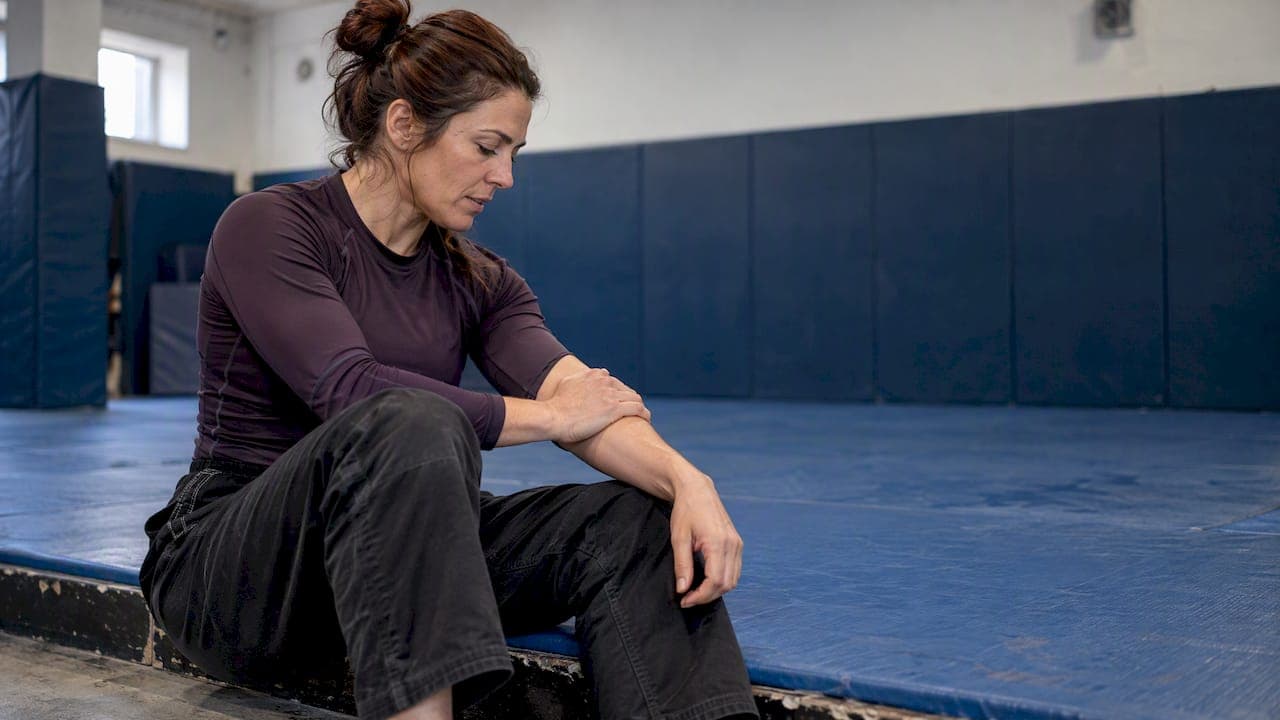
CBD may not do much for post-training soreness on its own. The best-controlled trial of a topical CBD ointment found no difference from placebo. Oral CBD looks somewhat more promising, but the evidence is early. Martial artists also carry extra risks: drug-test rules and contaminated products. This guide covers what research shows, how to use a balm sensibly, and when soreness is an injury.
TL;DR
- A 2023 double-blind trial of topical CBD ointment found no significant difference from placebo in soreness, swelling or strength after a muscle-damage protocol.
- A 2026 systematic review found oral or sublingual CBD reduced subjective soreness within 48 to 72 hours, while topical forms showed no efficacy.
- Tested athletes carry the risk. USADA says athletes are strictly liable for what is in their system.
- Sharp, lasting or function-limiting pain is not soreness. See a doctor.
- A balm is a rub-on option for sore spots. Treat it as a comfort tool, not a proven treatment.
Table of Contents
- Why martial arts soreness is its own problem
- What the research says about CBD and sore muscles
- Topical or oral: which fits a martial artist?
- Drug testing and rules for competitors
- Safety and product quality
- When soreness is not soreness
- How to use a topical balm after training
- Our perspective
- Choosing a balm
- A sensible recovery plan for combat athletes
- FAQ
- Sources
Why martial arts soreness is its own problem
Jiu-jitsu, judo, wrestling, karate, Muay Thai and MMA load the body in odd ways. Grips tax forearms. Guard work taxes hips and adductors. Kicks hit hamstrings and calves. Rolling and drilling add thousands of small, awkward contractions.
The result is delayed onset muscle soreness, or DOMS. Mass General Brigham says DOMS commonly develops about two days after overly intense exercise. It usually needs rest rather than urgent care.
Martial artists also train again within a day or two. That is why recovery products sell well in gyms and dojos. It is also why honest answers matter: you are asking a product to help while you keep training.
What the research says about CBD and sore muscles
The marketing is ahead of the science. Here is what controlled studies show.
Topical CBD
A 2023 double-blind randomized trial tested a topical CBD ointment. It was applied 30 minutes, 24, 48 and 72 hours after a DOMS protocol. It found no significant difference from placebo in arm swelling, elbow-flexion strength, or soreness at 24, 48 or 72 hours.
The 2026 systematic review points the same way for skin application. It reported that oral or sublingual CBD reduced subjective DOMS and biochemical muscle-damage markers within 48 to 72 hours. Topical forms showed no efficacy.

That does not mean a balm feels like nothing. A rub-on product can help for other reasons: massage while applying it, warmth or cooling, and a pleasant scent. But those are not proof that CBD itself reduces muscle damage.
Oral and sublingual CBD
The oral picture is more hopeful and still thin. A 2026 feasibility trial saw potential for sublingual CBD at 67 mg daily to reduce pain and strength loss 48 hours after injury. The researchers stress that larger studies are needed.
A pilot study of a beverage with 35 mg CBD plus 50 mg CBG twice daily for 3.5 days reported a moderate estimated drop in average soreness at 72 hours versus placebo. The drink also held beta-caryophyllene, BCAAs and magnesium. So the result cannot be credited to CBD alone.
What combat sports doctors say
The Association of Ringside Physicians (ARP) published a position statement on cannabis in combat sports. It says benefits in athletic contexts are unproven. It recommends against marijuana use in combat sports. It neither encourages nor discourages topical, purified CBD.
That is a fair summary of where things stand: not endorsed, not condemned, not proven.
For deeper reading on our site, see CBD for muscle recovery: what the evidence shows and CBD for DOMS.
Topical or oral: which fits a martial artist?
The answer depends on the problem.
| Situation | Topical balm | Oral or sublingual CBD |
|---|---|---|
| Sore, tight spot (forearm, neck, calf, hip) | Easy to target the spot | Whole-body, not targeted |
| Trial evidence for DOMS | No benefit over placebo in the cited trial | Early signals, small studies |
| Drug-test concerns | Lower exposure concern, but still read labels | Broad-spectrum products can produce detectable cannabinoids WADA prohibits |
| Interaction concerns | Fewer systemic issues | FDA notes CBD can affect how other medicines work |
| Speed | Felt on the skin right away; the sensation is not the same as tissue recovery | Studies looked at 48 to 72 hours |
One caution on that last row. People often ask how fast CBD works for pain. The research here measured soreness at 24, 48 and 72 hours, not minutes. Any quick feeling from a balm is likely from its other ingredients or from the rubbing itself.
Drug testing and rules for competitors
If you compete, this section matters more than the soreness question.
USADA says athletes are strictly liable for any substance found in their system. It also says using any CBD product is at the athlete's own risk. Third-party certification can reduce the risk of a positive test. It does not remove it.
A 2026 article notes that broad-spectrum CBD supplements can produce detectable urinary concentrations of cannabinoids prohibited by WADA.
Practical steps for tested athletes:
- Check your federation's current rules before you use any CBD product.
- Prefer products stated as THC-free with batch test results you can read.
- Keep the product label and batch number.
- Ask your governing body or team physician when in doubt.
Our own guides go further: WADA CBD rules, is CBD athlete safe and CBD sports massage and drug test safety.
Safety and product quality
The FDA has approved only one CBD product, Epidiolex, for seizures tied to Lennox-Gastaut syndrome, Dravet syndrome or tuberous sclerosis complex. Other CBD products have not been evaluated by the FDA for efficacy, dosage, interactions or safety.
The same FDA page says CBD can cause liver injury and affect how other medicines work. It also lists male reproductive toxicity concerns from animal studies. It says many tested products did not contain the CBD levels they claimed, and it is investigating reports of contaminants.
What that means in practice:
- If you take prescription medicine, ask a doctor or pharmacist before using CBD, especially oral forms.
- Buy products with batch-level third-party lab reports.
- Do not assume the label equals the contents. Check the report.
When soreness is not soreness
Martial arts injuries hide behind "just sore." Do not push through the following. Mass General Brigham advises seeking medical care for:
- Sudden, sharp, lasting pain during exercise
- Pain that prevents movement
- Swelling, bruising or deformity
- Spreading numbness, burning or tingling
- Pain with chest pain, fever, chills, sweats, vomiting or digestive problems
It also says to consider seeing a doctor if pain limits function for more than three days.
Cleveland Clinic describes normal soreness as dull and low-level, around 2 to 3 out of 10, and improving with rest or ordinary activity. Sudden, strong, sharp or persistent pain, especially pain limiting movement, should be assessed rather than pushed through.
The NIAMS gives similar advice: seek care for severe pain, swelling or bruising, and check with a provider if symptoms persist or worsen.
A balm over a torn muscle, a sprained joint or a concussion-adjacent neck problem is the wrong move. See a doctor. Then decide on topicals.
How to use a topical balm after training
If you want a rub-on option, keep the routine simple.
- Wait until you are clean and dry. Apply to skin after a shower, not to sweaty skin or mats-burned skin.
- Use a small amount. A thin layer over the sore muscle is enough.
- Massage it in for a minute or two. The massage may be doing part of the work.
- Keep it off broken skin, eyes and mucous membranes. Wash hands after. Balms with menthol or cayenne can sting.
- Patch test first. Try a small area before using it widely.
- Track what you feel. Note soreness on a 0 to 10 scale before and 24 hours after.
How often? There is no consensus on optimal application frequency. The trial above applied ointment 30 minutes and 24, 48 and 72 hours after the DOMS protocol. Follow the label on your product, and stop if skin reacts.
On strength: the strongest cream is not necessarily the best. Milligrams per ounce tell you concentration, not outcome. With no trial showing a topical benefit, "strongest" is a weak buying criterion. Consider the lab report, ingredients and return policy instead.
Other athlete-specific guides on our site: CBD for CrossFit recovery, CBD for shin pain, calf strain and quadriceps strain.
Our perspective
We make topical balms. So we say this plainly: the controlled trials do not show that topical CBD cuts DOMS. We will not tell you otherwise.
What we hear from athletes and chronic pain customers is about feel. They want a balm they enjoy using on a sore forearm, shoulder or knee. Ours combine CBD at 1,000 mg per ounce with botanicals such as arnica, menthol, turmeric, eucalyptus, peppermint, cinnamon, clove, ginger and cayenne pepper. The sensation is the point for many users.

We make our products vegan, non-GMO, paraben-free, THC-free and cruelty-free. We use third-party testing. That matters most for people in tested sports.
Our advice to martial artists: treat a balm as one small part of recovery. Sleep, food, water, easy movement and rest days do the heavy lifting. If pain is sharp, swollen or lasting, see a professional first.
If a balm does not work for you, we refund the purchase in full within 30 days. Try it, track your soreness, and decide on your own results.
— Cindy
Choosing a balm
Our Seriously Soothing Pain Balm and RIKKI TIKKI Recovery are priced from $26.95 to $39.95, as published on our site. Flavors and scents include original, cinnamon and clove, and lavender lemongrass.
- Seriously Soothing Pain Balm: for sore muscles and stiff joints. Try the original or the cinnamon and clove.
- RIKKI TIKKI Recovery: formulated for post-training use. See the 2 oz recovery tin.
Curious how balms compare with over-the-counter rubs? Read our alternatives to Icy Hot. You can browse everything on the Mongoose CBD Co. homepage.
Tested athletes: confirm your federation's rules before ordering.
A sensible recovery plan for combat athletes
Because topical CBD has not beaten placebo for DOMS, build recovery on basics first.
- Cut the spike. DOMS follows sudden jumps in volume or new movements. Increase load in steps.
- Move lightly. Easy walking, mobility work or a light roll can ease stiffness.
- Sleep and eat. Recovery happens off the mat.
- Schedule rest days. Especially after hard sparring or competition.
- Add a balm if you like it. Think comfort and routine, not treatment.
- Use the 3-day rule. If function is still limited after three days, get it checked.
FAQ
Does CBD help with tight muscles?
There is no solid proof it does. A 2023 trial of topical CBD ointment found no difference from placebo for soreness, swelling or strength. Some early oral studies hint at benefit, but they are small. Massage, warm-up and rest remain the proven basics.
How often should I apply CBD cream for pain?
There is no consensus on frequency. One trial applied ointment 30 minutes, then 24, 48 and 72 hours after hard exercise. Follow your product's label, use a thin layer, and stop if your skin reacts. If pain persists past three days, see a doctor.
How fast does CBD kick in for pain?
The studies measured soreness over 24 to 72 hours, not minutes. A quick feeling from a balm likely comes from ingredients like menthol or from the massage itself. No trial shows topical CBD relieving DOMS quickly.
Will CBD show up on a drug test?
It can. Broad-spectrum supplements have produced detectable urinary cannabinoids that WADA prohibits. USADA says athletes are strictly liable and use CBD at their own risk. Certified products lower the risk but do not remove it.
Is CBD better for soreness than rest?
No. Rest, sleep and gradual training load are the dependable tools. CBD is, at most, an add-on, and the evidence for it is still early.
Sources
- Topical Cannabidiol and the Progression Rate of Delayed Onset Muscle Soreness (PMC)
- Randomized, double-blind, placebo-controlled pilot study of a CBD and CBG beverage (PMC)
- Assessing the Efficacy of Cannabidiol (CBD) in Athletic Recovery
- Efficacy and safety of cannabidiol (CBD) on reducing pain
- Cannabis in combat sports: position statement of the ARP
- Topical application of cannabidiol for muscle recovery
- Athletes: 6 Things to Know About Cannabidiol | USADA
- FDA: What You Need to Know About Products Containing Cannabis or Cannabis-Derived Compounds
- When to Seek Treatment for Workout Pain | Mass General Brigham
- Sports Injuries: Diagnosis, Treatment, and Steps to Take | NIAMS
- Is It Normal To Be Sore After a Workout? | Cleveland Clinic