
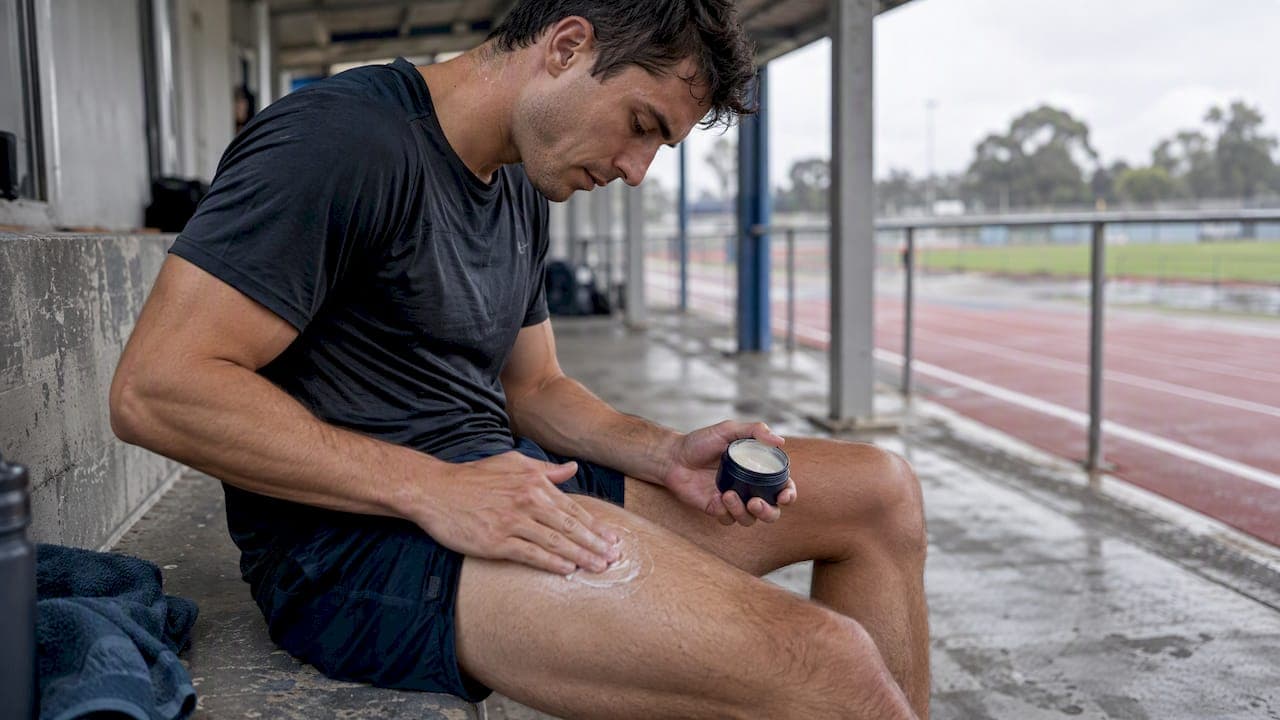
Topical CBD balms may ease pain and soreness from a quadriceps strain, but they work as an adjunct, not a cure. Evidence from human trials is mixed, with some short-term recovery signals and many null results. A topical balm is the most practical starting point, applied alongside rest, ice, and standard rehab, and only after checking for drug interactions and product quality.
TL;DR:
- A 2026 trial found the CBD group regained baseline strength within 24 hours, while placebo remained below baseline at 48 hours; one trial is inconclusive.
- A 2024 systematic review found limited benefits for some performance measures but little consistent improvement in strength or recovery, with small studies using differing doses.
- Apply a thin layer two to three times daily after icing and once skin returns to normal temperature; continue rest, compression, and graduated rehabilitation.
- The FDA has not approved nonprescription CBD for muscle strains, and CBD may alter medication levels, so people taking prescriptions should consult a clinician first.
- Seek medical care for visible deformity, significant swelling, inability to bear weight, infection signs, or pain that worsens or fails to improve after a few days.
Table of Contents
- What CBD is and how it might affect muscle pain
- What the research shows on CBD for muscle injury and recovery
- Topical balms vs. oral CBD: which route fits a quad strain?
- Safety, regulation, and drug interactions to check first
- How to use a CBD topical for a quadriceps strain
- Rehab essentials and red flags: where CBD actually fits
- Publisher evidence: our trials and product facts
- Author perspective: setting realistic expectations
- A practical option for muscle soreness: our balms
- FAQ
- Sources
What CBD is and how it might affect muscle pain
CBD, or cannabidiol, is one of many compounds found in the cannabis plant. Unlike THC, it does not produce a high. Researchers believe CBD interacts with the body's endocannabinoid system, a network of receptors involved in regulating pain signaling, inflammation, and recovery processes.
The plausible pathways relevant to a strained quadriceps include:
- Pain modulation: CBD may influence receptors involved in how pain signals are processed.
- Inflammation support: some lab and animal research suggests CBD interacts with inflammatory pathways, though human confirmation is limited.
- Local vs. systemic action: a topical balm acts mainly at the skin and underlying tissue, while an oral product circulates through the bloodstream and affects the whole body.
None of these mechanisms are proven cures for muscle injury. They describe a plausible biological basis, not a guaranteed outcome.
What the research shows on CBD for muscle injury and recovery
The human evidence is genuinely mixed, and that matters more than any single promising headline. A 2026 randomized controlled trial measuring isometric peak torque after exercise-induced muscle damage found that the CBD group returned to baseline strength within 24 hours, while the placebo group remained below baseline at 48 hours. That is a real signal, but it comes from one trial using a specific dose and timing window, not a settled finding.
A 2024 systematic review found a limited beneficial effect of CBD on parameters like VO2 and mean power, but little to no consistent benefit for strength or post-load recovery overall. The same review flagged that most included studies were small and used different doses, from a single 60 mg amount to pre-exercise doses of 300 mg or weight-based regimens, which makes comparing results across trials difficult.

The pattern across this research: occasional positive findings in the first 24 to 72 hours after injury, surrounded by a larger body of neutral or inconclusive results. Our review of CBD and muscle recovery research walks through these same trials in more depth. The honest summary is that CBD shows promise for some recovery metrics without rising to proven treatment for muscle injury.
Topical balms vs. oral CBD: which route fits a quad strain?
For a localized injury like a quadriceps strain, a topical balm is generally the more practical choice. Topical application keeps the product concentrated at the site of pain rather than circulating through the bloodstream, which lowers systemic exposure and the odds of interacting with other medications.
- Topical balms offer easy, targeted application directly over the sore muscle.
- Oral CBD (capsules, tinctures) has been used in exercise-science trials measuring systemic recovery markers, but it carries a different risk profile because it reaches the whole body.
- Topicals are generally better tolerated, with localized skin reactions reported as uncommon in small trials.
- Oral products require more caution around drug interactions, discussed in the next section.
Pro Tip: Start with a topical balm on the strained area before considering an oral product, since it limits systemic exposure while you gauge how your body responds.
Our guide to CBD for delayed-onset muscle soreness covers how the two routes compare for general post-exercise soreness, which overlaps with strain recovery in practice.
Safety, regulation, and drug interactions to check first
The FDA has not approved any nonprescription CBD product to treat muscle strains or any other medical condition. The only FDA-approved CBD product is Epidiolex, a prescription drug for specific seizure disorders, and it has nothing to do with muscle injury. That means any topical or oral CBD product for a quad strain is being used outside of FDA-evaluated indications, so expectations should stay modest.
A few practical safety points worth checking before you start:
- CBD can inhibit several liver enzymes (CYP enzymes) that metabolize other medications, which can raise or lower the effective dose of drugs you already take.
- Anyone on prescription medication should talk to a clinician or pharmacist before adding CBD, oral or topical, to their routine.
- Topical products reported low rates of mild skin reactions like dryness in small clinical trials, with systemic side effects uncommon.
- Unregulated CBD products can contain trace THC, which creates a real risk of a positive drug test for competing athletes. Our guide to athlete-safe CBD use covers testing and contamination risk in more detail.
How to use a CBD topical for a quadriceps strain
A topical balm works best as one piece of a broader first-aid routine, not a replacement for it.
- Start with PRICE or RICE in the first 24 to 72 hours: protection, rest, ice, compression, and elevation. This is the foundation; CBD is the add-on.
- Clean and dry the skin over the strained area before applying any balm.
- Apply a thin layer and massage gently into the muscle, avoiding any open cuts or broken skin.
- Repeat two to three times daily, adjusting frequency based on how your skin and symptoms respond.
- Watch for irritation. Stop use if you notice redness, itching, or a rash that does not resolve.
- Combine with short-term NSAID use if appropriate for pain control, and follow a graduated rehab plan as swelling subsides over the following weeks.
Pro Tip: Apply the balm after icing, once the skin has returned to normal temperature, so the product absorbs rather than sitting on a cold, tightened surface.
Our guide on using CBD for muscle knots has more detail on massage technique and timing that applies to muscle soreness.
Rehab essentials and red flags: where CBD actually fits
Muscle strain recovery generally moves through three phases: acute inflammation control in the first few days, tissue regeneration over the following one to two weeks, and remodeling over the following weeks to months as strength and flexibility rebuild. Progressive loading, moving from isometric holds to isotonic strengthening to functional movement, is what actually prevents reinjury. CBD does not replace that progression.
Seek medical evaluation if you notice:
- A visible deformity, significant swelling, or an inability to bear weight.
- Signs of infection at the injury site, such as warmth, spreading redness, or fever.
- Pain that worsens or fails to improve after a few days of standard first aid.
Physical therapy guidance on quadriceps injuries also emphasizes positioning early on, such as keeping the knee flexed to avoid the muscle healing in a shortened position, which affects outcomes regardless of any topical product used alongside it.
Publisher evidence: our trials and product facts
There are observational trials suggesting some users of certain balms report soreness relief without positive drug test results, as described in a sports massage trial writeup. Another trial tracking outcomes over weeks was also described.
- Some balms on the market contain CBD along with botanicals such as arnica, menthol, and turmeric.
- Many topical CBD products are formulated to be THC-free, vegan, and paraben-free.
- Some vendors offer refund policies to enhance customer satisfaction.
These are our own trial observations, not independent clinical proof, and they sit alongside the mixed research summarized above rather than replacing it.
Author perspective: setting realistic expectations
Treat CBD as a modest support tool, not a fix. The research backs mild symptom relief for some people, nothing more dramatic. Track how your own body responds, check with a clinician if you take other medications, and keep rehab, not a balm, as the center of your recovery plan.
— Cindy
A practical option for muscle soreness: our balms
We built our Seriously Soothing Pain Balm and RIKKI TIKKI Recovery specifically for muscle soreness and recovery, with 1,000 mg of CBD per ounce and botanicals like arnica and menthol in every formula.
- Every order carries a 30-day full refund if it does not work for you.
- Some topical balms are formulated with athletes in mind and aim to be safe with regard to drug tests.
- A low-commitment sample size is available if you want to try before committing to a full tin.
If you take prescription medication, check with a clinician first. Ready to try one for yourself? Visit our Seriously Soothing Pain Balm page to get started.
This article is general information, not a substitute for advice from a qualified doctor. Consult a qualified healthcare professional about your own circumstances before acting on anything here.
FAQ
Does CBD help with strained muscles?
CBD may offer modest pain and soreness relief for some people with a strained muscle, based on mixed research findings. It works best as a supporting measure alongside rest, ice, and standard rehab rather than as a standalone treatment.
Can CBD help with muscle ache?
Some small trials report improvements in short-term recovery metrics after muscle ache or exercise-induced soreness, though results are inconsistent across studies. A topical balm applied directly to the sore area is the most practical way to try it.
Does CBD loosen tight muscles?
There is no strong evidence that CBD directly loosens tight muscle tissue. Any perceived relief likely comes from its effect on pain perception rather than a direct action on muscle fibers themselves.
Will CBD help with muscle recovery?
Research shows a mixed picture: some randomized controlled trials found earlier return of strength measures like isometric peak torque within 24 to 48 hours, while a broader systematic review found limited consistent benefit for recovery overall. CBD is best viewed as an adjunct to rest, graduated rehab, and standard first aid, not a replacement for them.
Sources
- PubMed: (2026) RCT on CBD and isometric peak torque
- The effect of cannabidiol on performance and post-load recovery among healthy and physically active individuals: systematic review (PMC)
- FDA: Regulation of cannabis and cannabis-derived products, including CBD