
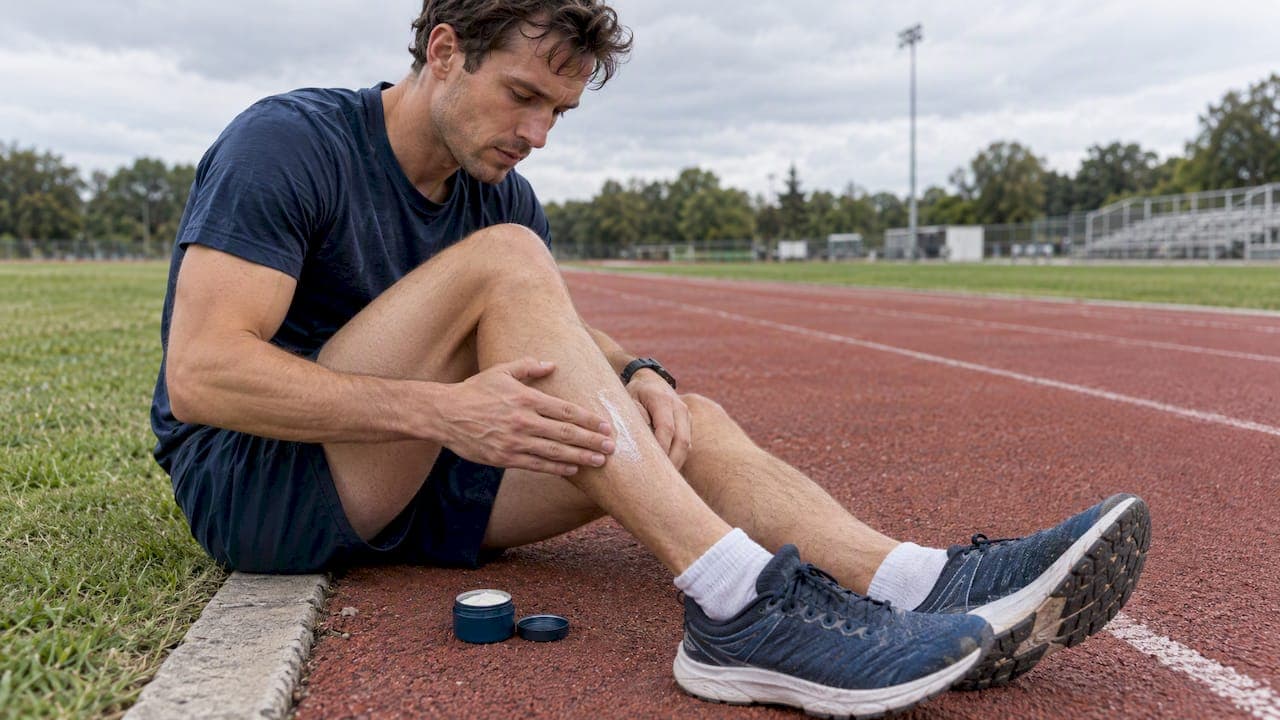
Topical CBD can offer symptomatic relief for some people with shin pain, but clinical results are mixed and a balm works best as an addition to standard care, not a replacement for it. Short-term studies suggest topical forms are generally well tolerated. If your pain sits over one spot on the bone, worsens, or lingers, get it checked before relying on any topical product.
TL;DR:
- The 2026 crossover pilot found no significant soreness reduction among 15 active students, although isometric torque recovery improved between 24 and 72 hours.
- No trial has isolated shin splints, and a review of seven studies found exercise recovery evidence limited and inconsistent, with small samples and varied measures.
- Standard care includes rest, ice for about 20 minutes at a time, activity changes, and supportive footwear; a balm should supplement, not replace, these measures.
- Seek medical evaluation for pinpoint bone pain, swelling, pain at rest or overnight, or difficulty bearing weight, since these symptoms can signal a stress fracture.
- Athletes subject to drug testing should verify a batch specific third party certificate of analysis, because labels claiming THC free may still conceal trace THC.
Table of Contents
- What Topical CBD Is and How It May Ease Shin Discomfort
- What Clinical Trials Show About CBD and Lower-Leg Pain From Exercise
- How to Apply a CBD Balm for Shin Pain Alongside Standard Care
- Side Effects, Drug Testing, and Who Should Be Cautious
- Warning Signs That Mean It's Time to See a Doctor
- How Our Balms Fit Into This Approach
- Where the Evidence Leaves Us
- Try a Balm Built for This Kind of Recovery
- FAQ
- Sources
What Topical CBD Is and How It May Ease Shin Discomfort
Topical CBD refers to a cannabidiol-infused balm, gel, or patch applied directly to the skin over the painful area, as opposed to oral CBD, which is swallowed and processed through the digestive system and liver. Transdermal products are designed to pass through the skin into deeper tissue, while purely topical ones work closer to the surface, which is part of why formulation matters so much for results.
The proposed mechanisms behind topical CBD are mostly receptor-based. CBD is thought to interact with CB2 receptors involved in immune and inflammatory response, TRPV1 channels that influence pain signaling, and PPARγ and adenosine pathways tied to inflammation control. A 2015 study using transdermal CBD in a rat model of arthritis found reduced joint swelling and inflammatory markers in a dose-dependent way, which supports the biological plausibility of local effects, even though animal data doesn't guarantee the same response in humans.
How much of this reaches the tissue that actually hurts depends on the product itself. Skin penetration, local concentration, and the carrier ingredients in a formulation all affect whether a balm does much of anything.
- Gels tend to sit on the skin surface and work fastest but may not penetrate as deeply.
- Balms and salves often combine CBD with warming or cooling agents like menthol for a layered sensory effect.
- Patches offer slower, steadier release over hours rather than an immediate hit.
Pro Tip: Look for a product that lists CBD content per ounce rather than a vague "CBD-infused" label, since concentration is one of the biggest variables behind inconsistent results.
The honest limitation here is that formulation and dosing vary widely across brands, and that variability is a major reason study results and real-world experiences don't always match.
What Clinical Trials Show About CBD and Lower-Leg Pain From Exercise
The research on topical CBD for exercise-related pain is still young, but a few recent trials give a useful picture. A 2026 randomized, double-blinded pilot study tested topical CBD gel against a placebo gel in 15 physically active students using a crossover design. The trial found no significant reduction in DOMS scores, meaning the gel didn't clearly reduce delayed-onset muscle soreness, but it did find a moderate, statistically significant effect on isometric torque recovery between 24 and 72 hours after exercise.

A 2023 pilot study of elite athletes with chronic lower-extremity pain reported that topical CBD was well tolerated over six weeks, with only minor side effects and a significant reduction in reported pain. That combination, tolerability plus a measurable pain drop, is part of why topical CBD keeps showing up in athlete recovery routines even without large-scale proof.
A broader systematic review looking at studies through April 2024 found similarly mixed signals across the field:
- Evidence for CBD's benefits on exercise recovery and performance remains limited and inconsistent.
- The review identified seven qualifying studies, most with small sample sizes and differing outcome measures.
- Some physiological markers improved modestly while strength and recovery data stayed equivocal.
Part of the inconsistency comes down to what each study actually measures. One trial tracks muscle soreness, another tracks strength output, another tracks subjective pain scores, and doses and delivery methods differ from one product to the next. For shin splints specifically, no trial has isolated that exact injury, so the fair read is that the research is encouraging for general exercise-related soreness and tolerability, not proof of a shin-specific fix.
How to Apply a CBD Balm for Shin Pain Alongside Standard Care
A topical balm works best as one part of a broader plan, not the whole plan. The American Academy of Orthopaedic Surgeons recommends rest, icing for about 20 minutes at a time, compression, activity modification, and supportive footwear or orthotics as the standard approach to shin splints, along with staying pain-free for at least two weeks before returning to full activity.
To try a topical CBD balm as part of that routine:
- Wash and dry the shin area before application to remove sweat, dirt, or other lotions.
- Test a small patch of skin first and wait 24 hours to check for irritation.
- Apply a dime- to quarter-sized amount directly over the sore area.
- Rub it in gently rather than massaging aggressively, especially within the first 24 to 48 hours after new pain starts, since firm pressure over acutely inflamed tissue can aggravate it.
- Reapply two to three times a day, or as the label directs, alongside icing and rest.
Pair the balm with graduated return to activity rather than pushing through pain. Give any single approach a fair trial window of two to four weeks while tracking your symptoms (pain level, swelling, how far you can run or walk) so you can judge whether it's actually helping.
When comparing products, check the label for CBD milligrams per ounce, a visible third-party certificate of analysis confirming THC-free status, and the specific botanicals included, since ingredients like menthol or arnica add a warming or cooling sensation that some people find helps with perceived relief. If you compete under drug-testing rules, our guide to athlete-safe CBD use covers what to verify before you buy.
Pro Tip: Keep a simple daily log of pain level and activity tolerance during your trial window so you have real data, not just a vague impression, when deciding whether to continue.
Side Effects, Drug Testing, and Who Should Be Cautious
Topical CBD is generally mild in terms of side effects. The most commonly reported issues are transient skin irritation, redness, or dryness at the application site, most of which resolve on their own or with reduced frequency of use.
The bigger practical concern is contamination. Even balms labeled "THC-free" can contain trace THC if testing is inconsistent, and that trace amount has been enough to trigger positive results on sensitive urine drug tests in some cases. Verifying third-party lab testing before buying matters more than trusting the label alone.
- Check for a batch-specific certificate of analysis showing THC content, not just a general claim.
- Be aware that CBD can interact with medications metabolized by liver enzymes in the CYP family, so check with a clinician if you take prescription drugs regularly.
- Pregnant or breastfeeding individuals, and children, should avoid CBD products or use them only under medical guidance, since safety data for these groups is limited.
As one clinical caution puts it, non-intoxicating doesn't mean risk-free, and CBD is best treated as a comfort measure rather than a substitute for medical evaluation when pain is focal or doesn't improve. Our guide on topical CBD and sensitive populations goes into more detail on who should check with a doctor first.
Warning Signs That Mean It's Time to See a Doctor
A topical balm can take the edge off soreness, but it shouldn't mask a problem that needs medical attention. Certain symptoms point toward something more serious than a typical case of shin splints, most notably a stress fracture.
Watch for pinpoint pain over one specific spot on the bone rather than pain spread along the shin, visible swelling, pain that shows up at rest or wakes you at night, or an inability to bear weight comfortably. Shin splints and stress fractures can feel similar early on, but a stress fracture needs a different recovery approach and sometimes imaging to confirm.
If pain doesn't improve within seven to fourteen days of rest, ice, and activity modification, or sooner if the pain is sharply localized to one point, stop activity and get evaluated by a sports medicine provider or orthopedist. Masking that kind of pain with a topical product and continuing to train risks turning a manageable injury into a longer, more serious one.
How Our Balms Fit Into This Approach
Our pain balms are formulated with CBD plus arnica, menthol, turmeric, and other botanicals chosen to support the kind of local relief and sensory effect described above. They are vegan, non-GMO, paraben-free, THC-free, and cruelty-free, and purchases are backed by a 30-day full refund policy if a balm doesn't work for you.
If you want a structured way to test one during shin pain, our shin splints trial protocol lays out a conservative approach you can follow alongside rest and icing, and our recovery evidence review breaks down topical versus oral use in more depth. For independent analysis beyond our own content, Cannible's review of CBD athletic recovery research is a useful outside reference.
Where the Evidence Leaves Us
The honest picture is this: topical CBD looks tolerable, mildly promising for pain and recovery markers, and still short of proven for any single injury like shin splints. That's not a reason to dismiss it, it's a reason to trial it thoughtfully, track what happens, and keep seeing a clinician if focal or persistent pain doesn't ease up. Pair any balm with rest, ice, and sensible loading, and let your body's response guide the next step.
— Cindy
Try a Balm Built for This Kind of Recovery
If you want to put the trial approach above into practice, our Seriously Soothing Pain Balm blends CBD with arnica and menthol for a fast-acting, soothing sensation over sore or inflamed areas, while RIKKI TIKKI Recovery is formulated specifically for muscle and joint recovery after activity.
Either balm works well as a two-to-four-week trial alongside rest, icing, and gradual return to activity, and since we back every purchase with a 30-day full refund policy, there's no financial risk in finding out whether it helps your shins specifically.
- Seriously Soothing Pain Balm: $26.95 to $39.95, built around arnica, menthol, and 1,000 mg of CBD per ounce.
- RIKKI TIKKI Recovery: $26.95 to $39.95, formulated for post-activity muscle and joint recovery.
- Both come in a THC-free, vegan, paraben-free formula with a third-party certificate of analysis.
Browse the Seriously Soothing Pain Balm or explore the full lineup, including RIKKI TIKKI Recovery, on our product page to find the option that fits your routine.
This article is general information, not a substitute for advice from a qualified doctor. Consult a qualified healthcare professional about your own circumstances before acting on anything here.
FAQ
What are the potential side effects of using a CBD pain patch?
The most common side effects of a topical CBD patch are mild skin irritation, redness, or dryness at the application site. These effects are usually temporary and tend to lessen with reduced frequency or a different formulation.
Do you need a prescription to get CBD cream?
No, topical CBD creams and balms are generally sold over the counter without a prescription. Check your product's certificate of analysis to confirm THC content and quality before purchasing.
Can CBD help with sports recovery?
Early research suggests topical CBD may support some aspects of recovery, with a 2023 athlete pilot study reporting significant pain reductions over six weeks of use. A broader systematic review found the evidence is still limited and mixed, so it's best viewed as a possible aid rather than a guaranteed fix.
Is CBD rub an anti-inflammatory?
CBD is thought to interact with receptors involved in inflammation and pain signaling, including CB2 and TRPV1, which gives it plausible anti-inflammatory activity at the local level. Human evidence specific to topical rubs is still limited, so effects can vary from person to person.
Sources
- Topical application of cannabidiol for muscle recovery after exercise-induced muscle damage: a randomized, double-blinded pilot study | PubMed
- Shin splints - OrthoInfo - AAOS