
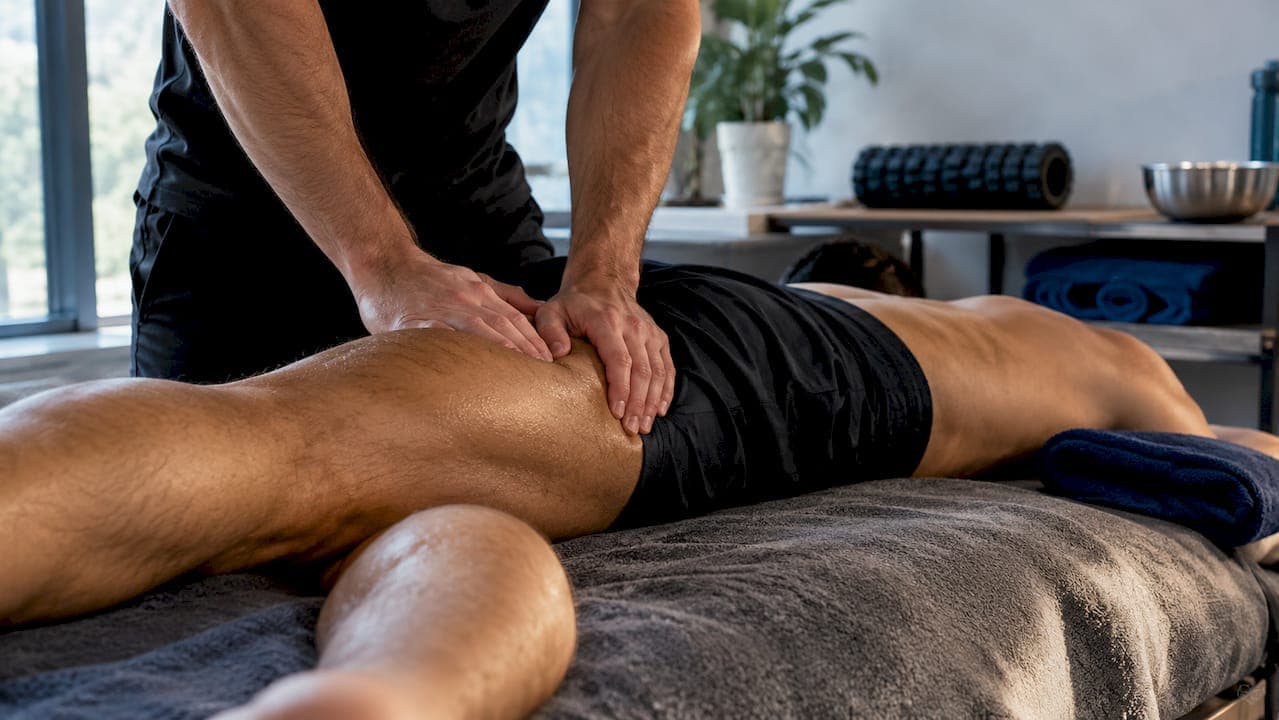
Topical CBD sports balms can ease the surface-level ache of sore muscles for some people, largely thanks to menthol, arnica, and other active ingredients working alongside CBD. Clinical evidence that CBD itself speeds objective recovery, though, remains thin and mixed. For athletes, the bigger practical issue is product quality: contamination risk and mislabeled THC content matter more than whether a balm "works." Buy from a brand with lab testing and a real refund policy, like Mongoose CBD Co., and you reduce most of the actual risk.
TL;DR:
- The evidence for CBD's role in speeding muscle recovery is limited and inconsistent, with most benefits being short-term relief rather than faster tissue repair.
- Topical CBD products mainly provide immediate sensory relief from ingredients like menthol and capsaicin, not systemic anti-inflammatory effects or objective recovery improvements.
- Contamination with undeclared THC poses a higher risk to athletes than CBD itself, so verified third-party testing and sport-specific certification are essential before use.
- Applying CBD balm within an hour after training and repeating twice daily can help manage soreness, but do not expect it to significantly shorten recovery time.
- Always check labels for verified CBD content, batch-specific lab results, and a solid refund policy when choosing a product, especially if competing under drug testing rules.
Table of Contents
- What the Research Says About CBD Sports Massage and Muscle Recovery
- What's Actually in a CBD Sports Balm (and Why It Feels Like It Works)
- How to Apply a CBD Balm for Sore Muscles
- Contamination Risk: What Athletes Need to Know Before Competing
- How to Choose a CBD Sports Balm: A Buyer's Checklist
- A Cautious, Evidence-Based Take on CBD for Muscle Recovery
- Where to Start With Mongoose CBD Co.
- Sources
- FAQ
What the Research Says About CBD Sports Massage and Muscle Recovery
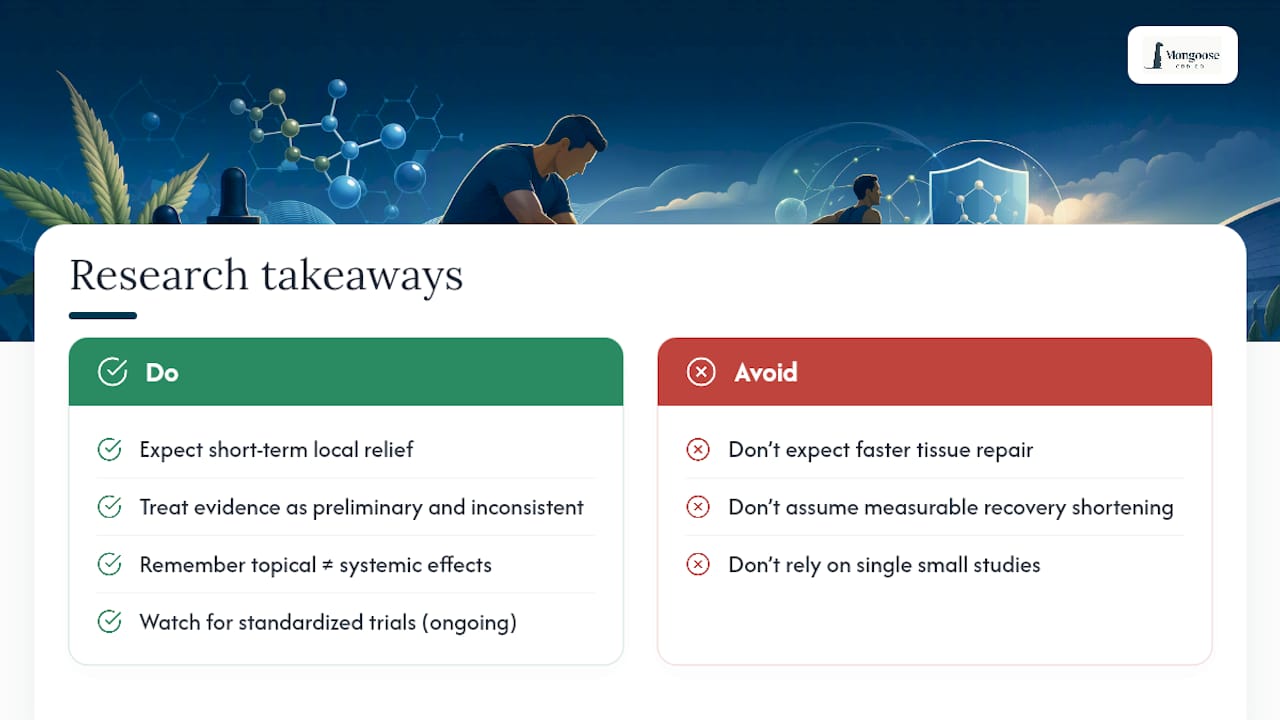
The most direct evidence on topical CBD for exercise recovery comes from a randomized, double-blinded pilot study that compared a CBD gel to placebo after exercise-induced muscle damage. The result: no consistent advantage on delayed-onset muscle soreness (DOMS) or most objective recovery markers, though isometric torque improved somewhat in one small subgroup. That's a common pattern in this research area. Small samples, short follow-up windows, and formulation differences make it hard to draw a firm conclusion in either direction.
Sport-specific reviews back up that caution. A synthesis on cannabis for athletic pain and DOMS describes the topical evidence base as preliminary and inconsistent, and points out that bioavailability and delivery method likely explain more of the variation than the presence of CBD itself. That tracks with what's known about oral CBD, too: some studies using doses around 60 mg sublingually found reduced creatine kinase and myoglobin at 48 to 72 hours, while other oral trials found nothing. Systemic and topical routes behave differently, and neither has produced a clean, repeatable win.
Registered trials are trying to close that gap. NCT06320327 uses standardized application zones, repeated dosing, and pressure-pain threshold testing at 24 and 48 hours, a more rigorous design than most existing published work.
What this means practically: a topical balm may ease local discomfort in the moment for some users, but you shouldn't expect it to measurably shorten your recovery timeline. Local, short-term relief is realistic. Faster tissue repair is not yet proven.
For more on how this specific research applies to soreness, see CBD for DOMS: what the research actually says.
What's Actually in a CBD Sports Balm (and Why It Feels Like It Works)
CBD itself has plausible local mechanisms. Preclinical work suggests it can interact with skin-level receptors, including TRPV1, and may influence local anti-inflammatory signaling. That's cell and animal data, though, not proof of a clinical effect once you rub the balm into a sore hamstring.
The sensation you actually feel usually comes from the supporting cast:
- Menthol triggers a cooling receptor response that produces temporary, noticeable analgesia.
- Arnica has a long traditional history as a topical treatment for bruising and soft-tissue soreness.
- Capsaicin and cayenne act as warming counterirritants, creating a distraction sensation that can mask ache.
- Turmeric and eucalyptus add mild warming or cooling notes and contribute to the overall sensory profile.
Carrier oils and texture matter more than most labels admit. A greasy, poorly absorbed balm sits on the skin instead of penetrating it, while a lighter formulation massages in and reaches tissue faster. None of this adds up to a systemic anti-inflammatory effect. What you're buying is local, sensory, and short-lived, not a substitute for oral anti-inflammatories or rest.
Pro Tip: If a balm feels like its "working" within 60 seconds, that's the menthol or capsaicin talking, not the CBD. Judge a product over a week of consistent use, not one application.
More detail on which ingredients actually matter is in this breakdown of CBD balm formulations.
How to Apply a CBD Balm for Sore Muscles
Timing and technique affect how much benefit you get from any topical product, CBD or otherwise.
- Apply within an hour after training, and again before bed if soreness is building. DOMS typically peaks 24 to 48 hours post-exercise, so a second application the next morning often helps more than a single post-workout dose.
- Use a dime- to quarter-size amount per muscle group. Labeling varies a lot between brands, so check the product's own dosing guidance rather than assuming a universal amount.
- Massage in circular strokes for 60 to 90 seconds, moving from the outer muscle toward the center, with firm but comfortable pressure. This isn't a deep-tissue sports massage technique, just enough friction to work the balm past the surface layer and encourage local circulation.
- Repeat once or twice daily for persistent soreness, rather than applying heavily once.
- Wash your hands after application and avoid open cuts, broken skin, and mucous membranes, since capsaicin and menthol can sting badly if they reach your eyes or nose.
Pro Tip: Warm the muscle slightly first, a hot shower or five minutes of light movement, before applying. Warmer skin absorbs topicals faster than cold skin.
Contamination Risk: What Athletes Need to Know Before Competing
Topical CBD generally shows low systemic absorption, meaning very little reaches your bloodstream compared to oral or sublingual use. The real risk for tested athletes isn't CBD itself. It's undeclared THC contamination in a poorly manufactured product, according to a review of CBD and THC cream evidence.
Before you buy anything, check for:
- A current Certificate of Analysis (COA) from a third-party lab, matched to the specific batch number on your product.
- Confirmed THC levels at or near non-detectable, not just a "THC-free" label with no data behind it.
- Sport-specific certification, such as NSF Certified for Sport, when you're competing under a testing body's rules.
- A lab name you can verify independently, not an in-house or unnamed "third-party" claim.
Reviews aimed at sport medicine consistently recommend athletes stick to products with clear third-party testing rather than gambling on unverified labels. If competition is close and you're unsure, choose a lab-verified isolate and use it conservatively in the weeks beforehand.
How to Choose a CBD Sports Balm: A Buyer's Checklist
Most CBD balm marketing leans on the milligram number printed on the front of the jar. That number matters less than what's actually verified behind it.
- Confirm the CBD amount per ounce and the total ingredient list, not just a headline milligram claim.
- Look for a linked, batch-matched COA you can check yourself, not a vague "lab tested" badge.
- Check for sport-safe certification if you compete under any testing organization.
- Read the refund policy. A brand confident in its formulation typically backs it with a real return window.
- Look for complementary actives (arnica, menthol, capsaicin, turmeric) rather than CBD alone, since these are what most people actually feel.
- Match the tool to the job. A balm suits localized, surface-level soreness. Ice, NSAIDs, or oral CBD may fit systemic inflammation or deeper joint pain better.
A Cautious, Evidence-Based Take on CBD for Muscle Recovery
The honest position is this: trial a topical CBD balm for symptomatic relief, not as a recovery shortcut. Keep your tested, boring recovery habits, sleep, hydration, and progressive loading, doing the actual work. Track your own response over two or three weeks before deciding it's worth keeping in your kit, and buy only from brands willing to show their testing and stand behind a refund.
— Cindy
Where to Start With Mongoose CBD Co.
Some CBD balm brands build their products around 1,000mg of CBD per ounce, paired with ingredients chosen for immediate, noticeable sensation rather than a milligram number alone. Some pain balms target everyday muscle soreness and arthritis-related discomfort using warming cinnamon and clove blends. Some CBD balms are formulated specifically for post-workout muscle recovery in small tins sized for regular use. Other balms on the market aim to address deeper, more persistent soreness.
Many formulations are vegan, non-GMO, paraben-free, THC-free, and cruelty-free, and some brands offer a 30-day full refund policy, enabling customers to test a balm against their soreness without commitment. That's the practical difference between guessing at a shelf product and trying one backed by a brand willing to take it back. If DOMS or chronic soreness is part of your training cycle, start with the Seriously Soothing Pain Balm or Rikki Tikki Recovery and give it two weeks of consistent use before judging the result.
Sources
- Topical application of cannabidiol for muscle recovery after exercise-induced muscle damage: a randomized, double-blinded pilot study | Journal of Cannabis Research
- Clinicaltrials
FAQ
Does CBD massage balm actually reduce muscle soreness?
It may ease surface-level soreness for some people, largely due to menthol, arnica, or capsaicin in the formula, but controlled trials on CBD itself show mixed, mostly null results for objective recovery markers.
How long does it take a CBD balm to work on sore muscles?
Sensory effects like cooling or warming appear within minutes, but any deeper benefit from consistent use is better judged over one to two weeks of regular application.
Can CBD topicals cause a failed drug test for athletes?
Topical CBD has low systemic absorption, so the real risk is undeclared THC in a poorly tested product, not the CBD itself; always check a batch-matched Certificate of Analysis before competing.
How much CBD balm should I use per application?
Most guidance points to a dime to quarter-size amount per muscle group, massaged in for about a minute, though labeling varies by brand, so check the specific product's instructions.
Is Mongoose CBD Co. safe for athletes to use before competition?
Some CBD balms are formulated THC-free with approximately 1,000mg of CBD per ounce and are backed by refund policies, but athletes competing under a testing body should still confirm sport-specific certification before use.