
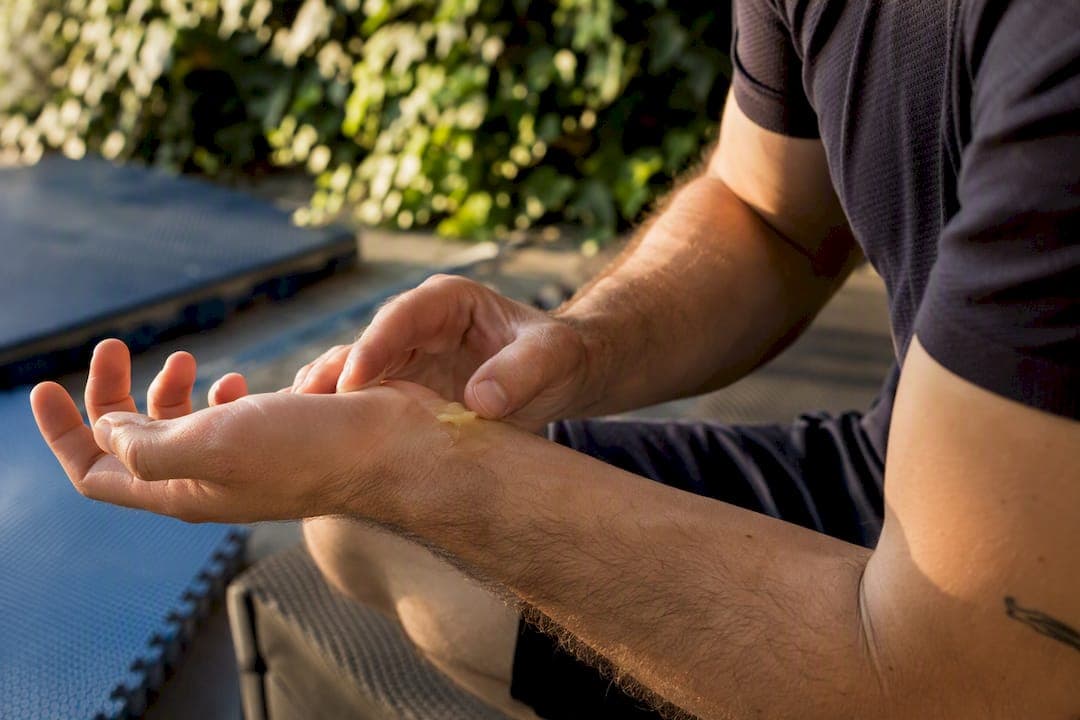
CBD is a reasonable, evidence-backed addition to a BJJ recovery routine, but it plays two distinct roles, not one. Topical CBD balms are the clearest practical fit for localized mat injuries: jammed fingers, bruised shins, sore trapezius muscles after a hard sparring round. Oral CBD has a different job. It shows the most promise for sleep and anxiety support, and considerably less evidence for acute performance or strength recovery.
That distinction matters because most of the CBD marketing aimed at athletes blurs the two together. A 2024 systematic review screened 901 publications and found only 7 trials rigorous enough to include, concluding the evidence for CBD improving post-load muscle recovery and strength is limited at best. A 2025 dose-ranging trial in trained runners found that 50 mg and 300 mg oral doses taken before exercise didn't move the needle on perceived exertion, pain, or physiological performance markers. Meanwhile, a registered clinical trial is now testing 200 mg per day of CBD in BJJ athletes over 12 weeks, tracking inflammatory markers, pain, and sleep quality specifically in grapplers.
Here's how to act on that today:
- Apply a topical CBD balm after training to targeted, sore joints and soft tissue.
- If sleep disruption is undermining your recovery, start with a conservative oral dose rather than jumping to a topical for that purpose.
- Always check third-party lab results (COAs) before competition, since THC remains prohibited even though CBD itself is not.
Statistic to remember: Only a handful of trials met strict inclusion criteria out of many screened publications, which tells you how young this research field still is.
Table of Contents
- How CBD Interacts With Your Body's Recovery Systems
- What the Research Actually Shows About CBD and Recovery
- Topical Vs Oral CBD: Which One Fits Your Recovery Goal
- Dosing, Safety, and Competition Rules Every Grappler Should Know
- How to Use CBD for Common BJJ Injuries
- Why Mongoose CBD Co.'s Balms Fit This Protocol
- What the Research Actually Supports, and What It Doesn't
- Where to Start With a Topical CBD Balm for Recovery
- Sources
How CBD Interacts With Your Body's Recovery Systems
CBD works through the endocannabinoid system (ECS), a network of receptors your body uses to regulate pain, inflammation, mood, and sleep. Two receptor types matter most here: CB1, concentrated in the central nervous system and involved in pain perception, and CB2, found more heavily in immune cells and peripheral tissues, including the joints and muscles grapplers beat up every week.
CBD doesn't bind directly to CB1 or CB2 the way THC does. Instead, it appears to modulate how these receptors respond to your body's own endocannabinoids and to other signaling molecules, which is part of why its effects tend to be subtler and slower to build than a typical over-the-counter painkiller.
This is where topical versus systemic application starts to matter. A balm rubbed into a swollen knuckle or a stiff shoulder works largely on local tissue and peripheral CB2 activity near the application site. An oral capsule or tincture gets absorbed into the bloodstream and can influence receptor activity more broadly, including the central nervous system pathways tied to anxiety and sleep regulation.
Inflammation is the second piece of the puzzle. Some research suggests CBD may influence inflammatory cytokines like IL-6 and IL-10, the chemical messengers your immune system releases after tissue damage, whether from a sprained finger or 90 minutes of live rolling. This is exactly why the ongoing BJJ-specific trial uses IL-6 as its primary outcome measure. It's a direct read on whether CBD meaningfully changes the inflammatory cascade in athletes doing the sport, not just in a lab setting.
Sleep and anxiety modulation round out the picture, and grapplers tend to underrate this part. A few relevant points:
- Deep sleep is when the bulk of muscle repair and growth hormone release happens, so anything that reliably improves sleep quality has a downstream recovery effect.
- Pre-competition anxiety can suppress sleep and elevate cortisol, which works against tissue repair.
- CBD's most consistent human evidence right now leans toward anxiety and sleep support rather than direct anti-inflammatory action, which is worth knowing before you build expectations around the wrong use case.
What the Research Actually Shows About CBD and Recovery
The honest summary: evidence for CBD in athletic recovery is real, growing, and still thin. If you're deciding whether to use it, you should know exactly what has and hasn't been demonstrated.
The most rigorous synthesis to date is the 2024 systematic review, which screened 901 published studies and found just 7 trials that met strict methodological criteria for evaluating CBD's effect on post-load muscle recovery and strength. That's a tiny evidence base for a supplement now marketed to millions of athletes. The review's conclusion wasn't that CBD doesn't work. It was that we don't yet have enough well-designed trials to say definitively how well it works, or for whom.
A companion systematic review published in PMC reached a similar verdict, identifying seven eligible trials covering 134 participants total. It found limited beneficial effects on some physiological parameters but insufficient data specifically on strength and post-load recovery. One notable point in CBD's favor: no adverse effects were reported across those studies, which matters when you're weighing it against NSAIDs.
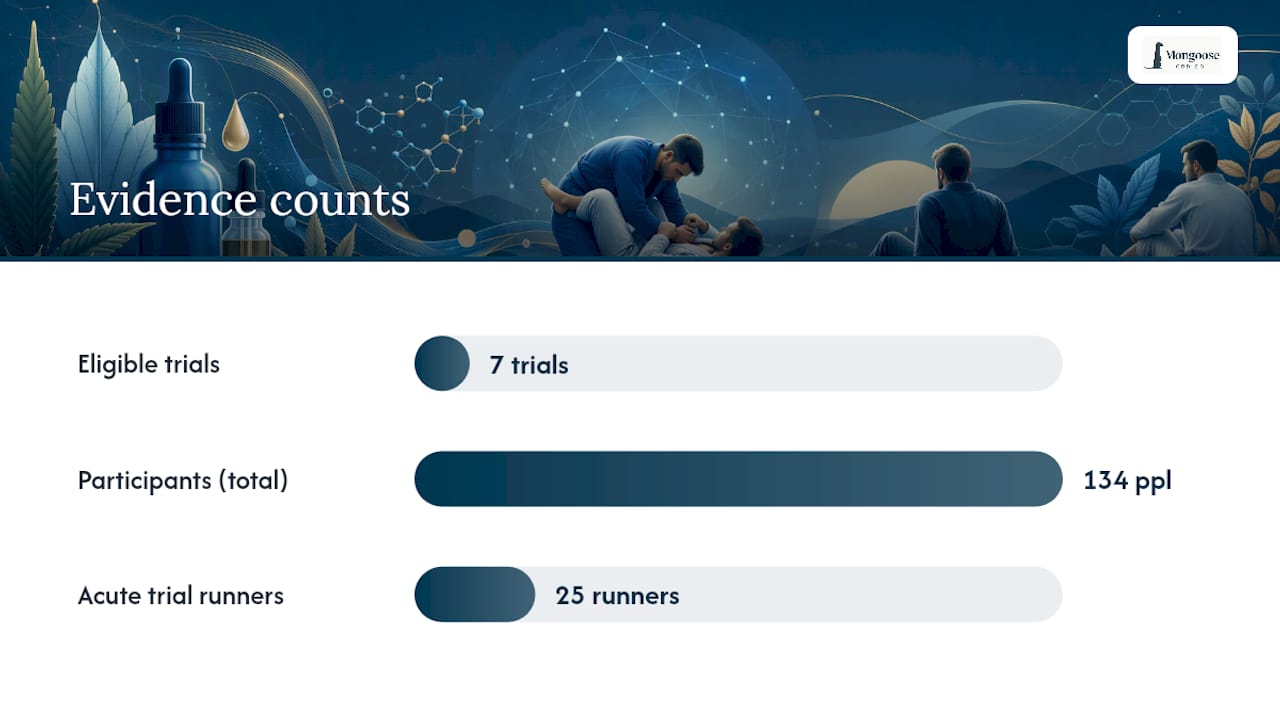
On the acute performance side, the picture is clearer and less flattering to CBD hype. A 2025 randomized dose-ranging trial gave 25 trained runners single doses of either 50 mg or 300 mg of CBD, 90 minutes before exercise. The result: no statistically significant difference in heart rate, VO2, time to exhaustion, perceived exertion, or pain versus placebo. A related analysis in Sports Medicine Open found that while CBD didn't meaningfully boost or hurt endurance performance, higher doses did shift some secondary metabolic markers like respiratory exchange ratio and glucose handling. That's a signal worth watching, not a reason to expect a performance edge on the mats.
Here's what the evidence base looks like when you line it up:
- Muscle recovery and strength: Limited evidence, small trial pool, no strong consensus.
- Acute performance: No significant benefit at 50 mg or 300 mg oral doses in controlled trials.
- Safety profile: No adverse effects reported across the reviewed trials.
- Sport-specific data: A registered clinical trial is now testing 100 mg twice daily (200 mg/day) for 12 weeks specifically in BJJ athletes, measuring IL-6, pain via VAS scoring, sleep quality via the PSQI, and quality of life via SF-36.
That BJJ trial is the one to watch. It's the first rigorous attempt to answer the question grapplers actually care about, rather than extrapolating from runners or general athletic populations. Until results are published, the fair takeaway is that CBD is a modest, context-dependent tool. It is not a guaranteed shortcut around the grind of proper rehab, sleep, and load management.
Topical Vs Oral CBD: Which One Fits Your Recovery Goal
Choosing the right format matters more than choosing the right brand. Topical and oral CBD are not interchangeable, and treating them as such is where most athletes waste money or get disappointed results.
- Localized musculoskeletal pain (jammed fingers, mat burn, sore lats, bruised shins) calls for a topical balm applied directly to the site. You're working with peripheral CB2 receptor activity in the skin and underlying tissue, not systemic circulation.
- Sleep disruption, pre-competition anxiety, or chronic systemic inflammation respond better to oral CBD, since it needs to reach the bloodstream and influence central nervous system pathways.
- Post-training soreness across multiple areas (the day-after ache from a hard sparring session) often benefits from combining both: topical on the worst spots, oral in the evening if sleep is also suffering.
Timing is where a lot of grapplers get it backward. Apply a topical after training, once the session is over and you're assessing what actually hurts. Using a balm before rolling to numb a nagging joint is a common instinct, but practitioners who work with grapplers regularly caution against it. Masking pain pre-training can create a false sense of security and encourage you to push through movements your body is trying to warn you about.
Bioavailability is the other overlooked factor. The milligrams listed on a topical label and the milligrams in an oral tincture are not equivalent doses. Very little of a topically applied cannabinoid reaches systemic circulation. It works locally, which is exactly why it's suited to a sore knuckle but not to anxiety or sleep. Oral CBD, particularly with fat-soluble carriers, gets absorbed more broadly but at highly variable rates from person to person.
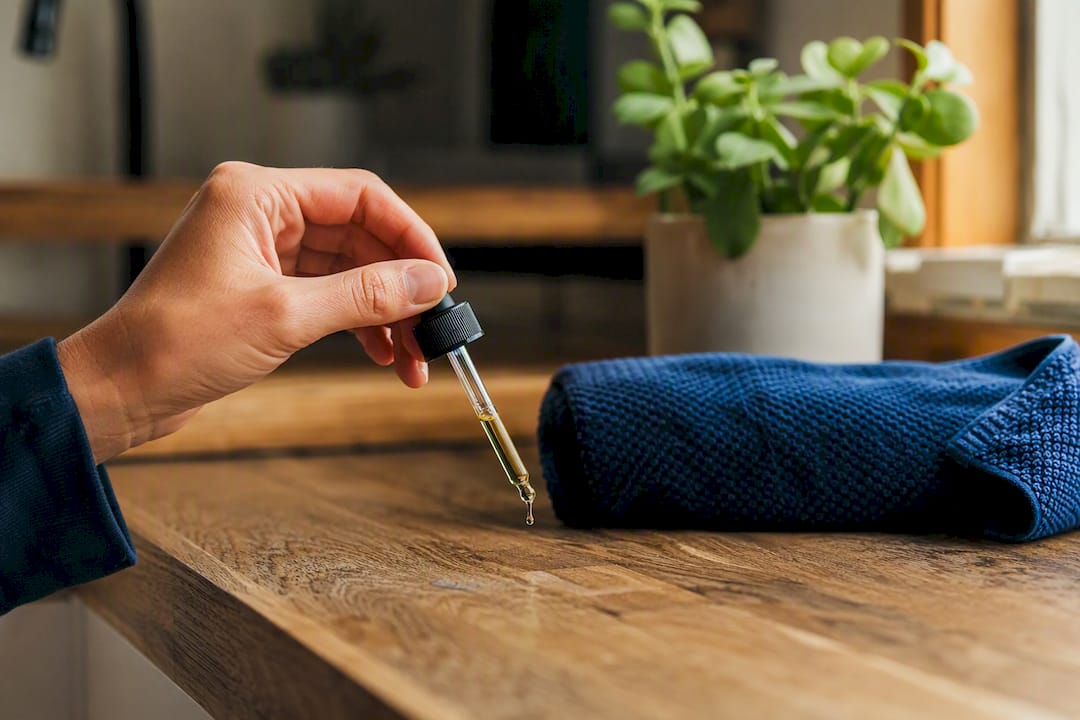
Pro Tip: Don't judge a topical balm by comparing its milligram count to an oral capsule's. Judge it by how targeted the relief is and how it feels on the specific joint or muscle you're treating.
Dosing, Safety, and Competition Rules Every Grappler Should Know
Getting the format right is only half the job. Dosing conservatively and knowing the rules that govern competition are the parts that actually protect you.
For oral CBD aimed at sleep support, start low. A common conservative range is 25 to 50 mg taken in the evening, with gradual increases only if needed after several nights of consistent use. There's no reason to jump straight to the 300 mg range tested in performance trials, especially since that dose showed no added performance benefit over 50 mg in controlled research. For topicals, look at the concentration per ounce on the label. Products formulated around 1,000 mg of CBD per ounce give you a meaningful dose per application without needing to reapply constantly through the day.
A few safety checks matter more than most athletes realize:
- CBD is processed through the liver's CYP450 enzyme system, the same pathway many common medications use, including some blood thinners, anti-seizure drugs, and certain antidepressants.
- If you're on a prescription medication, especially anything with a grapefruit warning on the label, talk to a doctor before adding oral CBD.
- Watch for unexpected sedation, unusual fatigue, or signs of liver stress like jaundice. These are rare but worth taking seriously if they show up.
- If you have any co-existing condition being medically managed, get clearance before starting a daily oral regimen rather than just checking dosing charts online.
Statistic to remember: The registered BJJ trial testing 200 mg per day for 12 weeks includes AST liver enzyme monitoring as a built-in safety measure, which tells you how seriously researchers treat this even at moderate doses.
Competition rules are more straightforward than most athletes expect. Both WADA and USADA have removed CBD itself from the prohibited substances list. THC has not been removed and remains banned in competition. The catch is that CBD products, especially full-spectrum ones, can contain trace THC that shows up on a drug test. Buy only products with a third-party certificate of analysis (COA) confirming THC content, and if you compete under a federation with drug testing, stick to broad-spectrum or isolate formulations with a documented zero-THC result.
How to Use CBD for Common BJJ Injuries
Different injuries call for different protocols, and applying the same approach to a jammed finger and a chronically achy shoulder wastes the product's potential.
- Jammed fingers and small joint bruises: Apply a topical balm within a few hours of the injury, rubbing it gently into the joint two to three times daily. Pair it with basic buddy taping if there's swelling. If pain worsens after 48 to 72 hours, or the joint looks visibly deformed, that's a signal to get imaging rather than continuing to self-treat.
- Minor sprains and general soft-tissue soreness (ankle rolls, wrist strain from grip fighting): Combine topical application with a conservative rehab routine, meaning light mobility work, gradual reloading, and avoiding aggressive stretching in the first 48 hours. The topical helps manage discomfort during that window; it doesn't replace the rehab.
- Chronic joint soreness in the elbow, knee, or shoulder, the kind that builds up over months of training, responds well to a topical used during flare-ups rather than daily as a preventive measure. If the soreness is also disrupting sleep, adding a modest oral dose in the evening may help on the sleep side, which indirectly supports the tissue repair that happens overnight.
A few expectation-setting points worth knowing before you start:
- Topical relief is often noticeable within 15 to 30 minutes, though the sensation of relief comes partly from co-ingredients like menthol and arnica working alongside the CBD.
- Full anti-inflammatory effects, if present, build over repeated use rather than a single application.
- CBD is not a substitute for physical therapy on anything beyond mild, self-limiting soreness. If a joint isn't improving over one to two weeks of consistent care, see a professional.
Combining CBD With the Rest of Your Recovery Program
CBD works best as one piece of a larger recovery system, not the centerpiece of it. Sleep, nutrition, progressive loading, and manual therapy still do most of the heavy lifting. Adequate protein intake and omega-3 fatty acids support the same inflammatory pathways CBD is thought to influence, and neither should be skipped in favor of a balm.
A simple evening routine that pairs well with training: apply a topical to your sorest areas after your last meal, dim the lights an hour before bed, and if sleep has been inconsistent, add a modest oral dose alongside your usual wind-down routine. The combination targets both the local tissue and the sleep architecture that drives repair.
CBD may also reduce how often you reach for NSAIDs like ibuprofen for routine soreness, which matters given the gastric and kidney risks of frequent NSAID use. That said, for acute injuries with significant swelling or suspected structural damage, standard medical care, including NSAIDs when a doctor recommends them, still belongs in your plan. CBD complements that care. It doesn't replace it.
Why Mongoose CBD Co.'s Balms Fit This Protocol
Mongoose CBD Co. formulates its topical line around 1,000 mg of CBD per ounce, which lines up with the concentration levels recommended earlier in this guide for meaningful per-application dosing without constant reapplication. The Seriously Soothing Pain Balm and Rikki Tikki Recovery both build on that base with active botanicals that support the localized relief protocols covered above:
- Arnica and menthol for the immediate cooling and sensation relief athletes want post-training.
- Turmeric, ginger, and clove for their traditional anti-inflammatory roles.
- Eucalyptus, peppermint, cinnamon, and cayenne pepper rounding out a formulation built for muscle and joint soreness specifically.
Every formula is vegan, non-GMO, paraben-free, THC-free, and cruelty-free, which matters directly for the competition considerations covered earlier. A THC-free formulation removes the drug-testing risk entirely rather than relying on trace-amount thresholds. Mongoose CBD Co. also backs every purchase with a 30-day full refund policy, a meaningful signal given how much of the CBD topical market sells on hype rather than transparent formulation.
| Product Trait | How It Maps to Grappler Needs |
|---|---|
| 1,000 mg CBD per ounce | Matches the concentration cues recommended for meaningful per-application relief. |
| Active botanicals (arnica, turmeric, menthol) | Targets localized joint and muscle soreness the way topical protocols call for. |
| THC-free formulation | Removes competition drug-testing risk without needing to check a COA threshold. |
| 30-day refund policy | Lets you test the balm on your own recovery routine with low financial risk. |
CBD works as one tool in a broader recovery approach: pairing a targeted topical with sleep, nutrition, and proper rehab produces better outcomes than any single intervention alone.
| Point | Details |
|---|---|
| Match format to the problem | Use topicals for localized joint and muscle pain, oral CBD for sleep and anxiety support. |
| Evidence is real but limited | Only 7 rigorous trials exist on CBD and post-load recovery out of 901 screened studies. |
| Acute doses don't boost performance | Neither 50 mg nor 300 mg oral CBD improved performance markers in a 2025 runner trial. |
| Check COAs before competition | CBD is permitted by anti-doping bodies, but trace THC in some products is not. |
| Mongoose CBD Co. fits the topical protocol | Its 1,000 mg per ounce, THC-free balms align with the localized relief guidance covered above. |
What the Research Actually Supports, and What It Doesn't
The conventional advice on CBD for athletes tends to oversell it as a blanket recovery accelerant, and that framing doesn't survive contact with the actual trial data. What the research supports is narrower and, frankly, more useful: CBD looks promising for sleep and localized discomfort, and unproven for boosting strength, endurance, or acute performance. Grapplers who expect it to function like a mild painkiller with bonus anti-inflammatory effects are asking more of it than the evidence currently justifies.
Where I think most guides get it wrong is treating "CBD for recovery" as one product decision. It's two separate decisions: what format, and what problem you're solving. A sore knuckle and a restless night before competition are not the same problem, and reaching for the same product format for both is how people end up unimpressed.
If you take one thing from this guide, prioritize matching the format to the actual issue before you worry about dosage or brand. Get that right, and CBD becomes a genuinely useful, low-risk addition to a recovery routine already built on sleep, rehab, and smart training load.
— Cindy
Where to Start With a Topical CBD Balm for Recovery
If the protocols above make sense to you, the next question is which balm to actually put in your gym bag. Mongoose CBD Co. builds its formulas specifically around the concentration and ingredient profile grapplers need: 1,000 mg of CBD per ounce, paired with arnica, turmeric, and menthol rather than filler ingredients that dilute the dose.
Unlike generic topical CBD products that list a milligram count without explaining what it's built for, Mongoose CBD Co.'s line is formulated around targeted athletic recovery, not general skincare. Every batch is THC-free, so you're not gambling on a trace-amount threshold before a tournament weigh-in. Every purchase is backed by a 30-day refund window, so testing it against your own sore knuckles and stiff shoulders carries almost no downside.
If localized post-training soreness is your main issue, start with the Seriously Soothing Pain Balm. If you're managing recurring joint flare-ups from months of hard training, look at Rikki Tikki Recovery, formulated specifically for muscle recovery. Add it to your cart and apply it after your next session.
Sources
- PubMed entry for a 2024 systematic review on CBD and post-load recovery
- Acute effects of cannabidiol dose-ranging trial (2025)
- The effect of cannabidiol on performance and post-load recovery: systematic review (PMC)
- Clinicaltrials