
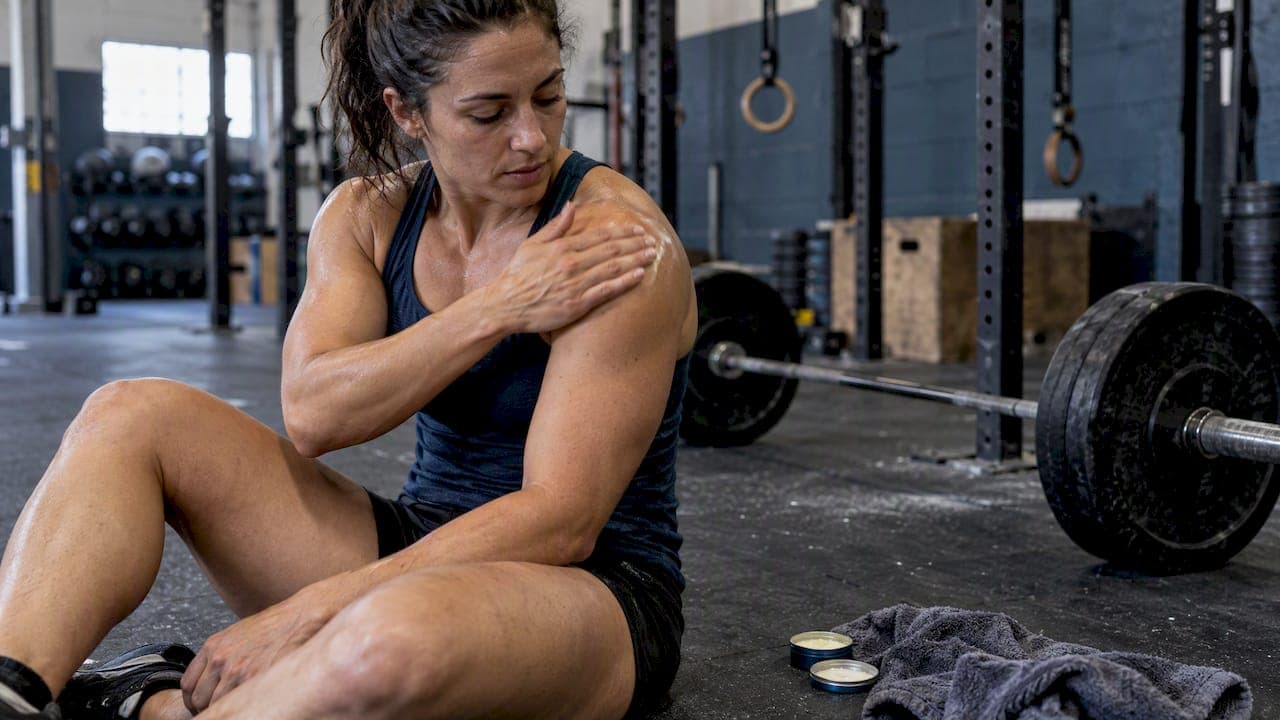
CBD has not been shown to speed up muscle recovery after hard training. Several controlled trials found topical CBD no better than placebo for soreness. A balm can still be a useful part of a recovery routine, mostly because of the massage, the cooling or warming sensation and the other botanicals in the formula. If you test in competition, there is a separate risk: product contamination. This guide covers both sides for CrossFit athletes, with sources.
TL;DR
- Trials of topical CBD for delayed onset muscle soreness (DOMS) have mostly found no difference from placebo.
- Oral CBD has some early data on muscle damage markers, but also real risks, including liver enzyme elevation and drug interactions.
- CBD is not banned by WADA, but other cannabinoids are, and labels do not reliably predict trace THC.
- Our balms combine 1,000mg of CBD per ounce with arnica, menthol and other botanicals. Treat them as a topical comfort product, not a performance tool.
- Sleep, food, load management and rest still do most of the recovery work.
Table of Contents
- What CrossFit recovery actually asks of you
- What the research says about CBD and muscle recovery
- Safety: liver, medications and labels
- Drug testing: what CrossFit competitors must know
- Where a topical balm fits in a CrossFit week
- Our perspective
- Choosing a balm for training
- Try Mongoose CBD balms
- FAQ
- Sources
What CrossFit recovery actually asks of you
CrossFit stacks heavy lifting, gymnastics and high-rep conditioning in one week. That produces three kinds of recovery cost:
- Muscle soreness. DOMS usually peaks 24 to 72 hours after unfamiliar or eccentric-heavy work such as high-rep squats, pull-ups or box jump step-downs.
- Joint and connective tissue irritation. Shoulders, elbows, wrists, knees and lower back take the repeated load.
- Central fatigue and sleep debt. Early classes, stress and hard sessions cut into sleep.
CBD is marketed against all three. The evidence differs for each, so it helps to take them one at a time.
What the research says about CBD and muscle recovery
Topical CBD
This is the category most CrossFit athletes actually buy, and the data is not encouraging.
A systematic review of CBD in athletic populations looked at the effect on post-exercise recovery, performance and psychophysiological responses. Its analysis of topical studies, using doses from 100mg to 1000mg, found no significant difference from placebo on recovery indicators.
Individual trials point the same way:
- A double-blinded, placebo-controlled pilot study published in 2024 concluded that topical CBD cream may not reduce muscle soreness or improve performance after exercise.
- A randomized crossover pilot of a topical CBD gel applied to the quadriceps and hamstrings for 72 hours after damaging exercise found no significant differences from placebo in plasma myoglobin or DOMS scores.
The researchers point to dose and skin absorption as possible reasons. Whatever the cause, a topical product has not been shown to change the biology of recovery in deep muscle.
Oral CBD
Oral products get more attention in the lab, but results are mixed. One trial found that acute CBD supplementation did not reduce inflammation or improve performance after strenuous exercise. The review above notes that some oral formats may lower certain muscle damage markers, such as creatine kinase, in specific protocols. That is a lab marker, not proof you will lift better on Thursday.
Oral use also carries the safety issues covered below.
What this means in plain terms
The honest summary: no good evidence that CBD makes you recover faster. The perceived relief from a balm often comes from other things, such as menthol's cooling effect, the rubbing itself and the ritual of caring for a sore spot. That is not nothing. Comfort helps people train consistently. But you should know what you are paying for.
Safety: liver, medications and labels
Natural does not mean harmless. The CDC states that using CBD products is not risk free and that scientists are still learning how CBD affects the body.
The FDA has been specific. Only one CBD drug, Epidiolex, is approved, for certain seizure disorders. In an FDA randomized trial of CBD safety in healthy adults, some participants showed liver enzyme (ALT) elevations above three times the upper limit of normal, and liver injury can occur without symptoms. The agency also warns that over-the-counter products may be mislabeled or contaminated.

If you take prescription medication, talk to your physician or pharmacist before using oral CBD. A comprehensive review of CBD interactions notes that many predicted interactions come from lab and animal evidence and have not been confirmed clinically. That is a reason for a conversation with a clinician, not a reason to assume it is fine.
Topical use is a different exposure from swallowing a high daily dose. Even so, if you have liver disease, are pregnant or nursing, or take blood thinners or other medication, ask your doctor before you use any CBD product.
Drug testing: what CrossFit competitors must know
If you compete in sanctioned events with drug testing, or might in the future, read this section before you buy anything.
The World Anti-Doping Agency exempts CBD from its Prohibited List, but all other natural and synthetic cannabinoids remain prohibited, and so do products containing them. The USADA marijuana FAQ explains that this applies in-competition, and that THC is the compound that most often causes a positive result.
The problem is trace content. USADA's page on hemp products and anti-doping tests discusses a study of cannabinoid content in hemp products, and the risk that a product contains more than its label says. Full-spectrum and broad-spectrum products are the greater concern, because they are made from whole plant extracts. A "THC-free" label is a claim from the seller, not a guarantee.
Practical rules:
- Ask the seller for a current certificate of analysis tied to the specific batch.
- Treat any claim of "zero THC" as something to verify, not accept.
- If you are tested under a federation program, check the rules and your obligations with the governing body before use. Tested athletes bear the responsibility for what goes on and in their bodies.
- When the risk to your eligibility outweighs the benefit, skip it.
We cover the same ground in more detail in Is CBD Athlete Safe? What Every Competitor Must Know.
Where a topical balm fits in a CrossFit week
Given the evidence, we suggest a modest framing. A balm is a comfort and massage aid. It is not a substitute for the basics.
The recovery basics come first
- Sleep: the single biggest lever for recovery.
- Protein and total calories: enough to repair tissue and support training.
- Load management: deload weeks, scaling and avoiding back-to-back sessions that hit the same pattern.
- Easy movement: walking, cycling or mobility on rest days.
What a balm can add
A balm gives you a reason to spend two minutes on a tight spot. Menthol and similar ingredients create a cooling sensation. Arnica, ginger and cayenne are traditional ingredients in topical rubs. Many athletes simply like the feel after a hard session, and that is a fair reason to use one.
A simple routine:
- Shower after training, then dry the area.
- Apply a thin layer to the sore muscle, such as quads after squats or forearms after high-rep grip work.
- Massage for one to two minutes, working along the muscle rather than across it.
- Wash your hands before touching your face, because menthol and cayenne sting eyes.
- Repeat later in the day if you like the effect. Stop if skin gets irritated.
Do not apply to broken skin. A sharp, localized or worsening pain, swelling or a joint that will not bear weight needs a clinician, not a balm.
For related situations, see our pages on CBD for DOMS, topical CBD for weightlifters and CBD for muscle knots. For a broader view, read CBD for Muscle Recovery: What the Evidence Shows.
Our perspective
We make topical balms, so you might expect us to claim CBD fixes soreness. We would rather tell you what we can stand behind.
Our balms are built for people who train hard and hurt. Each uses 1,000mg of CBD per ounce, alongside arnica, menthol, turmeric, eucalyptus, peppermint, cinnamon, clove, ginger and cayenne pepper, depending on the formula. They are vegan, non-GMO, paraben-free, cruelty-free and THC-free, and they go through third-party testing.

We also know the trial record on topical CBD is thin and mostly negative on DOMS. So we position the balm as a practical product: a formula that feels good, that you can use after a workout, and that you can return within 30 days for a full refund if it does not work for you. That refund policy is how we handle the gap between what people report and what a pilot trial can measure.
If you are a tested athlete, ask us for batch documentation before you buy, and weigh the decision against your own program's rules. If you are a recreational CrossFitter dealing with sore quads and stiff shoulders, a balm is a low-effort thing to try.
— Cindy
Choosing a balm for training
Whatever brand you pick, check these points:
| What to check | Why it matters |
|---|---|
| Batch-specific lab report | Confirms CBD content and screens for contaminants and THC |
| Full ingredient list | Menthol, arnica or cayenne may be doing the work you notice, and some people react to them |
| CBD amount per ounce | Lets you compare products on equal terms |
| Return policy | Trial results are individual, so a refund window matters |
| Texture and scent | You will use it more if you like it |
If you want a ready comparison of a CBD balm against heat-and-cool rubs, our story on alternatives to Icy Hot for muscle soreness and arthritis lays it out.
Try Mongoose CBD balms
The Seriously Soothing Pain Balm and RIKKI TIKKI Recovery are priced from $26.95 to $39.95 depending on size. Seriously Soothing comes in several scents, including original and cinnamon and clove. The RIKKI TIKKI Recovery 2 oz tin is the formula made for post-training muscles. Every order is covered by a full refund within 30 days of purchase. You can see the full range on the Mongoose CBD Co. homepage.
FAQ
Does CBD help CrossFit recovery?
There is no solid evidence that it speeds recovery. Topical CBD trials have mostly shown no difference from placebo for soreness, and oral data is mixed. Some people still like how a balm feels after training.
Will CBD make me fail a drug test?
CBD itself is not on the WADA Prohibited List, but other cannabinoids are, and products can contain trace amounts not shown on the label. Tested athletes should ask for batch lab reports and check their governing body's rules first. Choosing no CBD at all is the safest option for a tested athlete.
Is CBD harder on the liver than alcohol?
The research does not support a simple comparison. What the FDA has reported is that CBD can raise liver enzymes in some healthy adults, sometimes without symptoms. If you take CBD orally in regular doses, ask your doctor about liver monitoring, especially if you drink or take other medication.
What should you not mix CBD with?
Talk to a pharmacist or physician before combining oral CBD with prescription drugs, alcohol or sedatives. A review of CBD interactions identifies many potential interactions, though most are not yet confirmed in clinical settings. A topical balm is a lower-exposure format, but the same conversation applies if you have a medical condition.
Sources
- Assessing the Efficacy of Cannabidiol (CBD) in Athletic Populations
- Topical Cannabidiol Application May Not Attenuate Muscle Soreness or Improve Performance
- Topical application of cannabidiol for muscle recovery after exercise-induced muscle damage
- Acute Supplementation with Cannabidiol Does Not Attenuate Inflammation or Improve Measures of Performance following Strenuous Exercise
- About CBD, CDC
- CDER Investigators Address the Safety of CBD in a Randomized Trial, FDA
- Cannabidiol Interactions with Medications, Illicit Substances, and Alcohol: a Comprehensive Review
- The Prohibited List, World Anti-Doping Agency
- Marijuana FAQ, U.S. Anti-Doping Agency
- Can Hemp Products Cause a Positive Anti-Doping Test?, USADA