
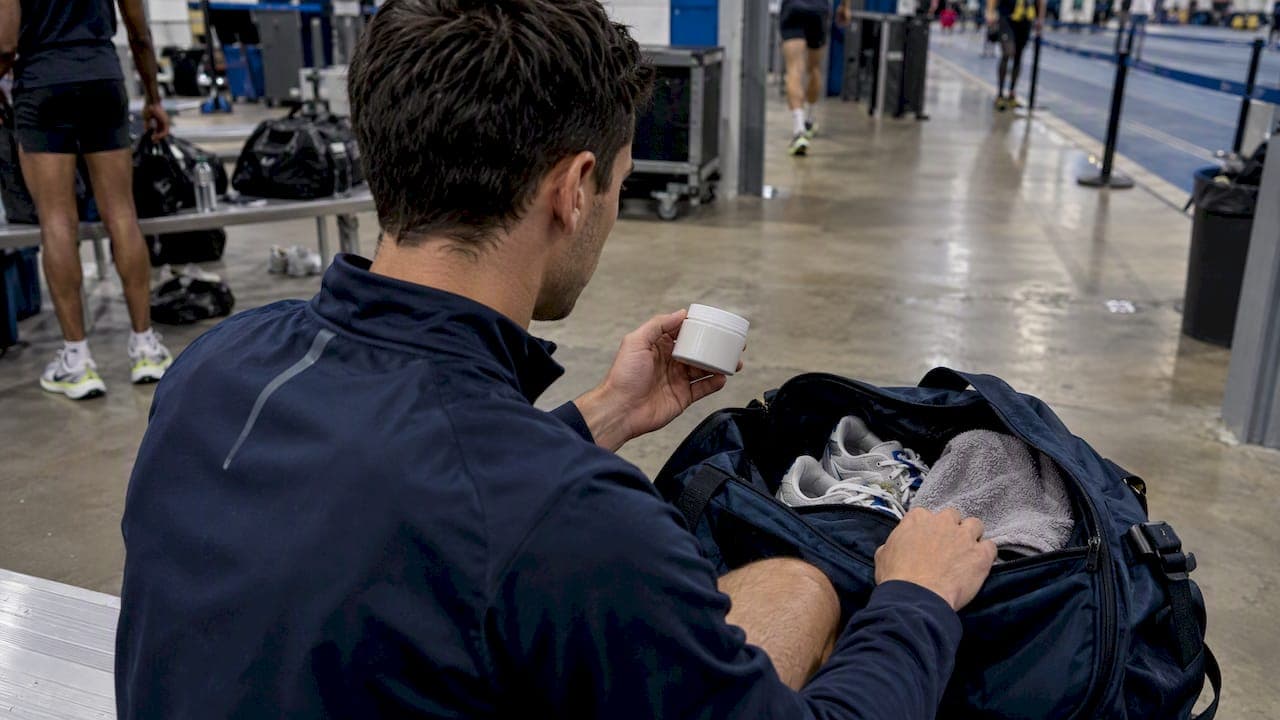
WADA does not ban cannabidiol (CBD). It does ban every other natural and synthetic cannabinoid in competition, THC included. So the rule is simple, and the risk is in the product: a CBD balm, oil or gummy that carries even trace THC can still lead to an anti-doping violation. This guide covers what the 2026 Prohibited List says, how the THC threshold works, and what athletes can do to lower the risk.
TL;DR
- Pure CBD is permitted under the WADA 2026 Prohibited List. All other cannabinoids are prohibited in competition.
- Urine THC is only reported above 150 ng/mL. Other prohibited cannabinoids have no threshold.
- Strict liability applies: you answer for whatever is in your sample, however it got there.
- Third-party certification lowers risk but does not remove it. Check the exact lot number.
- Athletes who cannot accept any risk should avoid CBD products entirely, as USADA advises.
Table of Contents
- What WADA actually says about CBD
- The 150 ng/mL THC threshold
- Why a permitted ingredient can still cause a positive test
- What third-party certification does and does not do
- A practical checklist before you use any CBD product
- Topicals, balms and drug tests
- Our view on CBD and anti-doping
- If WADA rules do not apply to you
- How the rules affect specific athletes
- Where the rules can change
- FAQ
- Sources
What WADA actually says about CBD
WADA publishes the Prohibited List each year. The 2026 List took effect on 1 January 2026. In the cannabinoids class, pure CBD is the one exemption. Every other natural cannabinoid and every synthetic cannabinoid that mimics THC is on the list. This is the same position USADA explains for U.S. athletes: CBD is allowed, other cannabinoids are not.
CBD was removed from the list in 2018. Before that, it was treated as a prohibited cannabinoid. Many older articles still describe the earlier rule.
Three details trip people up:
- Cannabinoids are prohibited in competition only. They are in the in-competition section of the List, not banned at all times. What counts as "in competition" is set by the rules of each sport, so check yours.
- "Cannabinoid" is broad. It covers THC, but also compounds such as CBN, CBG, THCV and delta-8 THC. Per a 2026 regulatory summary, delta-9 THC is the only one with a urinary threshold.
- The List says nothing about your specific product. It describes substances, not brands. A permitted ingredient can sit in a product that also holds a prohibited one.
The 150 ng/mL THC threshold
For THC, WADA uses a reporting threshold in urine. In competition, THC below 150 ng/mL is not treated as a positive result by a WADA-accredited laboratory. Every other prohibited cannabinoid has no threshold. Any detectable amount is a violation.
That threshold is not a safe dose. It is a laboratory reporting level. You cannot work backward from a product label to a urine number, because the result depends on your body and your history.
| Substance | Status under the 2026 List | Threshold |
|---|---|---|
| Pure CBD | Permitted | Not applicable |
| THC | Prohibited in competition | 150 ng/mL in urine |
| Other natural cannabinoids (CBN, CBG, THCV and others) | Prohibited in competition | None |
| Synthetic cannabinoids that mimic THC | Prohibited in competition | None |
Why a permitted ingredient can still cause a positive test
Strict liability
Under WADA and USADA rules, you are responsible for any prohibited substance in your sample. Intent does not matter, and "it was in my CBD product" is not a defense. USADA's own guidance says that because CBD extracts can be contaminated with other cannabinoids during production, athletes face a real risk of a violation when they use them.
Labels are unreliable
The CBD market is thinly regulated. An FDA-presented survey of 25 commercial CBD products found big gaps between label and contents. Some had no CBD at all. Others had enough THC to possibly cause impairment. A product that says "THC-free" or "pure CBD" has made a claim, not proven one.
Quality control varies by seller and by country. Some retailers, such as this German shop selling lab-tested cannabinoid products, publish testing and quality claims for their ranges. A claim of this kind still needs to be backed by a lab report for the batch you hold.
Washout is unpredictable
Athletes often ask how many days to stop before a competition. USADA's answer is that there is no reliable number. Metabolism, body fat and how often you have used all change how long cannabinoids stay detectable, so nobody can guarantee clearance before an in-competition test.
What third-party certification does and does not do
Certification programs test supplements for banned substances. They help, and they are the best filter an athlete has. But USADA is direct about the limits. Its Clean Sport Handbook says certification reduces contamination risk but does not make it zero. The only way to remove the risk of a positive test from a CBD product is not to use it.
USADA also warns that certification logos are being misused. A logo on a label does not mean the batch in your hand was tested. Look up the product and the lot number in the certifier's own database.
The same handbook cautions against treating ingredient lookup tools as a safety check. A tool like GlobalDRO tells you the anti-doping status of an ingredient. It does not tell you whether a specific product is free of undeclared substances.
A practical checklist before you use any CBD product
Use this if you compete under WADA or USADA rules and are still considering CBD.
- Confirm your sport's rules. Check whether you are tested, and when in-competition begins for your event.
- Ask your governing body or USADA first. If you are in a testing pool, talk to them before you buy.
- Look for a batch-specific lab report. It should show cannabinoid content, including THC and other cannabinoids, for the lot you bought.
- Verify certification yourself. Search the certifier's database by product and lot number.
- Do not trust the label alone. "THC-free" is a claim until a batch report backs it up.
- Stop and decide early. If a positive test would cost you a season, a scholarship or a contract, the risk-free option is to skip CBD.
- Keep records. Save receipts, lot numbers and reports.
We cover the same points from the product side in Is CBD Athlete Safe? What Every Competitor Must Know.
Topicals, balms and drug tests
Topical products are a common question. A balm sits on the skin rather than being swallowed, so many athletes assume it is safer. The rule for the List is the same, though. What matters is the cannabinoid content of the product and whether a prohibited cannabinoid is in it at all. We do not claim that any topical is risk-free for tested athletes, and no seller can honestly do so.
If you are weighing the risk for a job rather than a sport, our article on CBD cream and drug tests for safety-sensitive workers covers that case. Our piece on CBD sports massage for athletes covers drug test safety in a trial setting.
The tests used by employers and transport regulators differ from WADA's. In the U.S., employer drug policy depends on state law and the workplace. Do not assume a WADA answer applies to a job test, or the reverse.
Our view on CBD and anti-doping
We make topical balms for muscle soreness, joint pain and recovery. Our Seriously Soothing Pain Balm and RIKKI TIKKI Recovery use 1,000mg of CBD per ounce with botanicals such as arnica, menthol, turmeric, eucalyptus, peppermint, cinnamon, clove, ginger and cayenne pepper. The balms are vegan, non-GMO, paraben-free, THC-free and cruelty-free, and we say our products go through rigorous third-party testing.

We also think it is wrong to oversell. The WADA rule is clear, and the rule on certification is just as clear: reduced risk is not zero risk. If you compete in a tested sport, the honest advice is to read the rules, ask your anti-doping contact, and decide with the whole risk in view. If you do not compete under WADA rules, such as recreational runners, lifters and people with chronic or arthritis pain, a THC-free topical is a reasonable thing to try. That is why we back it with a 30-day full refund.
What we want an athlete to leave with is the ability to ask the right questions of any brand, including us: what is in this batch, who tested it, and can I see the report?
— Cindy
If WADA rules do not apply to you
Most people who buy a CBD balm are not subject to anti-doping rules. They have sore quads after a long run, stiff hands, a nagging shoulder or arthritis. For them, the practical question is whether a balm helps and whether the purchase is low risk.
Our balms are priced from $26.95 to $39.95, depending on the product and size, and come with a full refund within 30 days of purchase. You can see the full range, including the Original, Cinnamon & Clove, Lavender Lemongrass and Eucalyptus Mint scents, on the Mongoose CBD Co. homepage. If you want to compare it with a familiar over-the-counter rub first, read our guide to Icy Hot alternatives for muscle soreness and arthritis.
If you are a tested athlete, read the rest of this guide first and talk to your anti-doping contact before you order.

How the rules affect specific athletes
Tested professional or national-level athletes
You are most likely in a testing pool. Strict liability applies in full. Any cannabinoid other than CBD found in a sample in competition is a problem, and the only zero-risk path is no CBD products. If you still choose to use one, the checklist above is the minimum, not the maximum.
College and amateur athletes
Many college and amateur bodies follow their own lists, which may differ from WADA's. Some also test year-round. Ask your athletic department or governing body for their current list in writing.
Runners, lifters and weekend competitors
If you enter events with anti-doping controls, such as certain races or lifting meets, the same rules can apply to you. Check the event rules. Our articles on IT band pain for runners and topical CBD for weightlifters look at trial periods and drug test safety for those groups.
Travelers
Planning to fly with a balm to a competition? We wrote a short guide on how to travel with CBD cream through TSA. Rules abroad differ, so check the destination country too.
Where the rules can change
WADA reviews the Prohibited List every year after consultation, and each new version takes effect on 1 January. The 2026 List PDF was published in September 2025. Always read the version in force on the day you compete, not a summary written years ago. The cannabinoid status of CBD has been stable since 2018, but a stable rule is not a guarantee of future ones.
FAQ
Is CBD banned by WADA?
No. Pure CBD is permitted under the 2026 Prohibited List. All other natural and synthetic cannabinoids, including THC, are prohibited in competition. The practical risk is that a CBD product may contain THC or another cannabinoid.
What is the WADA THC limit?
For THC in urine, the in-competition reporting threshold is 150 ng/mL. A lab does not report a positive below that level. Other prohibited cannabinoids have no threshold, so any detectable amount counts.
Can a THC-free CBD balm still cause a positive test?
It can, if the label is wrong or the batch is contaminated. Studies have found products with undeclared THC despite their claims. Third-party certification lowers the risk but does not eliminate it, so check the lot number and ask for the batch report.
How long before a competition should I stop using CBD?
There is no reliable answer. USADA notes that washout time depends on metabolism, body fat and how often you have used a product. If you are tested, ask USADA or your governing body before you use CBD at all.
Do WADA rules apply to non-competitive users?
No. They apply to athletes under anti-doping jurisdiction. If you do not compete in a tested event, other rules may still matter, such as an employer's drug policy.
Sources
- WADA: The Prohibited List
- WADA: Prohibited List resource page, 2026 edition
- WADA: 2026 Prohibited List (PDF)
- USADA: 6 Things to Know About Cannabidiol
- USADA: 2026 Clean Sport Handbook
- USADA: Always verify third-party certified logos on supplements
- FDA presentation: CBD content vs. label claim
- GlobalDRO: U.S. search
- NIOSH/CDC: Marijuana and driving
- Cannabis regulations summary: WADA THC threshold 2026