
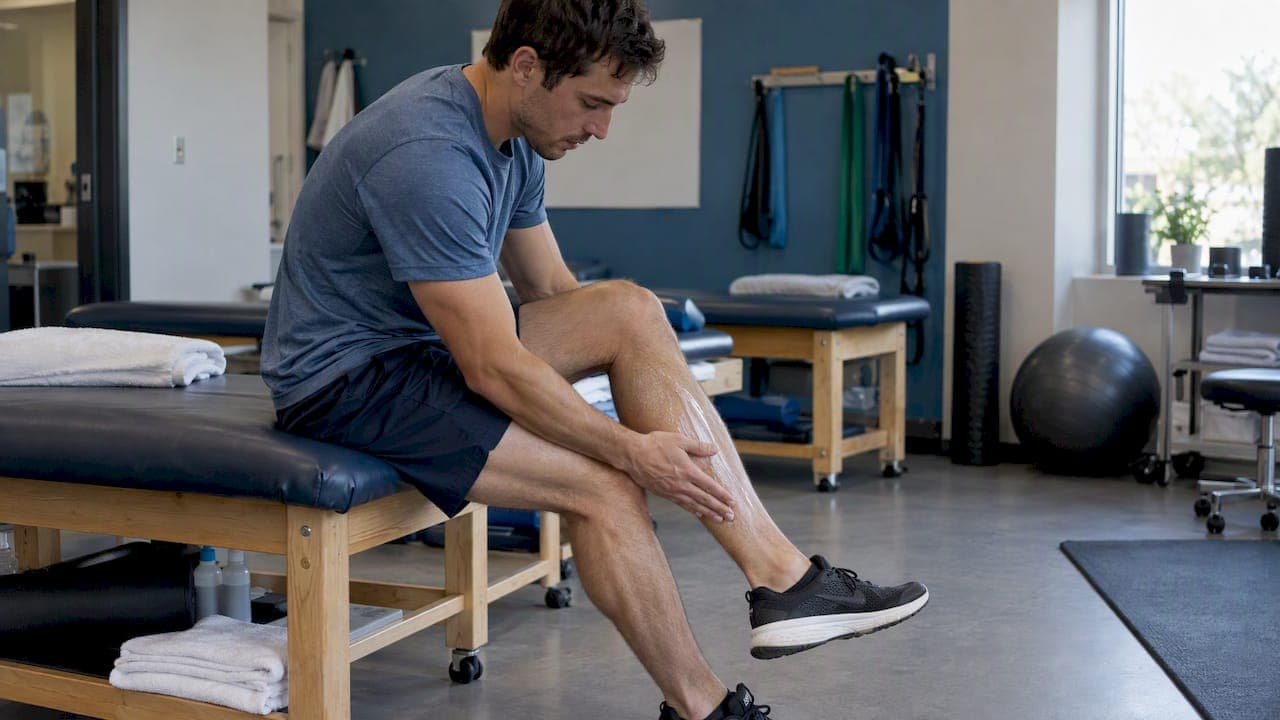
CBD can offer modest symptom relief for some people with a calf strain, and a topical balm is usually the more sensible first step for localized pain. Small trials show oral CBD may ease pain and speed recovery slightly, while topical results are mixed. Staged rehab still matters most, and anyone with severe or worsening symptoms should see a clinician before relying on CBD alone.
TL;DR:
- Small studies indicate that oral CBD may modestly reduce peak pain and slightly shorten recovery time, but effects are limited and vary between formulations.
- Topical CBD products show inconsistent results, with some measures of muscle function improving slightly, but no clear overall benefit.
- Using CBD as a supplement to staged rehabilitation is reasonable for comfort, but it should not replace objective measures and clinician guidance during recovery.
- Safety concerns include potential liver enzyme elevation with oral CBD and interactions with medications metabolized through the CYP450 pathway, requiring medical oversight.
- The best approach involves combining topical CBD for localized relief with a careful, progressive rehab plan guided by objective tests and clinician assessment.
Table of Contents
- How CBD Might Work for Muscle Pain and What the Research Shows
- Topical Versus Oral CBD for a Calf Strain: Pros, Cons, and Formulations
- How to Use CBD for a Calf Strain, From Acute Injury to Return to Load
- Safety, Interactions, and What Athletes Should Know
- Fitting CBD Into a Clinician-Led Calf Strain Rehab Plan
- A Realistic Take on CBD and Calf Strain Recovery
- Where Mongoose CBD Balms Fit This Approach
- FAQ
- Sources
How CBD Might Work for Muscle Pain and What the Research Shows
CBD interacts with the body's endocannabinoid system, a network involved in regulating pain signaling and inflammatory responses. The proposed mechanisms include local neuromodulation at sensory nerve endings, dampening of inflammatory signaling pathways, and reduced excitability of the nerves that transmit pain from damaged tissue. None of this amounts to a cure for torn muscle fibers. It describes a way CBD might turn down the volume on discomfort while the tissue itself heals through the same biological timeline it always has.
The clinical picture backs a cautious version of that story. A randomized, placebo-controlled feasibility trial testing sublingual CBD at 67 milligrams per day found it reduced peak pain at rest and with movement 48 hours after exercise-induced muscle injury, and suggested symptomatic recovery arrived roughly half a day sooner than with placebo. The trial reported average recovery times of 4.4 days for the CBD group versus 4.8 days for placebo, a small but measurable difference in a small study.

Topical results tell a less consistent story. A randomized, double-blinded pilot study of topical CBD gel (1% concentration, 2 grams applied) after exercise-induced muscle damage found no consistent benefit for concentric muscle function or delayed-onset muscle soreness, though it did find moderate effect sizes favoring CBD for isometric torque at 24 to 72 hours in some measures. That is a mixed result: real signal on one functional measure, nothing on others.
Small randomized trials suggest oral CBD can modestly reduce peak pain and slightly shorten recovery after muscle injury, according to the feasibility trial published in the Journal of Cannabis Research, though topical formulations have not shown the same consistency.
A few limitations run through this research and deserve a plain read:
- Sample sizes in both trials were small, so the effect sizes carry wide uncertainty.
- Doses and formulations varied between studies, making head-to-head comparisons difficult.
- Outcome measures differed (peak pain, concentric torque, isometric torque, DOMS scores), so "CBD works" or "CBD doesn't work" oversimplifies results that depend heavily on what was measured.
None of this rules CBD out as a reasonable adjunct. It just means the evidence supports modest expectations rather than dramatic ones, and that more rigorous trials with standardized formulations and larger cohorts would sharpen the picture considerably.
Topical Versus Oral CBD for a Calf Strain: Pros, Cons, and Formulations
For a calf strain specifically, the choice between topical and oral CBD comes down to where the pain lives and how much systemic exposure you are willing to accept.
Topical application puts CBD directly at the site of discomfort. Absorption stays largely local, so systemic exposure is lower than with oral use, which matters for anyone concerned about liver enzyme effects or drug interactions. Products typically list CBD concentration per ounce or per container rather than per dose, so reading the label for total milligrams and applying consistently matters more than chasing a specific percentage. Topical formulations also range widely in vehicle, from gels to ointments to balms, and in excipients, with some including penetration enhancers that increase local uptake but can also raise systemic absorption slightly.
Oral CBD reaches the whole body through the bloodstream, which is why the feasibility trial's sublingual dose of 67 milligrams per day produced a measurable systemic effect on pain at 48 hours. Other trials in the broader CBD literature have tested daily doses in the 75 to 150 milligram range. Oral use demands more safety attention: it is the route tied to the liver enzyme findings discussed in the FDA's safety research, and it requires more deliberate monitoring than rubbing a balm onto a sore calf.
A short formulation checklist helps before buying either type; for more details on selecting quality CBD products, see our practical guide on choosing CBD products.
- Look for a current third-party lab report or certificate of analysis matching the specific batch, not just a generic claim of testing.
- Confirm THC content is at or near zero if drug testing or legal clarity matters to you.
- Understand the difference between full-spectrum (contains other cannabinoids and trace THC), broad-spectrum (other cannabinoids, no THC), and isolate (CBD only) before choosing a product.
- Check whether the formulation includes transdermal enhancers, which can improve local relief but also slightly increase absorption into the bloodstream.
Our guide to CBD for muscle knots walks through topical application technique in more detail, and the research on CBD for muscle recovery covers how absorption differs across formulations.
Pro Tip: Apply topical CBD to clean, dry skin and wait a few minutes before covering the area with clothing or a compression sleeve, so the product has a chance to absorb rather than transfer.

How to Use CBD for a Calf Strain, From Acute Injury to Return to Load
The first 24 to 72 hours after a calf strain call for standard acute-injury management: rest, ice, compression, and elevation. Massage and heat should wait for clinician guidance, since aggressive early manipulation can worsen bleeding within the muscle. CBD fits into this window as a topical adjunct for comfort, not as a substitute for protecting the tissue.
A practical approach looks like this:
- Days 1 to 3: Apply a topical CBD balm two to three times daily to the affected area, avoiding broken skin, alongside R.I.C.E. and any clinician-directed activity restrictions.
- Days 4 to 7: Continue topical application as swelling subsides, and begin light, pain-guided range-of-motion work if a clinician has cleared it.
- Week 2 onward: Introduce progressive loading (isometric holds, then controlled calf raises) and keep using topical CBD as needed for soreness after sessions, watching for skin irritation and discontinuing if redness or a rash develops.
- Before increasing load again: Check objective markers rather than relying on pain alone: can you perform a single-leg calf raise comparable to the uninjured side, and does a hop test feel stable and pain-free?
If considering oral CBD at any point, start at the lower end of trial-tested ranges, monitor for drowsiness or digestive upset, and discuss liver enzyme monitoring with a prescriber if using it for more than a few weeks or alongside other medications.
| Phase | Primary action | CBD role |
|---|---|---|
| Acute (days 1 to 3) | R.I.C.E., avoid heat or deep massage | Topical balm for localized comfort |
| Early rehab (days 4 to 7) | Light ROM work if cleared | Continued topical use as needed |
| Progressive loading (week 2+) | Isometric and calf-raise progressions | Topical use post-session; oral only with clinician input |
| Return to load | Single-leg calf raise and hop testing | Reassess need for continued use |
Safety, Interactions, and What Athletes Should Know
The most important safety signal comes from the FDA's own regulatory-science review of a randomized oral CBD trial: among participants taking a daily oral CBD solution at doses representative of consumer use, about 5.6% developed ALT elevations greater than three times the upper limit of normal within four weeks, compared with none in the placebo group. That is a liver enzyme signal in a measurable minority of healthy adults, not a rare fluke, and it is the clearest reason oral CBD deserves more caution than topical use.
A few other safety points matter for a calf strain specifically:
- CBD is metabolized through liver enzymes in the CYP450 family, which means it can interact with medications that share that pathway, including blood thinners like warfarin. Anyone on prescription medication should check with a prescriber before starting oral CBD.
- Athletes subject to drug testing should stick to THC-free, third-party-tested products, since WADA prohibits THC and several other cannabinoids even though CBD itself is not banned.
- Pregnant or breastfeeding individuals should avoid CBD. Animal studies on a major CBD metabolite found embryofetal malformations at high oral doses in pregnant rats, and human safety data remain insufficient to rule out risk.
Because the consumer CBD market is not standardized, product composition and contamination risk vary considerably from brand to brand, which is exactly why a current batch-specific lab report matters more than marketing language on a label.
Fitting CBD Into a Clinician-Led Calf Strain Rehab Plan
Calf strains carry a real recurrence risk, and the clinical literature is consistent on the fix: staged rehabilitation with objective monitoring beats pain-guided progression. A narrative review of calf strain management in athletes found that reinjury risk peaks within the first two months after the initial injury, often because return-to-play decisions were made too early based on how the leg felt rather than on what it could actually do.
That matters directly for CBD use, because CBD's main appeal is symptom relief, and symptom relief can mask the very signals clinicians rely on to pace loading. Expert sports clinicians interviewed about calf strain management describe a checklist approach instead of a pain-only approach:
- Palpation tenderness at the injury site, checked at each rehab milestone rather than assumed to be resolved once pain fades.
- Single-leg calf raise capacity compared directly against the uninjured leg, not just "does it hurt."
- Range of motion at the ankle and knee, since restricted motion often persists after pain has settled.
These "asterisk signs" give a more reliable read on healing than subjective comfort alone. If CBD is part of a recovery routine, the practical rule is simple: use it for comfort, but advance loading based on the checklist, not on how good the leg feels that day.
Pro Tip: Keep a simple log of palpation tenderness and calf raise reps each week. If comfort improves faster than those numbers do, hold the current loading stage rather than progressing.
A Realistic Take on CBD and Calf Strain Recovery
The honest reading of the evidence is that CBD is a modest comfort tool, not a recovery shortcut. The oral trial data showing a half-day faster recovery is encouraging but small, and topical trials have shown real effects on some measures and nothing on others. Readers who expect a balm to heal a torn muscle fiber faster than biology allows will be disappointed. Readers who expect it to take the edge off soreness while they follow a sensible rehab plan have a reasonable shot at that outcome.
We favor topical balms over oral products for most calf strain cases because the pain is localized and the systemic risk profile is lower. Formulation quality varies enormously across brands, which is why checking for third-party lab reports and clear THC content matters more than any single ingredient claim. A 30-day refund window on a product is also a meaningful signal: it tells you a company is willing to stand behind results rather than just the sale. For anything beyond mild strain symptoms, or symptoms that worsen over a few days, seeing a clinician still comes first.
— Cindy
Where Mongoose CBD Balms Fit This Approach
We formulate topical balms designed for localized muscle pain similar to that caused by a calf strain. The Seriously Soothing Pain Balm combines CBD with arnica, menthol, and other traditional pain-relief botanicals for fast, localized comfort, and it is a reasonable starting point for the acute and early rehab phases described above. RIKKI TIKKI Recovery is built with an athlete's recovery routine in mind, suited to the progressive loading phase when soreness after a session is the main concern rather than acute swelling.
Both lines are THC-free, third-party tested, and made without animal ingredients, paraben, or genetically modified components, which may be important if drug testing or ingredient sensitivity is a concern. We offer a refund window, so trying a balm alongside a staged rehab plan carries little financial risk.
- Start with the Seriously Soothing Pain Balm during the acute and early rehab phases.
- Move to RIKKI TIKKI Recovery as loading progresses and post-session soreness becomes the main issue.
- Unsure where to begin? A free sample of our pain balm lets you test the formulation before committing to a full container.
Browse the full line at Mongoose CBD and pair any balm with the staged rehab steps above for the most sensible path back to full activity.
This article is general information, not a substitute for advice from a qualified doctor. Consult a qualified healthcare professional about your own circumstances before acting on anything here.
FAQ
Is CBD good for a pulled muscle?
CBD may offer modest pain relief for a pulled muscle, with small trials showing reduced peak pain and slightly faster recovery with oral use, though effects are not dramatic. It works best as a comfort adjunct alongside rest, protection, and staged rehab rather than as a treatment on its own.
Can CBD help relieve muscle pain?
CBD can help some people manage muscle pain through its interaction with pain-signaling pathways, though the effect size in trials has been modest. Topical application targets localized pain directly, while oral use affects the whole body and carries more safety considerations.
Is CBD or ibuprofen better for inflammation?
Ibuprofen has decades of clinical use and well-established anti-inflammatory dosing, while CBD's anti-inflammatory evidence for muscle injury comes from small, early-stage trials with mixed results. Neither should replace clinician guidance for significant inflammation, and anyone combining the two should check for interaction risk with a prescriber.
Will CBD help with muscle recovery?
Small randomized trials suggest oral CBD may modestly speed symptomatic recovery after muscle injury, with one trial reporting about half a day faster recovery than placebo. Topical CBD results are more mixed, helping some functional measures in pilot studies but not others.