
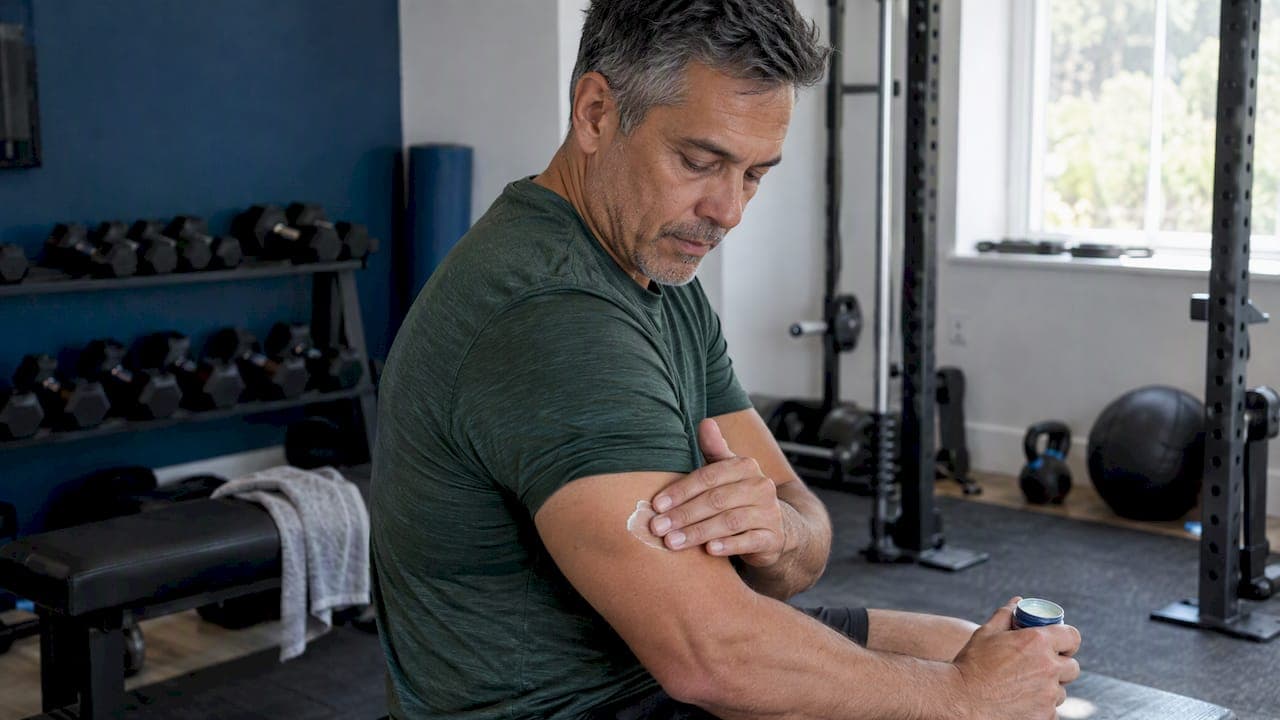
There is no established, proven dose for topical CBD. What you can do is work out how many milligrams a balm gives you per application, start with a small amount, and adjust over a set trial period. A pea-sized to dime-sized dab, applied once or twice a day, is the usual place to begin. The sections below show how to read the label, do the math, and know when to stop.
TL;DR
- No dose for topical CBD has been established. Researchers advise starting low and going slow.
- Balm strength is usually printed as total milligrams in the tin. Divide by the tin's weight to estimate milligrams per gram, then per dab.
- Start with a small dab on the sore area once or twice a day, and change only one thing at a time.
- Set a trial of two to six weeks. If nothing changes, stop rather than keep paying for it.
- Talk to a doctor or pharmacist first if you take blood thinners or anti-seizure medication.
Table of Contents
- Why topical CBD dosing is different from oral dosing
- What doses have actually been used in studies
- How to read balm strength
- Can you trust the label?
- How much to apply, and how to adjust
- Balm, salve or something else?
- Safety: skin reactions, medications and product claims
- What we think about topical dosing
- Try it with a 30-day refund
- FAQ
- Sources
Why topical CBD dosing is different from oral dosing
Most of what ranks for this topic is about oral CBD: capsules, oils and gummies, with ranges like 5 mg to 40 mg per serving. Those numbers do not transfer to a balm. An oral dose goes through digestion and the bloodstream. A balm sits on the skin over the area that hurts, and how much gets through depends on the formula, not just the milligrams.
The research reflects that. A systematic review of transdermal and topical CBD found trials using a wide range of doses, from 50 to 250 mg or concentrations of 0.075% to 1.0%. Many of those products also contained other ingredients, so it is hard to say what the CBD itself contributed. The same review notes that the evidence is limited by mixed methods, high risk of bias and poor reporting of dose, efficacy and safety.
A review of CBD in rheumatic conditions says the same in plainer terms: dosing for symptom relief has not been established, and topical products have inconsistent effects because formulas and additives vary. Any site that gives you one exact milligram number for a balm is guessing. We would rather tell you how to find your own number.
If you want the bigger picture on oral versus skin application, our guide to topical CBD versus oral for pain covers it.
What doses have actually been used in studies
The numbers below are real, but they come from small studies and none is a recommendation.
| Study | Product and dose | What was reported |
|---|---|---|
| 2023 open-label pilot, 20 former elite athletes with chronic lower-extremity pain | 10 mg topical CBD twice daily from a controlled dispenser | Tolerated well. Half of completers reported minor side effects, mostly skin dryness and rash. |
| Withdrawn trial protocol for musculoskeletal pain | 50 mg/mL, 1 mL applied twice daily | Never completed, so there are no results. |
| 2025 randomized, placebo-controlled pilot on exercise soreness | CBD cream after exercise | No significant effect on muscle recovery, soreness or performance. |
| 2024 study of five hemp-derived topicals, 46 healthy adults | Applied twice daily for 9 days | Absorption varied a lot by product. The top performer had the highest CBD concentration plus a permeation enhancer. |
Two things stand out. First, the one pilot in people with chronic pain used a modest, measured amount, about 10 mg per application, twice a day. Second, the exercise-soreness pilot found nothing. We sell balms for recovery, and we still think you should know that. Evidence for topical CBD is thin, which is why we favor short, structured trials over open-ended use.
How to read balm strength
Balm strength is almost always printed as total CBD in the container, such as 500 mg, 1,000 mg or 1,500 mg. Salves in this category commonly fall somewhere between about 250 and 1,500 mg per ounce. Our own balms are formulated at 1,000 mg of CBD per ounce, alongside botanicals such as arnica, menthol, turmeric, eucalyptus, peppermint, cinnamon, clove, ginger and cayenne.
That total number does not tell you what you are applying. Researchers at JAMA Network Open noted that labels usually state the total amount in the product, not the amount for each application, and that directions can be vague. So the label is where you start, and the arithmetic is yours to do.
The math, step by step
An ounce is about 28.35 grams. For a balm labeled 1,000 mg per ounce:
- Divide 1,000 mg by 28.35 g. That is roughly 35 mg of CBD per gram of balm.
- Estimate your dab. A pea-sized dab is often around a quarter to a half gram, though this depends on how dense the balm is. Weigh a dab on a kitchen scale once if you want to be exact.
- Multiply. A quarter gram is roughly 9 mg of CBD. Half a gram is roughly 18 mg.
Those are estimates, not guarantees. They line up with the roughly 10 mg per application used in the athlete pilot, which makes a small dab of a 1,000 mg per ounce balm a reasonable starting point to try, and not a prescription.
Strength comparison at a glance
| Label strength | Approx. CBD per gram | Approx. per quarter-gram dab | Approx. per half-gram dab |
|---|---|---|---|
| 500 mg per ounce | 17.6 mg | 4.4 mg | 8.8 mg |
| 1,000 mg per ounce | 35.3 mg | 8.8 mg | 17.6 mg |
| 1,500 mg per ounce | 52.9 mg | 13.2 mg | 26.5 mg |
This is our own arithmetic from the ounce-to-gram conversion. Apply it to the weight on your label, since tin sizes differ.
Can you trust the label?
Not automatically. In a 2022 analysis of 105 hemp-derived topical products, only 24% were accurately labeled. Some 58% contained more than 10% more CBD than advertised, and 18% contained less. The researchers also noted that clinical research showing efficacy was limited.

That is why a third-party lab report matters more than a big number on the front. A certificate of analysis tells you what was actually measured in a batch. If you have never read one, this walkthrough on reading CBD lab reports and certificates of analysis explains the cannabinoid panel, the contaminant tests and what to look for.
It also means a higher label strength is not proof of a better balm. The 2024 absorption study found that the product delivering the most CBD had both the highest concentration and an added permeation enhancer. Formula and delivery matter, and concentration is only one part.
How much to apply, and how to adjust
This is the part with the least formal research behind it, so treat it as practical guidance and not a clinical rule.
Start small
- Clean and dry the skin over the sore area. Do not apply to broken, irritated or sunburned skin.
- Take a pea-sized dab, enough to cover a small area with a thin layer.
- Massage it in for 30 to 60 seconds, until it mostly disappears.
- Wash your hands afterward, and keep it away from your eyes and mucous membranes.
- Repeat once or twice daily at first, and write down the time and how the area feels.
Adjust one variable at a time
After several days, change either the amount or the frequency, not both. A larger area, like a lower back or a thigh, needs more balm to cover it thinly, so scale the dab to the area. A small joint like a wrist or elbow needs less. Some people stay at a single daily application. Others go to two or three.
For limits, there is no CBD-specific rule. As a point of reference, one over-the-counter menthol and camphor balm lists use no more than three to four times daily for adults. Our balms also contain menthol, so that is a sensible ceiling to keep in mind. Read your own label and stay within its directions.
Run a trial with an end date
We suggest two to six weeks, tracking pain on a 0 to 10 scale before and after use. Rheumatology researchers say CBD should be discontinued if no benefit appears within a defined trial period, and that patients should not carry the cost of treatments with uncertain effect. If your scores are flat after the trial, stop. If you want a protocol for a specific area, we have written trial guides for shoulder arthritis, wrist pain, elbow pain, Achilles pain and weightlifting recovery.
Balm, salve or something else?
The format changes how much you end up using. Balms and salves are firmer and are applied sparingly, and creams and lotions spread more easily and are often used in larger amounts. If you are not sure which you need, our comparison of when to use a balm or a salve walks through it. The type of CBD also matters: isolate versus full spectrum changes what else is in the tin. Research on combinations of CBD and THC in topicals is, according to a 2024 review, still at a preliminary stage in humans.
Safety: skin reactions, medications and product claims
Topical CBD was well tolerated in the athlete pilot, but not free of effects. Half of the people who finished it reported minor problems, most often dry skin and rash. So test first: put a small amount on the inside of your forearm and wait a day before using it on a larger area. Stop if you get redness, itching or swelling.

If you take medications processed by similar enzyme systems, such as warfarin or valproate, the rheumatology review says to consult a physician about possible interactions. Ask your doctor or pharmacist before starting, and the same goes if you are pregnant, nursing or treating a child.
Also look at what a seller promises. The FDA says products intended for therapeutic use or to affect the body's structure or function fall under the Federal Food, Drug, and Cosmetic Act. It has sent warning letters, including one to a company marketing CBD with disease-treatment claims, saying the products were unapproved drugs and misbranded. A balm is not a treatment for arthritis or any disease. Pain that is sudden, severe, getting worse, or comes with swelling, numbness or fever needs a clinician, not a balm.
What we think about topical dosing
We make balms, so you might expect us to say more is better. We do not. We built our formulas at 1,000 mg of CBD per ounce and paired the CBD with arnica, menthol, turmeric, eucalyptus, peppermint and other botanicals, because athletes and people with chronic aches told us they wanted something that feels good going on and is easy to use consistently.
Our view is simple. Use the least amount that does the job, and give it a fixed window. Do the math on your label, favor a product with third-party testing, and keep notes. The balms are vegan, non-GMO, paraben-free, THC-free and cruelty-free, so there is little to second-guess in the ingredient list. And because the evidence is modest, we back every purchase with a full refund within 30 days. If it does not work for you, you should not be out the money.
— Cindy
Try it with a 30-day refund
If you want a balm to run your own trial with, our Seriously Soothing Pain Balm and RIKKI TIKKI Recovery are priced from $26.95 to $39.95. Seriously Soothing is the everyday option for sore joints and muscles, and RIKKI TIKKI is formulated for recovery after hard training. Both are 1,000 mg of CBD per ounce, and your purchase is covered by our full refund within 30 days.
Not sure whether you want a switch from a menthol rub? Our piece on Icy Hot alternatives for muscle soreness and arthritis compares what you might look for. For a deeper look at product quality, see why most topical CBD for pain fails.
FAQ
How much CBD should I use in a topical?
There is no established dose. A common starting point is a pea-sized dab once or twice a day, which for a 1,000 mg per ounce balm is roughly 9 to 18 mg of CBD by our math. Adjust slowly over two to six weeks and stop if you see no benefit.
What is a good CBD balm strength?
Balms commonly range from about 250 to 1,500 mg per ounce. Higher is not necessarily better, since labels are often inaccurate and formula affects absorption. Look for a lab report and a strength you can easily convert to milligrams per application.
How often can I apply CBD balm?
Follow the directions on your product. Many people use it once or twice daily. Some balms with menthol or camphor are directed for use no more than three to four times a day, so use that as an upper limit unless your label says otherwise.
How long does it take for topical CBD to work?
It varies, and some people notice nothing. Menthol and similar ingredients can feel cooling or warming right away, which is separate from any CBD effect. Give it a defined trial of two to six weeks and track your pain, then decide.
Can I use too much topical CBD?
More balm mostly means more waste and a higher chance of skin irritation, since the studied amounts were modest. If you notice rash, dryness or swelling, stop. If you take blood thinners or anti-seizure drugs, ask your doctor before you start.
Sources
- Systematic review on transdermal and topical cannabidiol (PubMed)
- Cannabidiol in rheumatic diseases (PMC)
- Topical cannabidiol in former elite athletes, pilot study (PubMed)
- Topical CBD for musculoskeletal pain, withdrawn protocol (ClinicalTrials.gov)
- Topical CBD and muscle recovery, 2025 pilot (PubMed)
- Pharmacokinetics of five hemp-derived topicals (Journal of Analytical Toxicology)
- Cannabinoid content and label accuracy of hemp-derived topicals (JAMA Network Open)
- Evidence of cannabidiol effectiveness (PMC)
- Dragon Pain Relieving Balm label (DailyMed)
- FDA regulation of cannabis and cannabis-derived products
- FDA warning letter, BioCBDPlus
- How to read CBD oil lab reports and certificates of analysis