
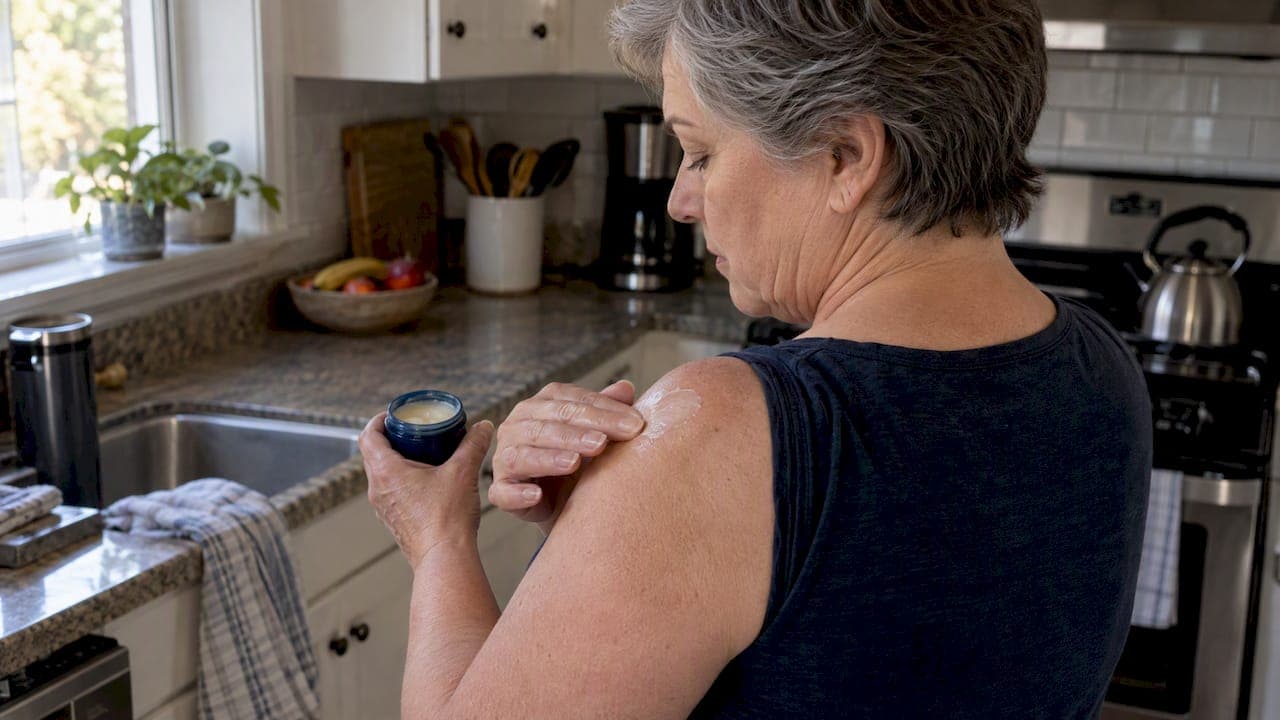
The evidence on CBD for shoulder arthritis is mixed, and no large trial has tested it on the shoulder specifically. A topical product applied directly to the joint carries lower risk than an oral or sublingual dose, which is why trying a topical first, alongside your regular care and your clinician's input, is the more reasonable starting point for most people.
TL;DR:
- High-dose oral CBD added to pain medication showed no pain relief and caused more side effects, including liver enzyme elevations, in knee osteoarthritis studies.
- Topical CBD has shown inconsistent results in small trials and carries a lower systemic risk, making it a preferable initial option for shoulder arthritis.
- CBD's proposed anti-inflammatory mechanism in humans remains unconfirmed, and there is virtually no shoulder-specific clinical evidence to support its use.
- Adverse events from oral CBD highlight the importance of consulting a clinician, especially regarding drug interactions and liver function monitoring.
- Choosing a reputable topical CBD product requires third-party lab testing, clear CBD content, and avoiding products making unsubstantiated healing claims.
Table of Contents
- Human clinical trials and reviews: what the best evidence shows (and doesn't)
- Topical vs oral CBD: how they work and what that means for shoulder arthritis
- Safety, adverse effects, and drug interactions to discuss with your clinician
- A step-by-step trial plan to try topical CBD safely for shoulder arthritis
- Choosing a quality topical CBD product: labels, lab reports, and ingredients that matter
- Where CBD fits: complementary care, and when to see a doctor or specialist
- Publisher perspective: our focus on topical pain relief and editorial transparency
- What the evidence actually tells us to do
- If you want to try a topical balm: our options and refund policy
- FAQ
- Sources
Human clinical trials and reviews: what the best evidence shows (and doesn't)
The strongest data we have on CBD and joint pain comes from a randomized, double-blind, placebo-controlled trial, and it is not encouraging for oral use. Researchers added 600 mg per day of oral CBD to paracetamol in adults with painful knee osteoarthritis and compared it to placebo over eight weeks. The CBD group did not report less pain than the placebo group, and they had more adverse events, including some liver enzyme elevations, according to the randomized controlled trial of oral CBD for knee osteoarthritis. That is a high-dose, oral formulation tested in the knee, not the shoulder, but it is the closest thing we have to a rigorous human test of CBD for joint arthritis pain, and the result argues against routine use of high-dose oral CBD for this purpose.
Observational research tells a different, murkier story. An exploratory cross-sectional study of people already using CBD for arthritis and joint pain found that many reported feeling better, but a survey of CBD users with arthritis cannot separate a real drug effect from placebo, expectation, or whatever else those people were doing for their pain at the same time. Self-reported improvement is real to the person reporting it, but it is not proof that CBD caused it.
Authoritative bodies arrive at the same cautious place. The Arthritis Foundation's guidance on CBD states that animal studies and a handful of small human studies hint at anti-inflammatory and pain-relieving properties, but that larger, high-quality human trials are lacking, and it recommends talking with your provider before trying CBD. The NIH's NCCIH overview of complementary approaches for arthritis echoes this: anecdotal use is widespread, but clinical evidence remains limited, which is part of why NIH has funded further research into how cannabinoids act on pain pathways.
A few things are worth separating out here:
- Preclinical promise is not the same as human proof. Animal and cell studies have suggested anti-inflammatory activity for cannabinoids, but those findings have not reliably translated into pain relief in controlled human trials.
- Shoulder-specific data barely exist. Almost every trial we have studies the knee or hand; the shoulder has not been tested on its own, so any extrapolation is an assumption, not a finding.
- Topical and oral routes are not interchangeable. The negative knee trial used an oral, high-dose formulation; small topical and transdermal trials have shown mixed results, some positive for hand osteoarthritis, some showing no effect.
- Adverse events were not trivial. The oral CBD group in the knee trial saw more side effects than placebo, not fewer.
Put together, the evidence does not support reaching for high-dose oral CBD as a go-to arthritis treatment. It also does not rule out a cautious, low-risk topical trial, since the small topical studies that exist show inconsistent but not alarming results, and the risk profile of a product applied to skin over a joint is different from swallowing a capsule.
Topical vs oral CBD: how they work and what that means for shoulder arthritis
CBD is thought to act on peripheral receptors and inflammatory pathways involved in pain signaling, though the exact mechanism in human joint tissue is not well mapped out. Researchers describe this as a proposed, not confirmed, anti-inflammatory action, and we should be cautious about overstating what is still a working theory rather than an established mechanism.
Route of administration changes what actually reaches the joint and what reaches the rest of the body:
- Topical application aims to deliver CBD to the skin and underlying tissue near the shoulder, with uncertain and likely limited penetration past the surface layers, but minimal absorption into the bloodstream.
- Oral or sublingual CBD enters systemic circulation, meaning it travels through the liver and affects the whole body, not just the painful joint.
- Onset and duration differ by route. Topicals tend to act locally within minutes to an hour and wear off within a few hours, while oral doses take longer to kick in and linger longer in the system.
- Risk differs by route. Because topical use limits how much CBD enters the bloodstream, it carries a lower likelihood of the systemic issues seen in oral trials, including the liver enzyme changes noted in the knee study.
For a localized problem like shoulder arthritis, this distinction matters. A topical only needs to reach the joint capsule and surrounding tissue, not circulate through your liver and interact with other medications. That is the practical argument for trying a topical first: it narrows the question to "does this help my shoulder" without adding systemic exposure you did not need. Our related piece on why topical CBD is worth a trial before oral for osteoarthritis walks through this comparison in more depth.
Safety, adverse effects, and drug interactions to discuss with your clinician

Before trying any form of CBD, including a topical, it helps to know what has actually shown up in trials and regulatory reviews. The oral knee osteoarthritis trial reported more adverse events in the CBD group than placebo, including drowsiness, gastrointestinal upset, and liver enzyme elevations, according to the oral CBD osteoarthritis trial. The FDA's drug safety labeling review for cannabidiol similarly flags dose-related liver toxicity and interactions with drug-metabolizing enzymes as safety signals that warrant medical oversight, particularly for systemic use.
A few practical points to raise with your clinician before starting, in order of priority:
- Ask about CYP enzyme interactions. CBD is processed by liver enzymes shared with many common drugs, so it can raise or lower blood levels of medications including anticoagulants, certain antidepressants, and some antirheumatic drugs used for inflammatory arthritis.
- Ask whether baseline liver function tests make sense if you are considering oral or sublingual CBD, especially if you already take medications processed by the liver.
- Mention any current prescriptions by name, not just by category, since interaction risk depends on the specific drug, not just the drug class.
- Patch test a new topical on a small area of skin for 24 hours before applying it broadly to your shoulder, to check for irritation.
- Avoid applying any topical to broken or irritated skin, since that changes absorption and raises the risk of local irritation.
Pro Tip: Bring the actual product label or ingredient list to your next appointment rather than describing it from memory. Clinicians checking for interactions need the specific formulation, not a general category.
None of this is meant to frighten you away from a cautious trial. It is meant to make sure the trial is actually safe for your situation, which depends on what else you take and how your liver and kidneys are doing.
A step-by-step trial plan to try topical CBD safely for shoulder arthritis
If you and your clinician decide a trial makes sense, a structured approach beats an open-ended "just try it and see." Here is a conservative framework:
- Start topical, not oral. Apply a small amount of CBD balm directly to the shoulder, following the product's suggested frequency, typically two to three times a day.
- Give it two to four weeks before deciding whether it is helping. A single application telling you nothing either way is normal; joint pain fluctuates for reasons that have nothing to do with what you put on your skin.
- If you are considering an oral product instead of or alongside a topical, do this only with your clinician's guidance, starting at the lowest labeled dose and keeping the trial limited in duration with periodic check-ins, given the liver enzyme signal seen in trials.
- Reassess at the end of the trial window using whatever you tracked, rather than relying on a vague sense of "maybe a little better."
What to track in a simple daily or weekly log:
- Pain level on a 0 to 10 scale, recorded at roughly the same time each day
- Shoulder range of motion or how far you can comfortably reach or lift
- Sleep quality, since arthritis pain often disrupts it independently of daytime function
- Any side effects, however minor, including skin irritation or digestive changes
Stop the trial and talk to your clinician if you notice new or worsening liver-related symptoms such as unusual fatigue or yellowing of the skin or eyes, if a topical causes a skin reaction, or if four weeks pass with your log showing no meaningful change. A trial that is not working is information, not failure, and it should lead you back to the treatments your clinician already recommends rather than to a higher dose. Our breakdown of trial doses versus balms after rotator cuff repair covers a similar practical logging approach for shoulder-specific recovery.
Choosing a quality topical CBD product: labels, lab reports, and ingredients that matter
Not every topical on the shelf deserves a spot in your trial. A few label checks separate a reasonably trustworthy product from a guess:
- Look for a third-party Certificate of Analysis (COA) tied to the specific batch you are buying, not a generic one posted for the whole product line, showing CBD content and screening for contaminants like heavy metals and pesticides.
- Check the total CBD amount per container against the amount per typical application, since a jar listing "1,000 mg" tells you little until you know how much is in the amount you actually rub on your shoulder.
- Note any additional active ingredients, such as menthol, camphor, or arnica, since these counter-irritants and anti-inflammatories can produce a noticeable cooling or warming sensation and some pain relief on their own, which can make it hard to credit the CBD specifically for how you feel.
- Confirm the product lists clear contact information and a reasonable return or refund policy, both signs of a seller willing to stand behind what is on the label.
Pro Tip: If a product's marketing claims it cures arthritis or eliminates inflammation outright, treat that as a red flag rather than reassurance. Legitimate sellers describe symptom support, not cures.
Red flags worth walking away from include vague or missing lab testing, no listed CBD milligram amount, and any claim framed as a guaranteed medical outcome. For more on how non-CBD actives can muddy your sense of what is working, see our guide on what actually works in a CBD balm for arthritis.
Where CBD fits: complementary care, and when to see a doctor or specialist
CBD, topical or otherwise, is an adjunct at best, never a replacement for the treatments with actual evidence behind them for shoulder arthritis. Standard nonoperative care still centers on targeted physical therapy, activity modification, heat or ice, and NSAIDs when appropriate, a framework laid out in the Cleveland Clinic's overview of shoulder arthritis treatment. A topical CBD balm can sit alongside physical therapy sessions, and some readers use it specifically to make movement more tolerable during rehab, a pairing we cover in our piece on easing physical therapy with topical CBD for frozen shoulder.
See a doctor promptly, rather than waiting out a CBD trial, if you notice:
- Rapid worsening of pain or function over days rather than weeks
- A sense of the shoulder locking, catching, or feeling unstable
- Fever, significant swelling, or other signs of systemic inflammation
If you have an inflammatory form of arthritis affecting the shoulder, CBD is not a substitute for disease-modifying therapy, a distinction we cover in more detail in our overview of CBD for rheumatoid arthritis.
Publisher perspective: our focus on topical pain relief and editorial transparency
We built this guide around topical pain relief because that is where we specialize: we formulate balms aimed at muscle soreness, recovery, and arthritis-related discomfort, backed by a refund policy and third-party testing on our products. That background shapes our topical-first framing here, and we have tried to stay upfront about what the research does and does not show rather than overselling it.
Our editorial approach is evidence-first: we report trial results as they were measured, flag where data are thin or shoulder-specific evidence is absent, and point readers back to their clinician for anything involving existing medications or diagnoses. Author credentials are not publicly listed beyond what appears with this piece.
What the evidence actually tells us to do
The most overrated idea in this space is that CBD is either a breakthrough or a dud, full stop. That is not a verdict against CBD. It is a verdict against treating it as a substitute for physical therapy, NSAIDs, or your clinician's existing plan.
What gets underweighted in most consumer advice is the route question. People fixate on whether CBD "works" without asking whether they are testing it the lower-risk way. A topical applied to the shoulder and tracked for a few weeks tells you something real about your own body, at a fraction of the systemic risk an oral dose carries. If you try CBD at all, that is where we think the priority belongs: a short, logged, topical trial, run alongside the care that already has evidence behind it, not instead of it.
— Cindy
If you want to try a topical balm: our options and refund policy
If a topical trial sounds like the right next step for your shoulder, we built our Seriously Soothing Pain Balm and RIKKI TIKKI Recovery line specifically for this kind of use: direct application to sore, arthritic joints and muscles, formulated with CBD alongside ingredients like arnica, menthol, and turmeric.
A few things worth knowing before you order:
- We offer topical balms, not oral capsules, which fits the lower-risk, topical-first approach this guide recommends.
- Our products are tested through third-party labs, the kind of documentation this guide suggests you check for in any topical you consider.
- We have a full refund window on orders, so a trial that does not work out for your shoulder is not money lost.
You can see current formulations, including the original and cinnamon and clove versions, on our product and ordering page.
FAQ
Does CBD work for shoulder pain?
No trial has tested CBD specifically for shoulder arthritis, so a direct answer does not exist yet. The closest evidence, a randomized trial in knee osteoarthritis, found that oral CBD added to paracetamol did not reduce pain better than placebo, while small topical studies elsewhere show mixed, inconsistent results.
What is the newest treatment for shoulder arthritis?
Standard care for shoulder arthritis still centers on physical therapy, activity modification, NSAIDs, and corticosteroid injections, with surgery considered for more advanced cases, according to the Cleveland Clinic's shoulder arthritis overview. CBD is not an established or newly approved treatment for shoulder arthritis; it remains an area of ongoing research rather than a defined therapy.
How to help arthritis in the shoulders?
The treatments with the strongest evidence behind them are targeted physical therapy, activity modification, heat or ice, and appropriate use of NSAIDs or injections under a clinician's guidance. Some people also trial a topical CBD product alongside this care, applying it directly to the joint, since that route limits systemic exposure compared to an oral dose.
What is the best CBD product for shoulder pain?
There is no single product proven best for shoulder arthritis, since no trial has compared products head-to-head for this specific use. Choose a topical with a third-party Certificate of Analysis matching its batch, a clear CBD amount per application, and a return policy, which are the label checks that matter most regardless of brand.
Sources
- Oral cannabidiol (CBD) as add-on to paracetamol for painful chronic osteoarthritis of the knee: a randomized, double-blind, placebo-controlled clinical trial
- CBD for Arthritis Pain: What You Should Know - Arthritis Foundation