
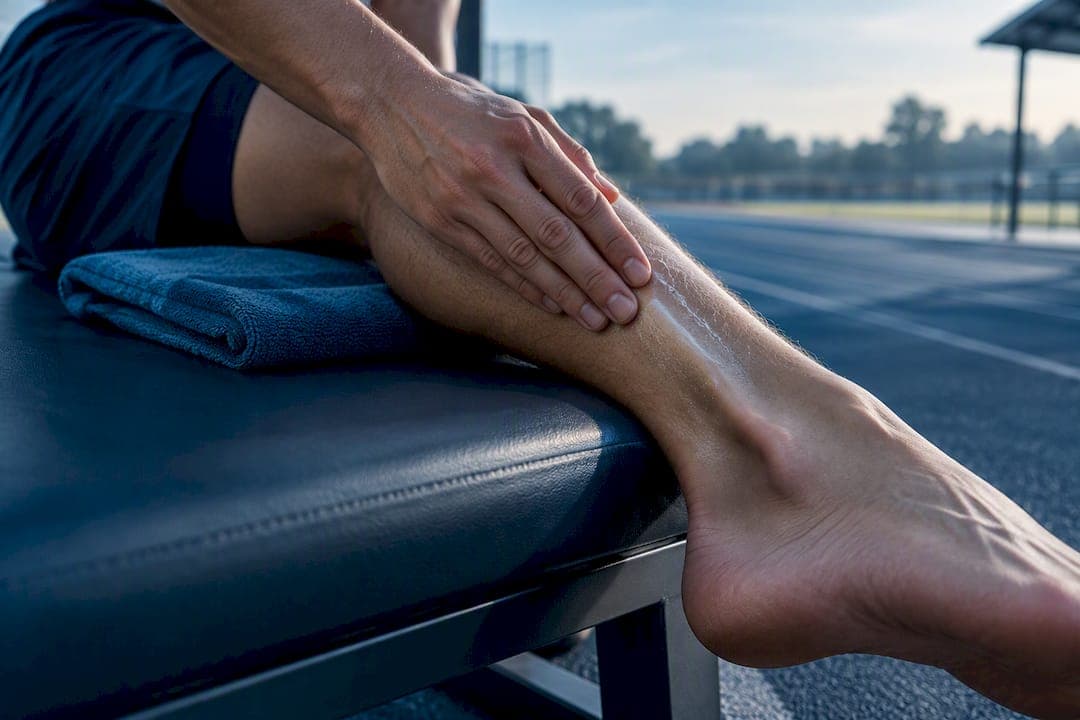
Topical CBD is a reasonable, low-risk comfort option to try alongside standard Achilles tendon care and not a stand-alone fix. The strongest data come from an animal tendon-healing study and a small human pilot, both suggesting tolerability and possible symptom relief rather than tissue repair. Read the safety and application sections before starting, since drug interactions and product quality both affect the outcome.
TL;DR:
- Topical CBD may reduce Achilles tendon pain temporarily but has not been proven to promote tissue healing or structural repair.
- Small human studies and animal research suggest it is well tolerated and can decrease pain when used consistently for several weeks.
- High expression of CB1 receptors in degenerated tendon tissue indicates a potential biological link, but topical CBD mainly affects surface tissues with limited deep tendon absorption.
- Users should perform patch tests, verify third-party lab reports, and be cautious of drug interactions with medications affecting liver enzymes.
- Combining CBD with standard rehab, including rest and physical therapy, remains essential, with use monitored over a trial of two to six weeks.
Table of Contents
- What the research actually finds about CBD and tendon pain
- Why topical CBD might reduce pain and why it won't rebuild tendon tissue
- Safety checklist: side effects, drug interactions, and product-quality risks
- Practical guidance: what format to pick and how to apply CBD to the Achilles
- Mongoose CBD Co.'s practical view: product design, testing, and realistic expectations
- Trial option: try a tested topical balm
- Sources
- FAQ
What the research actually finds about CBD and tendon pain
The evidence base for CBD and tendon pain is small, recent, and mostly preliminary. It points toward safety and modest symptom relief rather than proof of healing.
- A rat Achilles tendon repair model found that CBD did not impair biomechanical tendon healing compared to untreated controls, which is a safety signal in animals, not evidence of benefit in people.
- A 2023 pilot study in elite former athletes using topical CBD twice daily for six weeks reported good tolerability along with reduced pain and improved function, though the sample was small and short-term.
- A living systematic review of cannabis-based treatments for chronic pain found low to moderate strength evidence overall, with some benefit tied to products containing both THC and CBD, while purified oral CBD alone showed little advantage over placebo.
A 2023 pilot trial found that daily topical CBD over six weeks was well tolerated and linked to reduced pain and better function in a small group of former elite athletes. That result is encouraging but far from conclusive: no tendon-specific randomized trial has yet measured whether CBD changes healing timelines or produces a reliable effect size. The honest summary is promising signals, not proof.
Why topical CBD might reduce pain and why it won't rebuild tendon tissue
Achilles tendon pain has a plausible biological link to the body's cannabinoid system, which is part of why CBD draws interest here in the first place.
- Human Achilles tendinosis tissue shows increased CB1 receptor expression in coenocytes compared to healthy tendon, suggesting the endocannabinoid system plays some role in tendon pain signaling.
- Topical application mostly stays local: it concentrates near the skin and surface tissue with limited systemic absorption, which helps explain low rates of systemic side effects but also means less of the compound reaches deeper tendon structures.
- Tendinosis is largely a degenerative process involving collagen breakdown, not classic inflammation, so an anti-inflammatory approach can ease discomfort without reversing the underlying structural changes.
No human trial has shown that topical CBD repairs or regenerates tendon tissue. It may quiet the pain signal without touching the pathology underneath.
Pro Tip: Think of topical CBD as turning down the volume on pain, not fixing the source. Pair it with load management, not with pushing through soreness.
Safety checklist: side effects, drug interactions, and product-quality risks
Topical CBD is generally well tolerated, but it isn't risk-free, and a few checks go a long way.
- Watch for mild side effects such as skin irritation at the application site; systemic effects like dizziness, sedation, or nausea are more common with oral or high-THC products than with topical use.
- Check for drug interactions before combining CBD with other medications, since CBD affects CYP450 liver enzymes that also process anticoagulants and certain antidepressants, and a pharmacist-facing primer on CBD interactions lists specifics worth reviewing with a clinician.
- Patch test on a small area of skin first, and buy only from brands that publish third-party lab reports confirming CBD content and THC-free status, since mislabeled products remain a documented problem.
- Stop use and seek care if pain worsens, the skin shows signs of infection, or you notice symptoms beyond local irritation.
Harvard Health notes that topical CBD may help with localized pain and inflammation, but cautions that high-quality human trials are still lacking and product regulation is inconsistent. That inconsistency is exactly why sourcing matters as much as the ingredient itself.
Practical guidance: what format to pick and how to apply CBD to the Achilles
Format matters more for the Achilles than for most other joints, since the area sits close to socks, shoes, and skin folds at the back of the heel.
- Choose a roll-on for daytime use before activity, since it applies cleanly without hand contact and reduces transfer to socks or shoe linings.
- Use a cream if you want faster absorption between applications and don't mind a short wait before dressing.
- Reserve a thicker balm or salve for overnight use, when slower absorption and a longer dwell time on the skin work in your favor.
- Apply to clean, dry skin over the tendon and just above the heel, let it absorb for a few minutes before covering with socks or shoes, and wash your hands afterward.
- Try a defined trial: apply twice daily for two to six weeks while tracking pain and function in a simple log, and stop if you notice irritation or no change.
Topical CBD works best as a companion to rehab, not a replacement for it. Continue relative rest, progressive loading, and physical therapy, and resist the temptation to use reduced pain as a signal to load the tendon harder than your rehab plan allows. The same logic applies to using CBD alongside shin splint rehab: it supports the plan, it doesn't replace it.
Pro Tip: Log your pain on a simple 0 to 10 scale each morning before you apply anything. Patterns show up faster than memory does.

Mongoose CBD Co.'s practical view: product design, testing, and realistic expectations
Some companies specialize in CBD products formulated to ease pain and support recovery, built around the idea that a topical should do its job without complicating a rehab plan. Some products are designed as topical options for athletes and people managing chronic pain, meant to sit alongside physical therapy and progressive loading rather than substitute for either. Some companies offer refund policies giving a low-risk way to test whether a topical fits your routine. Readers should still verify third-party lab reports on any product before use, the same standard that applies across this whole category. Similar tolerability questions come up with CBD for exercise-related soreness, where the same adjunct approach applies.
— Cindy
Trial option: try a tested topical balm
If you want to test topical CBD on your Achilles while keeping your rehab plan intact, the Seriously Soothing Pain Balm and RIKKI TIKKI Recovery are built for exactly that: fast-absorbing balms formulated for athletes and people managing chronic pain, without added THC.
- Products are THC-free by label and third-party tested, so you can confirm what's actually inside before applying it near an injury.
- A 30-day refund policy means a trial period carries little financial risk if the balm doesn't fit your routine.
- Keep a simple pain and function diary during the trial, and stay with your physical therapy and loading plan the whole time.
Browse the Seriously Soothing Pain Balm or the RIKKI TIKKI Recovery balm to see current options, or visit Mongoose CBD for the full product line and return policy details.
This article is general information, not a substitute for advice from a qualified doctor. Consult a qualified healthcare professional about your own circumstances before acting on anything here.
Sources
- Biomechanical Effects of Δ9-Tetrahydrocannabinol (THC) and Cannabidiol (CBD) ... (PMC7401174)
- Living systematic review on cannabis and other plant-based treatments for chronic pain (AHRQ/NCBI NBK618045)
- Cannabidiol (CBD): What we know and what we don't - Harvard Health
- Increased expression of cannabinoid CB1 receptors in Achilles tendinosis (PLOS One)
FAQ
Does CBD help with Achilles tendon pain?
Topical CBD may ease pain and discomfort for some people, based on a small human pilot study and animal tendon research, but it has not been shown to heal or repair tendon tissue. Treat it as a comfort measure alongside rest, loading exercises, and physical therapy rather than a cure.
Is CBD cream or oil better for Achilles tendonitis?
Topical formats like roll-ons, creams, and balms are generally preferred over oral CBD for localized Achilles pain, since they act mostly at the surface with limited systemic absorption. A roll-on is often the most practical choice for the heel area because it avoids hand contact and keeps the product off socks and shoes.
Can CBD interact with other medications I'm taking?
Yes. CBD affects liver enzymes that also process certain other drugs, including some blood thinners and antidepressants, so anyone on prescription medication should check with a clinician or pharmacist before starting CBD, topical or otherwise.
How long should I try topical CBD before deciding if it works?
A reasonable trial period is two to six weeks of consistent twice-daily application while tracking pain and function. Stop earlier if you notice skin irritation or any adverse reaction.
Is CBD legal to use for pain relief?
Legal status for CBD varies by product type, THC content, and location, so check the rules that apply where you live before buying or using it. Choosing products with third-party lab testing and clear THC-free labeling helps confirm what you're actually getting.