

For most people buying a CBD topical for the first time, CBD isolate is the safer starting choice — it's THC-free, odorless, and predictable. If you're subject to drug testing, have terpene sensitivities, or just want a clean ingredient list, isolate topicals are the clear pick. Full-spectrum topicals are worth considering when you want the potential added benefit of the entourage effect and you are not concerned about trace THC. Broad-spectrum sits in the middle: terpenes and minor cannabinoids without the THC.
Quick buyer profiles:
- Athlete or workplace-tested employee: Choose CBD isolate or broad-spectrum. Trace THC in full-spectrum products can accumulate and flag a drug test even at federally legal levels.
- Chronic pain or inflammation seeker: Full-spectrum may offer more through cannabinoid and terpene synergy, though human topical evidence is still limited.
- Fragrance-sensitive or allergy-prone user: Isolate is odorless and free of terpenes that can trigger reactions.
Before you buy anything, check the batch-specific Certificate of Analysis (COA) and the full ingredient list. The COA tells you actual potency and whether THC is truly absent.
Pro Tip: Look for a COA from a third-party lab dated within the last 12 months. If a brand can't produce one on request, skip the product entirely.
Key Takeaways
For topical CBD buyers, formulation quality and COA transparency matter more than the isolate vs. full-spectrum label alone.
| Point | Details |
|---|---|
| Isolate is safest for tested users | CBD isolate is THC-free and odorless, making it the right choice for athletes or employees subject to drug testing. |
| Full-spectrum may add synergy | Full-spectrum topicals include terpenes and minor cannabinoids that may enhance effect, but human topical evidence is limited. |
| Formulation drives performance | Carrier oils, penetration enhancers, and actives like menthol and arnica often matter more than CBD type for topical results. |
| Always verify with a COA | Check the batch-specific third-party COA for actual THC level, potency, and residual solvents before buying any topical. |
| Mongoosecbd offers THC-free options | The Seriously Soothing Pain Balm delivers 1,000mg CBD per ounce with natural actives and a 30-day refund guarantee. |
Table of Contents
- What isolate, full-spectrum, and broad-spectrum mean for topicals
- How topical CBD actually works on your skin
- Does the entourage effect actually apply to topicals?
- Benefits and drawbacks of CBD isolate in topicals
- Benefits and drawbacks of full-spectrum topicals
- Broad-spectrum topicals: the middle option
- Safety, skin sensitivity, and what the FDA says
- How to choose between isolate, broad-spectrum, and full-spectrum topicals
- Practical steps for applying topical CBD
- What peer-reviewed research says about topical CBD
- An editorial perspective on the isolate vs. full-spectrum debate
- Mongoosecbd's Seriously Soothing Pain Balm fits these buyer profiles
- Primary sources and further reading
- Sources
What isolate, full-spectrum, and broad-spectrum mean for topicals
These three terms describe how much of the hemp plant ends up in the final product. For topicals specifically, the difference shows up in scent, ingredient complexity, and THC presence.
Everything else — other cannabinoids, terpenes, plant waxes — has been stripped away. The result is a white crystalline powder that's odorless and flavorless, which makes it easy to blend into a balm or cream without affecting the scent profile. No THC, no terpenes, no surprises.
federal law for hemp-derived products. In a topical, this translates to a more complex botanical scent and a richer ingredient profile.
Broad-spectrum is full-spectrum with the THC removed through an additional processing step. It retains terpenes and minor cannabinoids, so it carries more of the plant's natural profile than isolate without the THC exposure risk.
| Type | THC Present | Terpenes | Typical Scent |
|---|---|---|---|
| CBD Isolate | No | No | Neutral/odorless |
| Full-Spectrum | Yes (up to 0.3%) | Yes | Earthy, herbal |
| Broad-Spectrum | No (removed) | Yes | Mild herbal |
How topical CBD actually works on your skin
Topical CBD acts locally. When you rub a balm into your knee or shoulder, the cannabinoids interact with CB1 and CB2 receptors in the skin, peripheral nerves, and underlying tissue — without meaningfully entering the bloodstream under normal conditions. That's the key distinction from oral CBD: you get targeted relief at the application site rather than systemic effects.
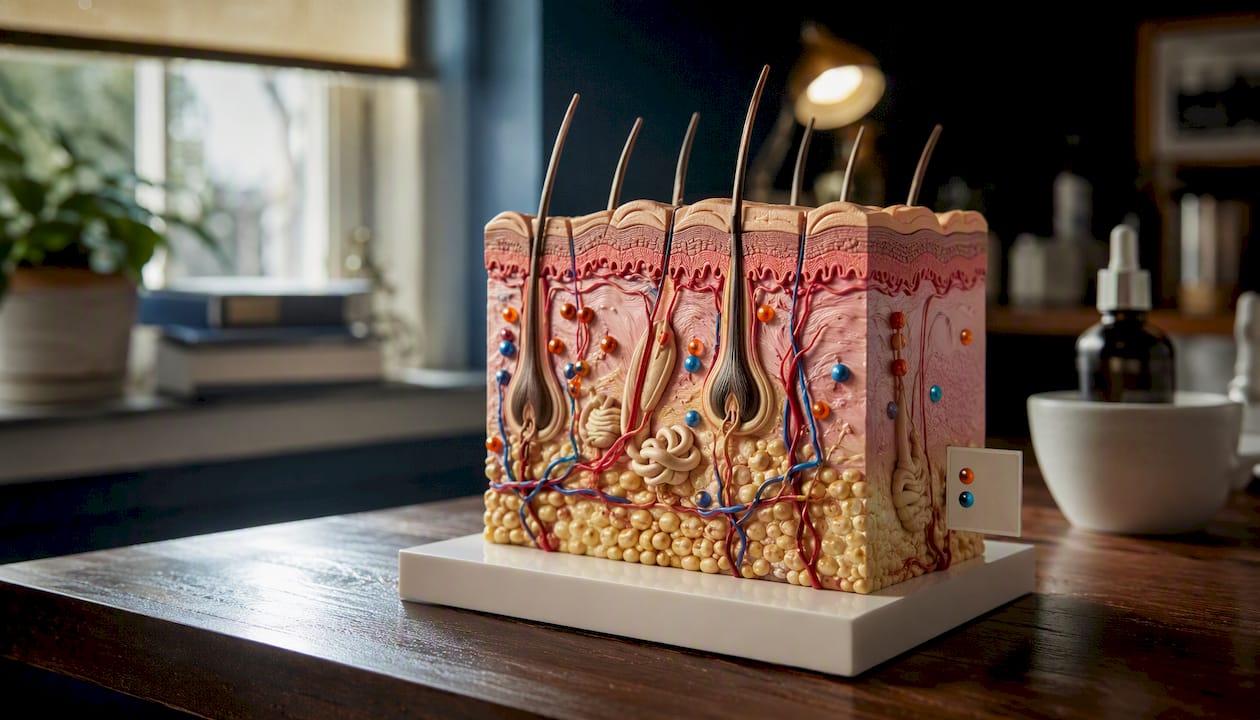
Clinical safety literature confirms that intact skin provides a significant barrier, keeping systemic absorption low. The exception is broken or compromised skin, or large-area application, where absorption can increase noticeably.
Onset for most topicals runs roughly 15–45 minutes after application, with effects that can last 2–6 hours depending on formulation and individual response. But here's what most buyers miss: the CBD type (isolate vs. full-spectrum) is often less important than what surrounds it. A cosmetic-science review found that carrier oils, emollients, penetration enhancers, and added actives like menthol and arnica determine how well a topical actually delivers its ingredients to target tissue.
What to expect after applying:
- 0–5 min: Carrier oils and warming/cooling agents (menthol, capsaicin) create immediate sensory feedback
- 15–45 min: CBD and other actives begin interacting with local receptors
- 1–3 hours: Peak effect window for most balm formulations
- Reapply: Every 4–6 hours as needed, or after washing the area
Pro Tip: Warming agents like capsaicin and cooling agents like menthol create distinct sensations regardless of CBD type. If a product "feels like it's working" immediately, that's usually the menthol — not the CBD, which takes longer to act. Both effects are real and useful; just know which is which.
Does the entourage effect actually apply to topicals?
The entourage effect is the theory that cannabinoids and terpenes work better together than any single compound does alone. A peer-reviewed pharmacological review supports the concept with preclinical and limited clinical signals, but calls clearly for more human trials before strong conclusions can be drawn.
For topicals specifically, the picture is even murkier. Most entourage effect research involves oral or inhaled administration, where compounds reach the bloodstream and interact systemically. Topical application keeps most of those compounds at the skin surface and peripheral tissue, which may limit how much synergy actually occurs.
What this means practically:
- Full-spectrum topicals may offer added benefit through synergy, but no large-scale human topical trial has confirmed this definitively
- Terpenes in a topical can have their own local effects (anti-inflammatory, analgesic) independent of CBD
- Formulation quality and CBD concentration likely matter more than isolate vs. full-spectrum for most users
The honest answer: the entourage effect is a plausible and scientifically grounded concept, but its magnitude in topical products is still being studied.
Benefits and drawbacks of CBD isolate in topicals
Isolate-based topicals have a strong practical case, especially for specific buyer situations.
Benefits:
- Zero THC: No risk of trace THC exposure, which matters for drug-tested users
- Neutral scent: Odorless base makes it easy to add or avoid fragrances intentionally
- Predictable dosing: Single-compound formulation means consistent potency batch to batch
- Lower terpene allergy risk: No plant terpenes means fewer potential irritants for sensitive skin
- Regulatory simplicity: Easier to make accurate label claims without complex extract variability
Drawbacks:
- No entourage effect potential — you're working with CBD alone
- Some users report isolate topicals feel "less potent," though this is subjective and formulation-dependent
- Penetration still depends entirely on the carrier and formulation, not the CBD type
Who should choose isolate topicals:
- Athletes subject to WADA or employer drug testing protocols
- People with known terpene or botanical sensitivities
- Anyone who wants a fragrance-free daily application product
- Users who want the simplest possible ingredient list
Pro Tip: *If you're in a sport governed by anti-doping rules, "hemp-derived" and "THC-free" on the label are not enough.
Benefits and drawbacks of full-spectrum topicals
Full-spectrum topicals bring the whole plant profile to the formulation, which is either a feature or a liability depending on your situation.
Benefits:
- Potential entourage synergy from combined cannabinoids and terpenes
- Richer botanical sensory profile that some users prefer
- Terpenes like linalool and beta-caryophyllene may contribute their own anti-inflammatory or analgesic properties locally
- Often preferred by users with complex or chronic pain who find isolate alone insufficient
Drawbacks:
- Trace THC present (up to 0.3% in compliant U.S. hemp products) — and research on cannabinoid content variability shows that "THC-free" claims without third-party testing can be unreliable
- Stronger hemp scent, which some users find unpleasant or impractical for daytime use
- Batch-to-batch variability in terpene and minor cannabinoid content
- Slightly higher risk of skin sensitivity reactions from terpenes
Drug testing reality check: Even topical full-spectrum products carry a non-zero THC exposure risk. Topical absorption is low through intact skin, but repeated large-area application could theoretically contribute to detectable THC levels over time. Anyone with strict testing requirements should stick to verified isolate or broad-spectrum products with COAs confirming undetectable THC.
Pro Tip: Don't rely on a brand's marketing copy for THC status. Pull the actual COA, find the THC column, and confirm the number — not just the label claim.
Broad-spectrum topicals: the middle option
Broad-spectrum is the practical compromise for buyers who want more than isolate but can't accept THC. The THC is removed after extraction, leaving the terpenes, minor cannabinoids, and flavonoids intact. In a topical, that means a mild herbal scent and a richer plant profile without the drug-test risk of full-spectrum.
When broad-spectrum makes sense:
- You want potential entourage benefit but need to minimize THC exposure
- You prefer a more natural botanical scent than isolate but find full-spectrum too strong
- You're in a gray zone on drug testing — not strictly tested but cautious
Pros:
- Terpenes and minor cannabinoids preserved
- THC removed (verify with COA)
- More complex profile than isolate
Cons:
- Processing to remove THC can also reduce some terpene content
- Slightly more expensive than isolate formulations
- Still requires COA verification — "THC-free" on the label needs lab confirmation
Quick buyer profile: Broad-spectrum suits the wellness-focused user who wants a full plant experience without the compliance risk. It's also a reasonable first step for someone transitioning from isolate who wants to test whether a richer profile makes a noticeable difference.
Safety, skin sensitivity, and what the FDA says
Topical CBD has a favorable safety profile for most adults, but a few practical precautions apply before you apply anything new to your skin.
Before first use:
- Patch test on a small area of inner forearm
- Wait 24 hours and check for redness, itching, or swelling
- If no reaction, proceed with normal application
- Stop use immediately and contact a clinician if you develop a rash, hives, or worsening pain
Systemic safety: Clinical reviews confirm that topical cannabinoids show low systemic absorption through intact skin, which significantly reduces the risk of drug interactions. That said, application over large body areas or on broken, inflamed, or compromised skin can increase absorption and, in rare cases, create systemic exposure. If you're on medications metabolized by the liver (particularly blood thinners or anticonvulsants), mention topical CBD use to your prescribing clinician.
Regulatory context: The FDA maintains regulatory authority over cannabis-derived products and has flagged concerns about unsubstantiated health claims and inadequate labeling. CBD is not currently FDA-approved as a general consumer drug ingredient, which makes third-party COAs the most reliable quality signal available to buyers. The CDC's guidance on inhalation risks is a useful reminder that route of administration matters for safety — topical use carries none of the pulmonary risks associated with vaping.
Red flags that warrant a clinician call:
- Severe or spreading rash after application
- Pain that worsens rather than improves over 7–14 days of use
- Systemic symptoms (dizziness, nausea) after large-area topical application
- Any signs of allergic reaction beyond mild local redness
This article provides general information only and is not a substitute for medical advice. Confirm any health decisions with a qualified clinician.
How to choose between isolate, broad-spectrum, and full-spectrum topicals
Start with your primary constraint, then evaluate the product itself.
Decision framework:
- Drug testing required? Choose isolate or broad-spectrum with a COA confirming undetectable THC.
- Want maximum potential effect? Full-spectrum is worth trying if testing isn't a concern.
- Sensitive skin or fragrance issues? Isolate is the lowest-irritant option.
- Want a middle path? Broad-spectrum gives you terpenes without THC.
What to check on a COA:
- Potency (mg of CBD per gram or per container — confirm it matches the label)
- THC level (look for the actual number, not just "compliant")
- Residual solvents panel (should show none detected or below safety thresholds)
- Heavy metals and microbial testing (present on a thorough COA)
- Lab name and date (third-party, dated within 12 months)
Formulation checklist — what matters beyond CBD type:
- Carrier oil quality (coconut, jojoba, and shea are common; they affect skin feel and penetration)
- Penetration enhancers (some formulations include ingredients that help actives reach deeper tissue)
- Additional actives: menthol, arnica, turmeric, capsaicin, and eucalyptus all contribute independently to pain and inflammation response
- Concentration: more mg per ounce generally means a more potent product
Spot mislabeling red flags:
- No COA available or COA is from an in-house lab
- Label says "full-spectrum" but COA shows only CBD
- THC listed as "0%" with no detection limit stated
- No batch number on the product or COA
For a deeper look at how topical CBD performs for arthritis specifically, the formulation factors above become even more relevant.
Practical steps for applying topical CBD
Getting the application right matters as much as choosing the right product.
- Clean the area with mild soap and water; pat dry. Avoid applying immediately after using alcohol-based cleansers, which can disrupt the skin barrier.
- Apply a moderate amount — a dime-to-quarter-sized amount for a joint or small muscle group. More is not always better; the skin can only absorb so much at once.
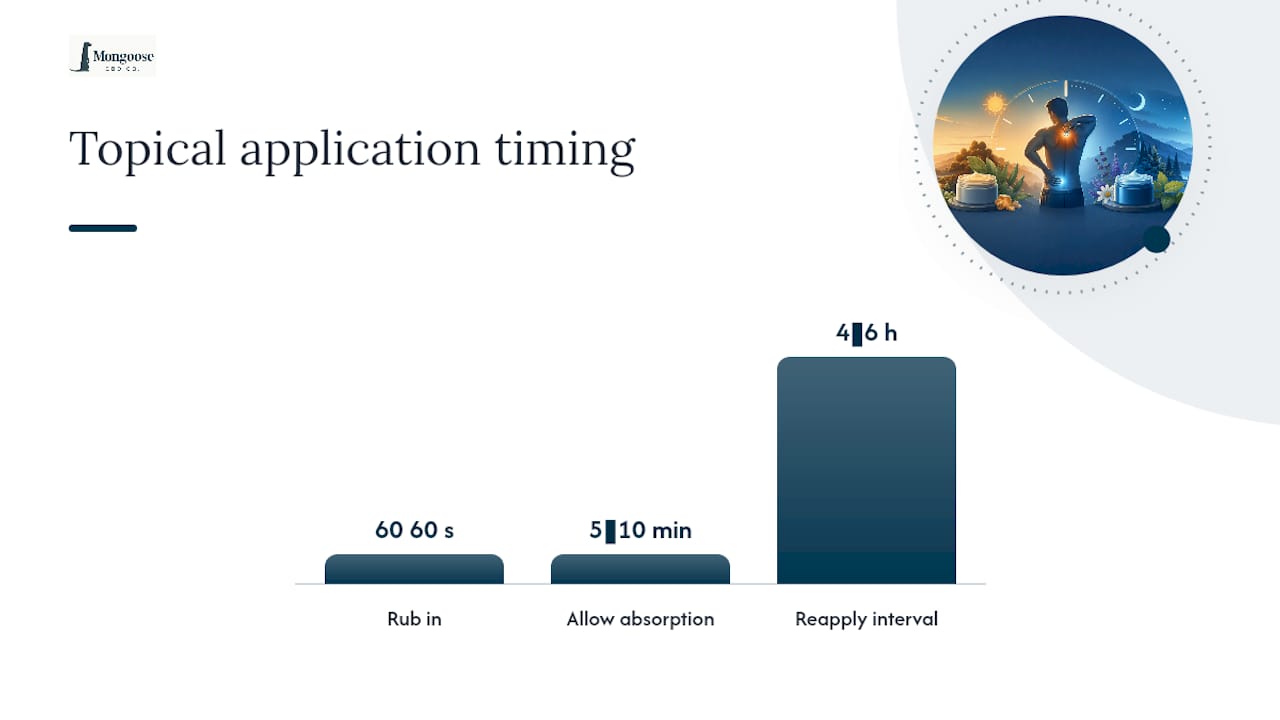
- Rub in thoroughly using circular motions for 60–90 seconds to encourage penetration and local circulation.
- Allow absorption for at least 5–10 minutes before covering with clothing or bandaging.
- Reapply every 4–6 hours as needed, or as directed on the product label.
- Store properly: keep balms away from direct heat and sunlight to preserve active ingredients.
Dos and don'ts:
- Do apply to intact skin only
- Do wash hands after application unless treating hand pain
- Don't apply over open wounds or severely broken skin
- Don't combine with heating pads immediately after application without checking product guidance
If you need systemic support alongside local relief — for example, managing widespread inflammation or sleep disruption — a topical alone won't provide that. Oral CBD addresses systemic needs; topical addresses local ones. They can be used together, but they serve different functions.
Pro Tip: Pairing a topical that contains menthol with a light massage before application can increase local blood flow and improve how well the product penetrates. The warming and cooling effects of capsaicin-based formulations work through a different mechanism than CBD, but the combination tends to produce stronger perceived relief than either alone.
What peer-reviewed research says about topical CBD
The honest summary: clinical evidence specific to topical cannabinoid preparations is limited. A systematic review of topical cannabis-based medicines found that most studies are preclinical or heterogeneous in formulation, making broad clinical conclusions difficult. That doesn't mean topical CBD doesn't work — it means the research hasn't caught up with consumer use yet.
Key findings from the evidence base:
- Preclinical data supports CB1 and CB2 receptor activity in skin and peripheral tissue
- The entourage effect review provides pharmacological rationale for combined cannabinoid use but stops short of confirming topical-specific synergy in humans
- Formulation science research consistently shows that carrier ingredients and penetration enhancers drive topical performance as much as the active compound itself
- Medical News Today's consumer summary notes that some animal and small human studies suggest full-spectrum extracts may outperform isolate for certain pain outcomes, while acknowledging inconsistent evidence
What quality looks like in practice: The FDA's regulatory framework means that no topical CBD product can legally claim to diagnose, treat, or cure a condition. Brands that stay within those boundaries and back their products with third-party COAs, transparent ingredient lists, and cGMP manufacturing are the ones worth trusting.
Limitations to keep in mind:
- Most strong evidence is preclinical (animal models) or from systemic administration
- Human topical trials are sparse and often small
- Formulation variability across studies makes direct comparisons unreliable
- Individual response to topical CBD varies based on skin type, application area, and underlying condition
An editorial perspective on the isolate vs. full-spectrum debate
Most of the content on this topic frames the isolate vs. full-spectrum question as a potency debate — full-spectrum wins because entourage effect, end of story. That framing misses the point for topical buyers.
The entourage effect is a real and scientifically grounded concept. But the evidence for it is strongest in systemic administration contexts, not topical ones. When you're rubbing a balm into a sore knee, the cannabinoids aren't reaching your bloodstream in meaningful amounts. The synergy that might matter in an oral product simply doesn't have the same pathway to work through skin.
What actually determines whether a topical CBD product helps you is the formulation: the carrier oils, the penetration enhancers, the additional actives like arnica or menthol, and the concentration of CBD per ounce. A well-formulated isolate balm at 1,000mg per ounce will outperform a poorly formulated full-spectrum balm at 250mg per ounce every time. The label type is secondary to what's actually in the jar.
The other thing most guides understate: drug testing risk is real even with topicals. "Hemp-derived" and "federally legal" don't mean "won't flag a test." Trace THC accumulates.
My practical recommendation: start with a well-formulated isolate or broad-spectrum topical from a brand that publishes batch COAs. Track your response over 7–14 days. If you're not getting the relief you need and drug testing isn't a concern, try a full-spectrum option with the same concentration. The difference, if any, will be clear within a couple of weeks.
Mongoosecbd's Seriously Soothing Pain Balm fits these buyer profiles
If you've worked through the checklist above and you want a THC-free topical with a transparent formulation, Mongoosecbd's products are worth a close look.
The Seriously Soothing Pain Balm delivers 1,000mg of CBD per ounce alongside a formulation built around natural pain-relieving actives: arnica, menthol, turmeric, eucalyptus, peppermint, and ginger. The Cinnamon & Clove variant adds warming botanicals that complement the CBD for users who prefer that sensation. For athletes and active recovery, the Rikki Tikki Recovery balm is formulated specifically for post-workout muscle soreness.
All products are vegan, non-GMO, paraben-free, THC-free, and cruelty-free — which checks the boxes for drug-tested users and sensitive-skin buyers alike. Mongoosecbd backs every purchase with a 30-day full refund policy. Check the batch COA on the product page before ordering, and if you want to test the formula before committing to a full jar, a sample option is available.
Primary sources and further reading
The following sources were used in this article. For batch-specific product data, check the COA linked directly on each product page before purchasing.
- The pharmacological rationale for combining cannabinoids (PMC) — peer-reviewed review of entourage effect evidence and limitations
- FDA regulation of cannabis and cannabis-derived products — official FDA guidance on CBD labeling and regulatory status
- CBD isolate vs. full-spectrum CBD — Medical News Today — consumer-focused summary of differences and study findings
- Formulation factors influence topical delivery (MDPI Cosmetics) — cosmetic science review on how carrier ingredients affect topical performance
- Topical cannabis-based medicines: a review (PMC) — systematic review of clinical evidence for topical cannabinoid preparations
- Cannabinoids and the skin: safety considerations (PMC) — absorption and systemic safety data for topical cannabinoids
- WADA anti-doping guidance — relevant for athletes choosing THC-free topical formulations
Sources
- The pharmacological rationale for combining cannabinoids: an evidence-based review
- FDA regulation of cannabis and cannabis-derived products, including CBD
- Formulation factors influence topical delivery and consumer experience
- Topical cannabis-based medicines for the treatment of skin conditions: a review