
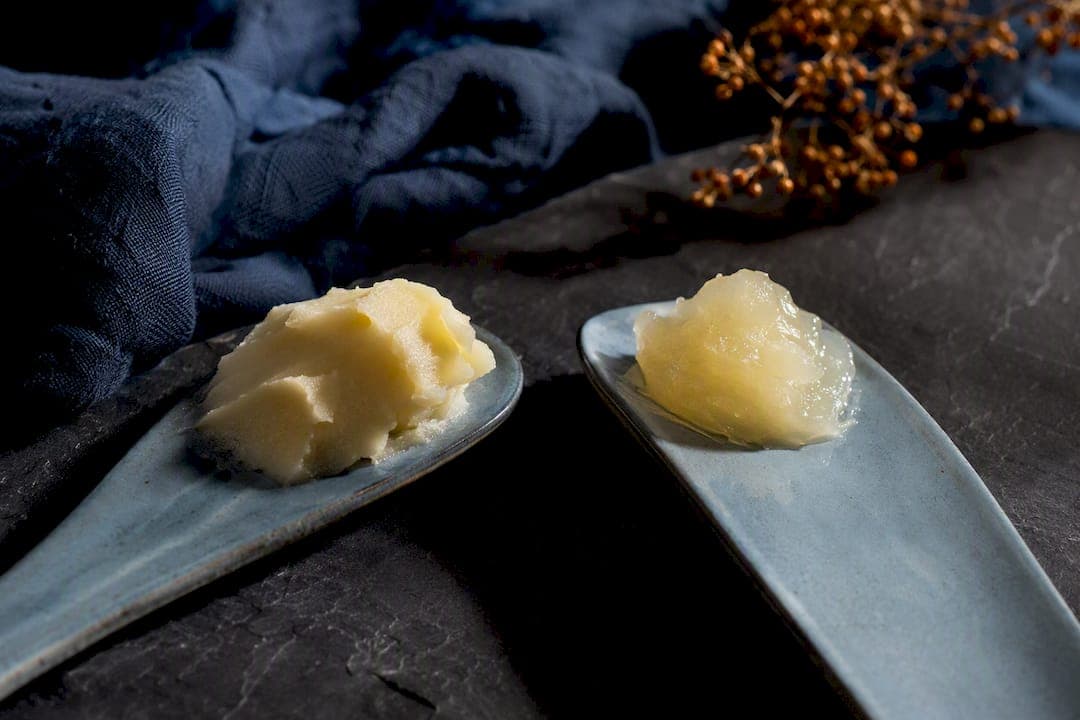
Choose a balm when you need a firm, wax-heavy barrier that seals moisture in and stays put on lips, cracked heels, or a joint you're targeting for hours. Choose a salve when you need something softer and oilier that spreads fast over a larger area and works into skin that's actively healing. The wax-to-oil ratio decides almost everything else.
TL;DR:
- A balm provides a firmer, wax-heavy barrier ideal for targeted, long-lasting moisture retention, especially on lips, heels, or joints.
- A salve is softer and oilier, spreading easily across larger or healing-prone areas like cuts, rashes, and eczema patches.
- The key difference lies in wax-to-oil ratio: balms have more wax for durability, while salves have more oil for absorption.
- Both are water-free, reducing spoilage risks, but labelling and ingredient sourcing, especially for CBD products, require careful scrutiny.
- Using both formats in layered application enhances healing and moisture locking, with choice depending on the treatment area and longevity needed.
Table of Contents
- Balm vs Salve: What Each One Actually Is
- Texture, Absorption, and Feel: A Side-by-Side Look
- When to Reach for a Balm vs a Salve
- Applying Either One Safely
- Making Your Own: Basic Ratios and a Simple Recipe
- How Mongoose CBD Co. Builds a Recovery-Focused Balm
- Regulatory and Labeling Differences You Should Know
- Sourcing Ingredients Responsibly
- Why the Balm vs. Salve Debate Misses the Real Question
- Which Mongoose CBD Co. Balm Should You Buy
- Sources
Balm vs Salve: What Each One Actually Is
Both are anhydrous, meaning they contain no water. That absence matters more than people realize. Water-based creams and lotions need preservatives to stop bacterial growth; balms and salves largely skip that problem because wax-based, water-free formulations create an environment bacteria struggle to survive in. That's part of why a tin of balm can sit in a gym bag for months without going rancid, while a lotion left in a hot car is asking for trouble.
A balm is a thick, wax-forward blend built to sit on top of skin and hold there. A salve uses more carrier oil relative to wax, which makes it softer and more spreadable, better suited to larger or healing-prone areas.
Typical ingredients overlap heavily; for example, many formulations include carrier oils and waxes similar to those found in CBD skincare products, bridging the gap between balms and creams.
- Wax base: beeswax or candelilla wax (vegan option)
- Carrier oils: coconut, olive, jojoba, sunflower
- Butters: shea or cocoa for added richness
- Actives: arnica, menthol, essential oils, and increasingly, CBD extract
The difference between balm and salve isn't the ingredient list. It's the proportions.
Texture, Absorption, and Feel: A Side-by-Side Look
Wax content is the lever that changes everything downstream. More beeswax raises the melting point, which means the product stays solid at room temperature and softens only from body heat. That's why a lip balm survives a hot pocket without turning to soup, while a salve in the same conditions would liquefy.
Higher beeswax content also produces firmer products that sit on the skin longer, while higher oil content increases spreadability and absorption. That single relationship explains most of the practical differences buyers notice:
- Balm: slower absorption, slight surface residue, long wear time, ideal for a stick or tin you reapply once and forget
- Salve: faster absorption, minimal greasy residue once worked in, shorter wear time, ideal for jars where you scoop and massage
- Packaging fit: balms travel well in twist-up sticks or small tins; salves work better in wider jars that let you scoop a bigger amount for a bigger area
Balm-to-salve ratio, roughly speaking: a firmer balm typically runs close to one part wax for every four to eight parts oil, while a softer salve leans toward one part wax for eight to sixteen parts oil. Push wax higher and you get something closer to a lip balm stick. Push oil higher and you get something closer to a massage-friendly salve.
When to Reach for a Balm vs a Salve
Match the format to the job, not the label on the tin.
Balms work best for:
- Chapped lips, dry knuckles, and cracked heels
- Sealing in moisture after a shower or shave
- Targeted joint or muscle spots where you want the product to stay in place for hours
Salves work best for:
- Healing cuts, scrapes, and rashes where absorption matters more than staying power
- Eczema patches and other larger irritated areas
- Massage-style application across a wide muscle group
Pro Tip: Layer them when you're dealing with both damage and dryness. Apply a healing salve first to work into the irritated skin, then follow with a firmer balm on top to lock in whatever the salve just delivered. Herbalists and makers have used this two-step routine for years, and it works because each format is doing a different job.
Topical CBD balms fit naturally into the muscle and joint recovery category, positioned alongside other over-the-counter topical pain relief options like menthol rubs and capsaicin creams, without replacing medical care for serious injuries.
Applying Either One Safely
- For small areas (lips, knuckles, a single joint): warm a pea-sized amount between fingers, then press and rub gently until it disappears into the skin.
- For larger areas (a shoulder, a full forearm, an eczema patch): use a broader palm swipe and work it in with light circular motion rather than heavy pressure.
- Patch test first. Apply a small dab to your inner forearm, wait 24 hours, and watch for redness, itching, or swelling before using it anywhere else. Patch testing and avoiding open wounds are standard safety steps for any topical herbal product.
- Skip it on open, deep wounds unless the product is specifically labeled for wound care.
Topical CBD is non-psychoactive, so there's no intoxicating effect from skin application, but label directions still matter and anyone managing a serious condition should check with a clinician first. For a deeper look at what to watch for, see this breakdown of CBD balm side effects.
Making Your Own: Basic Ratios and a Simple Recipe
If you want to try a small batch at home, the ratios above are your starting point: roughly 1 part beeswax to 4 to 8 parts oil for a firmer balm, or 1 part beeswax to 8 to 16 parts oil for a looser salve.
- Infuse your carrier oil with dried herbs (calendula and lavender are common starting points) over low heat for two to three hours, then strain.
- Melt the beeswax gently, stir in the infused oil, and add any essential oils once the mixture cools slightly.
- Pour into sterilized tins or jars while still liquid, then let set at room temperature.
- Label each batch with the date and ingredients, store in a cool, dark spot, and expect roughly six to twelve months of shelf life before the oils start to turn.
Always patch-test a homemade batch before wider use, since herb-infused oils carry their own allergy risk separate from the wax itself.
How Mongoose CBD Co. Builds a Recovery-Focused Balm
A CBD balm meant for muscle recovery isn't just wax and oil with CBD dropped in. Mongoosecbd formulates at 1,000mg of CBD per ounce and pairs it with botanicals chosen for a reason: arnica for its traditional use on sore muscles, menthol and eucalyptus for the cooling sensation that signals a product is working, and warming additions like cinnamon, clove, ginger, and cayenne pepper in select formulas for a different kind of relief profile.
Every formula is vegan, non-GMO, paraben-free, THC-free, and cruelty-free, which matters to buyers who don't want to trade one set of skin irritants for another. Mongoosecbd backs every purchase with a full refund within 30 days, a policy that only makes sense if the product actually performs the way it's described. None of this replaces a doctor's care for a real injury. It's a functional recovery tool, not a cure.
Regulatory and Labeling Differences You Should Know
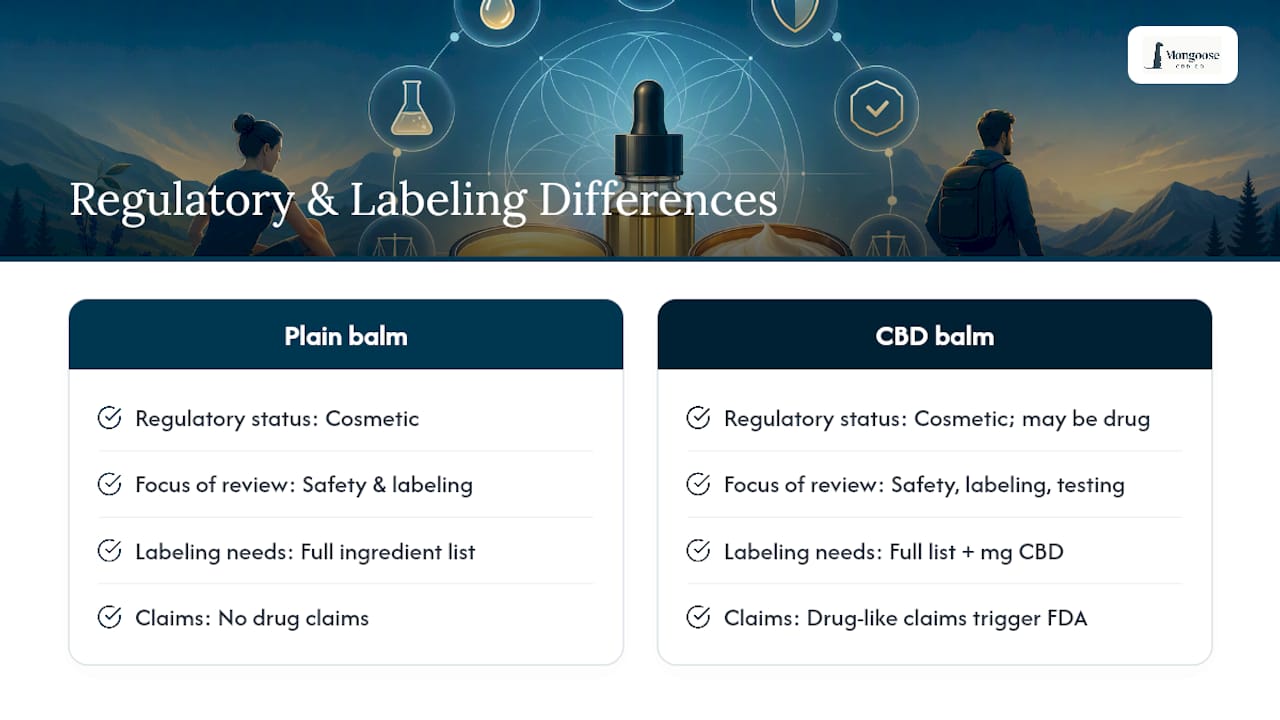
Balms and salves generally fall under cosmetic regulation in the United States, which means they're reviewed for basic safety and truthful labeling rather than proven medical efficacy. That changes the moment a product makes a drug-like claim, such as promising to "cure" or "treat" a disease. At that point, the FDA can classify it as an unapproved drug regardless of what the ingredient list looks like.
CBD-infused topicals sit in a gray area that's shifted repeatedly over the past several years. Labeling requirements typically expect accurate CBD milligram content, a full ingredient list, and no unverified medical claims.
The practical takeaway for shoppers: a plain herbal balm or salve faces looser scrutiny than a CBD-infused one, and that gap is exactly why lab testing and clear labeling matter more with CBD products. If a CBD balm doesn't disclose milligram strength per ounce or per application, treat that as a red flag rather than an oversight.
Sourcing Ingredients Responsibly
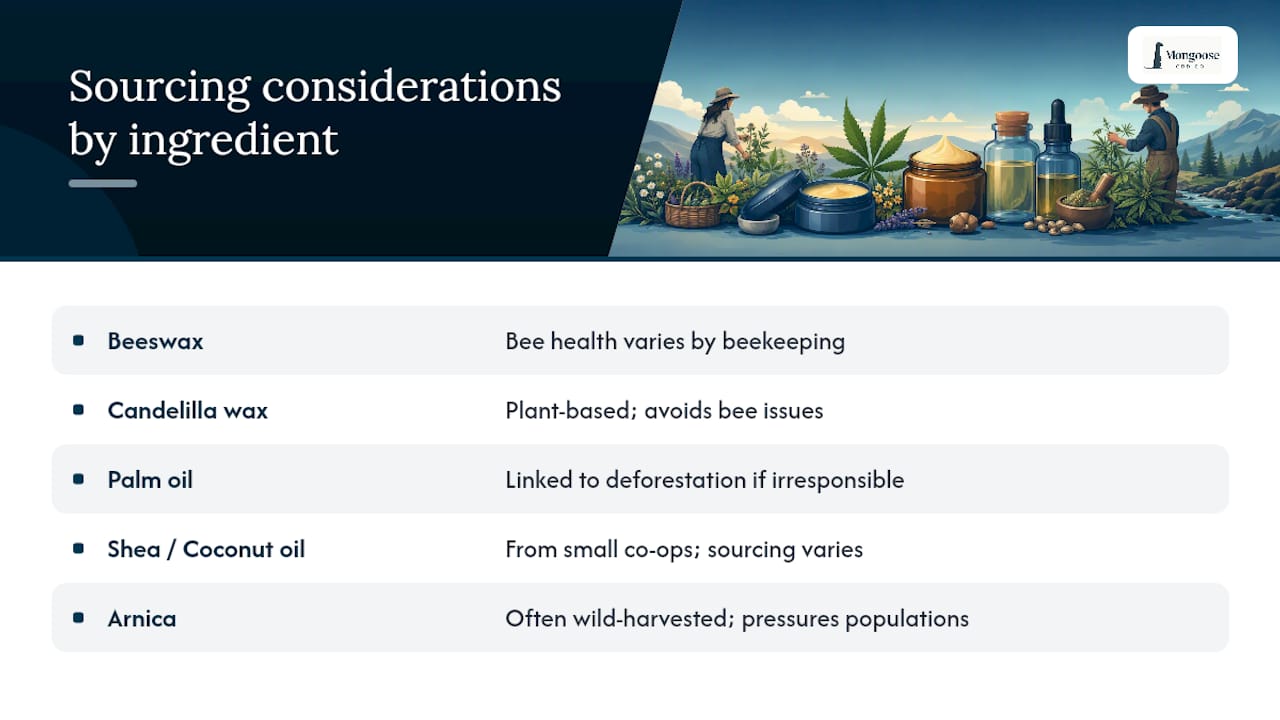
Beeswax sourcing raises real questions about bee health, since commercial beekeeping operations vary widely in how they treat colonies. Candelilla wax, a plant-based alternative, sidesteps that issue entirely and is why more brands now offer vegan balm options.
Carrier oils carry their own footprint. Palm oil, for instance, is linked to deforestation in Southeast Asia when sourced irresponsibly, while shea butter and coconut oil tend to come from smaller cooperative farms, though sourcing quality still varies by supplier. Arnica and other botanical actives are frequently wild-harvested, which puts pressure on natural populations if demand outpaces sustainable collection practices.
Buyers who care about this should look for brands that name their sourcing practices rather than staying vague. A short paragraph on a product page naming where the wax or oil comes from is a better signal than a generic "natural ingredients" claim with no detail behind it. It's a small thing to check, but it separates companies that have actually thought about supply chains from those recycling a marketing template.
Why the Balm vs. Salve Debate Misses the Real Question
Most explainers treat balm versus salve like a binary choice you make once and stick with. That's backwards. The real skill is recognizing that your skin's needs change by the week, sometimes by the day, and the smartest medicine cabinets have both formats on hand.
The conventional advice oversells "healing" as the main use case and undersells the recovery angle, where firmer, longer-wearing balms genuinely outperform a runny salve. If you're rubbing a product into a knee before a run and expecting it to still be doing something an hour later, wax content is your friend, not a drawback.
What gets overlooked most: ingredient sourcing and lab transparency matter as much as texture, especially once CBD enters the picture. A balm with a vague ingredient list and no lab results isn't a better product just because it feels nice going on. Prioritize the company that shows its work first, then worry about scent and texture preference second.
— Cindy
Which Mongoose CBD Co. Balm Should You Buy
If you're dealing with a specific sore spot, an aching knee, a stiff shoulder, a flare-up of arthritis pain, the Seriously Soothing Pain Balm - ORIGINAL is built for targeted application with 1,000mg of CBD per ounce plus arnica and menthol working together.
If you're recovering from a harder training session and want something suited to broader massage across a whole muscle group, the Rikki Tikki Recovery tin is formulated with that larger-area use in mind. Not sure which fits your situation? The free sample of Miracle Pain Balm lets you test the formula before committing to a full tin. Every order carries a full refund within 30 days, so trying a new balm doesn't mean gambling on it. Compare the full lineup on the Mongoosecbd shop page and pick the one that matches how you actually move through your week.
Sources
- Ointment vs. Cream, Lotion, and Gel: What Makes Them Different?
- Balm vs. Salve: What’s the Difference and How to Make Your Own
- Essential guide to over-the-counter topical pain relievers