
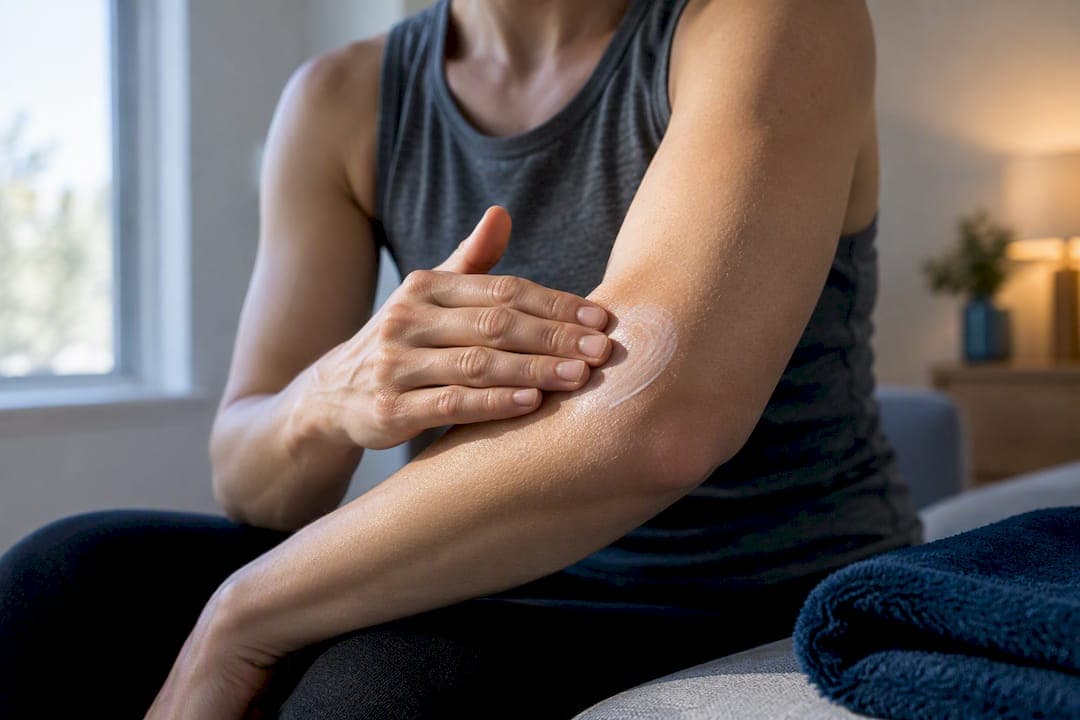
CBD can ease elbow pain for some people, and a topical balm is the more sensible place to start. Evidence remains preliminary, and high-dose oral CBD carries a documented liver enzyme risk that a topical product does not share to the same degree. A short, structured trial with a topical product, paired with standard rehab, is the practical next step.
TL;DR:
- Topical CBD offers localized relief for elbow pain with fewer systemic side effects compared to oral CBD, especially at high doses.
- A short, two-to-six-week trial applying CBD balm twice daily can help determine if it eases discomfort and improves movement.
- Evidence for CBD's effectiveness is limited and varies, making it a supportive comfort tool rather than a definitive cure for tendon injuries.
- CBD's safety profile is better with topical applications, but oral CBD poses risks of liver enzyme changes and side effects like dizziness at higher doses.
- Combining CBD topical use with standard rehab exercises maximizes the chance of symptom relief and addresses the underlying tendon problem more effectively.
Table of Contents
- How CBD May Relieve Elbow Pain
- Topical Versus Oral CBD: Which Fits Your Elbow Pain
- Running a Topical CBD Trial for Elbow Pain
- What the Research Actually Shows
- Safety, Side Effects, and Drug Interactions to Know
- When to See a Clinician and How CBD Fits With Rehab
- Our Trial Reports and Product Guarantee
- What Most Advice on This Topic Gets Wrong
- Try a Topical CBD Trial With Our Balms
- Sources
- FAQ
How CBD May Relieve Elbow Pain
The body's endocannabinoid system helps regulate inflammation and pain signaling at the cellular level. CBD interacts with receptors in this system, and when applied directly to the skin over a sore joint, it acts locally rather than moving through the bloodstream first. That local action is the reason topical formulas are often preferred for a single sore spot like a tennis elbow.
It helps to be clear about what CBD can and cannot do here.
- CBD applied topically may ease discomfort and stiffness around the joint.
- It does not repair or regenerate damaged tendon tissue.
- Any relief is symptomatic, similar to what a topical anti-inflammatory offers, not a cure for the underlying injury.
Harvard Health notes that CBD may reduce pain and inflammation in some conditions, though the evidence is still preliminary and the FDA has not approved CBD for chronic pain. Treat it as a comfort tool that supports recovery, not a substitute for addressing the mechanical cause of tennis elbow.
Topical Versus Oral CBD: Which Fits Your Elbow Pain
The delivery method changes both the likely benefit and the risk profile, so the choice matters more than which brand you pick.
- Topical CBD stays largely local, which lowers systemic exposure and may lower the chance of side effects elsewhere in the body.
- Oral CBD travels through the digestive system and liver, which can affect pain more broadly but raises the odds of drowsiness, nausea, or liver enzyme changes at higher doses.
- Topical products tend to feel faster for a single joint because the effect is concentrated where you apply it.
- Oral products may suit widespread pain across multiple joints, but that use case calls for closer monitoring.
For an isolated case of tennis elbow, a topical trial is the more sensible starting point. Oral CBD is worth considering only under a clinician's guidance, particularly for anyone with broader joint pain or existing liver concerns. A comparison of topical and oral delivery lays out the uptake differences in more detail if you want to weigh the two routes further.
Running a Topical CBD Trial for Elbow Pain
A short, structured trial gives you a real answer instead of a guess. Here is a workable version:
- Clean and dry the skin over the elbow before each application.
- Apply a dime-to-quarter-sized amount of topical CBD balm directly to the sore area.
- Rub it in fully until absorbed, twice daily, morning and evening.
- Rate your pain on a simple 0-to-10 scale before starting, then again at the two-week and six-week marks.
- Note any change in grip strength or pain during specific movements, like lifting a cup or turning a doorknob.
- Continue any exercises or stretches your clinician or physical therapist already recommended.
Watch for skin redness, itching, or a rash at the application site, and stop if any of those appear. A meaningful drop in resting pain or improved comfort during movement by the two-week check is a reasonable sign to continue; little to no change by six weeks suggests it is not doing much for you.
Pro Tip: Take a phone photo of the elbow at day one and apply the same lighting and angle at each check-in. It makes swelling or skin changes easier to track than memory alone.

This structure mirrors the kind of short trial protocols used in topical CBD reports for wrist pain, adjusted here for the elbow.
What the Research Actually Shows

The clinical picture on CBD for musculoskeletal pain is mixed and still developing. A living systematic review covering 29 randomized trials and 15 observational studies found low- to moderate-strength evidence overall, with small average pain improvements for some cannabinoid products, while purified oral CBD alone showed no clear pain reduction in several of the reviewed trials. Dizziness and sedation showed up more often in people taking cannabinoid products than in those on placebo.
A living systematic review found small average pain improvements for some cannabinoid products across 29 RCTs and 15 observational studies, with mixed results for purified CBD alone. That gap between "some cannabinoid products" and "purified CBD" matters: not every formulation performs the same way.
- Topical pilot studies suggest localized benefit for some joint conditions, though sample sizes tend to be small.
- Larger, well-controlled trials specific to topical CBD for elbow or tendon pain are still limited.
- Overall effect sizes across the research are modest and vary from study to study, not dramatic or consistent.
Read this evidence as supportive of a cautious trial, not as proof that CBD reliably resolves tennis elbow.
Safety, Side Effects, and Drug Interactions to Know
The FDA has flagged a real safety signal worth understanding before you consider oral CBD at higher doses, including the potential for liver toxicity and safer sourcing. In controlled clinical trials, 13% of patients taking 10 to 20 milligrams per kilogram per day had liver enzyme levels (ALT) rise above three times the upper limit of normal, compared with 1% on placebo. That risk applies to high oral doses, not to a topical balm rubbed onto the skin.
Common side effects to watch for include:
- Mild dizziness or drowsiness, mostly reported with oral use.
- Nausea or digestive upset at higher oral doses.
- Skin irritation, redness, or itching at the application site with topical products.
- Potential interaction with other medications processed through the liver's CYP450 enzyme pathway.
Anyone taking other prescription medications, managing liver disease, or already on blood thinners should talk to a clinician before adding oral CBD, and ideally before starting any new product if they have existing liver concerns.
When to See a Clinician and How CBD Fits With Rehab
See a clinician promptly if you notice significant weakness in the forearm, numbness, fever, or spreading redness at the elbow: these point to something beyond simple tendon strain. For straightforward tennis elbow, standard care centers on eccentric strengthening exercises, load management, and sometimes a brace, with topical adjuncts easing symptoms alongside that work rather than replacing it.
- Keep doing prescribed eccentric exercises even while trialing a topical balm.
- Mention any CBD product, dose, and duration of use when you see your provider.
- Ask about liver function testing if you are also considering an oral CBD product.
Our Trial Reports and Product Guarantee
Mongoose CBD Co. has published topical trial reports for conditions including wrist pain, frozen shoulder, and bursitis, documenting application schedules and what was tracked along the way. Its balms combine CBD with botanicals like arnica and menthol, and purchases carry a 30-day refund policy. The same twice-daily, two-to-six-week structure used in those reports adapts directly to an elbow-focused trial.
What Most Advice on This Topic Gets Wrong
Most articles on CBD for elbow pain either oversell it as a fix for tendon damage or dismiss it outright because the big clinical trials are not there yet. Both miss the point. The honest read of the evidence is narrower and more useful: topical CBD is a reasonable comfort tool for a joint that is already inflamed, not a treatment that changes the underlying tendon problem.
The bigger mistake readers make is skipping the exercises. A topical balm can make the elbow feel better within a couple of weeks, and that comfort makes it easier to keep doing the loading exercises that actually address tennis elbow over time. Drop the exercises and rely on the balm alone, and the underlying issue tends to persist no matter how good the short-term relief feels.
Start with the topical route, give it a real two-to-six-week trial with honest tracking, and treat any relief as a bonus that supports the rehab work rather than a replacement for it.
— Cindy
Try a Topical CBD Trial With Our Balms
Topical CBD balms formulated with CBD and botanicals like arnica, menthol, and turmeric are available for localized pain relief.
- Use either balm with the twice-daily protocol described above to test whether topical CBD eases your elbow pain.
- Seriously Soothing Pain Balm and RIKKI TIKKI Recovery are both priced at $26.95 to $39.95, one-off purchase.
- Some providers offer refund policies to support customer satisfaction and product trials.
Start your trial with the Seriously Soothing Pain Balm or explore the free sample option if you want to test it before committing to a full-size product.
Sources
- What You Need to Know About Products Containing Cannabis or Cannabis-derived Compounds (FDA)
- Living Systematic Review on Cannabis and Other Plant-Based Treatments for Chronic Pain: 2025 Update (NCBI Bookshelf)
- Can CBD oil help manage pain? (Harvard Health)
- Tennis elbow (lateral epicondylitis) - Cleveland Clinic
FAQ
Does CBD Actually Help With Muscle Pain?
CBD may offer modest relief for some types of muscle and joint pain, particularly when applied topically to a specific sore area. A living systematic review found small average pain improvements for some cannabinoid products, though results vary widely between studies and formulations.
Can CBD Heal Tendonitis?
CBD does not heal or repair tendon tissue itself. It may ease pain and stiffness around an inflamed tendon, which is why it works best alongside exercise-based rehab like the eccentric loading used for tennis elbow, not as a stand-alone treatment.
What Form of CBD Is Best for Inflammation?
Topical CBD balms are generally the better starting point for localized joint or tendon inflammation, since they act on the area applied with less systemic exposure than oral products. Oral CBD may suit broader pain but carries a higher chance of side effects, including the liver enzyme changes the FDA has documented at high doses.
Is CBD Cream Better Than Voltaren?
There is no direct head-to-head evidence comparing CBD topicals with diclofenac gel products like Voltaren for elbow pain. Both are used as topical anti-inflammatory options, and Harvard Health notes that CBD's pain-relieving evidence remains preliminary, so a clinician can help decide which suits your specific case.