
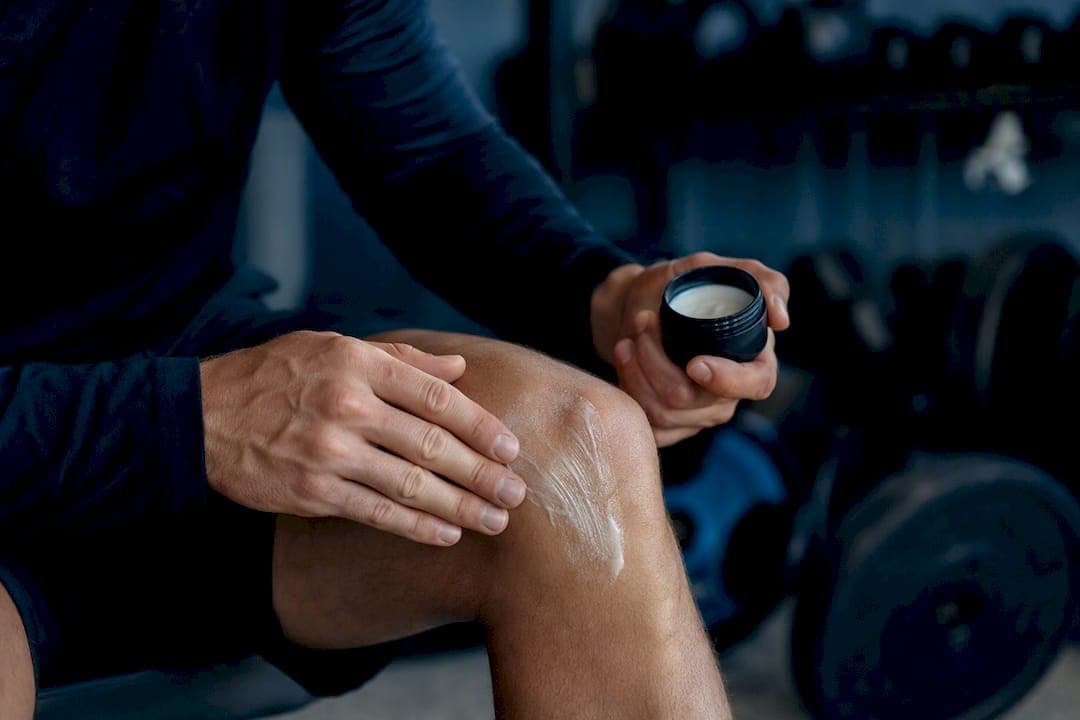
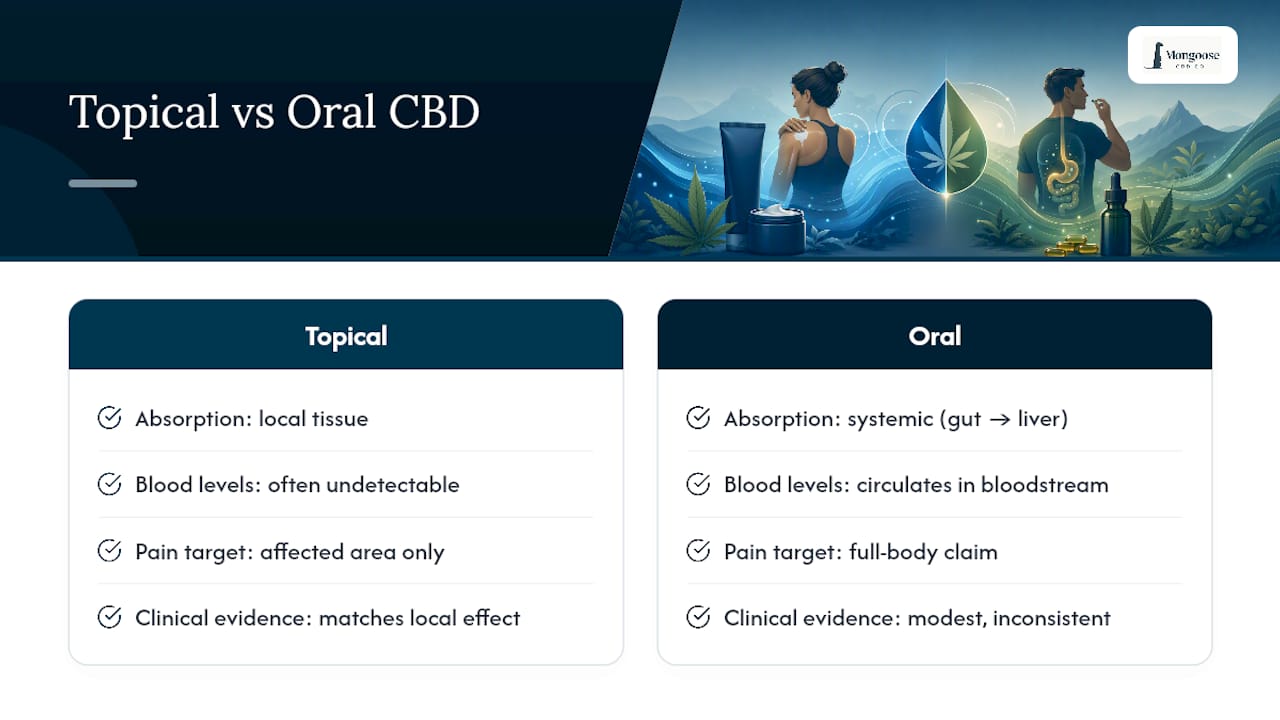
Topical CBD wins for localized joint or muscle pain because it acts right where you rub it in. Oral CBD makes more sense for widespread or systemic symptoms since it circulates through your bloodstream instead of staying put. The catch: topicals bring faster relief at the application site, while oral products take longer to kick in and absorb unevenly from person to person.
- Localized pain (a bad knee, a stiff shoulder): reach for a topical.
- Systemic or generalized symptoms: oral CBD has a better shot at reaching tissue throughout your body.
- Caveat: high-quality pain trials remain limited, and oral CBD carries drug-interaction and THC urine-test risks that topicals generally don't.
A randomized crossover pharmacokinetic study found oral CBD produced dramatically higher blood levels than a single topical dose, which frequently registered below the lab's detection limit entirely.
Key Takeaways
Topical CBD delivers faster, localized relief with minimal systemic exposure, while oral CBD reaches the bloodstream more thoroughly but absorbs unevenly and carries more interaction risk.
| Point | Details |
|---|---|
| Match format to pain type | Use topicals for localized joint or muscle pain, oral for systemic or widespread symptoms. |
| Oral absorption varies widely | Fasted-state bioavailability ranges roughly 4% to 22%, and fatty meals raise it further. |
| Topicals stay local | Standard balms and creams show minimal systemic absorption in pharmacokinetic testing. |
| Evidence for pain is mixed | Systematic reviews show many CBD pain trials found no benefit over placebo. |
| Combining both is reasonable | No strong evidence argues against pairing a topical flare-up treatment with a daily oral baseline. |
Table of Contents
- Topical CBD vs. Oral CBD: How Oral Absorption Actually Works
- How Topical CBD Works: Balms, Creams, Gels, and Patches
- Topical CBD vs. Oral: Comparing Onset, Duration, and Safety
- What the Research Actually Shows About CBD and Pain
- How to Choose and Use Topical vs. Oral CBD
- Mongoose CBD Co.'s Approach to Targeted Pain Relief
- The Real Lesson Buried in the Pharmacokinetic Data
- Frequently Asked Questions
- Sources
Topical CBD vs. Oral CBD: How Oral Absorption Actually Works
Swallow a CBD gummy and it has to survive your digestive tract before anything reaches your bloodstream. That journey through the liver, known as first-pass metabolism, breaks down a large chunk of the compound before it ever gets to work. Oral bioavailability tends to land somewhere between 4% and 22% in a fasted state, a wide range that reflects how much individual biology matters here.
Common oral formats include:
- Gummies and edibles: onset in 30 to 90 minutes, effects lasting 4 to 6 hours.
- Capsules: similar timing to gummies, with more consistent dosing per unit.
- Tinctures and sublingual drops: held under the tongue for partial absorption through oral tissue, onset often 15 to 45 minutes.
Food changes the math considerably. A high-fat meal can boost oral absorption substantially compared to taking CBD on an empty stomach, according to pharmacokinetic research on CBD and colloquium data presented to FDA and the Society of Toxicology. If you're using oral CBD for consistent daily support, taking it alongside the same meal each day, ideally one with some fat, gives you a more predictable result than dosing on an empty stomach one day and after dinner the next.
How Topical CBD Works: Balms, Creams, Gels, and Patches
Topicals are built to stay local. A balm or cream sits on the skin's surface and works through nearby cannabinoid and vanilloid receptors without needing to enter your bloodstream at all. That's the whole point of applying it directly to a sore knee instead of swallowing a capsule.
Product types break down roughly like this:
- Balms and salves: thicker, often wax-based, designed to stay put on a specific spot for extended contact time.
- Creams and lotions: lighter, faster-absorbing into the skin's outer layers, good for larger surface areas.
- Gels: fast-drying, often used for quick application before activity.
- Transdermal patches: engineered differently, using enhanced delivery systems to push CBD deeper and, in some cases, into systemic circulation over many hours.
Standard topicals show minimal systemic absorption because the skin's outer layer is genuinely difficult to cross. Purpose-built transdermal systems change that equation by using penetration enhancers or nanoparticle technology to move more compound deeper, according to pharmacology reviews on cannabinoid delivery. A patch and a balm are not interchangeable products, even though both get called "topical."
Pro Tip: Apply topicals to clean, dry skin. Lotion residue or sweat can block absorption before the product gets a chance to work.
Topical CBD vs. Oral: Comparing Onset, Duration, and Safety
The tradeoffs come down to speed, reach, and risk.
- Onset: topicals act at the application site within minutes to an hour; oral products typically take 30 minutes to 2 hours to show any effect.
- Duration: topical relief at the application site often fades faster; oral effects tend to last longer once absorption is complete.
- Systemic exposure: oral dosing puts measurably more CBD into your bloodstream. The crossover study cited above found topical application often produced levels below the limit of quantification, while oral dosing reached a meaningfully higher peak.
- Safety: oral CBD can inhibit CYP450 liver enzymes, which affects how your body processes other medications, according to toxicology colloquium materials. Topicals carry mainly a local skin-irritation risk. Oral products also raise the odds of a positive THC screen on a urine drug test, something a topical rarely triggers.
Neither route is inherently "better." They solve different problems, and the safety profile shifts depending on which one you pick.
What the Research Actually Shows About CBD and Pain
The honest answer is that the evidence remains thinner than marketing claims suggest. A systematic review of CBD pain products found that many randomized trials showed little benefit over placebo, with several trials coming back negative outright. That doesn't mean CBD does nothing for everyone, but it does mean the science isn't settled the way some product pages imply.
Clinicians reviewing the trial landscape have cautioned that high-quality studies remain limited and results inconsistent enough that efficacy claims for chronic pain deserve real skepticism, not blanket acceptance.
That caution comes from AAFP's community commentary on chronic pain treatment. Meanwhile, the pharmacokinetic side of the picture is clearer: oral dosing produced an AUC roughly 15 times higher than topical dosing in one crossover trial, and oral administration also triggered a positive urine THC screen that topical application did not. Dose, formulation quality, and how a study measures outcomes all shape whether a given trial finds benefit, which explains why results vary so much between products and between studies.
How to Choose and Use Topical vs. Oral CBD
- Match the format to the problem. A flared-up knee or a sore shoulder points to a topical. Widespread stiffness or systemic inflammation points toward oral.
- Start low with oral products and increase gradually over one to two weeks, watching for interactions if you take other medications.
- Take oral CBD with a meal containing some fat for steadier absorption, and keep the timing consistent day to day.
- Apply topicals generously to clean skin, two to three times daily, directly over the sore area.
- Combine both when it fits your pain pattern: topical for the flare-up, oral as a daily baseline. No strong clinical evidence argues against using them together.
- Track what actually helps. Note onset time, duration, and any side effects for each format so you're not guessing after a few weeks.
Pro Tip: If you're new to CBD, trial one format for at least a week before adding the other. It's the only way to tell which one is doing the work.
Mongoose CBD Co.'s Approach to Targeted Pain Relief
Mongoose CBD Co. builds specifically for the topical side of this comparison, because localized pain is where a well-formulated balm earns its keep. The Seriously Soothing Pain Balm in Cinnamon & Clove pairs 1,000mg of CBD per ounce with warming botanicals like cinnamon, clove, and cayenne, giving you an immediate sensory cue that something's happening while the CBD works on local receptors underneath. Rikki Tikki Recovery leans on menthol and eucalyptus for post-workout muscle soreness.
- Every product is vegan, non-GMO, paraben-free, and THC-free.
- A 30-day refund policy backs every purchase, a direct response to a category full of vague efficacy claims.
- Formulations combine CBD with permeation-friendly carriers designed to address the penetration limits inherent to standard topicals.
For a deeper look at topical use for specific conditions, read what actually works for arthritis pain and the evidence on CBD for muscle recovery.
Ready to try a topical built around real formulation choices instead of guesswork? Browse the Seriously Soothing Pain Balm, Original formula, and put the 30-day refund policy to the test on your own pain.
The Real Lesson Buried in the Pharmacokinetic Data
The pharmacokinetic numbers tell a story most CBD marketing skips entirely: a topical and an oral product aren't two versions of the same thing, they're two different tools solving two different problems. The crossover trial showing topical CBD often undetectable in blood isn't a knock against topicals. It's confirmation they're doing exactly what they're supposed to do, staying local instead of circulating everywhere.
Where conventional advice falls short is treating "more absorption" as automatically better. For a sore knee, you don't want CBD wandering through your liver and bloodstream. You want it staying put, working on the tissue that hurts. The gap between what oral products promise ("full-body relief") and what the trial evidence supports (modest, inconsistent benefit at best) is wide enough that skepticism is warranted.
My take: start with the format that matches your pain pattern, not the one with the flashiest bioavailability claim. Track your own results for two weeks before drawing conclusions. That's more reliable than any single study.
Frequently Asked Questions
Is topical CBD better than oral CBD for pain relief? Neither is universally better. Topical CBD works faster for localized pain because it acts at the application site. Oral CBD suits systemic or widespread symptoms since it circulates through the bloodstream, though absorption varies significantly between people.
Can you use topical and oral CBD together? Yes. Combining a topical for flare-ups with an oral product as a daily baseline is a common approach, and no strong clinical evidence contraindicates using both at once.
Does oral CBD show up on a drug test? Oral CBD dosing has been linked to positive urine THC screens in pharmacokinetic testing, a risk that topical application rarely presents given its minimal systemic absorption.
How long does topical CBD take to work compared to oral CBD? Topicals often act within minutes to an hour at the application site. Oral formats like gummies or capsules typically take 30 minutes to 2 hours before effects show up, depending on whether you've eaten.
Should I take oral CBD with food? Yes. A meal containing fat increases oral CBD absorption meaningfully compared to taking it on an empty stomach, which makes timing around meals a practical way to get more consistent results.
This article is general information, not a substitute for advice from a qualified doctor. Consult a qualified healthcare professional about your own circumstances before acting on anything here.
Sources
- Results of an Exploratory Crossover Pharmacokinetic Study Evaluating a Natural Hemp Extract-Based Cosmetic Product: Comparison of Topical and Oral Routes of Administration
- CBD effectiveness in treating chronic pain remains questionable — AAFP community blog
- Contemporary Issues in Risk Assessment (Vandrey SOT FDA colloquium slides)
- PMC review articles on cannabinoid pharmacology