
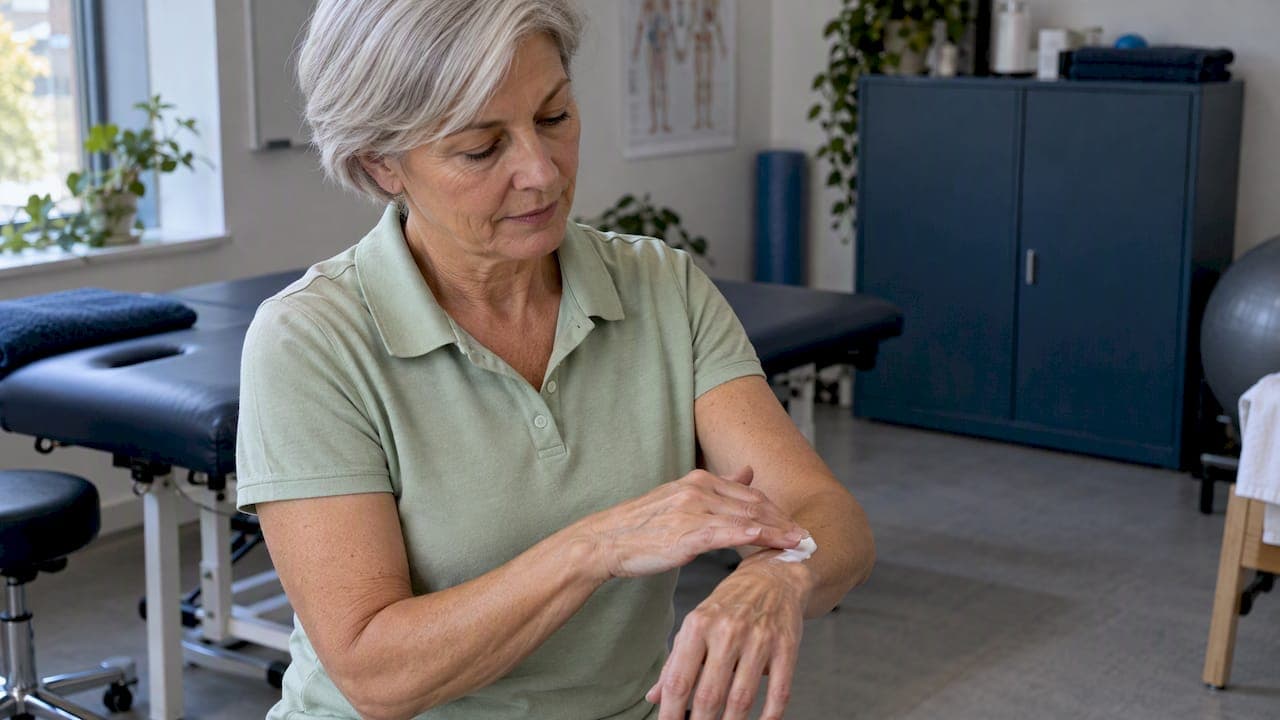
Menthol CBD cream can give short-term relief from minor muscle and joint aches. Most of that relief comes from menthol, which cools the skin and changes how pain feels for a while. The CBD part is less proven. Trials of topical CBD are mixed. This guide covers what each ingredient does, what the studies found, and how to use a menthol CBD product safely.
TL;DR
- Menthol is a counterirritant. It cools the skin and can temporarily change how pain feels.
- Evidence for topical CBD is limited and mixed. One arthritis trial was positive. A sore-muscle trial and a knee surgery trial were not.
- Use it on intact skin only. Keep it away from eyes, wash your hands, and skip tight wraps and heat.
- Talk to a doctor before use if you take blood thinners or seizure medicine, or if you are pregnant or breastfeeding.
- Pain that lasts more than seven days needs a doctor, not more cream.
Table of Contents
- What menthol CBD cream is
- How menthol works on the skin
- Menthol CBD cream benefits: what you can reasonably expect
- Menthol versus CBD: who does what
- Our perspective
- How to apply it
- Side effects and safety
- Is it legal, and do you need a prescription?
- Who is most likely to benefit
- A fair trial in four steps
- Our balms
- FAQ
- Sources
What menthol CBD cream is
It is a topical product that pairs cannabidiol (CBD) with menthol, usually in a balm, cream or gel base. Menthol is the cooling compound from mint plants. Many formulas add other botanicals such as arnica, eucalyptus or peppermint.
The two ingredients do different jobs. Menthol gives a fast, noticeable sensation. CBD is the ingredient with more open questions.
A topical is meant to act where you put it. A 2021 peer-reviewed review of topical cannabinoids explains that topical products are generally intended to stay local, while transdermal systems are built to cross the skin barrier and enter the bloodstream. The same review notes that CBD is highly lipophilic and has low water solubility, so penetration enhancers matter. It also says absorption and effect vary by formulation and should be judged product by product.
How menthol works on the skin
A 2018 review in the Journal of Clinical Pharmacy and Therapeutics describes menthol as a topical counterirritant. It activates a cold-sensing receptor called TRPM8. It first stimulates pain-sensing nerve endings in the skin, then desensitizes them. The result is a cooling feeling that can temporarily change how pain is perceived.

The same review reports that menthol can widen blood vessels in the skin. It also warns that high concentrations can irritate skin or cause cold-triggered pain.
The Arthritis Foundation puts it plainly: menthol and camphor products work by distracting you from pain with a cooling sensation, and relief may fade when the cooling wears off.
That is the honest core of the benefit. Menthol does not repair tissue. It changes what you feel for a while.
Menthol CBD cream benefits: what you can reasonably expect
Quick cooling and a change in how pain feels
This is the most dependable benefit, and it comes from menthol. You feel it within minutes. For minor aches, that can make it easier to move, stretch or rest. Dr. Mark Pfefer, writing in a review of topical products for pain relief, describes topical menthol as a useful ongoing self-care option that may help with sleep and with the ability to exercise, as long as it is used with care.
Sore muscles after exercise
Here the picture is less clear. In a randomized trial of 21 people with delayed onset muscle soreness, a topical CBD ointment did not significantly change inflammation, strength or soreness compared with placebo.
Menthol has a better track record for the feeling of soreness. An evidence guide from The Workout Mag lists typical menthol concentrations of 2.5 to 10% and rates the evidence for sore muscles as moderate. It also says menthol does not restore performance or resolve soreness. Treat it as symptom management, not as a recovery shortcut.
For more on this, see our look at what the evidence shows for CBD and muscle recovery and our notes for weightlifters trying topical CBD.
Joint aches and arthritis
One randomized controlled trial found that CBD applied twice a day (6.2 mg/mL in shea butter) significantly improved patient-reported pain and disability in thumb base arthritis, with no adverse events. That is a real result. It is also one small condition and one formula, without menthol.
On the other side, a prospective randomized trial after total knee replacement found that topical CBD added to a standard pain protocol did not reduce pain or opioid use, or improve sleep.
The Arthritis Foundation says evidence for topical CBD is limited and mixed. Its guidance is to treat it cautiously, because few high-quality studies show whether CBD reaches an arthritic joint or consistently improves pain.
If you want the joint-specific detail, we cover it in CBD balm for arthritis, topical CBD for osteoarthritis and a short trial approach for shoulder arthritis.

Tight spots and muscle knots
Menthol's cooling effect can make a tender spot feel easier to work on. That is a feeling, not proof the knot has released. Our page on CBD for muscle knots covers what studies do and do not show.
Menthol versus CBD: who does what
| Ingredient | What it likely does | Strength of evidence |
|---|---|---|
| Menthol | Cooling, counterirritant effect that changes pain perception for a short time | Moderate for sore muscles, short-lived |
| CBD | Possible local effect on pain and inflammation | Limited and mixed |
| Arnica | Traditionally used for bruises | See our page on arnica CBD balm |
If a cream feels great, you cannot tell from the sensation alone which ingredient is responsible. Our piece on warming versus cooling balms makes the same point: tingles are not proof. A related page covers arnica and menthol for pain.
Our perspective
We make topical balms, so we hold ourselves to a plain standard. We do not claim a balm cures arthritis or repairs muscle. The research does not support that.
What we hear from athletes and from people with chronic aches is simple. They want something they can rub on a sore spot that feels good and helps them get moving. Menthol, arnica and the other botanicals in our balms are part of that. Our balms use 1,000mg of CBD per ounce, and they are THC-free, vegan, non-GMO, paraben-free and cruelty-free.
We also think a trial period is the right way to judge any balm. Use it the same way for two to three weeks. Note your pain before and after. If you see no change, stop. That is why we offer a full refund within 30 days of purchase.
We would rather you buy one tin, test it honestly and keep what works.
— Cindy
How to apply it
The Arthritis Foundation's topical treatment guidance gives a good checklist:
- Apply only to intact skin. Not on cuts, rashes or irritated skin.
- Read the ingredient list first.
- Do not use tight bandages or heating devices over counterirritants such as menthol.
- Wash your hands after applying.
- See a doctor if skin, pain or irritation changes last more than seven days.
The Cleveland University review adds that a disposable glove is prudent when applying menthol products. It protects sensitive areas, and you keep the product away from your eyes.
Start with a thin layer. Wait a few minutes. If you feel burning rather than cooling, wash it off.
What to check on the label
- CBD amount per container. Look for the total milligrams, not just a large front-label number.
- Other active ingredients. Menthol, camphor and arnica each change how the product feels and who should avoid it.
- THC content. Hemp-derived products should state less than 0.3% THC. Ours are THC-free.
- Third-party testing. Look for a lab report you can read.
- Return policy. A trial is easier when you can get your money back.
The Boehnke review in a rheumatology journal suggests choosing products with Good Manufacturing Practice certification and less than 0.3% THC, from makers who do not advertise health benefits. Read that last point as a prompt to be skeptical of big promises on any label, ours included.
Side effects and safety
The most likely problem is skin irritation. The menthol review notes that high concentrations can irritate skin. Test a small patch first, especially if you have sensitive skin.
CBD itself carries known risks when taken in other ways. The FDA's consumer page says CBD has known risks, including liver toxicity, extreme sleepiness and harmful drug interactions. Those risks are mostly discussed for swallowed products. How much a topical adds to your bloodstream is not well settled, so caution makes sense.
Specific situations call for a call to your doctor or pharmacist first:
- You take warfarin or another anticoagulant, or an anticonvulsant such as valproate. The Boehnke review says physicians should monitor for CBD interactions with these drugs, which use similar enzyme systems.
- You are pregnant or breastfeeding. The FDA page above advises talking to a health professional.
- You have osteoarthritis and are weighing supplements or other options. The NCCIH notes that exercise and weight loss are part of management, and that you should discuss supplements with your provider.
- Pain is severe, getting worse, or has lasted more than seven days. A cream is not a diagnosis.
Keep all balms away from children.
Is it legal, and do you need a prescription?
In the US, the 2018 Farm Bill removed hemp with less than 0.3% THC from the Controlled Substances Act, which effectively legalized hemp-derived CBD, according to a 2022 review. You do not need a prescription for a hemp-derived CBD cream.
The FDA has warned vendors about mislabeling and illegal medical claims. In one 2019 warning letter, it said a seller's CBD products, including a topical relief cream, were unapproved new drugs. That is why reputable brands avoid promising to treat or cure a disease. State rules also differ, so check yours.
Who is most likely to benefit
Menthol CBD cream suits some people better than others.
- Active people with sore muscles. A cooling rub after training can feel good. Expect comfort, not faster recovery.
- People with mild, localized joint aches. A trial of two to four weeks is reasonable, alongside the exercise and care your doctor recommends.
- People who dislike pills. A topical keeps the product on the sore spot.
It is a poor fit if you want a proven anti-inflammatory for osteoarthritis. The Workout Mag guide notes that topical NSAIDs have stronger clinical evidence for joint inflammation, while evidence for CBD topicals is limited. Ask your doctor whether that option fits you.
A fair trial in four steps
- Pick one product. Changing creams mid-test muddies the result.
- Rate your pain from 0 to 10 before you apply and one hour after.
- Use it the same way for two to three weeks.
- Stop if skin reacts or nothing changes. Keep what is worth the cost.
This is how you separate the menthol feel from any lasting effect.
Our balms
Our Seriously Soothing Pain Balm and RIKKI TIKKI Recovery each combine 1,000mg of CBD per ounce with arnica, menthol and other botanicals such as eucalyptus, peppermint, turmeric, ginger and cayenne pepper. They are priced from $26.95 to $39.95. Choose from original, cinnamon and clove, or lavender lemongrass scents. Every order is covered by a 30-day full refund.
Shop our CBD pain balms or start with the original Seriously Soothing Pain Balm. If you are comparing against over-the-counter rubs, see our page on alternatives to menthol rubs for muscle soreness and arthritis.
FAQ
Does menthol CBD cream work for pain?
Menthol can briefly ease the feeling of minor muscle and joint pain by cooling the skin. CBD's added benefit is unproven. One trial helped thumb arthritis, while others found no effect on soreness or post-surgery pain.
Do you need a prescription to get CBD cream?
No. Hemp-derived CBD with less than 0.3% THC is federally legal in the US under the 2018 Farm Bill. State rules can differ, and sellers should not claim their product treats disease.
Can CBD cream interact with medications?
The main concern is with blood thinners such as warfarin and seizure drugs such as valproate. Ask your doctor or pharmacist before using it if you take either. How much a topical reaches the bloodstream is not well established.
How often can I apply it?
Follow the directions on your product's label. Use a thin layer on intact skin, wash your hands afterward, and avoid tight wraps or heat over the area. If pain or skin changes last more than seven days, see a doctor.
Sources
- The role and mechanism of action of menthol in topical analgesic products
- Safety and Sourcing of Topical Cannabinoids
- Topical cannabidiol and delayed onset muscle soreness trial
- Randomized controlled trial of topical cannabidiol for thumb arthritis
- Topical CBD after total knee arthroplasty
- A Review of Topical Products for Pain Relief
- Muscle and Joint Relief Cream: Do Topical Analgesics Work?
- Topical Treatments for Arthritis Pain, Arthritis Foundation
- Cannabidiol (CBD) in Rheumatic Diseases
- FDA: What You Should Know About Using Cannabis, Including CBD
- FDA warning letter, 2019
- Osteoarthritis: In Depth, NCCIH