
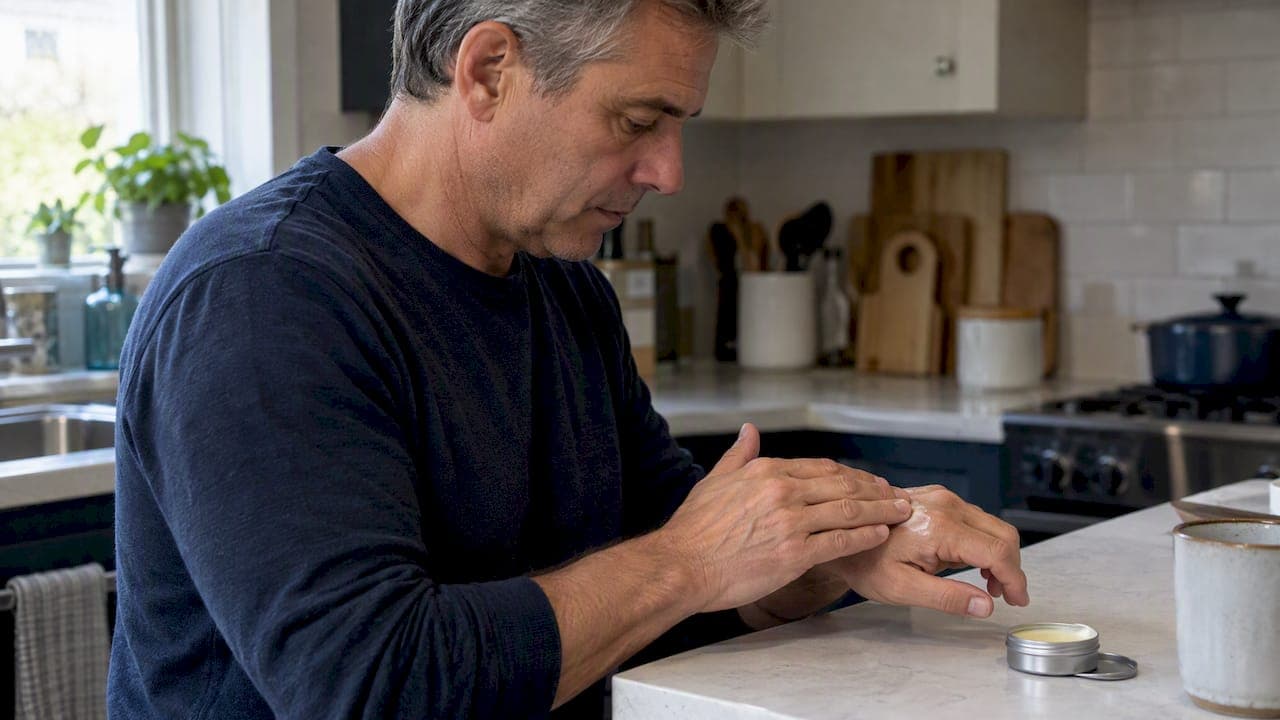
Yes, arnica and menthol can give short-term relief for sore muscles and achy joints, though the two do different jobs. Menthol cools the skin and quickly changes how pain feels. Arnica has modest, mixed evidence. Patch-test first, follow the product label, and know that the FDA has reported rare burns from some menthol products. We offer CBD balms that combine these botanicals.
TL;DR:
- A single hand osteoarthritis trial found arnica gel’s average benefit was about 3.8 points on a 100 point pain scale, similar to topical ibuprofen.
- Menthol’s cooling relief depends on concentration: low to moderate levels soothe, while higher amounts can irritate skin or trigger cold hypersensitivity.
- Follow label directions and patch test for 24 hours; rare burns can follow one use, so stop if blistering, swelling, or worsening pain develops.
- CBD balms may ease localized symptoms, but they are not proven to change arthritis; check third party testing, full ingredients, and stated CBD strength.
- Seek medical advice for severe or worsening pain, pain after a fall, swelling or numbness, or symptoms that persist beyond a couple of weeks.
Table of Contents
- How do menthol and arnica work on sore muscles and joints?
- What does clinical research say about topical arnica and menthol?
- How do you use arnica and menthol topicals safely?
- What should you check before choosing a balm?
- When does a CBD topical balm make sense?
- Why does ingredient transparency matter so much?
- Where can you try a balm with arnica and menthol?
- FAQ
- Sources
How do menthol and arnica work on sore muscles and joints?
Menthol and arnica act in different ways, and knowing the difference tells you what to expect when you rub a balm on.
Menthol works through sensation. It activates TRPM8, a cold-sensitive channel on nerve endings, which creates the cooling feel and dampens how strongly pain registers. Research indicates that TRPM8 is the principal mediator of menthol-induced analgesia for acute and inflammatory pain. The effect depends on dose. A 2022 review explains that low-to-moderate concentrations produce cooling analgesia, while higher concentrations can irritate the skin or cause cold hypersensitivity through a different channel called TRPA1.
Arnica is a plant extract used in gels, creams and salves. Some preparations may calm inflammatory pathways, but results vary by formulation. Cleveland Clinic notes that clinicians may suggest arnica for bruising and aches partly based on patient experience, while research quality stays limited.
Here is what that means in practice:
- Menthol is a sensory tool. The cooling feeling can make a sore area feel better, but it does not prove that inflamed tissue has been treated.
- Arnica is a botanical with limited proof. Its evidence belongs to specific preparations and conditions, such as hand osteoarthritis.
- Relief is not repair. Both ingredients help with symptoms. Neither should be treated as a proven way to change the course of arthritis or speed muscle healing.
- A combined product is not automatically a tested product. A balm that lists both ingredients has not necessarily been studied as a combination, so judge it by its own formulation and label.
Menthol's analgesic effect is concentration dependent: low-to-moderate levels cool and soothe, while higher levels can irritate the skin. More is not better.
What does clinical research say about topical arnica and menthol?
The evidence is real but thin, and it is worth reading at the right strength.
For arnica, the best-known source is a systematic review of topical herbal therapies for osteoarthritis. It found moderate evidence from a single study that arnica gel probably gives small benefits similar to topical ibuprofen for hand osteoarthritis, with a mean difference of about −3.8 points on a 0–100 pain scale. The same review stresses that studies are limited and more high-quality trials are needed. A PubMed record of the review summarizes seven studies and reaches the same cautious conclusion: arnica gel probably helps symptoms about as much as a topical anti-inflammatory in limited trials, but the quantity and quality of evidence fall short of definitive.
For menthol, the support is mostly mechanistic. Laboratory and genetic work explains why it cools and numbs, and reviews describe it as an active area of analgesia research. How much benefit you get from a given product depends on its formulation and dose.
Combination products and sports-recovery evidence remain limited. Claims of less soreness or quicker recovery should be treated as unproven.
Here is the honest summary:
- Arnica: small, possibly real benefit in some trials, with mixed results and small sample sizes overall.
- Menthol: reliable short-term sensory relief, tied to concentration.
- Combinations: promising in theory, thin in controlled testing.
- Adverse events: the main documented concern is skin irritation and, rarely, burns, covered in the next section.
The practical takeaway: expect modest, temporary relief of aches, not lasting improvement of an underlying joint condition. If you want deeper background on one half of the pairing, our guide to arnica for muscle pain covers formulations and application tips, and our look at arnica CBD balm evidence explains why the proof is stronger for bruises than for widespread pain.
Treat any claim that a balm "cures" arthritis or repairs muscle as marketing, not science. A good result looks like an easier afternoon, a stiff knee that loosens enough to walk comfortably, or a sore shoulder that settles for a few hours. That is a useful outcome, and it is the realistic one.
How do you use arnica and menthol topicals safely?
The FDA has reported rare serious burns from over-the-counter topical muscle and joint pain products. Burns sometimes appeared after a single application and within 24 hours, and the agency advises stopping use if pain, swelling or blistering develops. The agency's Spanish-language safety communication on burns documents second- and third-degree cases and notes that higher concentrations matched more severe events.
These events are rare. Careful use lowers the odds further.
- Read the label first. Check the active ingredients, the concentration if listed, and the stated directions.
- Patch-test. Apply a small amount to a coin-sized spot on your inner forearm and wait 24 hours before using more widely.
- Use intact skin only. Keep balm off cuts, rashes, sunburn and irritated skin.
- Start with a thin layer. Rub it in gently on the sore area, then wash your hands.
- Follow the labeled frequency. A DailyMed-listed cream illustrates why you should follow the directions on your own product label. Do not assume products have the same directions.
- Skip heat and tight wraps. Do not add a heating pad or cover the area tightly.
- Stop at the first warning sign. Blistering, severe irritation or worsening pain means wash the area and discontinue.
Pro Tip: Keep your first few applications small and spaced out. If your skin looks calm, you can use the balm as directed with more confidence.
Some people should check with a clinician before using any menthol or arnica topical: those who are pregnant, anyone treating a child, people with broken or very sensitive skin, and anyone whose pain is severe, worsening or not tied to an obvious strain. Pain that follows a fall, comes with swelling or numbness, or lasts well beyond a couple of weeks deserves a professional look rather than another layer of balm.
Our overview of CBD balm side effects goes further on skin reactions, if you want a longer read before you buy.
What should you check before choosing a balm?
Labels tell you most of what you need. A few minutes of reading keeps you away from weak or risky products.

Start with the actives. A DailyMed example label lists arnica montana at 1%, menthol above 1% and methyl salicylate above 1%, and notes that directions differ from product to product. That shows why concentrations matter: two balms with the same ingredient names can behave very differently.
Use this checklist:
- Menthol amount: look for a stated percentage and be cautious with high concentrations.
- Methyl salicylate or camphor: know whether they are present, since the FDA's burn reports center on menthol and methyl salicylate products.
- Arnica form: "Arnica montana" should appear in the ingredient list, not just on the front of the jar.
- Formulation type: gels feel light and cool on large areas, creams absorb moderately, and salves or balms sit on the skin longer and suit small, stubborn spots.
- Lab reports: third-party testing shows what is actually in the jar.
- Directions and allergens: clear use instructions and allergen information signal a careful maker.
- Realistic claims: "temporary relief of aches" is honest; "cures arthritis" is not.
- Return policy: a refund window lets you try a product with less risk.
| What to check | Why it matters | What a good label shows |
|---|---|---|
| Menthol percentage | Effect and irritation both depend on dose | A stated percentage |
| Methyl salicylate or camphor | Linked to FDA burn reports at higher levels | Clearly listed amounts |
| Arnica montana | Evidence belongs to specific preparations | Named in the active or ingredient list |
| Usage directions | Frequency limits reduce skin risk | Frequency and body areas spelled out |
| Third-party testing | Confirms contents | Accessible lab report |
Check the product label for its active ingredients and directions, since formulations and labeling can vary. If a product hides its ingredient amounts, that is a reason to look elsewhere. For help reading ingredient lists, see our piece on balm ingredients that matter, and if you are leaving a traditional rub behind, our Icy Hot alternatives guide compares options.
When does a CBD topical balm make sense?
A CBD topical balm adds a cannabinoid to the menthol and arnica pairing. It is a reasonable pick when you want a multi-ingredient product for recurring, localized discomfort and you are comfortable treating it as a symptom tool.
The people most likely to be happy with one are those with repeat muscle soreness, athletes looking for recovery support, and anyone with a chronic, localized joint ache who prefers a single topical over several.
Before you buy, verify:
- Third-party cannabinoid testing: a lab report that confirms CBD content and screens for contaminants.
- Ingredient transparency: every active and botanical named, not hidden under "proprietary blend."
- Stated strength: CBD concentration per ounce spelled out.
- Seller policies: a 30-day refund is a useful trust signal.
Keep expectations in line with the evidence. CBD topicals are not proven to modify arthritis. They are tools for easing how an area feels, used alongside rest, movement and medical care where needed.
Why does ingredient transparency matter so much?
I read the label before I read the marketing, and I think you should too. A balm earns trust when it tells you what is inside, how much, and how to use it, and when a third party has checked the jar. The warmth or chill you feel in the first minute is not the test of a good product. The test is how your skin looks a day later.
My advice is simple: patch-test, use a small amount first, and watch how your skin responds before you commit to regular use. Our own balms are built around that approach, with testing and a refund window behind them. If a product asks you to skip the careful steps, skip the product.
— Cindy
Where can you try a balm with arnica and menthol?
We make two balms for people who want topical relief for sore muscles and achy joints:
- Seriously Soothing Pain Balm: a CBD balm with botanical ingredients including arnica and menthol, for muscle soreness and arthritis discomfort.
- RIKKI TIKKI Recovery: a recovery balm aimed at athletes and anyone dealing with post-activity soreness.
Both are priced at $26.95–$39.95, and every order comes with a refund policy. Our products are third-party tested, THC-free, vegan and paraben-free. You can shop our pain balms or go straight to the Seriously Soothing Pain Balm or the RIKKI TIKKI Recovery tin.
Whichever balm you choose, patch-test first and follow the label directions. Pick a variant, try a small amount on your forearm, and check back in a day.
This article is general information, not a substitute for advice from a qualified doctor. Consult a qualified healthcare professional about your own circumstances before acting on anything here.
FAQ
Does arnica actually relieve pain?
Arnica may give small benefits in some topical forms, but the evidence is limited. One review found moderate evidence from a single study that arnica gel performed similarly to topical ibuprofen for hand osteoarthritis, and called for more high-quality trials.
What is a good cream with menthol for pain relief?
A good menthol cream lists its menthol percentage, gives clear directions and avoids unneeded extras. Check for methyl salicylate amounts, patch-test first and follow the labeled frequency, since the FDA reports rare burns tied to higher concentrations.
What do the Amish use for joint pain?
We have no reliable source describing what the Amish use, so we cannot say. For achy joints in general, topical options such as arnica or menthol balms offer temporary relief, and persistent joint pain is worth discussing with a clinician.
Which arnica is best for arthritis pain?
No single arnica product is proven best for arthritis. Evidence comes from specific preparations, such as arnica gel in hand osteoarthritis trials, so check the label for arnica montana and treat results as modest and temporary.
Sources
- DailyMed - ECM PAIN RELIEF- menthol, methyl salicylate, arnica cream
- Fda
- Topical herbal therapies for treating osteoarthritis
- TRPM8 is the principal mediator of menthol-induced analgesia of acute and inflammatory pain