
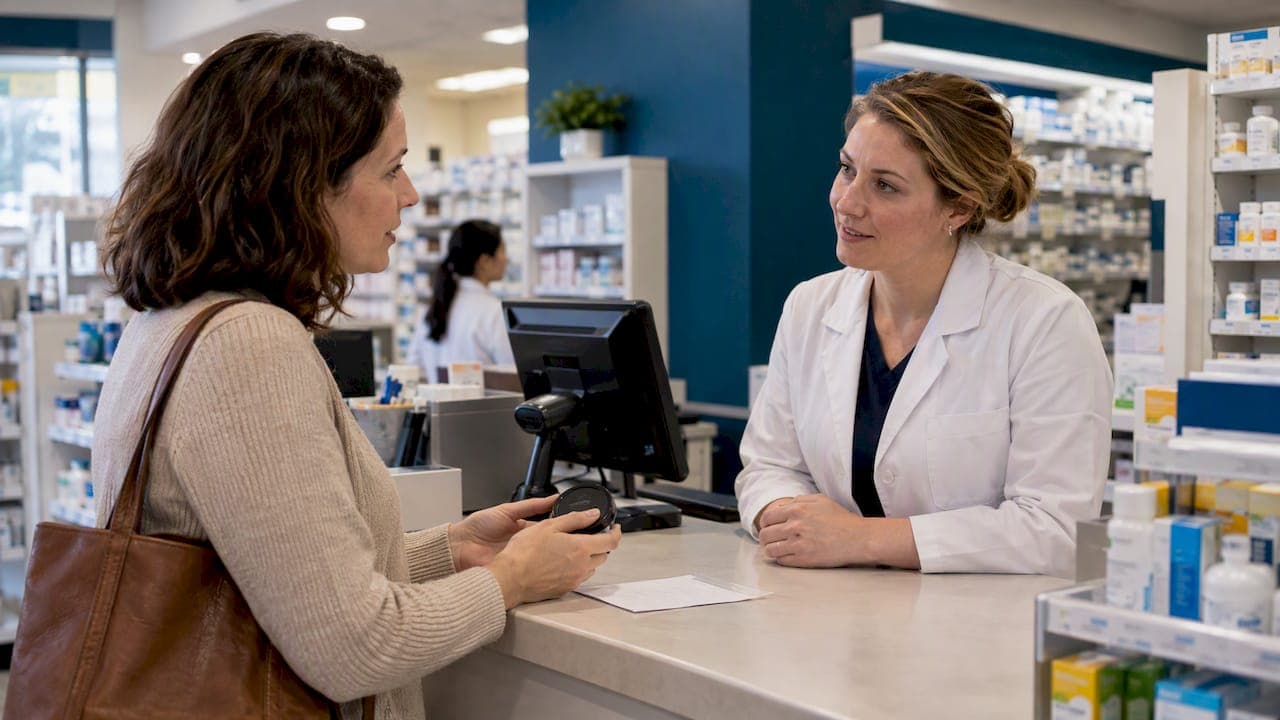
A CBD balm can interact with medications, but the risk looks lower than with oral CBD. Balms are made to act on the skin, and studies so far find little CBD in the blood after topical use. Lower is not zero. The risk depends on the product, how often you apply it, how much you use and what else you take. If you take a prescription drug with a narrow safety margin, ask a pharmacist before you start.
TL;DR
- The FDA warns that CBD can change how other medications work. That evidence mostly concerns oral CBD.
- Topical balms appear to reach the bloodstream in small amounts. Absorption varies by formula, and transdermal patches are built to do more.
- Warfarin, valproate, tacrolimus and sirolimus are the drugs most often named in interaction reports. Sedatives such as alcohol, opioids and benzodiazepines also need attention.
- Older adults, people on several medications and people with liver disease should talk to a doctor or pharmacist first.
- Bring the exact product label to the pharmacy. Ask about every CBD product you use, not only the balm.
Table of Contents
- Why CBD interacts with medications at all
- Does topical CBD get into your bloodstream?
- Topical, oral and patch compared
- Which medications deserve the most care
- How strong is the evidence?
- Label accuracy is part of the interaction question
- A safer way to use a CBD balm if you take medication
- What a pharmacist will want to know
- Perspective
- Try a balm built for local relief
- FAQ
- Sources
Why CBD interacts with medications at all
Most interaction concerns come from one mechanism. CBD and its main active metabolite affect cytochrome P450 enzymes, including CYP3A4 and CYP2C19. Your liver uses these enzymes to break down many medications. If CBD slows an enzyme, a drug can stay in the body longer and build up. If it speeds an enzyme, a drug can wear off sooner.
There is a second route. Some medications make you drowsy or lightheaded. CBD may do the same, so effects can stack. The Harvard Health review notes that using CBD with CNS depressants such as alcohol, opioids or benzodiazepines may raise the risk of heavy sedation, fatigue and falls.
Both routes depend on how much CBD gets into the blood. That is the key question for a balm.
Does topical CBD get into your bloodstream?
Some does, in small amounts, and the amount depends on the product.
Harvard Health puts it carefully. Creams and lotions may not enter the blood in amounts large enough to interact, but little is known about how much CBD gets there. That is a real limit, and it is why a pharmacist check is worth the five minutes.
A 2024 study gives some numbers. In the trial, people used hemp-derived topical products twice a day for 10 days. Peak blood CBD reached up to 2 ng/mL, far below what oral or vaporized CBD typically produces. The same paper found that systemic exposure varied by formulation. Lotions, creams and gels with permeation enhancers showed higher exposure than balms or patches.
A Society of Toxicology and FDA colloquium presentation describes the same study. Overall absorption was low. No blood cannabinoids were detected after 10 days with the tested patch and balm. Repeated use of the tested lotion, cream and gel led to accumulation.

A dermatology review from 2021 argues that safety has to be judged product by product. The base, the skin penetration and the enhancers can all change how much CBD reaches the blood. For a deeper look at skin absorption, see our write-up of human trials on CBD and the skin.
Topical versus transdermal
The words are not interchangeable. The same dermatology review separates the two. Topical products are meant to act locally without entering systemic circulation. Transdermal systems are designed to cross the skin barrier and raise systemic levels. That makes transdermal patches more relevant to interaction risk than an ordinary balm.
A balm rubbed on a sore knee and a patch built for steady delivery into the body are different products. Read the label to see which one you hold.
Topical, oral and patch compared
| Format | Intended action | Interaction relevance | What to check |
|---|---|---|---|
| Balm or salve | Local, at the skin | Lower, but not well measured | Area covered, frequency, other CBD products |
| Cream, lotion or gel | Local, may include permeation enhancers | Moderate in some studies, with accumulation on repeat use | Ingredient list, daily amount |
| Transdermal patch | Designed to enter the bloodstream | Higher | Ask a pharmacist before use |
| Oral oil, capsule or edible | Systemic | Highest, and the main source of interaction data | Dose, timing, all medications |
If your goal is local pain relief, the comparison in topical CBD versus oral CBD for pain explains why many people choose a balm.
Which medications deserve the most care
No list covers every drug, and a pharmacist will know your full regimen. The research points to some groups.
Narrow-margin drugs. A 2024 systematic review found that interactions with cannabinoids involving warfarin, valproate, tacrolimus and sirolimus were the most widely reported and may pose the greatest risk. These are drugs where a small change in blood level matters. Warfarin is a blood thinner. Valproate is used for seizures and mood disorders. Tacrolimus and sirolimus are used after organ transplants.
Sedating drugs. Alcohol, opioids and benzodiazepines are the main group. The concern is added drowsiness, as covered above.
Antidepressants, stimulants and other common prescriptions. Readers often ask about Zoloft and Adderall. We found no solid clinical study on a CBD balm with either one, so we will not claim a safe or unsafe answer. What can be said is general. Many drugs are cleared by CYP enzymes, and CBD affects some of them. Whether that matters depends on the drug, the dose and how much CBD reaches your blood. Ask your prescriber or pharmacist, and name the exact balm and how often you use it.
Older adults. Geriatric experts stress that older adults face both pharmacokinetic and pharmacodynamic interactions because of polypharmacy. Harvard Health also lists older age as a higher-risk factor because of age-related changes in how the body handles drugs.
For a wider look at how CBD and metabolism interact, this guide on CBD and medication metabolism covers the main drug groups.

How strong is the evidence?
It is thinner than many articles suggest. A 2021 comprehensive review concluded that predicted interactions based on in vitro work, animal data or mechanisms have not been established clinically. Some of those findings may need concentrations higher than ordinary use produces. The authors recommend cautious, monitored use and more human trials.
The FDA is open about the gaps too. It says information on cumulative exposure across product types is very limited. One example is eating a CBD gummy while also using a topical. It also says it does not know what level of intake triggers known risks.
Two practical points follow:
- Your total CBD from all products is the number that matters, not the balm alone.
- Absence of proof of an interaction is not proof of safety.
Label accuracy is part of the interaction question
An interaction check only works if the label tells the truth. The FDA has not approved any non-prescription CBD products. Poison Control notes that supplements and other non-pharmaceutical CBD products are not FDA-regulated and may be contaminated or may not contain what the label says.
A laboratory assessment of over-the-counter CBD products sold in the U.S. found that only 26 of 84 were accurately labeled, and 21% contained THC that was not listed. If you take medication, that uncertainty matters. So does it for people who face drug testing; our guide on CBD cream and drug tests covers that.
When you shop, look for:
- A clear CBD amount per container or serving.
- A full ingredient list, so a pharmacist can review every component, not only CBD.
- Third-party lab results you can read.
- A stated THC status.
The checklist in choosing a CBD cream goes through these checks in more detail. The difference between isolate and full spectrum topicals also affects what ends up on your label.
A safer way to use a CBD balm if you take medication
This is a practical routine, not a medical instruction. Your clinician has the final say.
- List everything you take. Include prescriptions, over-the-counter medicines, supplements and any other CBD products.
- Call or visit your pharmacist. Tell them the product name, the CBD amount and the ingredients. Ask directly whether any of your drugs rely on CYP3A4 or CYP2C19.
- Tell your prescriber if you use warfarin, valproate, tacrolimus or sirolimus. These need the closest attention.
- Start with a small area and a small amount. Use one product at a time so you can tell what causes what. Our guide to CBD dosage for topicals shows how to measure a starting amount.
- Avoid stacking CBD forms without advice. A balm plus an oral oil raises total exposure.
- Watch for symptoms. Harvard Health lists drowsiness, lightheadedness, nausea and diarrhea as possible CBD effects. Contact your doctor or pharmacist if they appear, or if you notice your regular medication acting differently. Our page on CBD balm side effects covers skin reactions.
- Keep the packaging. The batch and lot information helps if a question comes up later.
People with liver disease or heart problems should ask before using any CBD product. Harvard Health names these conditions as reasons for a doctor's input. The FDA also notes that animal studies reported male reproductive toxicity from CBD exposure, and that it is not yet clear what this means for humans. If you are pregnant or nursing, read our pregnancy and athlete safety guide and talk with your clinician.
What a pharmacist will want to know
Bring these facts:
- Product name and the CBD amount on the label.
- Where you apply it and how many times a day.
- How long you have used it.
- Whether you also take CBD by mouth.
- Your full medication list, including alcohol use.
The U.S. Pharmacist review of CBD in older adults advises that people using or considering CBD tell their doctor, especially with other medications or underlying conditions. A pharmacist can assess potential interactions and is often easier to reach than a physician.
Perspective
We make balms for people who need targeted relief: athletes, active people and those living with chronic or arthritis pain. That is why we pay attention to this question.
Our Seriously Soothing Pain Balm and RIKKI TIKKI Recovery are topicals. They are made to be rubbed onto the sore spot. We formulate them with 1,000mg of CBD per ounce plus botanicals such as arnica, menthol, turmeric, eucalyptus and ginger. The aim is local comfort on the muscle or joint that hurts. We say this as our own design intent, and we do not present it as a medical claim.
Our view is simple. A balm gives you a way to focus on the area that bothers you, and the published research suggests balms are a lower-exposure format than oral products. We still tell customers on prescriptions to speak with a pharmacist first. Good products come with good questions.
We also stand behind the purchase. If a balm is not right for you, we offer a full refund within 30 days.
Cindy
Try a balm built for local relief
If you have cleared a CBD topical with your pharmacist, our Seriously Soothing Pain Balm and RIKKI TIKKI Recovery are available at $26.95 to $39.95, depending on size. Both are THC-free, vegan and non-GMO. We offer a full refund within 30 days of purchase.
Browse the full line at Mongoose CBD Co., or start with RIKKI TIKKI Recovery for muscle recovery. For a comparison of what to look for in a product, see our page on the best CBD cream for pain, and learn why balm ingredients matter beyond milligrams.
FAQ
Are there drug interactions with topical CBD?
They are possible, but less well documented than with oral CBD. The FDA warns that CBD can change how other medications work. Harvard Health says creams and lotions may not enter the blood in sufficient amounts to interact, though little is known about how much does. Ask a pharmacist if you take prescriptions.
Does topical CBD cream get into your bloodstream?
A small amount can. In a 2024 study, twice-daily topical use for 10 days produced peak blood CBD of up to 2 ng/mL. Absorption differed by formula, with creams, lotions and gels containing permeation enhancers showing more exposure than balms or patches.
Can I use a CBD topical with Adderall or Zoloft?
We cannot give you a yes or no, and we are not aware of a clinical study on a CBD balm with either drug. Both are processed by the body in ways that CBD may touch in theory. Ask your prescriber or pharmacist, giving the balm name, strength and how often you apply it.
Is a CBD patch riskier than a balm?
It can be. Transdermal patches are designed to cross the skin and raise systemic levels, while ordinary balms are meant to act locally. That makes patches more relevant to medication interactions. Check with a pharmacist before combining a patch with other drugs.
Who should be most careful with CBD topicals?
Older adults, people taking several medications, and anyone on warfarin, valproate, tacrolimus or sirolimus. People with liver disease or heart conditions should also ask first. Pregnant and nursing readers should speak with their clinician.
Sources
- FDA: What You Need to Know About Products Containing Cannabis or Cannabis-Derived Compounds, Including CBD
- Harvard Health: CBD and other medications, proceed with caution
- Journal of Analytical Toxicology: Pharmacokinetics and pharmacodynamics of five distinct topical CBD products
- Society of Toxicology/FDA Colloquium 2024: Contemporary Issues in Risk Assessment
- Safety and Sourcing of Topical Cannabinoids (2021)
- Systematic review of drug-drug interactions of cannabinoids (2024)
- Potential Adverse Drug Events and Drug-Drug Interactions with Cannabidiol
- Today's Geriatric Medicine: Cannabis-Drug Interactions, A Special Risk for Older Adults
- Cannabidiol Interactions with Medications, Illicit Substances, and Alcohol
- U.S. Pharmacist: Cannabidiol Use in Older Adults
- Poison Control: CBD products, are they safe?