
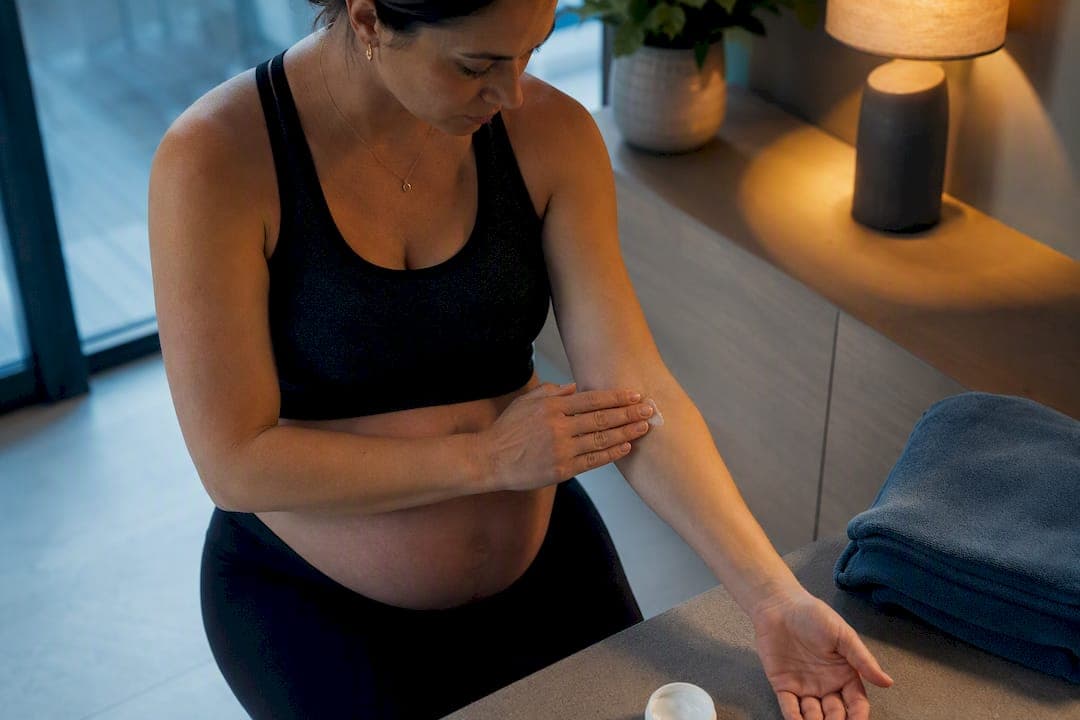
Topical CBD balms are generally well tolerated, and research on formulations like the ones studied in tolerability trials with elite athletes backs that up, with most side effects limited to minor skin dryness or rash. Some brands have built their balms around that lower-risk profile compared to swallowing an oral CBD product. The real caveat: how much relief you get, and how much CBD actually crosses your skin, depends heavily on the formulation and the condition of the skin you're applying it to.
TL;DR:
- Simple balms without permeation enhancers generally provide localized relief with minimal systemic absorption and low risk of drug interactions.
- Formulation details like vehicle type, concentration, and cannabinoid profile are crucial for predictability and safety, especially when avoiding THC or contaminants.
- Topical CBD shows promise for chronic joint pain but lacks consistent evidence for post-exercise muscle recovery benefits.
- Pregnant individuals should avoid topical CBD unless advised by a healthcare provider due to uncertain fetal exposure risks.
- Conduct a small, short-term patch test and discuss product specifics with a doctor before starting topical CBD, especially during pregnancy or with medication concerns.
Table of Contents
- How Topical CBD Absorption Works and Why Formulation Matters
- What Clinical Studies Say About Topical CBD for Pain and Recovery
- How to Pick a Safer, Better-Formulated CBD Balm
- How to Apply Topical CBD Safely
- What Official Guidelines Say About CBD Topical Use During Pregnancy
- Potential Risks to Pregnancy and Fetal Development From Topical CBD
- Interactions and Contraindications With Pregnancy Medications or Conditions
- Talk to Your Provider Before Using CBD During Pregnancy
- A Practical, Low-Risk Way to Test Whether Topical CBD Works for You
- Why Mongoosecbd Balms Fit a Safety-First Buyer's Checklist
- Sources
How Topical CBD Absorption Works and Why Formulation Matters
Your skin's outermost layer, the stratum corneum, is built to keep things out. It's a dense barrier of dead skin cells and lipids, and it's genuinely good at its job. CBD happens to be highly lipophilic, meaning it's fat-soluble, which helps it interact with the skin's own lipid layers but doesn't guarantee it travels any deeper than the surface tissue.
That distinction turns out to matter more than most product labels let on. A comparative study of five commercial hemp-derived CBD products found that only three actually produced measurable systemic absorption, and the difference came down to vehicle and permeation enhancers, not concentration on the label. A basic balm applied to intact skin tends to work locally, at the site of application, without flooding your bloodstream. A lotion or patch engineered with permeation enhancers is a different story. It's designed to push cannabinoids deeper, and it shows up in blood or urine tests more often.
Here's what that means in practice:
- Simple balms (oil and wax based, no enhancers): typically minimal systemic exposure
- Lotions and creams with enhancers: moderate to variable systemic absorption
- Transdermal patches and gels: designed specifically for systemic delivery
Pro Tip: If your goal is targeted relief without much of the CBD reaching your bloodstream, a wax-based balm without added permeation enhancers is usually the more predictable choice.
That lower systemic exposure is exactly why topical routes are considered a gentler entry point than oral CBD. Because they largely bypass first-pass liver metabolism, they carry fewer systemic side effects and drug interaction concerns for most users. The practical takeaway: look for a certificate of analysis (COA) that discloses the base formulation, and lean toward straightforward topicals rather than transdermal-marketed products if minimizing systemic exposure is your priority.
What Clinical Studies Say About Topical CBD for Pain and Recovery
The evidence is real, but it's a mixed bag, and any honest guide has to say so plainly. A 2024 open-label feasibility trial testing a transdermal CBD gel in people with hand osteoarthritis found meaningful results: pain ratings dropped by roughly 1.9 points on a 0 to 10 scale, and grip strength improved among the 15 people who completed the full trial. Researchers also detected low concentrations of CBD metabolites in urine, confirming some systemic absorption occurred, though the study lacked a placebo arm, so a larger randomized trial is still needed to confirm the effect wasn't partly a placebo response.
Exercise recovery is a tougher case. Randomized, double-blinded trials looking at topical CBD for delayed onset muscle soreness (DOMS) have generally landed on null results, with a well-designed pilot study on exercise-induced muscle damage finding no significant advantage over placebo for muscle recovery outcomes.
Why the split? A few likely reasons:
- Dose and vehicle differ wildly between studies, and a gel built for transdermal delivery behaves differently than a wax-based balm
- Endpoints vary: grip strength and joint pain in OA are measurable in ways that muscle soreness after a workout often isn't
- Sample sizes are small across nearly all of this research, which limits how confident anyone can be in either direction
The honest read: topical CBD shows a real signal for some localized, chronic joint pain, but it isn't a guaranteed fix for next-day soreness after a hard training session.
How to Pick a Safer, Better-Formulated CBD Balm
A jar that says "1,000 mg CBD" tells you almost nothing on its own. Concentration matters, but it's meaningless without knowing the vehicle, whether the CBD is isolate or full-spectrum, and whether the formulation includes permeation enhancers. A wax-based balm and a lightweight lotion at the same stated dose will behave completely differently on your skin.
Vehicle type affects contact time too. Balms tend to sit on the skin longer than gels or lotions, which can mean more sustained localized effect even at a lower absorption rate.
Here's a practical checklist for evaluating any topical CBD product before you buy:
- Check for a current, product-specific COA covering potency plus contaminant screening for pesticides, heavy metals, and residual solvents.
- Confirm the cannabinoid profile. Isolate or THC-free formulations are the safer bet if you're an athlete or work in a safety-sensitive role.
- Read the ingredient vehicle, not just the mg count. A balm built with arnica, menthol, or turmeric alongside CBD is targeting pain through multiple pathways, not CBD alone.
- Look for a refund or satisfaction guarantee. Consumer safety guidance consistently flags transparent labeling and a real return policy as signs a company stands behind its formulation.
- Skip anything without lab documentation available on request. If a brand won't show you a COA, that's a skip, not a maybe.
For a deeper breakdown of isolate versus full-spectrum tradeoffs, this comparison of isolate and full-spectrum topical options walks through which one fits which use case.
How to Apply Topical CBD Safely
Application is simple, but the details matter more than most people assume. Start with clean, dry skin, and use only a small amount at first, roughly a dime-sized dab, rubbed in until absorbed.
- Patch test first. Apply a small amount to your inner forearm and wait 24 hours before using it on the area that actually hurts.
- Start with once-daily use and observe your skin's reaction before increasing frequency.
- Reapply as needed, but give your skin a break if you notice redness or dryness building up over several days.
A few non-negotiables:
- Never apply to broken skin, open wounds, or active rashes. Damaged skin absorbs unpredictably and increases irritation risk.
- Stop immediately if you see a spreading rash, blistering, or swelling, and seek medical care if the reaction seems severe.
- If drug testing is a concern, know that even topical products can leave detectable trace metabolites in some transdermal formulations. THC-free isolates with a current COA are the safer route, a point covered in more detail in this guide to CBD cream and drug test risk.
See a clinician if pain is new, worsening, or accompanied by fever, swelling, or other signs of infection. A balm treats symptoms; it doesn't diagnose what's causing them.
What Official Guidelines Say About CBD Topical Use During Pregnancy
No major medical body currently endorses CBD, topical or otherwise, for use during pregnancy. The overwhelming clinical consensus, echoed by obstetric and public health guidance, is that pregnant patients should avoid cannabis and cannabis-derived products, including CBD, absent a direct recommendation from their own physician. This is not a formulation-specific warning. It applies whether the product is an oral tincture, edible, or topical balm, because the guidance is built on a lack of safety data rather than proof of harm from any one delivery method.
Part of the problem is that CBD research on topical absorption, tolerability, and localized pain relief, including the studies referenced throughout this guide, was conducted in non-pregnant adult populations. None of that evidence was designed to answer questions about fetal exposure, placental transfer, or developmental effects, so it simply doesn't apply to a pregnancy context. Extrapolating "well tolerated in athletes" to "safe in pregnancy" is a leap the data doesn't support.
The practical guidance from medical professionals is consistent and simple: treat CBD, including topical formulations, as an unstudied variable during pregnancy rather than a low-risk option by default. That's a different calculation than the one an athlete or chronic pain patient makes outside of pregnancy, and it's worth being direct about that difference rather than blurring it.
Potential Risks to Pregnancy and Fetal Development From Topical CBD
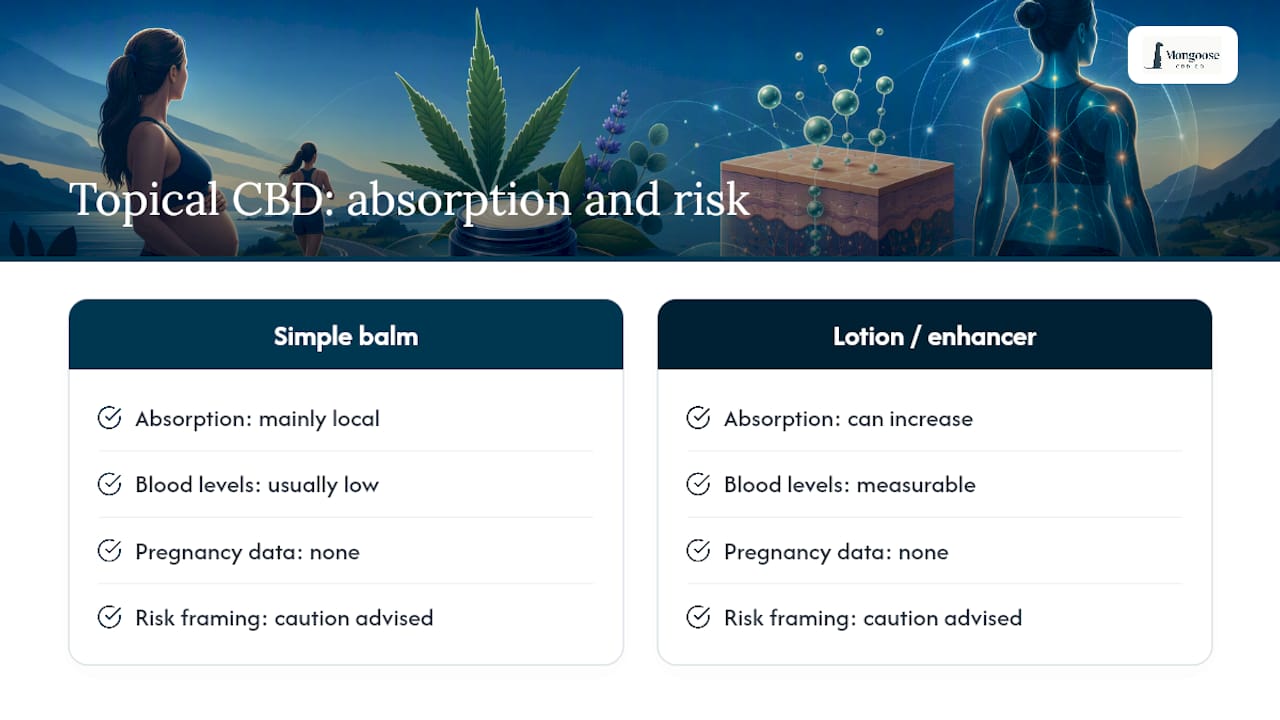
The specific risk with topical CBD during pregnancy comes down to one unresolved question: how much, if any, actively crosses into systemic circulation, and from there, potentially, to the placenta. As covered earlier, absorption varies by formulation. Simple balms tend to stay localized, while lotions or products with permeation enhancers can produce measurable blood levels in non-pregnant adults.
That variability is precisely why pregnancy guidance can't treat "topical CBD" as a single, predictable exposure. A balm that behaves one way in a tolerability study on athletes may behave differently once it's absorbed by skin undergoing the physiological changes of pregnancy, and there is no dedicated research answering that question either way.
Cannabinoids, including CBD, are known to interact with the endocannabinoid system, which plays a role in several stages of fetal development. That alone is enough for medical guidance to default to caution rather than reassurance, even though the topical route likely means lower systemic exposure than an oral product. Lower is not the same as zero, and "lower risk than oral CBD" is a very different claim from "no risk during pregnancy."
Until controlled studies specifically enroll pregnant participants, and none currently do, the responsible position is to treat any potential fetal exposure as an open question rather than a settled one. That is the framing medical guidance uses, and it's the one worth repeating rather than softening.
Interactions and Contraindications With Pregnancy Medications or Conditions
CBD is metabolized through liver enzymes, including several in the cytochrome P450 family, the same pathway many common medications use. That matters outside of pregnancy because it can alter how other drugs are processed. During pregnancy, the concern compounds: many patients are managing conditions like gestational hypertension, gestational diabetes, or clotting disorders that already require careful medication management.
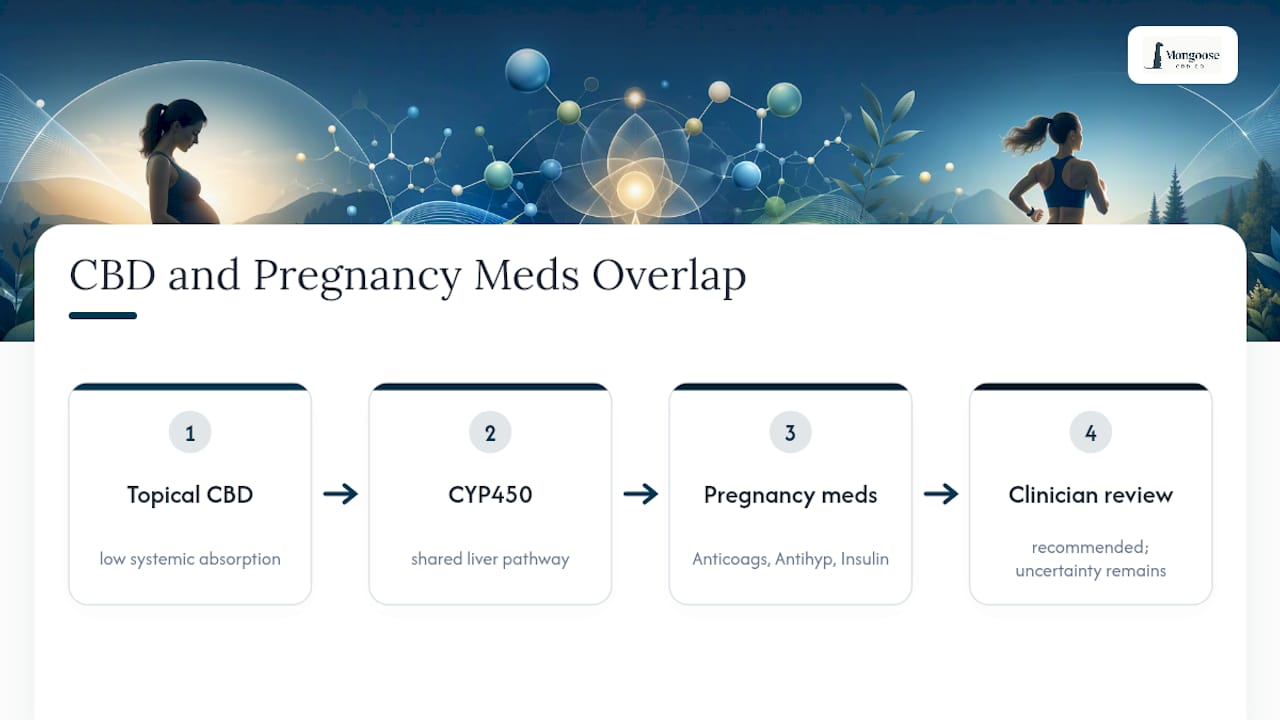
Topical CBD's lower systemic absorption, discussed in the formulation section above, likely reduces but does not eliminate this interaction risk. A simple balm applied to intact skin is a different exposure than a transdermal gel, but neither has been studied specifically alongside common pregnancy medications such as anticoagulants, antihypertensives, or insulin.
There's also a skin-specific consideration. Pregnancy changes skin sensitivity and barrier function for many people, meaning a product tolerated well before pregnancy could behave differently now. Combine that with unknown drug interaction potential, and the contraindication case is really about uncertainty stacking on uncertainty, not one single documented conflict. No published research has identified a specific pregnancy medication that clearly interacts with topical CBD, but the absence of a documented interaction is not the same as a documented safety clearance. That gap is exactly why this falls outside what generic pain-balm safety data can answer.
Talk to Your Provider Before Using CBD During Pregnancy
If you're pregnant and considering any CBD product, topical included, the guidance is the same across obstetric care: talk to your provider first, before you try it, not after. This isn't a formality. Your OB or midwife has context none of the studies referenced in this guide do, including your specific medications, any pregnancy complications, and your skin's current condition.
Bring specifics to that conversation. Tell your provider the exact product, its cannabinoid profile (isolate versus full or broad spectrum), and whether it's a simple balm or a transdermal-marketed formula, since that distinction affects how much might reach systemic circulation. If you're managing a chronic pain condition and were using a topical balm before pregnancy, say so. Your provider may have alternative pain management strategies suited to pregnancy that don't carry the same unanswered questions.
This conversation matters even for products marketed as natural pain relief or pregnancy safe pain relief. Those labels reflect marketing claims, not clinical clearance, and no topical CBD product currently carries a pregnancy-specific safety endorsement from a regulatory body. A provider can also flag any condition, like a clotting disorder or liver concern, that would make even low systemic exposure worth avoiding entirely. The five minutes that conversation takes is the single highest-value step in this entire guide.
A Practical, Low-Risk Way to Test Whether Topical CBD Works for You
My honest read after digging through this evidence: most people treat "does CBD work?" as a yes or no question, when it's really a formulation and tracking question. The osteoarthritis trial that showed real pain reduction and the DOMS trials that showed nothing weren't testing the same thing, even though both got lumped under "topical CBD" in casual conversation.
If you want a real answer for your own body, run a short, structured trial. Two to four weeks, with a baseline pain score written down before you start, and a simple daily log after. Patch test first, always. Choose a product with a current COA and THC-free labeling if drug testing or spectrum purity matters to you. That approach, informed rather than hopeful, is what separates people who get real signal from a topical from people who guess and give up after three days.
— Cindy
Why Mongoosecbd Balms Fit a Safety-First Buyer's Checklist
If everything above sounds like a lot to evaluate on your own, that's the point of buying from a brand that builds its formulations around exactly those criteria. Certain balms are formulated with 1,000 mg of CBD per ounce alongside complementary pain-relief ingredients like arnica, menthol, turmeric, and eucalyptus, and products are THC-free, vegan, and paraben-free, so spectrum or hidden fillers are clear.
That transparency matters more than a big number on the label. Combine it with the education-first approach covered in this guide, patch testing, watching for irritation, checking formulation details, and Mongoosecbd's 30-day refund policy gives you a real window to run your own short trial without financial risk if it doesn't work for your body. Start with the Seriously Soothing Pain Balm for general pain relief, or the Rikki Tikki Recovery balm if muscle recovery after training is your main goal. Patch test it this week, track your response for two to four weeks, and use the guarantee if it's not the right fit.
Sources
- Topical cannabidiol is well tolerated in individuals with a history of elite physical performance and chronic lower extremity pain | Journal of Cannabis Research
- An open-label feasibility trial of transdermal cannabidiol for hand osteoarthritis
- CBD & THC Creams for Pain: Evidence, Mechanism & Absorption – HormoneSynergy
This article is general information, not a substitute for advice from a qualified doctor. Consult a qualified healthcare professional about your own circumstances before acting on anything here.