
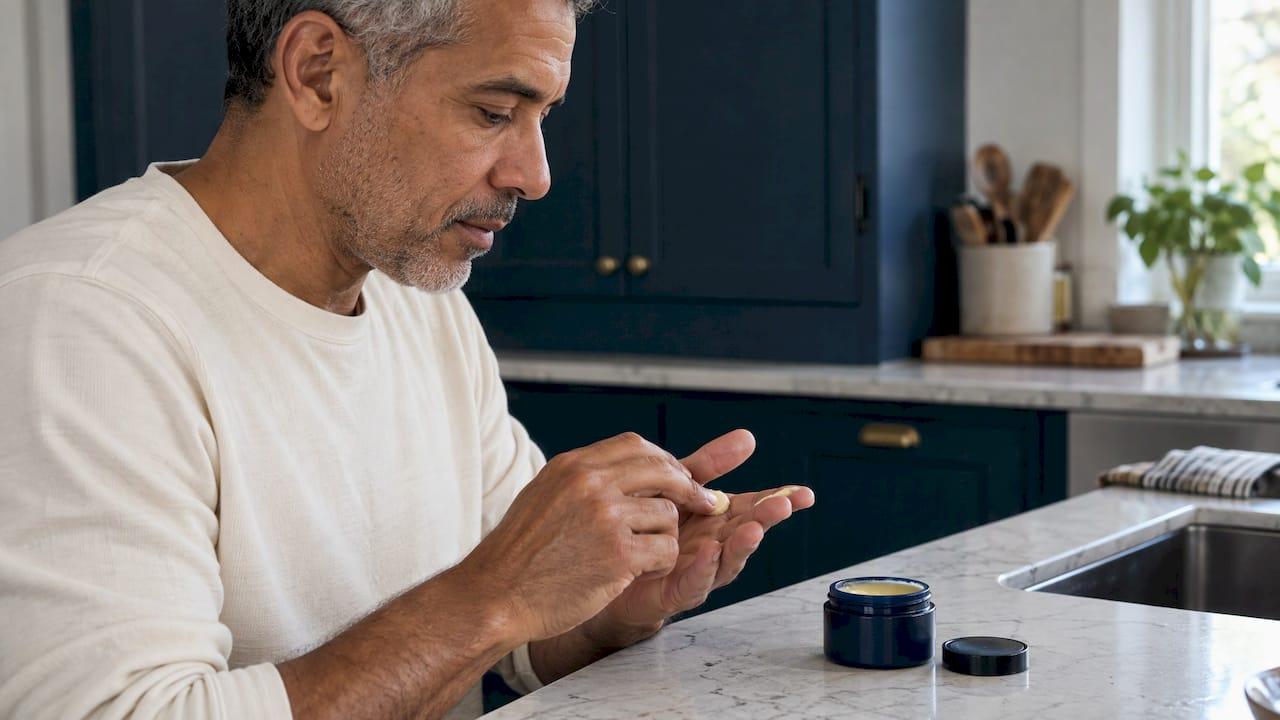
CBD has not been shown to treat neuropathy. The best reviews of cannabis-based medicines for nerve pain found no high-quality evidence of benefit over placebo. Some small studies of topical CBD, applied to the skin over the painful area, have reported encouraging signals. Many people with nerve pain still reach for a balm, because it stays local and is easy to use. This guide covers what has been studied, what the limits are, how to check a product, and how to use a topical safely next to your medical care.
TL;DR
- Large reviews, including a January 2026 Cochrane review, found no high-quality evidence that cannabis-based medicines relieve chronic neuropathic pain better than placebo.
- Topical CBD has been tested in small trials with mixed results. One small leg-neuropathy trial was positive, and a chemotherapy-neuropathy cream trial was not.
- A balm stays on the skin and is not the same as a daily oral dose. Interactions, liver effects and product quality still need a check.
- Check the lab report, the CBD amount and the THC content before you buy.
- New numbness, tingling or weakness needs a medical evaluation. A balm is a comfort measure, not a diagnosis or a replacement for care.
Table of Contents
- What neuropathy is, and why it is hard to treat
- What the human research says about CBD and nerve pain
- Topical CBD for nerve pain: the studies that exist
- Other topicals with stronger evidence
- Does the skin let CBD through?
- Perspective
- How to choose a CBD topical for nerve-area discomfort
- How to use a balm sensibly
- Safety: side effects, interactions and liver
- When to see a clinician
- Where our balms fit
- FAQ
- Sources
What neuropathy is, and why it is hard to treat
Peripheral neuropathy is damage to the nerves outside the brain and spinal cord. It often shows up as numbness, tingling, burning or jabbing pain in the hands and feet, and sometimes as extreme sensitivity to touch or muscle weakness, according to Mayo Clinic. Common causes include diabetes, chemotherapy, injury and compressed nerves, though sometimes no cause is found.
The usual medical starting point is a prescription. For painful diabetic neuropathy, guidance summarized by the American Family Physician lists pregabalin, gabapentin, amitriptyline and duloxetine as first-line choices, with topical lidocaine patches and capsaicin cream among later options. Those drugs do not work for everyone and can cause side effects. That is why people look for something else to add.
What the human research says about CBD and nerve pain
Here is the honest summary. The largest reviews do not support CBD as a proven nerve pain treatment, and the studies are small and uneven.
Cochrane, 2026. An updated Cochrane review covered 21 clinical trials with more than 2,100 adults over two to 26 weeks. It found no high-quality evidence that cannabis-based medicines, including CBD-only products, reduce chronic neuropathic pain more than placebo. Small gains with combined THC/CBD products were not large enough to be clinically meaningful. For CBD-dominant medicines specifically, the review says it is unclear whether they make any difference to the number of people with at least 50% pain relief, and the certainty is very low.
Study quality. A review author, Winfried Häuser, said in January 2026 that larger, well-designed studies lasting at least 12 weeks are needed. At present most trials are too poor in quality to draw firm conclusions. That cuts both ways: the evidence does not show benefit, and it does not rule out benefit for some people either.
Oral CBD and THC. A 2023 Danish trial in 134 people with multiple sclerosis or spinal cord injury found no significant difference from placebo for THC, CBD or the combination on neuropathic pain over six weeks.
Older reviews. The NCCIH notes that a 2018 review of 16 studies found low- to moderate-quality evidence of better pain relief than placebo, but small studies and possible bias meant the data could not be considered reliable. A 2022 evidence review from Oregon Health & Science University found that, among the products with valid evidence, the short-term neuropathic pain benefit came from prescription THC-based products and a THC/CBD spray not sold in the U.S. For a broader look at how study quality and side-effect dropouts shape these results, this overview of the evidence on CBD for chronic pain is a helpful companion.
Regulatory status. Harvard Health states that CBD alone is not FDA-approved for pain treatment. The only FDA-approved CBD product is the prescription medicine Epidiolex, approved for certain seizure disorders, as Mayo Clinic explains.
These are mostly findings about oral and combined cannabis medicines. Topicals are a different question, covered next.

Topical CBD for nerve pain: the studies that exist
A topical works at the skin, over the painful area. Reviewers describe topical CBD as having largely local, nonsystemic behavior. That is the main reason people ask about balms and creams for nerve pain, and it is why the topical studies deserve a separate look.
| Study | Who | What was tested | Result |
|---|---|---|---|
| Leg neuropathy RCT, described in a 2021 review | 29 patients with lower limb neuropathic pain | CBD cream, 250 mg CBD per 3 fl. oz | More pain reduction than placebo, but the data are limited to this single trial |
| Peripheral neuropathy of the legs, crossover trial, noted in a 2026 narrative review | Patients with neuropathy of at least three months | Topical CBD oil | Frequently cited as a positive signal, though small |
| 2024 pilot trial | 40 patients with established chemotherapy-induced neuropathy | CBD isolate cream, 250 mg per 1.7 oz, 0% THC, 4-week crossover | Scores similar to placebo; did not support improved painful neuropathy; well tolerated |
The picture is mixed. Small trials in leg neuropathy pointed in a good direction. A pilot trial in chemotherapy-related neuropathy did not. A 2026 systematic review of three small trials in that same chemotherapy group (68 participants) also found no improvement over placebo for pain or quality of life, though those studies covered cannabinoid medicines more broadly.
What this means in practice: neuropathy is not one condition. A person with diabetic foot burning, someone with a compressed nerve and someone with chemotherapy-related numbness may respond differently, and the data do not yet sort out who, if anyone, benefits. A clinician who has reviewed the topical literature, Dr. Benjamin Caplan, advises that patients should not defer or replace evidence-based neuropathic pain treatment with CBD topicals. That is sound advice, and it frames how a balm fits: as an addition you discuss, not a substitute.
Other topicals with stronger evidence
It helps to know what clinicians already use on the skin. The American Academy of Pain Medicine panel found strong evidence and high consensus that capsaicin 8% is effective for diabetic peripheral neuropathy and postherpetic neuralgia, and that lidocaine is effective for postherpetic neuralgia. These are options to raise with your doctor. A CBD balm can sit alongside a plan like this, but it should not be used to skip it.
Does the skin let CBD through?
This is an open question that researchers raise themselves. Because topical products are meant to act locally, trial designs for balms differ from the oral trials that dominate the big reviews. Whatever the mechanism, many people value a topical because it lets them put a product exactly where the discomfort is, and because it avoids a daily swallowed dose. If you want to read more about a related situation where a topical is often considered first, see our guide to CBD for a pinched nerve.
Perspective
We make balms for people who hurt, and we do not claim our products treat or cure neuropathy. What we can say is how we approach nerve-area discomfort, muscle soreness and joint aches.
Each balm combines 1,000 mg of CBD per ounce with botanicals such as arnica, menthol, turmeric, eucalyptus, peppermint, cinnamon, clove, ginger and cayenne pepper. Our formulas are designed to give a pleasant, fast sensation on the skin. For many people, that is what makes a topical something they actually use consistently.
A topical stays where you put it. You choose the spot, the amount and the timing, and you can stop at any time. That control is why we built our line as balms for athletes and for people living with chronic pain.
The products are THC-free, vegan, non-GMO, paraben-free and cruelty-free, and we back them with third-party testing and a 30-day full refund policy. We encourage everyone to keep their clinician involved and to treat a balm as one part of a comfort plan.
Cindy
How to choose a CBD topical for nerve-area discomfort
The research says product quality varies, so the label deserves attention.
- Check for a lab report. In one study of 84 CBD products bought online, more than a quarter contained less CBD than the label said, and THC turned up in 18 products, according to Mayo Clinic. A certificate of analysis from an independent lab shows what is in the jar. Our step-by-step guide to reading a CBD COA walks through it.
- Compare the CBD amount per ounce. The cream studies above used 250 mg of CBD in 1.7 to 3 fluid ounces. Our balms are formulated at 1,000 mg of CBD per ounce, so compare the number on the label with what you are used to.
- Look for THC-free. If you work in a safety-sensitive job or are drug tested, THC content matters. See CBD cream and drug tests.
- Read the full ingredient list. Menthol, cayenne and clove give a warming or cooling feel. If your skin is numb or very sensitive, a strong sensation can be hard to judge, so patch test on a small area first.
- Expect limited oversight. Mayo Clinic's Dr. Brent Bauer has said there is no consistent oversight to verify purity and safety of nonprescription CBD, so choose a brand that publishes testing. The FDA also keeps issuing warning letters to firms marketing cannabis-derived products, which is another reason to buy from a transparent company.
How to use a balm sensibly
A simple, tracked trial is more useful than guessing. Our guides on a four-week topical trial and on tracking a topical for knee swelling use the same idea, and it applies here too.
- Pick one spot and one product. Change one thing at a time.
- Patch test first. Apply a small amount to intact skin and wait a day. Never apply to broken skin or open wounds.
- Rate your discomfort daily. Use a 0 to 10 scale at the same time each day, with notes on sleep and activity.
- Apply on a schedule. Use a thin layer, massage in, wash your hands, and keep it away from eyes and mucous membranes.
- Review at four weeks. If your numbers have not moved, that is useful information to bring to your clinician.
Do not use a balm to mask new or worsening symptoms. If the area is numb, you may not feel heat, cold or injury, so be careful with heating pads and very hot water.
Safety: side effects, interactions and liver
Topical use is not the same as swallowing CBD, and most of the serious safety data come from oral dosing. Still, the safety points are worth knowing, particularly if you take other medications.
Side effects. Mayo Clinic lists rash, diarrhea, vomiting, loss of appetite, infection, liver injury, drowsiness and tiredness as reported side effects of CBD. In the Cochrane data on cannabis-based medicines, 10% of participants withdrew because of adverse events versus 5% with placebo. Our page on CBD balm side effects covers skin reactions and what to do about them.

Liver. A meta-analysis of 28 trials cited in a 2026 review linked CBD to a higher chance of liver enzyme elevation compared with placebo. That review also notes that no cases were reported in adults using under 300 mg a day, and that the liver risk is strongly associated with very high daily doses and with antiepileptic drugs, particularly valproate. These figures describe oral dosing, not balms.
Medications. The Merck Manual notes CBD is processed by the CYP3A4 and CYP2C19 enzymes, so it can raise levels of other drugs, including antiseizure medications, anticoagulants such as warfarin, tricyclic antidepressants, lithium, methadone and levothyroxine. Many people with neuropathy take amitriptyline, which is a tricyclic. Other hepatotoxic drugs, such as acetaminophen, add to liver concerns. If you take any of these, talk to your prescriber or pharmacist before starting. Our guide to CBD topical interactions goes through this in detail.
Pregnancy. The FDA strongly advises against using CBD during pregnancy or while breastfeeding.
When to see a clinician
Nerve symptoms deserve a diagnosis. Mayo Clinic advises seeking medical care right away if you notice tingling, weakness or pain in your hands or feet, because early diagnosis and treatment give the best chance of managing symptoms and preventing further nerve damage. See a clinician promptly if:
- numbness or tingling is new, spreading or getting worse;
- you have weakness, loss of coordination or falls;
- you have diabetes and notice foot pain, numbness or sores;
- you are in or after chemotherapy and your hands or feet change;
- you take medications from the list above, are pregnant, or have liver disease.
Bring up CBD at that visit, including the exact product. Mayo Clinic's Dr. Bauer advises talking with your health care provider before trying nonprescription CBD for any medical concern, and a liver function test may be recommended before and during CBD use.
Where our balms fit
If you and your clinician are comfortable with a topical, we make two. Seriously Soothing Pain Balm and RIKKI TIKKI Recovery both use 1,000 mg of CBD per ounce with arnica and other botanicals. They are formulated for muscle soreness, joint discomfort and arthritis aches, and they are priced from $26.95 to $39.95 depending on size.
They are THC-free, and every order comes with our 30-day full refund policy. Browse the full line on the Mongoose CBD Co. homepage. For related topics, see CBD for joint pain and CBD for rheumatoid arthritis.
FAQ
What form of CBD is best for neuropathy?
No form has been proven best for neuropathy. The large reviews found no high-quality evidence for CBD products in general. People who want a localized option often choose a topical balm or cream, because it stays on the skin over the painful area. Whatever you pick, choose a product with a lab report and a clear CBD amount.
Can CBD cure nerve damage?
No. The research does not show that CBD repairs nerve damage. At most, small studies suggest some people may feel less discomfort from topical products, and the Cochrane review found no clear evidence of relief beyond placebo. The cause of the nerve damage still needs a medical diagnosis and treatment.
Is CBD cream or balm good for nerve pain?
The evidence is limited. One small trial in leg neuropathy favored a CBD cream over placebo, while a pilot trial in chemotherapy-related neuropathy did not. A balm is best treated as a comfort measure used alongside medical care, tracked over a few weeks so you can see whether it helps you.
Can I use a CBD balm with my neuropathy medications?
Ask your prescriber or pharmacist first. CBD is processed by liver enzymes that also handle several drugs, including some antidepressants and blood thinners. Most interaction data come from oral CBD, but a professional can tell you what applies to your list.
Sources
- Cochrane: no clear evidence that cannabis-based medicines relieve chronic nerve pain
- Cochrane: benefits and risks of cannabis-based medicines for chronic neuropathic pain
- NCCIH: Cannabis and cannabinoids
- OHSU evidence review of cannabis products and chronic pain
- Harvard Health: CBD for chronic pain
- Mayo Clinic: CBD, safe and effective?
- Mayo Clinic: peripheral neuropathy symptoms and causes
- Mayo Clinic Q and A on oversight of nonprescription CBD
- American Family Physician: painful diabetic peripheral neuropathy
- Danish trial of cannabis-based medicine for neuropathic pain
- Topical CBD for chemotherapy-induced neuropathy, 2024 trial
- Review of topical treatments for neuropathic pain, 2021
- Narrative review of CBD for pain, 2026
- Systematic review of cannabinoids in chemotherapy-induced neuropathy
- AAPM: topical analgesics for neuropathic pain
- CED Clinic: CBD topicals for nerve pain
- Merck Manual: cannabidiol
- FDA: warning letters for cannabis-derived products
- Overview of the evidence on CBD for chronic pain