

CBD can help some people manage pinched nerve pain, but it works better as one piece of a plan than as a stand-alone fix. Start with a topical balm applied directly over the affected area for localized relief, since it acts fast and stays out of your bloodstream. If pain radiates or feels systemic, oral CBD at higher doses has real trial support, though it should be used under a clinician's watch, especially if you take other medications.
TL;DR:
- Topical CBD balms provide fast, localized relief for surface-level nerve pain, but often require consistent use over two to six weeks to show effects.
- High-dose oral CBD, up to 800 mg daily, has shown modest pain reduction in clinical trials, but individual responses vary widely, and interactions with other medications need consideration.
- Combining topical and oral CBD may offer a layered approach, with topical acting quickly on surface pain and oral supporting broader nerve health over time.
- Lab-tested full-spectrum or broad-spectrum balms with supporting ingredients like menthol or arnica are recommended for localized nerve discomfort.
- Expect topical CBD to produce effects within minutes, while oral CBD benefits typically emerge after several weeks of consistent use.
Table of Contents
- Which CBD Delivery Form Actually Helps a Pinched Nerve?
- What Does Research Say About CBD for Nerve Pain?
- How Should You Actually Use CBD for a Pinched Nerve?
- What Should You Look for in a Topical CBD Product?
- Why This Guide Leans Topical First
- Try a Topical Balm Built for Localized Nerve Discomfort
- Sources
- FAQ
Which CBD Delivery Form Actually Helps a Pinched Nerve?
The form you choose matters as much as the dose. A pinched nerve in your lower back behaves differently than nerve pain radiating down a leg, and each CBD format has a different reach.
- Topical balms and creams sit on the skin and work locally. They rarely enter the bloodstream in meaningful amounts, which limits systemic effects but makes them fast for surface-level, localized discomfort like a pinched nerve in the neck or lower back.
- Oral CBD (oils, capsules) travels through the digestive system and liver before reaching circulation, giving it a broader, whole-body effect. This is the format behind most of the higher-dose clinical trials for neuropathic pain, discussed below.
- Transdermal patches deliver a steady, slow release through the skin over hours. They can help with more constant, low-grade nerve irritation, but absorption varies by skin type and patch quality, and the evidence base is thinner than for oral or topical products.
- Inhalation produces the fastest onset of any format, sometimes within minutes, but effects fade quickly and the long-term safety picture for the lungs is less established.
Many people managing sciatica or a pinched nerve in the back use a combination: a topical balm for the flare-up itself, paired with an oral product to support the nervous system more broadly. That layered approach reflects how clinicians who work with nerve pain often think about treatment, pairing something fast and local with something systemic and sustained.
What Does Research Say About CBD for Nerve Pain?
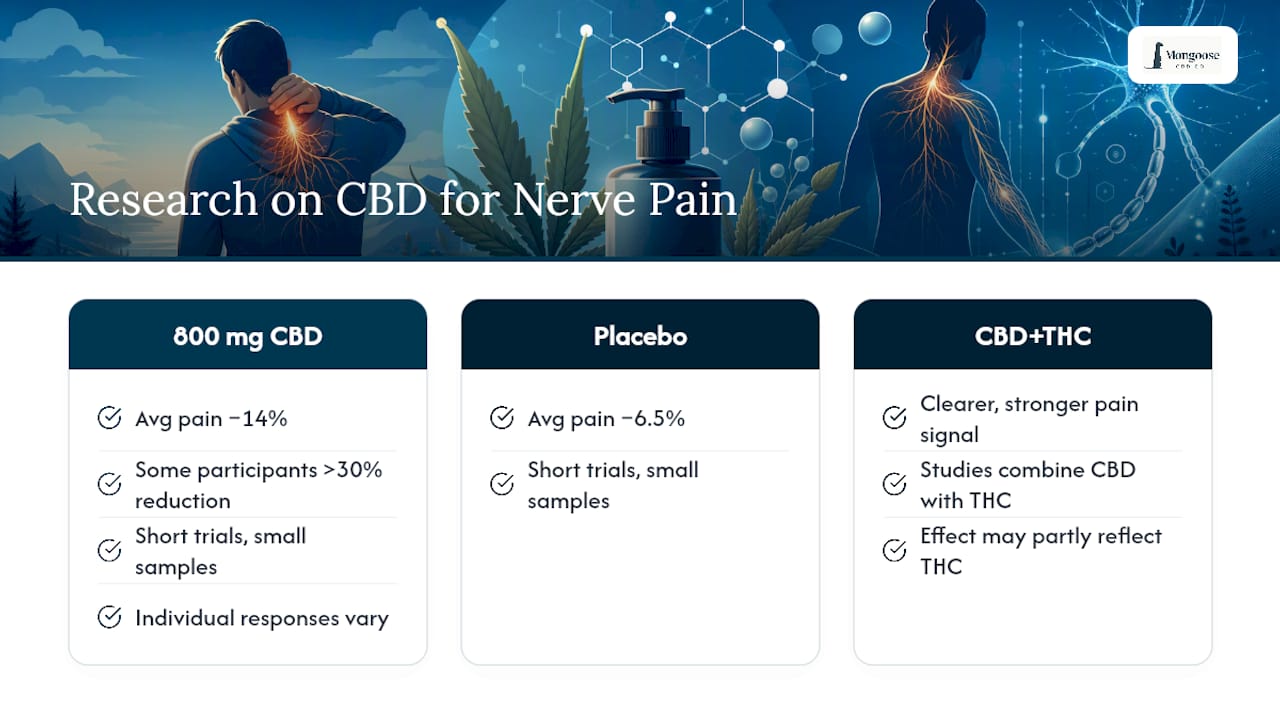
A 2026 randomized, placebo-controlled trial gives the clearest recent data point. Researchers gave participants with chronic neuropathic pain high-dose oral CBD, up to 800 mg per day, and tracked pain scores over six weeks.
By the numbers: The active CBD group saw an average pain reduction of about 14%, compared to roughly 6.5% for placebo. Some participants reported reductions greater than 30% over the six-week trial, according to research from the University of Sydney.
That 14% figure is real, but it is also modest, and it came at a dose most over-the-counter CBD oils don't come close to matching. The trial's own lead authors noted that individual response varies widely and flagged the need to understand how high-dose CBD interacts with other medications people with chronic pain often already take.
Broader reviews complicate the picture further. Systematic reviews and meta-analyses of cannabis-based medicines, most of which combine CBD with THC rather than using CBD alone, show a clearer signal for pain relief than CBD-only studies do, according to research published on PubMed. Trials combining CBD and THC for conditions like chemotherapy-induced nerve damage have shown stronger effects than isolated CBD trials, suggesting THC may be doing some of the heavy lifting in those combination results.
The honest takeaway: isolated CBD shows a real but limited effect at high oral doses, and the research base still leans on small samples and short trial windows. More dose-ranging studies are needed before anyone can call CBD a proven neuropathic pain treatment.
How Should You Actually Use CBD for a Pinched Nerve?
Getting a fair trial of CBD means being systematic about it, not just rubbing on balm once and giving up.
- Patch test any topical first. Apply a small amount to unaffected skin and wait 24 hours before using it on the painful area, especially if you have sensitive skin or allergies to botanical ingredients like arnica or menthol.
- Start low with oral CBD and titrate slowly. Trial doses reaching 800 mg per day were supervised by researchers. Don't self-escalate to that range without a clinician involved.
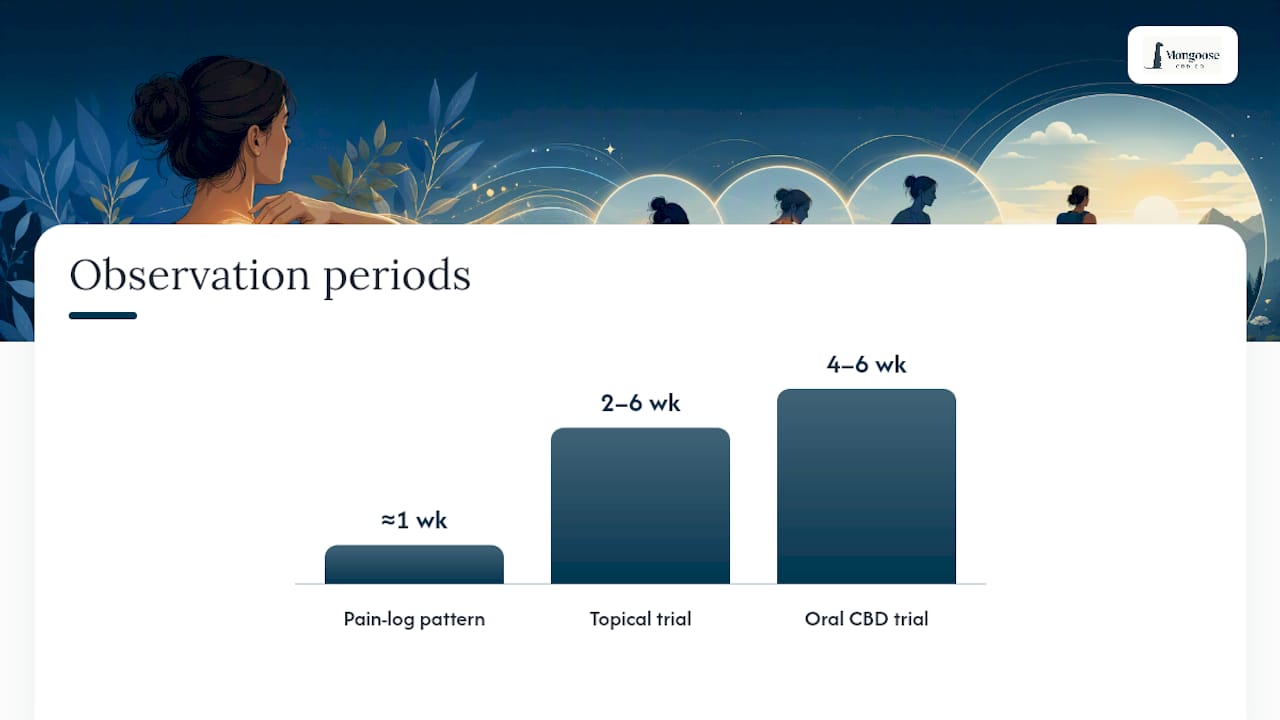
- Give a topical two to six weeks before deciding it isn't working, applying it consistently rather than only during flare-ups.
- Give oral CBD four to six weeks to judge any real shift in pain or function, tracking your pain level and daily function in a simple notebook or phone app so you're comparing data, not memory.
- Reassess with your doctor if you notice no change by those markers, or if side effects appear.
For topical application, a pea-to-almond-sized amount rubbed into the affected area two to four times daily is a reasonable starting point for most balms. You should feel a cooling or warming sensation within minutes if the formula includes menthol or capsaicin-adjacent ingredients, with any anti-inflammatory effect building over days of consistent use.
Pro Tip: Keep a simple pain log with a 0 to 10 scale, noting the time of application and what you were doing when pain flared. Patterns show up in about a week, and that log is the single best tool for telling your doctor what's actually working.
Watch for drug interactions if you're using oral CBD. It's metabolized by liver enzymes in the CYP450 family, the same pathway many blood thinners, seizure medications, and some statins use. Combining high-dose CBD with anticoagulants like warfarin can affect blood levels of both substances, and people with existing liver conditions should talk to a doctor before starting any oral regimen. Trials of high-dose CBD have generally reported it as well tolerated, but adverse events were still more common during active treatment phases than during placebo, so monitoring matters even when side effects are mild.
What Should You Look for in a Topical CBD Product?
Not every balm on a shelf is built the same way, and the differences matter more for nerve pain than for general soreness.
- Spectrum and potency. Broad-spectrum and full-spectrum products contain minor cannabinoids and terpenes that may work alongside CBD, while isolate contains CBD alone. If you want to avoid THC entirely for work or drug-testing reasons, a THC-free broad-spectrum formula is the safer pick.
- Supporting ingredients. Menthol, arnica, capsaicin, and eucalyptus each bring their own localized effect, cooling, anti-inflammatory, or warming, and a well-formulated balm layers these deliberately rather than relying on CBD alone.
- Third-party lab testing. A Certificate of Analysis (COA) should confirm what's actually in the jar, since the FDA has repeatedly warned that CBD product labeling is often inconsistent with lab results.
- Return policy. A brand confident in its formula will typically back it with a real refund window, not just fine print.
Ingredients matter more than the milligram number on the label, a point worth understanding fully in our breakdown of what actually goes into an effective CBD balm. Be skeptical of any product claiming to cure or reverse nerve damage. Regulators haven't approved CBD for that use, and a legitimate seller won't promise it.
Why This Guide Leans Topical First
The clinical trial data on high-dose oral CBD is encouraging but modest, and it came from doses far above what a casual user typically takes. That gap between the research headline and the retail reality is where a lot of marketing gets ahead of the science.
Topical products sidestep some of that uncertainty because they're not trying to replicate a systemic 800 mg trial. They're solving a narrower problem: localized discomfort at the site of a pinched nerve. Some balms are formulated around that narrower goal, using CBD alongside arnica, menthol, and other botanicals chosen for localized relief rather than trying to mimic an oral clinical protocol. Some products are third-party tested, and some purchases carry a refund window, which matters more than any label claim when you're the one deciding whether something worked.
None of this replaces a conversation with your doctor, particularly if your pinched nerve pain is worsening, spreading, or accompanied by numbness or weakness. The evidence for CBD in neuropathic pain is real but still developing, and this guide treats it that way rather than overselling it.
— Cindy
Try a Topical Balm Built for Localized Nerve Discomfort
If a pinched nerve has you reaching for whatever's in the medicine cabinet, a purpose-built topical is worth trying before you escalate to something systemic. Mongoosecbd's Seriously Soothing Pain Balm delivers 1,000 mg of CBD per ounce alongside arnica, menthol, and other botanicals chosen for fast, localized comfort, not a slow systemic build. For deeper muscle and nerve-adjacent recovery, RIKKI TIKKI Recovery is formulated for chronic pain sufferers and athletes managing recurring flare-ups.
Some products are third-party tested and backed by a refund policy, offering a risk-free trial period. Start with a patch test, apply as directed over the affected area, and check with your doctor first if you're on blood thinners or other CYP-metabolized medications. Ready to try it? Head to the Mongoosecbd product page and pick the balm that fits where your pain actually lives.
This article is general information, not a substitute for advice from a qualified doctor. Consult a qualified healthcare professional about your own circumstances before acting on anything here.
Sources
- Cannabidiol significantly reduces chronic pain for those with nerve damage
- Systematic reviews/meta-analyses on cannabis-based medicines for neuropathic pain
- What You Need to Know About Products Containing Cannabis or Cannabis-derived Compounds
FAQ
What Is the Fastest Way to Relieve a Pinched Nerve?
Rest, gentle stretching, and reducing pressure on the nerve are the fastest first steps, often paired with a topical anti-inflammatory product applied directly over the area. A topical CBD balm can offer localized relief within minutes to hours for some people, though severe or worsening pain needs medical evaluation, not just home care.
What Form of CBD Is Best for Nerve Pain?
For localized pain like a pinched nerve, a topical balm applied directly to the area tends to work fastest since it doesn't need to travel through the bloodstream. For pain that radiates or feels more systemic, oral CBD has trial support at higher doses, with one 2026 randomized trial using up to 800 mg per day.
How Fast Does CBD Work for Pain?
Topical CBD often produces a noticeable local effect within minutes, driven partly by companion ingredients like menthol. Oral CBD takes longer to build any measurable effect, with clinical trials assessing benefit over a period of weeks rather than hours.
How Much CBD Should I Take for Nerve Pain?
There's no universal dose, but the strongest trial evidence for neuropathic pain used up to 800 mg per day of oral CBD under clinical supervision, according to the 2026 Sydney trial. For topical use, frequency matters more than a single large dose. Two to four applications a day of a balm containing 1,000 mg of CBD per ounce is a reasonable starting point, adjusted with guidance from a doctor if you're also taking other medications.