

CBD is a reasonable adjunct for rheumatoid arthritis, but it is not a replacement for your prescribed disease-modifying therapy. The honest summary: preclinical studies show genuine anti-inflammatory effects, but human trials so far have been small and have not produced statistically significant improvements in clinical disease activity. That gap between lab results and clinical proof matters. Here is where to start right now:
- Check your current medications for CYP450 interactions. CBD is metabolized through cytochrome P450 enzymes, which means it can affect how your body processes corticosteroids, certain antidepressants, and warfarin. A pharmacist can flag conflicts in under ten minutes.
- Try a topical balm first. Topical CBD stays largely local, which means lower systemic exposure and fewer interaction risks for people already on multiple RA medications.
- Schedule a conversation with your rheumatologist before you start. Do not stop or reduce your DMARDs. CBD works alongside your treatment plan, not instead of it.
Table of Contents
- What does the research say about CBD and rheumatoid arthritis?
- How do clinicians and researchers interpret this evidence for RA?
- How might CBD affect pain and inflammation in rheumatoid arthritis?
- Topical vs. oral CBD: which form makes sense for your RA symptoms?
- What are the safety risks and drug interactions for people on RA treatments?
- How do you pick a CBD product that is actually safe and accurately labeled?
- How do you actually start a CBD trial for RA?
- What is the legal status of CBD in the United States?
- How much do CBD products cost, and what should you expect?
- What should you tell your rheumatologist before starting CBD?
- Should people with rheumatoid arthritis try CBD?
- What does long-term CBD use look like for people with RA?
- Key Takeaways
- A candid perspective on CBD and RA
- What the CBD-for-RA conversation usually gets wrong
- Mongoosecbd's topical balms: a conservative first option for joint pain
- Sources and further reading
What does the research say about CBD and rheumatoid arthritis?
The evidence picture is mixed, and reading it clearly matters before you spend money or adjust your routine.
Human clinical trials
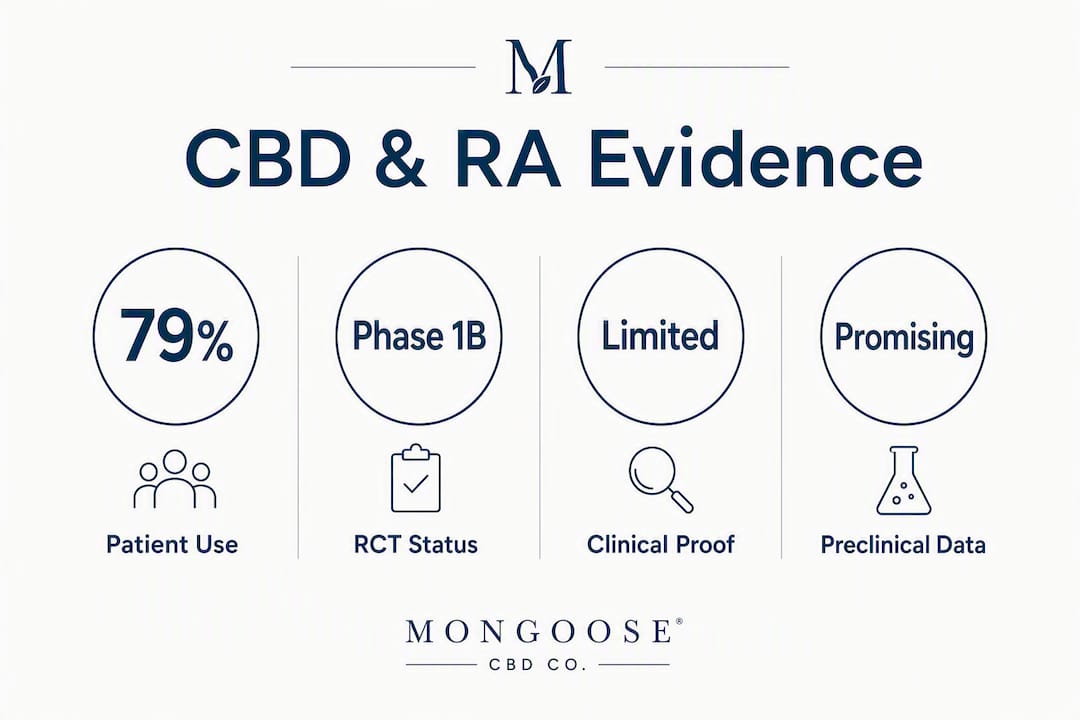
The most directly relevant human study is a phase 1B randomized, double-blind, placebo-controlled trial at UCLA that ran for 12 weeks. Participants received oral CBD at 200 mg twice daily, 400 mg twice daily, or placebo. The result: no statistically significant difference in DAS28 disease activity scores between any group. A numerical reduction in subjective pain appeared in the 200 mg group, but it did not reach significance. The 400 mg group reported more adverse events. That is the most rigorous RA-specific human data available right now.
A separate trial in knee osteoarthritis (a different condition, but relevant for joint pain context) tested oral CBD at 600 mg daily for eight weeks as an add-on to paracetamol. Pain scores improved in both the CBD and placebo groups by nearly identical amounts, with no significant group difference. Liver enzyme elevations were significantly more common in the CBD group.
Survey and observational data
Patient-reported data tells a different story. An Arthritis Foundation survey found that 79% of respondents reported using, previously using, or considering CBD, with pain management as the primary reason. Self-reported benefit is real to the people experiencing it, but surveys cannot control for placebo effects or product variability.
Preclinical findings
Here is where the science gets genuinely interesting. A 2025 study published in Frontiers in Immunology tested a high-CBD extract in murine RA models and found significant reductions in TNF-α, IL-6, IL-8, and MCP-1, along with lower leukocyte infiltration and upregulation of the anti-inflammatory cytokine IL-10. These are exactly the inflammatory pathways driving RA joint damage. The problem is that animal models do not reliably predict human outcomes, and the translation gap here is wide.

| Study Type | Design | Key Finding |
|---|---|---|
| UCLA Phase 1B RCT (RA) | 12-week, oral CBD 200/400 mg BID vs placebo | No significant DAS28 improvement; numerical pain reduction at 200 mg BID |
| Vienna KOA RCT | 8-week, oral CBD 600 mg/day vs placebo | No significant pain difference; liver enzyme rises more common with CBD |
| Frontiers Preclinical (2025) | Murine RA models, CBD-X extract | Significant reductions in TNF-α, IL-6, IL-8; increased IL-10 |
| Arthritis Foundation Survey | Observational, arthritis patients | 79% using, considering, or having tried CBD; pain relief cited as main reason |
Limitations worth knowing
- Sample sizes in human trials are small, limiting statistical power.
- Follow-up periods (8–12 weeks) may be too short to detect disease-modifying effects.
- Product variability across studies makes dose comparisons unreliable.
- Most trials use oral CBD; topical-specific RA data is nearly absent.
- Publication bias may favor positive findings in the literature.
How do clinicians and researchers interpret this evidence for RA?
The honest clinician position is cautious optimism, not enthusiasm. Preclinical results are mechanistically plausible, but the human trial data has not caught up. Harvard Health summarizes the state of evidence as small, short-term, or survey-based studies that suggest potential but are far from convincing, and explicitly recommends against stopping conventional RA therapy.
That framing is useful. The strongest case for CBD in RA right now is not "it will reduce your joint inflammation" but rather "it may help you sleep better and feel less anxious, which indirectly reduces how much pain you perceive." That is a real benefit, even if it is not the headline most people are looking for.
Clinician-aligned recommendations from the rheumatology literature are consistent:
- Start at a low dose and define what success looks like before you begin.
- Prefer topical for localized joint pain to minimize systemic exposure.
- If using oral CBD, monitor liver enzymes, especially if you are on hepatically metabolized medications.
- Do not rely on dispensary staff for medical guidance. They are not trained in drug interactions or RA pharmacology.
Pro Tip: Before your first dose, write down two or three specific outcomes you want to track: morning stiffness duration, sleep quality on a 1–10 scale, or pain at a specific joint. Without predefined goals, it is nearly impossible to evaluate whether CBD is actually helping after four weeks.
How might CBD affect pain and inflammation in rheumatoid arthritis?
CBD interacts with the endocannabinoid system, a network of receptors (primarily CB1 and CB2) distributed throughout the nervous system, immune cells, and joint tissue. CB2 receptors are particularly concentrated in immune cells, which is why CBD's anti-inflammatory potential is plausible in an autoimmune condition like RA.
Think of it this way: imagine a diagram with three parallel pathways. The first shows CBD binding to CB2 receptors on macrophages, reducing the release of pro-inflammatory cytokines like TNF-α and IL-6. The second shows CBD acting on TRPV1 receptors in peripheral nerves, raising the pain threshold at the joint level. The third shows CBD's interaction with serotonin receptors (5-HT1A), which may explain its effects on anxiety and sleep quality.
Each pathway connects to something a person with RA actually cares about:
- Cytokine modulation: May reduce the inflammatory signaling that drives joint swelling and damage.
- Peripheral pain signaling: May raise the threshold at which nerve fibers in joint tissue fire pain signals.
- Sleep and anxiety: May improve sleep architecture and reduce anxiety, both of which amplify pain perception when disrupted. Clinical commentaries note patient-reported improvements in these secondary symptoms even when direct anti-inflammatory effects are unclear.
The gap between these mechanisms and proven clinical outcomes is real. The pathways exist; the question is whether the doses achievable with commercial products are sufficient to activate them meaningfully in humans.
Topical vs. oral CBD: which form makes sense for your RA symptoms?
The delivery method matters as much as the dose. For most people with RA who are already on systemic medications, topical is the safer starting point.
| Form | Best For | Pros | Cons |
|---|---|---|---|
| Topical balm | Single joint flares, localized pain | Minimal systemic absorption, low interaction risk, easy to apply | Limited reach for systemic symptoms |
| Oral capsules/oils | Systemic symptoms, sleep, anxiety | Consistent dosing, longer duration | CYP450 interactions, liver enzyme risk, slower onset |
| Sublingual oil | Faster onset than capsules | Higher bioavailability than oral, titratable | Still systemic; interaction risk remains |
| Transdermal patch | Sustained local delivery | Steady absorption, hands-free | Limited product availability, variable quality |
| Inhalation/vaping | Fast onset | Rapid effect | Pulmonary risks; health advisories warn against vaping for people with inflammatory conditions |
When a topical balm makes the most sense: you have pain concentrated in one or two joints, you are on multiple systemic RA medications, or you want to trial CBD with the lowest possible interaction risk. A flare in your wrist or knee is a textbook topical use case.
When oral or sublingual forms might be worth discussing with your doctor: you have systemic symptoms like disrupted sleep, generalized anxiety, or widespread pain that a topical cannot reach. In that scenario, the interaction risk is real enough that you need a pharmacist review first.
Inhalation is the one form to skip entirely. Vaping products carry documented pulmonary risks from contaminants including vitamin E acetate, and those risks are compounded in people already managing an inflammatory condition.
Pro Tip: Start with a topical for the first four weeks. If you see localized benefit and want to address sleep or systemic symptoms, that is the time to bring oral CBD into the conversation with your rheumatologist, not before.
What are the safety risks and drug interactions for people on RA treatments?
CBD has a generally favorable safety profile compared to many pain medications, but "generally favorable" does not mean risk-free, especially for people on complex RA regimens.
Common side effects
Drowsiness, GI upset (nausea, diarrhea), and changes in appetite are the most frequently reported adverse effects. These are dose-dependent and tend to be more pronounced with oral forms. The more serious concern is liver enzyme elevation: the Vienna KOA trial found liver aminotransferase and gamma-glutamyltransferase rises were significantly more common in the CBD group than placebo.
Drug interactions via CYP450
CBD is both a substrate and an inhibitor of several CYP450 enzymes, particularly CYP3A4 and CYP2C9. This creates clinically relevant interaction potential with drugs commonly used in RA management:
- Corticosteroids (e.g., prednisone): CYP3A4 metabolism overlap; CBD may alter steroid levels.
- Tofacitinib (Xeljanz): Metabolized via CYP3A4; interaction plausible.
- Warfarin: CYP2C9 substrate; CBD can increase warfarin levels and bleeding risk.
- Certain antidepressants (SSRIs, TCAs): Serotonin pathway overlap plus CYP interactions.
- Tramadol: CYP2D6 and CYP3A4 involvement; combination may increase sedation.
The Arthritis Foundation explicitly advises consulting a clinician before use given these interaction risks.
Consultation checklist before starting
- List every medication you take, including dose and timing.
- Note any recent liver function test results.
- Identify which of your medications are metabolized via CYP3A4 or CYP2C9.
- Ask your pharmacist to run a formal drug interaction check.
- Confirm your RA disease activity level so you have a baseline to compare against.
Red flags: stop and contact your care team if you notice
- Jaundice or significant fatigue (possible liver stress).
- Unusual bruising or bleeding (especially if on warfarin).
- Sudden worsening of RA symptoms after starting CBD.
- Severe GI symptoms that do not resolve within a few days.
- Significant drowsiness that impairs daily function.
A survey of arthritis patients found that 79% had used or considered CBD, yet most had not discussed it with their physician first. That gap is where the real risk lives.
How do you pick a CBD product that is actually safe and accurately labeled?
Product quality is one of the biggest practical problems in the CBD market. Multiple reviews have documented mislabeled CBD content, undeclared THC, pesticides, heavy metals, and microbial contaminants in retail products. Because most CBD products are sold as supplements rather than drugs, they are not held to pharmaceutical manufacturing standards.
Shopping checklist
| What to Check | What to Look For |
|---|---|
| Certificate of Analysis (COA) | Batch-specific, from an accredited third-party lab |
| CBD content accuracy | Actual mg/mL or mg/g should match label claim |
| Total THC | ≤ 0.3% (federal hemp limit); zero THC if drug testing is a concern |
| Contaminants panel | Pesticides, heavy metals, mycotoxins, residual solvents |
| CBD type | Isolate (THC-free), broad-spectrum (trace THC removed), or full-spectrum (up to 0.3% THC) |
| GMP statement | Manufactured under Good Manufacturing Practices |
| Carrier/base ingredients | Check for allergens; for topicals, review skin-active ingredients |
Reading a COA
A COA is a lab report tied to a specific product batch. The key numbers to find: CBD concentration (mg per mL or mg per gram), total THC (should be below 0.3% for hemp-derived products), and the contaminants section. If a product does not have a COA, or the COA is not batch-specific, that is a disqualifying problem.
Label reading basics
- Serving size math: If a 1 oz balm contains 1,000 mg CBD and you apply roughly 1/30 of the container per use, you are applying approximately 33 mg per application.
- Concentration vs. total: A 500 mg bottle of oil is not the same as a 500 mg/mL concentration. Check both.
- Expiry and storage: CBD degrades with heat and light. Store in a cool, dark place and check the expiration date.
Pro Tip: Avoid unregulated edibles sold at gas stations or convenience stores. These products are the least likely to carry accurate COAs and the most likely to contain undeclared THC or contaminants. Stick to brands that publish batch-specific lab results on their website.
How do you actually start a CBD trial for RA?
A structured approach reduces risk and gives you real information to bring back to your doctor.
Step-by-step trial plan
- Get medical clearance first. Confirm with your rheumatologist and pharmacist that CBD does not conflict with your current medications.
- Choose your form. For most RA patients, a topical balm is the lowest-risk starting point.
- For topical use: Apply a pea-to-dime-sized amount (roughly 0.1–0.2 mL of balm) directly to the affected joint. Massage gently for 30–60 seconds. Start once daily, typically in the evening, and increase to twice daily after one week if tolerated.
- For oral/sublingual use (only after clinician review): Clinical guidance from the rheumatology literature suggests starting at 5–10 mg sublingually twice daily as an initial approach. Hold the oil under your tongue for 60–90 seconds before swallowing.
- Do not increase dose for at least one week. Give your body time to respond before adjusting.
- Run the trial for four weeks minimum before evaluating whether it is helping.
Trial timeline
- Days 1–7: Establish baseline. Note your current pain level, sleep quality, and morning stiffness duration each day.
- Days 7–14: First assessment. Any noticeable change in localized pain or sleep?
- Days 14–28: Continue at the same dose. Track consistently.
- Day 28: Evaluate against your predefined goals. If no benefit, discuss with your doctor before increasing dose or switching forms.
Simple tracking template
| Date | Dose (mg) | Form | Time of Day | Pain (1–10) | Sleep Quality (1–10) | Side Effects |
|---|---|---|---|---|---|---|
| Day 1 | — | Topical | Evening | — | — | None |
| Day 7 | — | Topical | Evening | — | — | — |
| Day 14 | — | Topical | Evening | — | — | — |
| Day 28 | — | Topical | Evening | — | — | — |
Copy this template into a notes app or a paper journal. The data you collect is genuinely useful when you follow up with your rheumatologist.
What is the legal status of CBD in the United States?
The federal framework is clear on one point: hemp-derived CBD containing no more than 0.3% THC by dry weight is federally legal under the 2018 Farm Bill. Marijuana-derived CBD remains a Schedule I controlled substance under federal law, regardless of state rules.
The FDA has not approved any nonprescription CBD product for the treatment of arthritis, pain, or any other condition. The only FDA-approved CBD product is Epidiolex, a prescription drug for specific seizure disorders. Consumers should be aware that CBD products marketed as dietary supplements are not evaluated for safety or efficacy by the FDA before they reach store shelves.
State laws vary. Some states have additional restrictions on CBD sales or possession, and a handful have stricter THC thresholds than the federal standard. If you are subject to workplace drug testing, even a product labeled "THC-free" carries a small risk of a positive result due to cross-contamination or mislabeling. Broad-spectrum or isolate products reduce that risk but do not eliminate it entirely.
This article is general information, not medical or legal advice. Confirm current rules with your state's health authority or a qualified professional for your specific situation.
How much do CBD products cost, and what should you expect?
Topical CBD balms in the U.S. typically run from roughly $20 to $60 per ounce, with higher-potency formulations (1,000 mg CBD per ounce and above) at the upper end of that range. Oral CBD oils generally cost $30 to $80 per bottle, with price varying significantly by potency and brand.
A cost-per-use example: a 1 oz balm at 1,000 mg CBD that costs $45 and provides approximately 30 applications works out to about $1.50 per use. An oral oil at $60 for 30 mL at 1,000 mg total, dosed at 10 mg per serving, yields roughly 100 servings at $0.60 each.
Higher potency does not automatically mean better results. The dose-response relationship for CBD is not linear, and the 400 mg oral dose in the UCLA RA trial produced more adverse events without additional benefit compared to 200 mg. Spending more on a higher-concentration product is not a substitute for proper dosing guidance.
On timeline: most people who notice any effect from a topical report it within the first one to two weeks of consistent use. Oral CBD may take two to four weeks to produce noticeable changes in sleep or anxiety. If you have seen no change after a full four-week trial at a consistent dose, the honest answer is that this product may not be working for you.
What should you tell your rheumatologist before starting CBD?
Bring a written summary to your appointment. Clinicians can give better guidance when they have specifics.
What to document
- Every medication you currently take, including dose, frequency, and how long you have been on it.
- Recent liver function test results (AST, ALT, GGT), if available.
- Your current RA disease activity level (number of swollen/tender joints, recent DAS28 score if known).
- Any other medical conditions, particularly liver disease, anxiety disorders, or sleep disorders.
- The specific CBD product you are considering (bring the COA if you have it).
Questions to ask your clinician
- Does any of my current medication interact with CBD via CYP3A4 or CYP2C9?
- Should I get a baseline liver function test before starting?
- How often should we recheck liver enzymes if I use oral CBD?
- What outcomes should I track, and how long should I trial it before we reassess?
- Is there a dose or form you would specifically advise against given my current regimen?
Reporting back
After your four-week trial, bring your tracking log to your follow-up. Report any side effects, changes in RA symptoms, and whether your predefined goals were met. This gives your care team real data rather than impressions.
Should people with rheumatoid arthritis try CBD?
CBD is worth considering as an adjunct for RA, not as a treatment on its own. The clearest case is localized joint pain and secondary symptoms like sleep disruption or anxiety, where the risk-to-benefit ratio is most favorable, especially with a topical product.
The single best recommendation: start with a topical balm on your most affected joint, coordinate with your rheumatology care team, and run a structured four-week trial with predefined goals before drawing any conclusions.
Three specific next steps if you want to proceed:
- Safety check first: Ask your pharmacist to review your current medications for CYP450 interactions before you purchase anything.
- Choose a topical with a COA: Look for a batch-specific third-party lab report confirming CBD content, THC level below 0.3%, and a clean contaminants panel.
- Set a follow-up date: Schedule a check-in with your rheumatologist at the four-week mark. Bring your tracking log and the product's COA.
What does long-term CBD use look like for people with RA?
Long-term safety data for CBD in RA specifically is thin. Most human trials have run 8–12 weeks, which is not enough to characterize effects over months or years. What the existing evidence does suggest:
The liver enzyme concern is real and worth monitoring. The Vienna KOA trial found significantly more liver enzyme elevations in the CBD group over just eight weeks. For people on hepatically metabolized RA medications, this is not a minor footnote. Periodic liver function testing is a reasonable precaution for anyone using oral CBD long-term.
Tolerance and efficacy over time are genuinely unknown. There is no strong human evidence that CBD maintains its effects over months of continuous use, nor is there clear evidence that it stops working. Animal models suggest sustained anti-inflammatory activity, but that has not been validated in long-term human RA studies.
The most defensible long-term approach: use CBD at the lowest effective dose, reassess every three to four months with your care team, and treat it as one tool in a broader pain management strategy rather than a permanent standalone solution. If your RA disease activity worsens at any point, that is a signal to prioritize your DMARD regimen, not to increase CBD.
Secondary symptom benefits, particularly for sleep and anxiety, may be the most durable rationale for continued use. These are areas where CBD's safety profile compares reasonably well to alternatives like benzodiazepines or opioids, and where the risk-to-benefit calculation tends to favor a cautious trial.
Key Takeaways
CBD for rheumatoid arthritis is best used as a low-risk adjunct to prescribed DMARD therapy, starting with a topical product and a pharmacist-reviewed safety check before any oral use.
| Point | Details |
|---|---|
| Evidence is limited but not zero | Human RCTs show no significant disease activity improvement; preclinical data show real anti-inflammatory mechanisms. |
| Topical first, always | Topical CBD has minimal systemic absorption, making it the safest starting point for people on multiple RA medications. |
| CYP450 interactions are real | CBD can affect how your body processes corticosteroids, warfarin, and tofacitinib; pharmacist review is non-negotiable before oral use. |
| Run a structured 4-week trial | Set predefined goals, track daily, and bring your log to your rheumatologist before adjusting dose or form. |
| Mongoosecbd topical balms | Mongoosecbd's Seriously Soothing Pain Balm and Rikki Tikki Recovery offer 1,000 mg CBD per ounce with a 30-day refund policy and no THC. |
A candid perspective on CBD and RA
What the CBD-for-RA conversation usually gets wrong
Most articles on this topic land in one of two camps: breathless enthusiasm that overstates the evidence, or reflexive skepticism that dismisses patient experience entirely. Neither is useful.
The more honest position is that CBD occupies a specific, limited role in RA management, and that role is not the one most people are hoping for. The preclinical data on cytokine suppression is genuinely compelling. The human trial data is not. That gap does not mean CBD is useless; it means we should be precise about what it might actually do for a person with RA.
The secondary symptom argument is underrated. If CBD helps someone with RA sleep through the night without waking in pain, or reduces the anxiety that amplifies their pain perception, that is a clinically meaningful outcome even if their DAS28 score does not budge. Pain is not just a biological signal; it is shaped by sleep, mood, and stress. Addressing those factors has real value.
The product quality problem is also underrated. The gap between what a label says and what a COA confirms can be enormous in the supplement market. Choosing a product with batch-specific third-party testing is not a nice-to-have; it is the minimum standard for anyone managing a serious autoimmune condition.
The one thing I would push back on hardest: the idea that trying CBD means you are doing something about your RA. It does not. Your DMARDs are doing something about your RA. CBD, at best, is making the experience of living with RA more manageable. That is worth something. Just keep the two things clearly separate in your mind.
Mongoosecbd's topical balms: a conservative first option for joint pain
If you have decided a topical is the right starting point, the formulation details matter. Mongoosecbd's Seriously Soothing Pain Balm delivers 1,000 mg of CBD per ounce alongside arnica, menthol, turmeric, eucalyptus, peppermint, and other botanicals with established topical pain-relief histories. The products are THC-free, vegan, non-GMO, paraben-free, and cruelty-free.
For people with RA who are cautious about systemic exposure, a THC-free topical is a meaningful distinction. There is no liver metabolism, no CYP450 interaction risk, and no concern about workplace drug testing. You apply it directly to the affected joint, which is exactly the localized approach the rheumatology literature recommends as a first step.
Mongoosecbd backs its products with a full 30-day refund policy. If you want to try before committing, a free sample of the Miracle Pain Balm is available. For recovery-focused use, the Rikki Tikki Recovery balm is formulated specifically for muscle soreness and joint recovery. Apply to the affected joint once or twice daily, track your symptoms for four weeks, and bring your results to your next rheumatology appointment. That is the right sequence, and Mongoosecbd is designed to fit into it.
Sources and further reading
| Source | Why It Is Useful |
|---|---|
| UCLA Phase 1B RA Trial — ACR Abstracts | The most directly relevant human RCT data on oral CBD in RA patients; covers DAS28 outcomes and adverse events. |
| CBD for Arthritis Pain — Arthritis Foundation | Patient-facing guidance from a major arthritis organization; covers survey data, drug interactions, and product advice. |
| Does CBD Help With Arthritis Pain? — Harvard Health | Clinical commentary on evidence quality; strong on the "adjunct only" message and the limits of current trial data. |
| Cautious Hope for CBD in Rheumatology — ACR Journals | Rheumatology-specific clinical guidance on dosing, product quality, COA requirements, and structured trial design. |
| High CBD Extract in RA Models — Frontiers in Immunology | Preclinical evidence for cytokine suppression (TNF-α, IL-6, IL-8) in murine RA models; explains the biological rationale. |
| Oral CBD in Knee Osteoarthritis — PMC/Vienna Trial | High-dose oral CBD RCT in OA; important for liver enzyme findings and the absence of analgesic benefit over placebo. |
| CBD for Arthritis — Forbes Health | Accessible summary including Dr. Boehnke's commentary on secondary symptom benefits and safety profile comparisons. |
| UCLA RA CBD Trial Registration — ClinicalTrials.gov | Full protocol details for the UCLA RA trial; useful for understanding study design, inclusion criteria, and outcome measures. |