
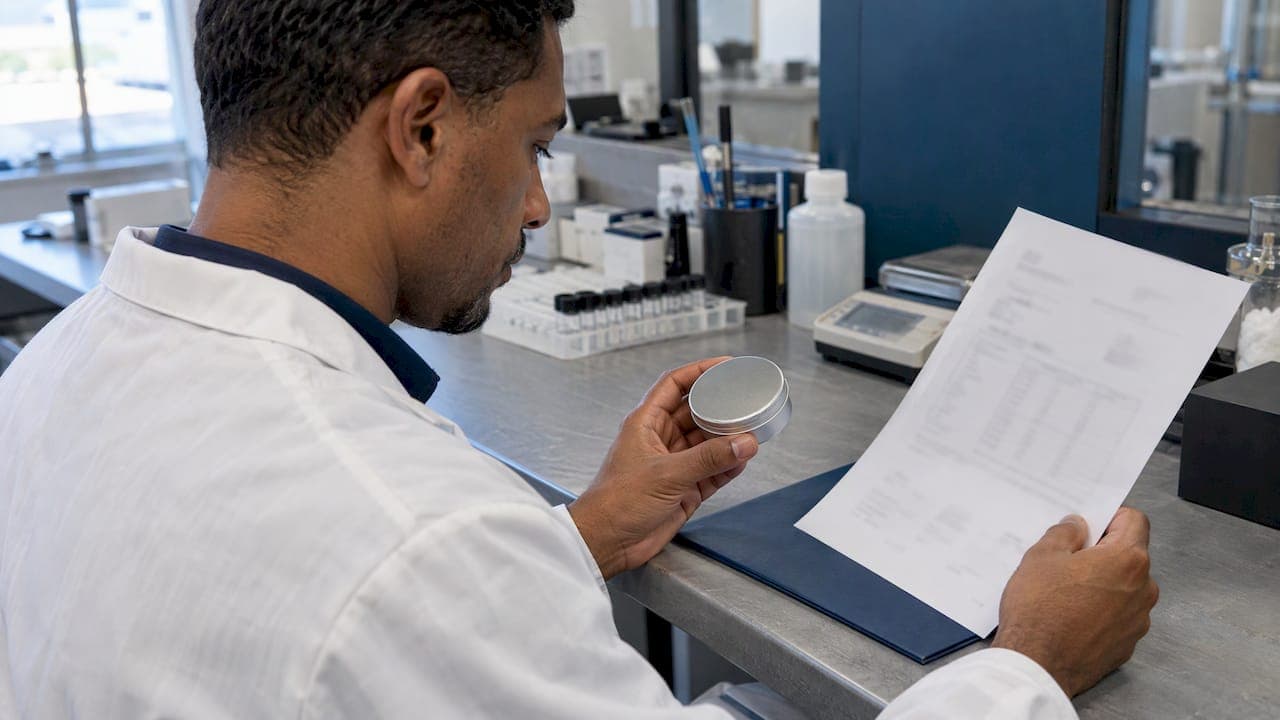
A CBD certificate of analysis (COA) is a lab report for one tested sample or batch. To read it, do five things in order. Match the batch number to your package. Check which lab ran the test. Read the CBD and THC amounts with their units. Review each contaminant panel against its limit. Then note what the report does not list. This guide walks through each step with the terms you will actually see.
TL;DR
- A COA only counts for your product if the brand, product name and batch or lot number match your package.
- Read potency with its unit (mg/g, percent by weight or mg per package) and compare it to the label.
- Contaminant panels show a result next to a limit. PASS means within the limit, FAIL means over it.
- ND, LOQ and "not tested" mean different things. A test that is not on the report cannot be assumed.
- A COA is evidence about a tested sample, not a guarantee about every jar.
Table of Contents
- What a CBD COA is and what it shows
- Step 1: Confirm the COA belongs to your product
- Step 2: Check who ran the test
- Step 3: Read the cannabinoid profile
- Step 4: Review the contaminant panels
- Step 5: Decode ND, LOQ and "not tested"
- Red flags on a COA
- What a COA cannot tell you
- Perspective: why we read COAs the way we do
- Put it into practice with a balm you can check
- FAQ
- Sources
What a CBD COA is and what it shows
A CBD COA is a laboratory report for a tested product sample or batch. According to New York's cannabis regulator, it can show the cannabinoid profile and potency, including CBD and THC, plus whatever contaminant panels were actually performed. It is not proof of tests the report does not list.
Illinois' cannabis regulator says a COA identifies the laboratory, the brand, the product and the potency of ingredients. It may also report CBD, CBG, CBN, residual solvents, pesticides, heavy metals, microbial impurities and mycotoxins.
Those are state cannabis programs, and hemp CBD sold online is not governed by the same rules. Still, their guides are the clearest public explanations of how a COA is laid out. The same layout shows up on most hemp CBD reports.
Most COAs follow the same order:
- A header with the lab, client, product and batch details.
- A summary of pass or fail results.
- A potency or cannabinoid table.
- One page or section per contaminant panel.
- A signature, date and sometimes accreditation marks.
The steps below follow that order.
Step 1: Confirm the COA belongs to your product
This is the step most people skip, and it decides whether everything else means anything. A flawless report for a different batch tells you nothing about the one in your hand.
Match these details against your package:
- Brand and product name.
- Batch or lot number.
- Product description or type (for example, topical or tincture).
- Report date and laboratory name.
ACS Laboratory lists the same checks: brand and product name, batch number and description, plus the report date and lab name. It also says the lot number on the package should correspond to the batch or sample information on the COA. A mismatch may mean the report applies to another product or batch.
Why the batch matters
A lab result is only meaningful for a lot when the sample represents that lot. The U.S. Pharmacopeia (USP) says representative sampling and documentation are essential. It recommends systematic collection, homogenization, appropriate equipment and an approved procedure. USP's cannabis quality recommendations also note that sampling variability and analytical inconsistencies can make it hard to tell whether a COA truly reflects the batch. That is why batch traceability matters.
In practice: find the lot number printed on your tin, jar or bottle, then find the same number on the report. If you cannot find it, you do not yet have a COA for your product.
Step 2: Check who ran the test
Look at the lab's name and details in the header. Ask three questions.
- Is the lab independent? A third-party lab has no stake in the result.
- Is it accredited? ACS Laboratory recommends looking for ISO/IEC 17025 accreditation, confirming the test date and contacting the lab directly if a report looks questionable.
- Is the report recent enough for the batch? The test date should fall before the product reached you, and be plausible for the batch.
Labs also check themselves against known standards. NIST says labs can verify measurement methods by analyzing reference material and comparing the results with NIST's values within an accepted margin of error. You will not see this on the COA, but it explains why accreditation is worth looking for.
Step 3: Read the cannabinoid profile
The potency section lists each cannabinoid the lab measured, with a result. Read the analyte name, the result, the unit and the limit of quantification.
Units you will see
The analyte is the compound being measured. ACS Laboratory explains that potency may be reported in milligrams per gram, and that liquids or oils may use milliliters instead. A percentage column converts milligrams per gram into percent by product weight. It is the same concentration written another way.
A quick conversion helps: 10 mg/g equals 1% by weight. FDA's warning letter data also shows CBD, delta-9 THC and other cannabinoids reported in mg/g and percent by weight.
One caution on unit types. New York's guide notes that inhaled products state percentages, while edibles state total THC in milligrams per serving and per package. Different product types report differently, so always look at the unit before you compare two reports.
CBD versus CBDA, THC versus THCA
New Jersey's guide says cannabinoid profiles may separately show delta-9 THC and THCA, CBD and CBDA, along with others such as CBG, CBC and CBN. The "A" stands for the acidic form found in the raw plant.
A common line in the research: if a COA shows only the neutral forms like THC or CBD, the lab may have already combined the acidic forms into the total. If it shows both, look for a total line. Do not read the acidic and neutral lines as two separate products.
Ratios
Some reports show a ratio. New York explains that a ratio such as 1:1 means equal amounts of THC and CBD, while ratios like 4:1 or 20:1 indicate different relative amounts. For a CBD product, you would normally expect far more CBD than THC.
The THC line
Find the THC result and read it with its unit. Some topicals are made with a THC-free formula and others are full spectrum. If you are sorting out which suits you, our guide on full spectrum versus THC-free topicals explains the choice. If you face drug testing, read our notes on CBD cream and drug tests, and for competition, see the WADA CBD rules for athletes.
Compare against the label
This is where a COA earns its keep. Take the total CBD on the report and compare it to the label claim.
- ACS Laboratory lists a variance of more than 10% between the THC or CBD claim and the result as a warning sign.
- An FDA-hosted University of Mississippi survey of 25 retail products found marked variability between label claims and measured content. Some had no CBD, some exceeded the label, one held only THC, and some exceeded 0.3% THC.
- FDA also lists a product labeled 200 mg CBD where no CBD result was reported, alongside a delta-9 THC result of 0.029 mg/g.
For a topical, the label usually gives total CBD per container. If a tin lists 1,000 mg CBD per ounce, you want a report whose figure, once converted from mg/g to the container size, lands near the label. Our CBD dosage guide for topicals shows how label strength turns into how much balm you apply.
Step 4: Review the contaminant panels
After potency, the report shows safety panels. New York's guide says to look for the panels relevant to the product: pesticides, heavy metals, microbes or microbial impurities, mycotoxins, residual solvents, and sometimes water activity or foreign matter.
What each panel looks for:
| Panel | What it checks | Source |
|---|---|---|
| Microbials | Mold, bacteria, yeast, E. coli, Salmonella, Aspergillus | New Jersey guide |
| Heavy metals | Lead, mercury, cadmium, arsenic | New Jersey guide |
| Pesticides | Residues compared with action limits | Washington LCB |
| Mycotoxins | Harmful molds or fungi | Washington LCB |
| Residual solvents | Extraction residues such as butane and hydrocarbons | Washington LCB |
Washington's regulator frames these panels as public-health risk control. Each one addresses a different hazard. USP likewise says cannabis-derived products can carry risks from pesticide residues, microbial or fungal contamination, organic solvents and elemental contaminants.
Note that New Jersey says residual-solvent testing applies to extracts and vapes. Not every panel applies to every product type, so a missing panel is a question to ask, not automatically a flaw.
PASS, FAIL and limits
New York says a contaminant section should name each specific contaminant and show pass or fail. A result below the applicable limit passes. One above the limit fails. Read every result with its unit and limit.
Illinois adds that a passing result means validated lab methods found no regulated contaminants above established limits.
A word on units for metals and pesticides. ACS Laboratory says an action level is the allowable threshold, and that 1 ppm equals 1 mg/kg while 1 ppb equals 1 microgram/kg. Read each result alongside its stated limit, never as an isolated number. A figure of 0.5 means nothing until you see the limit beside it.

Step 5: Decode ND, LOQ and "not tested"
These labels cause the most confusion.
- LOQ (limit of quantification): the smallest amount the lab can accurately measure. ACS Laboratory says a result written as less than LOQ means the contaminant is below the quantification limit and the stated safe allowable limit.
- ND (not detected): the lab did not detect the compound at its method's sensitivity. It is not the same as zero in an absolute sense, because every method has a floor. Check the LOQ column to see where that floor sits.
- Not tested (NT) or a blank: nothing was measured. Illinois warns that testing not performed cannot be inferred from a COA. A report tells you only what was tested, how it was reported and what the lab found in the sample.
When you see ND next to THC, read the LOQ too. An ND with a very low LOQ is a stronger statement than an ND with a high one.
Red flags on a COA
Use this checklist before you trust a report. ACS Laboratory names several of these as warning signs: missing contaminant tests, failed contaminant results, missing common cannabinoids, no laboratory certifications, noncompliant THC levels, or a claim variance above 10%.
Add the signs from Steps 1 and 2:
- No batch or lot number, or one that does not match your package.
- No lab name, no accreditation, or no test date.
- Potency only, with no safety panels at all.
- A CBD result that is blank for a product labeled with CBD.
- A report that is a cropped image with no way to see the full document.
- Results in different units from the label, with no conversion given.
If a report looks questionable, ACS Laboratory suggests contacting the lab yourself using details you find independently, not the ones printed on the document.
What a COA cannot tell you
Illinois' cannabis regulator states the central point: a COA is evidence about a tested sample, not a universal guarantee that the whole product is safe. It does not show how you will respond to a product, and it says nothing about tests the lab did not run.
Here is what that means in practice:
- It covers a batch, not a brand forever. A good report from last year applies to last year's lot.
- It does not predict effects. Potency and purity are quality markers. How a topical works for your joints or muscles is a separate matter.
- It does not replace medical advice. If you have a skin condition, take medications or are pregnant, talk to your doctor or pharmacist before using any CBD product.
For a wider view of buying a topical, our seven checks before you buy a CBD cream puts the COA alongside ingredients, strength and return terms.
Perspective: why we read COAs the way we do
We build balms for people who train hard or live with daily aches, and those people deserve to know what is in the tin. That is why we formulate around a clear number: 1,000 mg of CBD per ounce, paired with botanicals such as arnica, menthol, turmeric and eucalyptus.
Our approach is simple. We hold our products to rigorous third-party testing, and we think every buyer should read a lab report the same way, batch first, then potency, then safety panels. Our formulas are THC-free, vegan, non-GMO, paraben-free and cruelty-free, and those are claims we expect to stand next to a lab report.
We also back the product with a full refund within 30 days of purchase. A balm is meant to be used, felt and judged on your own skin and your own routine. The COA tells you what is in it. The 30 days let you decide if it works for you.
Cindy
Put it into practice with a balm you can check
Once you know how to read a COA, shop with the report in hand. Our balms are made for muscle recovery and arthritis discomfort, with 1,000 mg of CBD per ounce and botanicals like arnica, menthol and cinnamon & clove. The Seriously Soothing Pain Balm and RIKKI TIKKI Recovery are priced from $26.95 to $39.95, depending on the size and scent you choose.
Every order is covered by our 30-day full refund policy. Browse the full range on the Mongoose CBD Co. homepage.
FAQ
Where do I find the COA for a CBD product?
Look on the product page, on the package for a QR code, or in a lab report section on the brand's site. Then match the lot number on your package to the one on the report. If you cannot find a report for your lot, ask the brand to send it.
Does ND mean a product has no THC?
Not exactly. ND means the lab did not detect the compound at the sensitivity of its method. Check the LOQ column to see how low that method can measure. A lower LOQ makes an ND result more meaningful.
Is a passing COA a guarantee that the product is safe?
No. A passing result means the tested sample fell within the limits for the panels that were run. Illinois' regulator describes a COA as evidence about a tested sample, not a guarantee for the entire product. Check which panels were run and that the batch matches yours.
What does it mean if the CBD amount differs from the label?
Small differences are common in lab work, but ACS Laboratory treats a variance of more than 10% as a warning sign. FDA-hosted survey data found some retail products far from their label claims. If your report and label disagree by a wide margin, contact the brand and ask for an explanation.
Sources
- New York Office of Cannabis Management: How to read a COA
- Illinois: Understanding a COA
- Illinois: How to Read a COA
- New Jersey: How to Read a COA
- Washington State Liquor and Cannabis Board: Understanding Test Results
- ACS Laboratory: Certificate of Analysis
- ACS Laboratory: How to Verify Third-Party Lab Tests for Hemp Products
- FDA: Warning Letters for Cannabis-Derived Products
- FDA: Content vs. Label Claim, A Survey of CBD Products
- USP: Comments to Health Canada on cannabis standards
- USP: Cannabis Quality recommendations
- USP: Cannabis-derived products policy position, 2024
- NIST: New Hemp Reference Material