
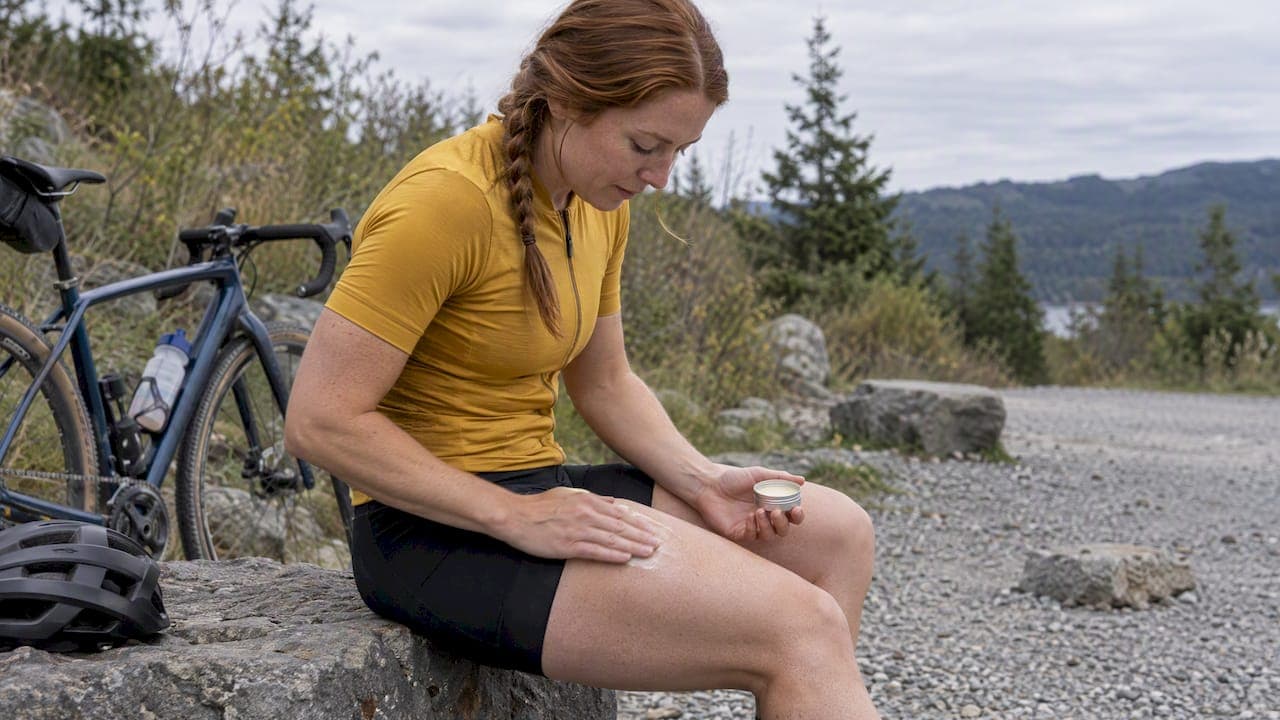
CBD may help cyclists feel better after hard rides, but the proof is thin. The best-supported recovery tools are still food, fluids and sleep. A topical balm can be a reasonable extra for sore quads, knees and lower back. Racers under anti-doping rules need to check the testing risk first.
This guide covers what the research says, where a balm fits, how to use one, and what to check before you buy.
TL;DR
- Evidence for CBD in post-exercise recovery is limited and often inconclusive, according to a 2024 systematic review.
- Topical balms are the most practical form for cyclists: applied to quads, calves, knees and lower back after a ride.
- Pure CBD is permitted by WADA. Other cannabinoids, including THC, are prohibited in-competition. Tested racers carry the risk.
- Nutrition, hydration and sleep come first. CBD is an add-on.
- Our balms cost $26.95 to $39.95 and carry a 30-day full refund.
Table of Contents
- What cyclists want from recovery
- What the evidence says about CBD and recovery
- Do topical CBD balms work?
- Drug testing: the part racers must read first
- Safety: liver and medication questions
- Recovery basics come first
- How cyclists use a recovery balm
- Our perspective
- Choosing a balm for your riding
- Try a balm after your next long ride
- Frequently asked questions
- Sources
What cyclists want from recovery
Cycling loads the same muscles for hours. Quads, hamstrings, calves and hips take repeated low-impact work. The lower back and neck hold a fixed position. Knees take thousands of pedal strokes per ride.
Soreness after a long ride or a stage race block usually comes from a mix of muscle fatigue, depleted fuel and, after a hard effort, muscle damage. Riders look for three things:
- Less soreness the next morning.
- Better sleep after a hard day.
- Fewer nagging aches in knees, back and hands.
CBD gets mentioned for all three. The honest answer is that it has not been proven for any of them in athletes.
What the evidence says about CBD and recovery
A 2024 systematic review of CBD in healthy, physically active people found preliminary signals for perceived soreness and some biomarkers in acute settings. It also found a lack of large, high-quality human trials in athletes. That is the key point: some small studies are promising, and none settle the question.
Researchers writing in Frontiers in Pharmacology describe the debate as open. Results conflict. Doses range widely, for example 50 mg in one trial and 300 mg in another. Methods of taking it differ, and so does the kind of fatigue being studied. That variability is why nobody can give a universal dose for a century ride or a hill-climb block.
Two points matter for cyclists:
- Most trials use oral CBD, not creams or balms.
- Soreness is subjective. A rider who expects relief may feel it.
For a deeper look, read our own summary, CBD for muscle recovery: what the evidence shows.
Do topical CBD balms work?
Topicals are where cyclists most often start. You rub them on the sore spot. You skip the swallowing and the dose guesswork of oils and gummies.
The caution is real. The Arthritis Foundation notes that it is unclear whether enough CBD penetrates the skin to reach a joint. When people report relief, it is hard to tell whether CBD or the other ingredients in the balm did the work. Menthol and camphor, for example, create a cooling sensation that distracts from pain.
That is why ingredients matter as much as the CBD number. Read more in CBD balm ingredients that matter for pain relief, and on arnica and menthol for pain. Our view: a balm is a short-term comfort tool. It can feel good and help you move. It does not repair tissue faster.
What a good cycling balm contains
Our balms combine 1,000 mg of CBD per ounce with botanicals chosen for how they feel on tired muscle. Depending on the formula, these include arnica, menthol, turmeric, eucalyptus, peppermint, cinnamon, clove, ginger and cayenne pepper. The formulas are vegan, non-GMO, paraben-free, THC-free and cruelty-free.
The balm types differ in sensation:
| Feel | Typical ingredients | Good for |
|---|---|---|
| Cooling | Menthol, peppermint, eucalyptus | Post-ride legs, hot days |
| Warming | Cinnamon, clove, ginger, cayenne | Cold-weather rides, stiff knees, lower back |
| Arnica-based | Arnica | Bruises, minor impact marks after a fall |
Warming and cooling sensations are comfort, not proof of healing. We cover that in warming vs. cooling CBD for sore muscles. For arnica specifically, see arnica CBD balm: evidence for bruises.
Drug testing: the part racers must read first
If you do not race under anti-doping rules, skip to the next section. If you hold a license or enter tested events, read this carefully.
The WADA 2026 Prohibited List permits CBD at all times. It prohibits other natural and synthetic cannabinoids, including THC, in-competition. Athletes are strictly liable for what is found in their system.
The risk is contamination. USADA warns that CBD products may still contain prohibited cannabinoids, and supplement labels are often inaccurate. Most products are not third-party certified. Even a THC-free label does not remove the risk. USADA's safest advice for the in-competition period is to avoid hemp products, which it explains on its page about hemp and positive anti-doping tests.
Our practical advice for tested riders:
- Ask your federation or national anti-doping organization before using any CBD product.
- Stop use well before competition, and do not treat any label as a guarantee.
- Keep batch information and test results for any product you use.
More detail is in our guides on WADA CBD rules for athletes in 2026 and whether CBD is athlete safe. A topical is lower in systemic exposure than an oil, but we make no promise about test outcomes for any product.
Safety: liver and medication questions
Most cyclists ask about oils, gummies and capsules too, so here is the safety picture.
An FDA randomized trial looked at liver effects. In clinical studies, high-dose oral CBD was linked to liver enzyme elevations in about 12 to 13 percent of participants at 25 mg/kg/day, against 1 percent on placebo. Changes were often without symptoms and reversed after stopping. Caution is greater if you also take other medications, including common over-the-counter pain relievers.

That dose is far above what a balm delivers. Still, if you take regular medication, have liver disease, or use pain relievers often after rides, talk to your doctor or pharmacist before adding any CBD product. Apply a balm only to intact skin. Test a small patch first and stop if you get a rash.
Recovery basics come first
No balm replaces fuel. The American College of Sports Medicine's nutrition and athletic performance guidance points to carbohydrate replenishment, adequate protein and rehydration as the proven drivers of recovery. Typical daily carbohydrate targets run 3 to 5 g per kilogram of body weight for general training, and protein of about 20 to 30 g per meal.
A simple post-ride checklist:
- Drink fluids with electrolytes within the first hour.
- Eat carbohydrates and protein soon after finishing.
- Spin easy for a few minutes to cool down.
- Sleep. Nothing else comes close.
- Then, if you want it, use a balm on the sore spots.
If CBD helps, treat it as an adjunct. It is not a substitute for any step above.
How cyclists use a recovery balm
Keep it simple.
- After the ride: Shower, dry off, then rub a small amount into quads, calves or the sore joint.
- Evening: Apply to the lower back or knees before bed if stiffness bothers your sleep.
- Cold-weather rides: A warming formula on the legs after the ride can feel pleasant.
- After a crash: Use arnica balm on bruises only, never on broken skin or road rash.
Keep it away from your eyes, and wash your hands after. Do not apply it under tight bib shorts or compression gear before the ride unless you have already tested how it feels. Do not use it in the saddle contact area.
We suggest tracking for two weeks. Note how sore you feel the next day with and without the balm. That is the only way to know whether it does anything for you.
Our perspective
We make balms, so we will be plain about what they are.
Our formulas pair CBD with arnica and other botanicals. We built them for people with sore muscles and chronic aches, including athletes. Customers tell us the sensation is pleasant and the comfort arrives quickly. We take that seriously, and we also take the research seriously.
The research does not show that CBD speeds muscle repair. It also leaves open whether CBD or the menthol, arnica and warming botanicals produce the relief you feel. We do not claim a balm heals tissue. We claim it offers a comfortable, topical option for sore muscles that many riders enjoy.

For tested athletes, our advice is cautious. We describe our products as THC-free, and we support third-party testing. Still, anti-doping bodies tell athletes that no hemp product is risk-free in competition. If your license is on the line, the safest choice is to ask your governing body first.
For everyone else, there is a no-risk way to find out: try a balm and use the refund if it does nothing for you.
— Cindy
Choosing a balm for your riding
Use these criteria:
- Clear CBD content. Look for the amount per ounce, not only per container.
- Ingredient list you can read. Know what produces the sensation.
- Third-party testing. Ask for it, especially if you are tested.
- Skin comfort. Strong menthol or cayenne formulas can irritate sensitive skin.
- A refund window. It lets you test the balm over several rides.
Other options exist by type: menthol rubs, arnica gels, heat wraps, foam rolling and massage. Each has a place. Menthol rubs and heat wraps bring comfort without CBD. Our page on alternatives to Icy Hot for muscle soreness and arthritis explains where a CBD balm differs.
Try a balm after your next long ride
Our two lines suit cyclists:
- RIKKI TIKKI Recovery: a muscle recovery balm in a 2 oz tin. See RIKKI TIKKI Recovery.
- Seriously Soothing Pain Balm: available in original, cinnamon and clove and lavender lemongrass.
Prices run $26.95 to $39.95. If the balm does not work for you, we offer a full refund within 30 days of purchase. Browse all products on our homepage.
Frequently asked questions
Does CBD help cyclists recover faster?
There is no solid proof that it does. A 2024 systematic review found limited and often inconclusive evidence in active people. Some riders report less perceived soreness, but that may reflect other factors. Sleep, food and fluids remain the proven tools.
Is a CBD balm better than an oil for sore legs?
A balm goes on the sore spot and avoids the oral dose questions that come with oils. Its limit is that it is unclear how much CBD reaches deep tissue. Much of the feeling may come from ingredients like menthol or arnica. For localized soreness, many riders find a balm more convenient.
Can CBD cause a positive drug test for cyclists?
It can. WADA permits pure CBD, but products may contain THC or other prohibited cannabinoids, and labels are not always accurate. USADA says the safest route in the in-competition period is to avoid hemp products. Tested riders should ask their governing body before using any.
Is CBD safe for the liver?
High oral doses have been linked to liver enzyme elevations in clinical studies, often without symptoms. A topical balm delivers far less than those doses. If you take regular medication or have liver concerns, check with your doctor first.
Sources
- The Effect of Cannabidiol on Performance and Post-Load Recovery: A Systematic Review (PMC)
- Cannabidiol in sports: insights on how CBD could improve performance and recovery (Frontiers in Pharmacology)
- CBD for Arthritis Pain (Arthritis Foundation)
- WADA Prohibited List
- Athletes: 6 Things to Know About Cannabidiol (USADA)
- Can Hemp Products Cause a Positive Anti-Doping Test? (USADA)
- CDER Investigators Address the Safety of CBD in a Randomized Trial (FDA)
- Nutrition and Athletic Performance (ACSM)