
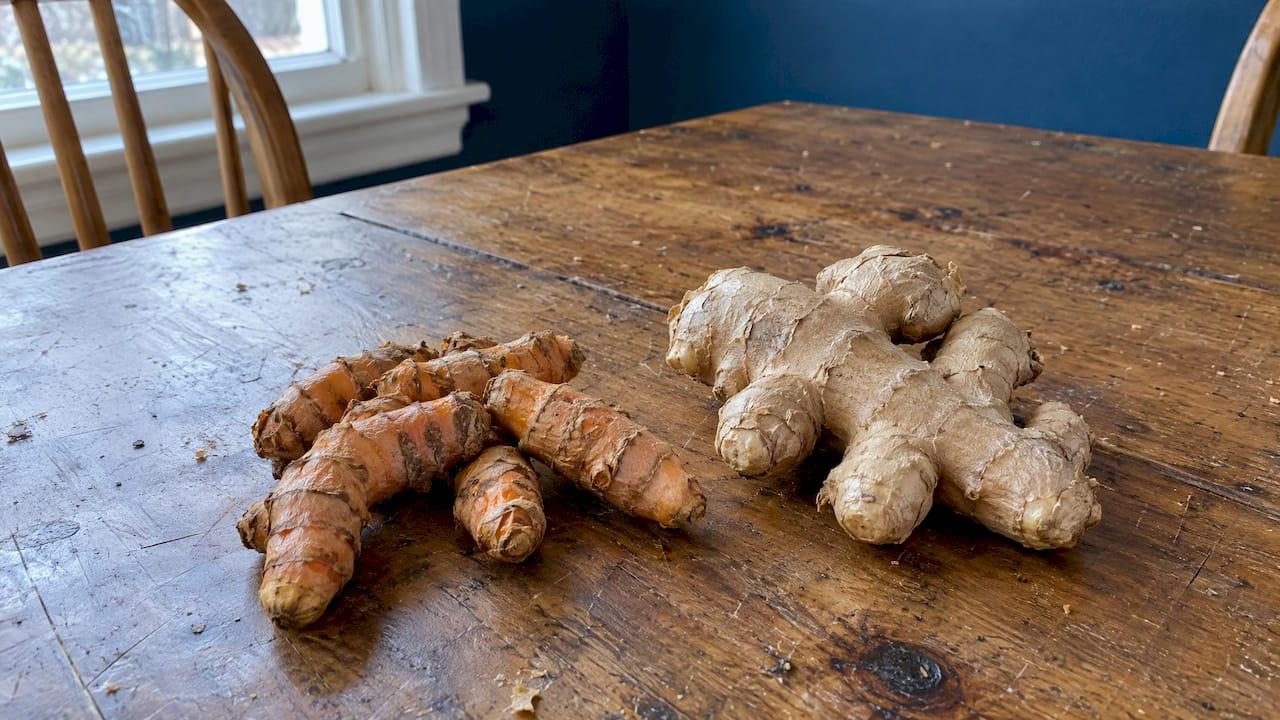
Turmeric is the better-studied of the two for joint pain, and ginger has the stronger track record for sore muscles after hard training. Neither has to be a one-or-the-other choice. They act on inflammation in different ways, which is why a topical balm that puts both on the skin, next to arnica and a warming botanical like cayenne, makes more sense than betting on a single spice.
This guide compares the two for the reader who hurts: the lifter with stiff shoulders, the runner with sore quads, the person whose knees complain on stairs. It covers what the studies found, what the doses looked like, where arnica and capsaicin fit, and what to check before putting any of it on your skin.
TL;DR
- Turmeric (curcumin) has the larger body of research for arthritis pain and stiffness. Ginger has trial data for delayed onset muscle soreness, the ache that peaks a day or two after a hard session.
- The two compounds work through different pathways, so using them together is a reasonable approach rather than a compromise.
- Arnica gel performed comparably to an anti-inflammatory gel for knee osteoarthritis in a Cochrane review, and capsaicin has high-certainty evidence for pain reduction over about four weeks.
- Ginger can add to bleeding risk when combined with drugs such as naproxen, so people on those medications should talk to their doctor or pharmacist first.
- Our balms combine 1,000mg of CBD per ounce with turmeric, ginger, arnica and other botanicals, and come with a 30-day full refund.
Table of Contents
- Turmeric vs. ginger at a glance
- What the research says about turmeric for pain
- What the research says about ginger for pain
- Which is better for inflammation?
- Why the topical route fits sore spots
- Arnica and capsaicin: how they compare
- CBD alongside capsaicin and the herbs
- Safety checks before you use ginger or turmeric
- A simple way to choose
- Perspective
- Our balms for sore muscles and joints
- FAQ
- Sources
Turmeric vs. ginger at a glance
Both are rhizomes from the same plant family, and both have been used for pain for centuries. The active compounds differ: turmeric's is curcumin, ginger's are gingerols and related compounds. That difference explains why their strengths do not overlap perfectly.
| Turmeric (curcumin) | Ginger | |
|---|---|---|
| Best-studied use | Osteoarthritis pain and stiffness | Muscle soreness after exercise, chronic pain in general |
| Typical oral form in trials | Standardized curcumin extracts | Powder or extract, about 2 g per day in the muscle soreness trials |
| Topical research | Early, mostly curcumin ointments and gels | Topical ginger oil and plant extracts in soreness trials |
| Skin note | Can cause itching or hives in some people | Can cause local irritation in sensitive skin |
| Medication note | Check with your doctor if you take blood thinners or have gallbladder issues | Can add to bleeding risk with drugs such as naproxen |
The rest of this article explains each row.
What the research says about turmeric for pain
Turmeric's best evidence is in joints. A 2016 systematic review of turmeric and curcumin for arthritis pooled the randomized trials and found reductions against placebo on both a visual analog pain scale (mean difference of −2.04 points) and the WOMAC score, a standard questionnaire covering pain, stiffness and function in knee and hip arthritis (mean difference of −15.36).
A 2021 systematic review of turmeric for knee osteoarthritis looked at 10 studies. All of them showed improvement in pain and function from baseline, and in the three studies that compared turmeric with NSAIDs (the family that includes ibuprofen and naproxen), outcome scores did not differ between the groups. The review also reported no significant adverse events in the turmeric groups.
What that means for you: if your pain is in the joints, especially the knees, and it comes with morning or post-sitting stiffness, turmeric has the most data behind it. Most of that data is on oral curcumin extracts, so dose and product quality matter in those studies. If you want the topical side in more depth, we cover it in does topical turmeric really ease joint pain.

How curcumin works, in plain terms
Inflammation is the body's response to tissue stress, and it is what makes a joint or muscle feel hot, tight and sore. Curcumin is associated with blocking some of the enzymes involved in that response. That is why turmeric shows up in studies of conditions where inflammation drives the symptoms, such as osteoarthritis.
What the research says about ginger for pain
Ginger's evidence is broader across pain types. A 2015 systematic review and meta-analysis of Zingiberaceae extracts, the plant family that includes both ginger and turmeric, reported a significant reduction in subjective chronic pain (standardized mean difference −0.67) and a linear dose-effect relationship. The included studies showed a good safety profile.
For athletes, the more useful finding comes from a 2020 review of clinical trials on ginger and pain. On delayed onset muscle soreness, it describes four randomized trials suggesting reduced inflammation after oral and topical ginger. It cites dosing examples such as 2 g per day for daily consumption and a 14% topical preparation of a ginger relative, Zingiber cassumunar.

What that means for you: if your problem is the soreness after leg day, a long run or a grappling session, ginger has direct trial support for that situation. Our post on whether topical ginger reduces inflammation and pain goes through how it behaves on the skin.
Which is better for inflammation?
It depends on where you hurt and when.
- Joint stiffness that lingers, especially in the knees or hands: turmeric has the larger evidence base, including pooled trials against placebo and NSAIDs.
- Muscle soreness that follows training: ginger has the trial data aimed at that exact problem.
- Pain that is a bit of both: the two are used together, and that is the logic behind many herbal formulas. A 2022 laboratory study on a ginger and turmeric combination is not what we rely on here; the more practical point is that because the compounds act differently, they complement each other rather than duplicate each other.
The honest answer to "which is better" is that the question assumes you can only choose one. You can pair them, and on skin you do not need to swallow capsules to do it.
Why the topical route fits sore spots
Pills spread an ingredient through your whole body. A balm puts it on the one place that hurts: the knee, the elbow, the trap that is knotted from the bar. That is the practical advantage for athletes and for people with arthritis in specific joints, and it is why we make balms and not capsules.
It also brings in two more botanicals worth knowing about, arnica and capsaicin, since the question of how they compare with turmeric and ginger comes up often.
Arnica and capsaicin: how they compare
Arnica
Arnica is a flowering plant used on skin for bruising and sore joints. In a Cochrane review of topical herbal therapy for osteoarthritis, arnica gel probably improved pain and function about as well as an NSAID gel. Memorial Sloan Kettering notes that a few clinical trials suggest topical arnica may help osteoarthritis and reduces bruising compared with placebo.
Arnica belongs on the skin, not in the mouth. People allergic to plants in the sunflower family, such as marigolds and ragweed, should avoid it, and Memorial Sloan Kettering describes serious adverse events from swallowing the raw herb. A 2021 review also found that oral forms carry more toxicity risk than topical ones, and that skin rash or itching from contact dermatitis is the typical topical reaction. For how arnica pairs with menthol's cooling effect, see arnica and menthol for pain.
Capsaicin
Capsaicin is the compound that makes chili peppers hot. A 2019 evidence-based decision aid reported high-certainty evidence that capsaicin reduces pain at the time point closest to four weeks (SMD −0.56). A 2024 review of topical pain relief options explains the mechanism: capsaicin binds a receptor called TRPV1 on pain-sensing nerve fibers, causes an initial burning sensation, then a reversible desensitization that can last several weeks. It also notes that topical capsaicin and topical NSAIDs both beat placebo at four weeks, with no significant difference between them.
The warmth is the trade-off. A systematic review of topical capsaicin found that about one third of patients had a local reaction, usually burning or itching. Memorial Sloan Kettering advises against using capsaicin on irritated or infected skin or on a wound, and recommends gloves during application and washing hands afterward so it does not reach your eyes or other sensitive areas.
Capsaicin vs. turmeric
They do different jobs. Capsaicin works on nerve signaling, with warmth first and reduced sensitivity afterward. Turmeric works on the inflammatory chemistry in the tissue. They are not rivals, and a formula can include more than one.
CBD alongside capsaicin and the herbs
Searches for CBD cream versus capsaicin cream usually come from people who want relief without the burn. CBD is a different kind of ingredient again: it is not a heat-producing counterirritant. Our guides on CBD for inflammation and CBD for joint pain and how to use a balm explain what the research shows and how to apply a balm.
A balm that combines CBD with botanicals lets you work from more than one direction at once. Our write-up on turmeric and CBD in a topical covers why that pairing is of interest.
Safety checks before you use ginger or turmeric
These are the points that matter for use on skin and by mouth.
- Blood thinners and NSAIDs. A 2021 review of herbal medicine and drug interactions notes that ginger may increase bleeding risk through its effect on thromboxane synthesis, and that using it with drugs of similar action, such as naproxen, may add to that risk. If you take anticoagulants or regular NSAIDs, or have surgery coming up, ask your doctor or pharmacist before taking ginger by mouth.
- Skin reactions. The National Center for Complementary and Integrative Health reports that topical curcumin can cause hives or itching. Test a small patch on your inner forearm before covering a larger area, and stop if a rash appears.
- Oral turmeric side effects. The same page lists nausea, reflux, stomach upset, diarrhea and constipation as possible effects of turmeric taken by mouth, and says standard oral turmeric is likely safe in recommended amounts for up to two or three months.
- Broken skin. Keep any balm off wounds and irritated skin.
- Persistent or severe pain. Pain that wakes you at night, follows an injury, comes with swelling or fever, or keeps worsening needs a doctor, not a balm.
A simple way to choose
Use this as a decision guide.
- Sore after training: look for ginger, plus arnica for the bruised, beaten-up feeling. See CBD for martial arts soreness or CBD for muscle knots for sport-specific cases.
- Stiff or achy joints: look for turmeric first, with warming and cooling botanicals for comfort on the skin.
- A localized, stubborn spot such as bursitis: a consistent routine matters more than a single application. Our two-week topical trial for bursitis pain shows how we approached it.
- You dislike strong heat: choose a formula where the warming ingredients are balanced with cooling ones like menthol and peppermint.
Perspective
We built our balms around a simple observation: people with sore muscles and stiff joints do not experience pain as a single-ingredient problem, so we do not formulate as if they did.
Each balm starts with 1,000mg of CBD per ounce. We add arnica, menthol, turmeric, ginger, eucalyptus, peppermint, cinnamon, clove and cayenne pepper, so the turmeric-or-ginger question is one you never have to answer. Both are already in the jar, along with ingredients chosen for a pleasant feel on the skin.
The result is made for athletes and for people living with chronic pain and arthritis. The balms are vegan, non-GMO, paraben-free, THC-free and cruelty-free, and our products go through third-party testing. If you try one and it is not right for you, we refund your purchase in full within 30 days.
Cindy
Our balms for sore muscles and joints
Seriously Soothing Pain Balm and RIKKI TIKKI Recovery are the two lines built for the situations above. Each is priced from $26.95 to $39.95, depending on the option you choose. Seriously Soothing is made for everyday aches, including arthritis pain, and RIKKI TIKKI Recovery is made for muscle soreness after training. You can browse both on our shop page, or go straight to the Seriously Soothing Pain Balm or RIKKI TIKKI Recovery.

Both carry our 30-day full refund policy.
FAQ
Which is better for arthritis, ginger or turmeric?
Turmeric has more research in arthritis, especially knee osteoarthritis, where pooled trials found less pain and stiffness than placebo. Ginger also shows pain-lowering effects in reviews. Because they act differently, many people use both, and a balm with both in it covers each.
Can you take ginger and turmeric together?
Yes, they are commonly combined in food, supplements and topicals. The main caution is for people taking blood thinners or NSAIDs such as naproxen, since ginger may add to bleeding risk. Ask your doctor or pharmacist before taking either by mouth if that is you.
Is capsaicin better than turmeric for pain?
They are not the same kind of ingredient. Capsaicin has high-certainty evidence for reducing pain over about four weeks, but it causes a burning sensation at first and reactions are common. Turmeric is gentler on the skin for most people and has stronger joint-specific data, so the better choice depends on whether you tolerate heat.
How does arnica compare with capsaicin?
In a Cochrane review of topical treatments for osteoarthritis, arnica gel probably improved pain and function about as well as an NSAID gel. Capsaicin works through nerve desensitization and tends to cause warmth or burning at the start. Arnica should not be used by people allergic to sunflower-family plants.
Sources
- Efficacy of Turmeric Extracts and Curcumin for Alleviating the Symptoms of Joint Arthritis (2016)
- Therapeutic effects of turmeric or curcumin extract on pain and function for knee osteoarthritis (2021)
- Zingiberaceae extracts for pain: a systematic review and meta-analysis (2015)
- Clinical trials on pain lowering effect of ginger (2020)
- Herbal Medicine for Pain Management: Efficacy and Drug Interactions (2021)
- Topical herbal therapy for treating osteoarthritis, Cochrane
- Arnica, Memorial Sloan Kettering Cancer Center
- Arnica for pain management: clinical trials, mechanisms and adverse effects (2021)
- Conditional Recommendations for Specific Dietary Supplements and Herbs, decision aid (2019)
- Making Sense of Topical Pain Relief Options (2024)
- Systematic review of topical capsaicin (2004)
- Capsaicin, Memorial Sloan Kettering Cancer Center
- Turmeric: Usefulness and Safety, NCCIH