
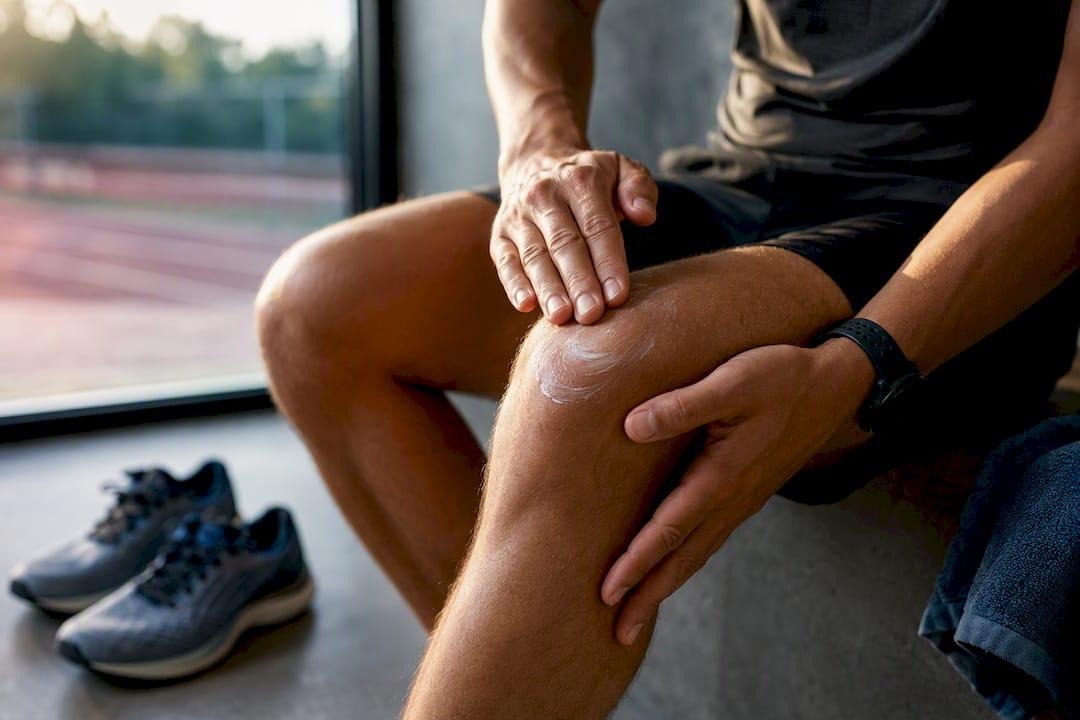
Topical CBD can ease knee discomfort for some runners as a short-term, symptomatic aid, especially when the product also contains menthol or arnica. It will not fix the mechanical problem causing runner's knee, and clinical trial results on CBD for joint pain remain mixed. Products like Mongoose CBD Co.'s balms give runners a reasonable topical option to try alongside real rehab, not instead of it.
TL;DR:
- Topical CBD with menthol or arnica may provide short-term relief for runner's knee but does not address the underlying mechanical causes.
- Clinical trials show minimal to no significant benefit from CBD, oral or topical, for joint pain, with effects often being small and formulation-dependent.
- Topical application offers localized effects within 15 to 30 minutes and minimizes systemic absorption, making it more practical for knee pain management.
- Using CBD products safely requires verifying third-party testing, avoiding contaminated or mislabeled products, and consulting with a healthcare professional if on medication.
- Persistent or severe knee symptoms after two to three weeks of conservative care should prompt a professional assessment rather than reliance on self-treatment.
Table of Contents
- What Runner's Knee Actually Is and Why It Shows Up
- What the Research Says About CBD and Joint Pain
- Topical vs. Oral CBD: Which One Actually Fits Runner's Knee?
- How to Apply Topical CBD for Knee Relief: A Practical Routine
- Safety, Drug Testing, and Drug Interactions Every Runner Should Check
- When to Stop Self-Care and See a Physio or Doctor
- Why We're Cautious About CBD Claims (And What We Actually Recommend)
- Finding the Right Topical Balm for Your Knee
- Sources
What Runner's Knee Actually Is and Why It Shows Up
Runner's knee, known clinically as patellofemoral pain syndrome, is pain around or behind the kneecap that flares during activities that load a bent knee: running downhill, squatting, climbing stairs, or sitting for long stretches with the knee flexed. It's one of the most common overuse injuries in distance running, and it rarely comes from a single bad step. It builds.
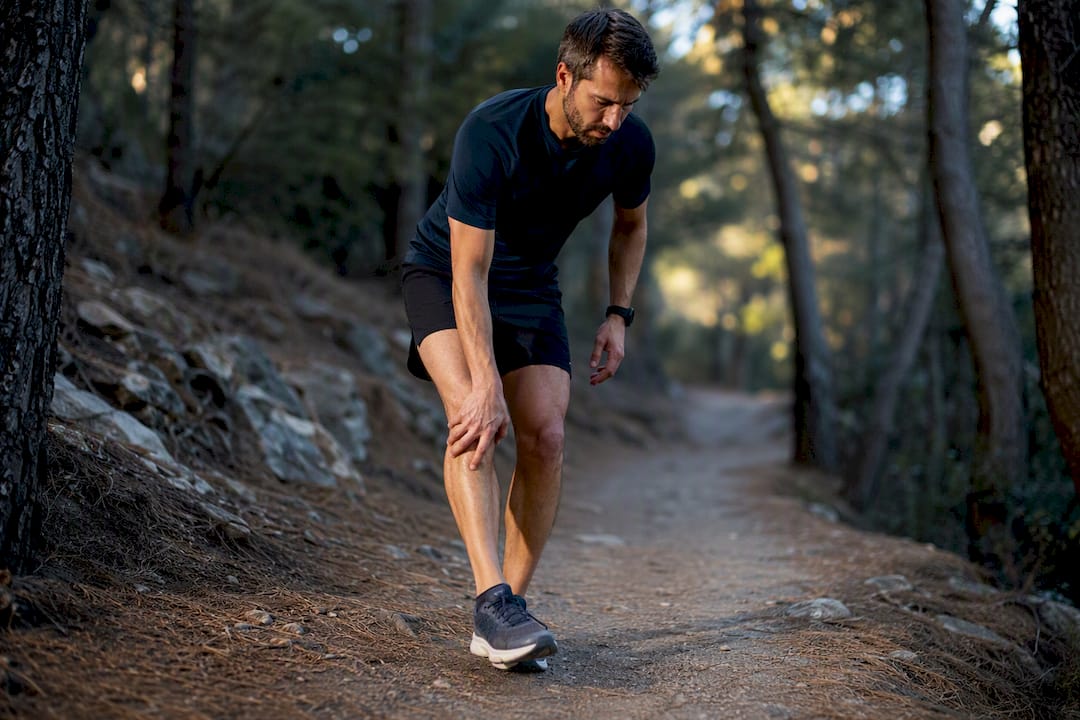
The mechanics usually trace back to a few overlapping issues. Weak hip abductors and glutes let the thigh rotate inward while running, which drags the kneecap off its normal track. Tight quads or IT bands add pulling force in the wrong direction. And training errors, ramping up mileage too fast, adding hill repeats before your tissue is ready, running exclusively on cambered roads, overload the joint faster than it can adapt.
Common symptoms include:
- A dull, aching pain around or under the kneecap, not sharp or localized to one spot
- Pain that worsens with stairs, squatting, or prolonged sitting ("theater sign")
- Mild swelling or a grinding sensation, but no true joint instability
- Pain that builds during a run rather than hitting all at once
Watch for red flags that go beyond typical patellofemoral pain: a knee that gives way, visible swelling that doesn't fluctuate, sharp pain with a specific mechanical catch, or an inability to bear weight. Those symptoms point toward a structural issue, not simple overuse, and they need a clinician before any topical product enters the picture.
What the Research Says About CBD and Joint Pain
The evidence on CBD for joint pain relief is genuinely mixed, and runners deserve the honest version rather than the marketing version. Multiple clinical trials in knee osteoarthritis, a condition with more research funding than runner's knee specifically, give the clearest signal we have, and that signal is not a strong "yes."
A late-2023 and 2025 round of clinical trials in knee osteoarthritis tested high-dose oral CBD against placebo and found no significant improvement in pain scores. One of those trials reported a p-value of 0.80, about as flat a null result as clinical research produces. A separate 2025 double-blind trial of a CBD-rich oil ran for 60 days in knee OA patients and again found no significant difference from placebo on standard pain measures, though the oil was well tolerated.
Topical formulations tell a similarly cautious story. A March 2026 randomized study of topical CBD gel found it did not accelerate recovery of muscle function or reduce delayed-onset muscle soreness compared to placebo, though one isometric torque measure showed a modest advantage.
The pattern across these trials isn't "CBD does nothing." It's that CBD's effect size, where one exists, tends to be small, formulation-dependent, and easy to lose in the noise of a placebo response that's already strong for topical pain products.
The honest summary: no major trial has shown CBD, oral or topical, clearly beating placebo for knee pain, though small tolerability studies show promise. A 2023 pilot study in former elite athletes with chronic lower-extremity pain found topical CBD was well tolerated and associated with decreased pain and improved function, but the sample was small. A broader 2024 systematic review found limited beneficial effects on some physiological markers but insufficient evidence that CBD reliably improves recovery after physical load.
Route, dose, and vehicle explain a lot of the divergence. A gel that doesn't penetrate skin well won't perform like one using castor oil or another absorption-enhancing carrier, and several registered trials on knee osteoarthritis are still testing dose and delivery combinations that could sharpen these results within the next few years.
Topical vs. Oral CBD: Which One Actually Fits Runner's Knee?
For runner's knee specifically, topical application makes more practical sense than oral CBD, and the reasoning isn't just about convenience.
Topical CBD stays localized. You apply it directly over the kneecap and surrounding tissue, exposure to the rest of your body stays low, and many multi-ingredient balms pair it with menthol, arnica, or capsaicin, ingredients with their own independent, well-documented soothing effects. That combination matters: even when CBD's own pharmacologic contribution is modest, the sensory cooling or warming from menthol or arnica produces real, immediate relief runners can feel within minutes. Athletes who compete under drug-testing rules also tend to prefer topical products because they limit systemic absorption and the associated risk of a positive test.
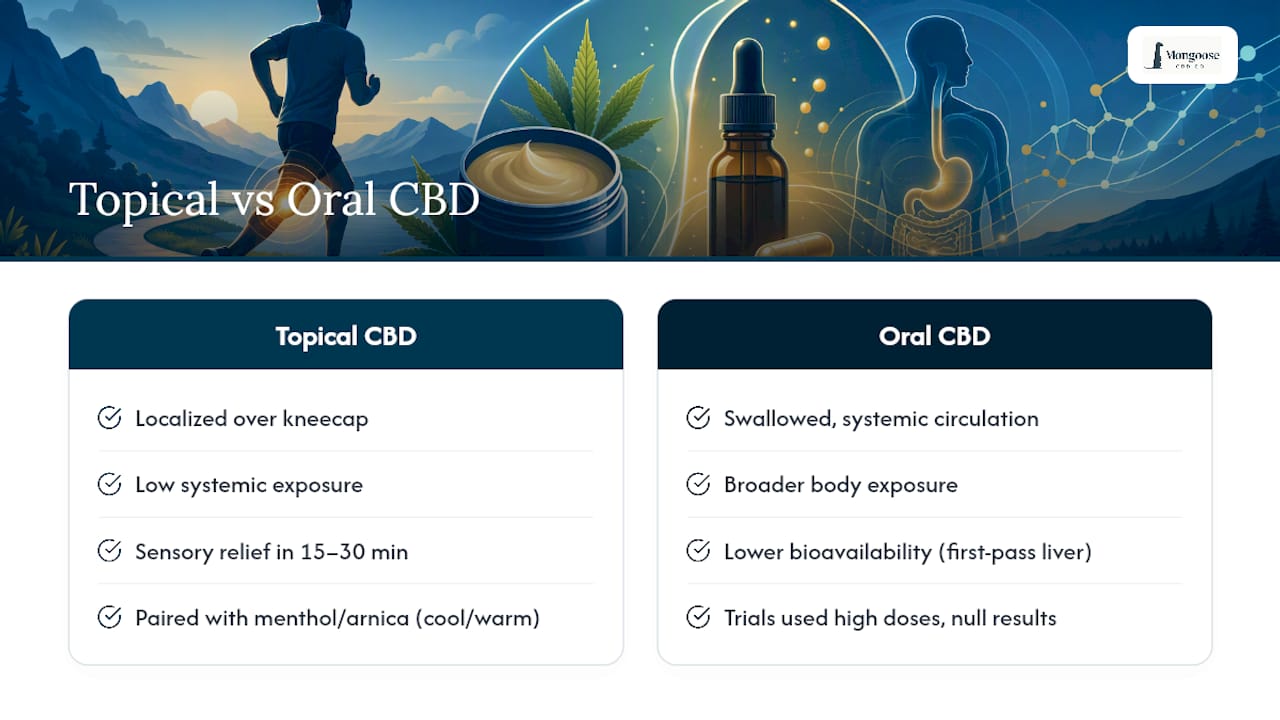
Oral CBD works differently and less efficiently. Swallowed CBD passes through first-pass liver metabolism before reaching your bloodstream, which cuts bioavailability substantially compared to topical or sublingual routes. That's part of why oral OA trials have needed high doses to test for an effect and still landed on null results. Oral use also means CBD circulates throughout your body, raising the odds of interacting with other medications.
The practical takeaway: expect a topical balm to deliver a sensory relief effect, cooling, warming, a sense of loosening, within 15 to 30 minutes, layered on whatever CBD itself is contributing. Don't expect either format to reduce swelling at a tissue level the way ice or anti-inflammatory rehab work can. For a deeper look at how CBD performs against muscle soreness and recovery, the evidence pattern holds steady across use cases.
How to Apply Topical CBD for Knee Relief: A Practical Routine
Getting a topical CBD balm to actually help means using it with some intention, not just rubbing it on wherever it hurts and hoping.
Before your first full application, patch test on a small area of skin, like your inner forearm, and wait 24 hours to check for irritation. This matters more for balms with cinnamon, clove, or capsaicin, since those ingredients can cause a stronger reaction in sensitive skin than plain CBD alone.
Once you've confirmed no reaction, follow this sequence:
- Clean and dry the skin around your knee, both the front over the kneecap and along the sides where the IT band runs.
- Use a dime to nickel-sized amount for one knee, more for a larger balm-to-surface ratio isn't necessarily better and can waste product.
- Massage in small, light circles around the patella and along the IT band, avoiding aggressive friction directly over any area that feels bruised or acutely swollen.
- Apply post-run or before bed, giving the balm time to absorb without immediately sweating it off or compressing it under gear.
- Combine with load management, easing weekly mileage back when soreness flares, using RICE (rest, ice, compression, elevation) for acute inflammation, and layering in targeted hip and quad strengthening work that addresses the actual mechanical cause.
Pro Tip: Track your response daily for at least a week rather than judging a balm after one application. Athletes who use topical CBD consistently, especially at bedtime, tend to report clearer patterns of what's working than those who apply it once before a race and expect an instant fix.
For runners managing broader post-run soreness alongside knee pain, the same application principles apply to DOMS management as a companion routine.
Safety, Drug Testing, and Drug Interactions Every Runner Should Check
Before adding CBD to your routine, run through a short risk checklist, because the biggest problems aren't with CBD itself but with what else might be in the bottle.
- Check for a third-party Certificate of Analysis (COA). It verifies actual cannabinoid content and confirms the product is genuinely THC-free, not just labeled that way.
- Know that WADA permits CBD but still prohibits THC and other cannabinoids above trace thresholds, and contaminated or mislabeled products have caused real positive tests in competitive athletes.
- Understand isolate vs. full-spectrum risk. Full-spectrum products carry trace THC by definition; broad-spectrum and isolate formulations strip that out, which matters if you're tested.
- Flag CYP450 interactions. CBD is metabolized through the same liver enzyme pathway (cytochrome P450) as many common medications, including some blood thinners and anti-seizure drugs, so talk to a pharmacist if you take prescription medication regularly.
- Watch for side effects. Topical use rarely causes more than mild skin irritation; stop use if you notice a rash, burning, or worsening redness.
The FDA's consumer guidance on cannabis products notes that product quality varies widely across the market and regulation remains limited, which is exactly why the COA step above isn't optional if you're competing or on medication.
A meaningful share of contamination risk in CBD products traces back to mislabeling rather than intentional spiking, which is precisely why checking lab results matters more than trusting a "THC-free" label at face value.
When to Stop Self-Care and See a Physio or Doctor
CBD, ice, and rest all have limits, and runner's knee that doesn't respond to conservative care within a reasonable window needs a professional look rather than a stronger balm.
See a clinician or physical therapist if you notice:
- Your knee gives way, buckles, or feels unstable during weight-bearing
- True swelling that doesn't fluctuate with activity, rather than mild puffiness
- Inability to bear full weight on the leg
- A mechanical catch or locking sensation during movement
As a general timeline, if symptoms haven't meaningfully improved after two to three weeks of reduced mileage, strengthening work, and topical care, book an evaluation. When you do, tell your clinician exactly what you've been using, product name, CBD concentration, other active ingredients like menthol or arnica, and how often you've applied it, since that context helps them separate a true treatment response from a placebo or sensory effect.
Why We're Cautious About CBD Claims (And What We Actually Recommend)
The CBD industry has a habit of overselling thin evidence, and runner's knee is a topic where that habit does real harm. Trials in knee osteoarthritis, the closest proxy we have to running-related knee pain, keep landing on the same result: CBD is tolerated, rarely harmful, and inconsistently better than placebo. Anyone telling you otherwise with confidence is skipping past the data.
That's exactly why some topical balms combine multiple active ingredients, such as arnica, menthol, turmeric, and eucalyptus, rather than relying on CBD alone to carry the entire pain-relief claim. Many products are THC-free, vegan, and paraben-free, often formulated with athletes in mind rather than as a general wellness afterthought. Some companies back their formulation confidence with refund policies, underscoring their expectations about product performance.
None of that replaces a diagnosis. If your knee pain has a mechanical cause, weak hips, poor running form, a training spike, a balm treats the symptom while the cause keeps building. Use CBD as one tool in a broader recovery routine, and loop in a clinician when self-care alone isn't cutting it.
— Cindy
Finding the Right Topical Balm for Your Knee
Once you've decided a topical is worth trying, the difference between products comes down to a short checklist: verified lab testing, a clear THC-free claim backed by that testing, a stated milligram concentration per ounce, and active sensate ingredients that do real work alongside the CBD itself.
Some CBD companies build their balms around that checklist. The Seriously Soothing Pain Balm combines 1,000mg of CBD per ounce with cinnamon and clove for a warming sensation runners often reach for post-run, while Rikki Tikki Recovery is formulated specifically around muscle and joint recovery for people training on a regular schedule.
Unlike buying a generic drugstore rub and hoping the ingredient list matches the marketing, some reputable CBD balms ship THC-free, cruelty-free, and may be backed by refund windows, so trying a new product on a nagging knee may come with less financial risk. If you're managing runner's knee alongside general training soreness, the Miracle Muscle Balm offers a different formulation worth comparing against your current routine. Pick one, apply it consistently for a week using the routine above, and judge it on how your knee actually feels, not on the label.
Sources
The clinical picture on CBD for knee pain is still forming, and these sources represent the studies and guidance this article draws from directly:
- Topical cannabidiol and muscle function recovery (March 2026)
- Clinical trials of oral CBD in knee osteoarthritis (2023–2025)
- Topical cannabidiol tolerated in elite athletes with chronic lower-extremity pain (2023)
This article is general information, not a substitute for advice from a qualified doctor. Consult a qualified healthcare professional about your own circumstances before acting on anything here.