

CBD can offer real, but limited, symptomatic relief for frozen shoulder. It is not a cure for adhesive capsulitis. Short-term human trials show meaningful pain reduction in the first day or two after treatment, but sustained benefit over weeks is much less consistent. Anyone considering CBD, especially in oral or buccal form, should check for medication interactions and talk to a clinician before starting.
TL;DR:
- Topical CBD may provide short-term relief for shoulder pain, especially immediately after application, but it does not influence long-term recovery from frozen shoulder.
- The strongest evidence shows pain reduction within the first 24 hours post-use, with no significant benefits observed after two weeks in clinical trials.
- Users should prioritize patch testing, choose products with transparent labeling, and only consider oral CBD under medical supervision due to drug interaction risks.
- CBD works best when used as a supportive supplement alongside physical therapy, not as a sole treatment to restore shoulder mobility.
- Long-term benefits are unproven, and CBD should be viewed as a symptom management aid rather than a cure for adhesive capsulitis.
Table of Contents
- What Is Frozen Shoulder, and Why Does Localized Relief Matter?
- How Might CBD Help with Shoulder Pain?
- What Do Human Trials Actually Show About CBD for Joint Pain?
- How Do You Try CBD Safely for Frozen Shoulder Pain?
- Where Does CBD Fit Alongside Physical Therapy?
- What Side Effects and Contraindications Should Frozen Shoulder Patients Know?
- Full Spectrum, Broad Spectrum, or Isolate: Which Fits Shoulder Pain?
- Is CBD Legal to Use for Frozen Shoulder Pain Relief?
- Where Mongoosecbd Stands on Topical Pain Relief
- Something Worth Trying Alongside Physical Therapy
- Sources
- FAQ
What Is Frozen Shoulder, and Why Does Localized Relief Matter?
Adhesive capsulitis, the clinical name for frozen shoulder, causes the connective tissue around the shoulder joint to thicken and tighten. The result is a joint that hurts to move and gradually loses range of motion, sometimes to the point where reaching overhead or behind the back becomes impossible.
The condition typically moves through three stages: freezing (increasing pain, decreasing motion), frozen (pain may ease but stiffness dominates), and thawing (motion slowly returns). According to a Mayo Clinic discussion of the condition's timeline, the whole cycle can take months to years to resolve.
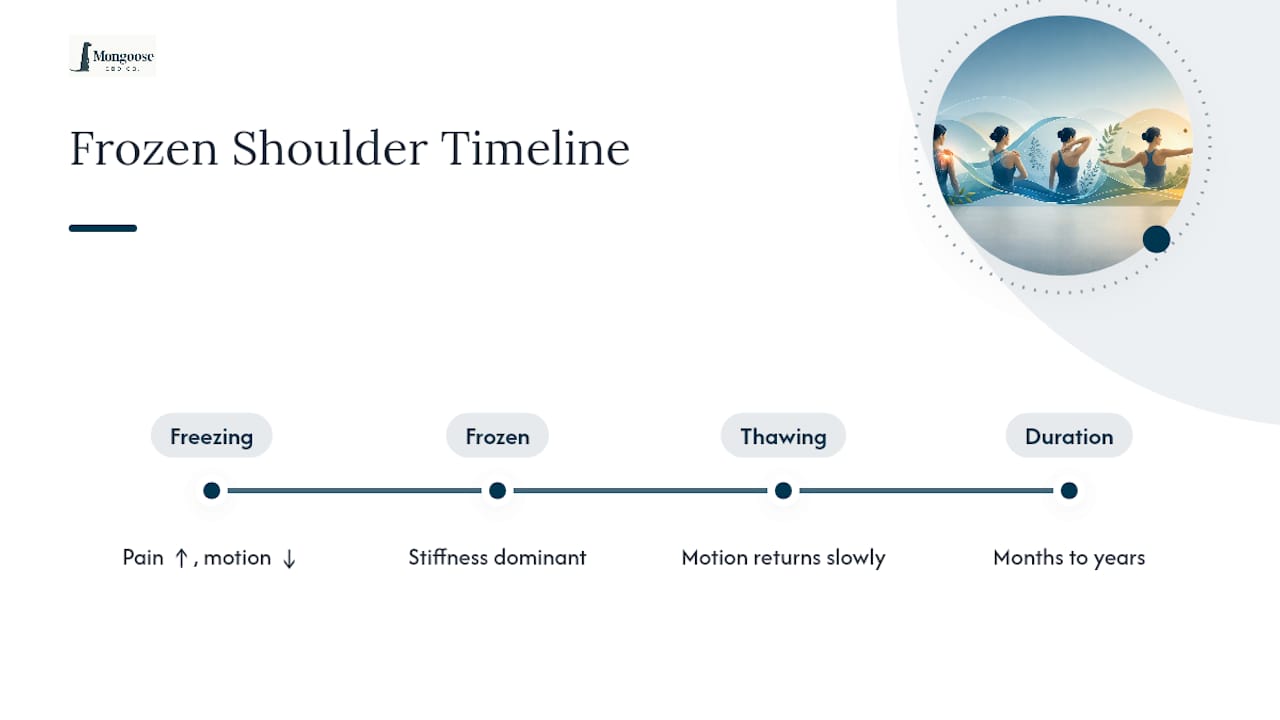
That long timeline is exactly why localized, symptomatic relief matters so much. Physical therapy is the backbone of recovery, but PT only works if the patient can tolerate the exercises. When pain is too sharp to push through a stretch, progress stalls. That is the gap where a topical approach, including topical CBD, tends to get attention: not as a fix for the underlying joint restriction, but as a way to make the daily work of regaining motion more bearable.
How Might CBD Help with Shoulder Pain?
CBD is thought to act on pain and inflammation through several overlapping pathways. Preclinical and early human research points to anti-inflammatory, analgesic, and neuromodulatory effects, meaning CBD may dial down swelling signals in tissue while also affecting how nerves transmit pain signals to the brain. None of this is settled science, but it is a coherent enough mechanism that researchers keep testing it in joint pain.
How you take CBD changes what you can expect from it:
- Topical CBD (balms, creams, gels) works at the site of application and skips first-pass liver metabolism, which is why it is often preferred for a single stiff, painful joint rather than body-wide pain.
- Complementary ingredients like menthol and arnica are commonly blended into topicals because they add their own cooling or anti-inflammatory action, independent of the CBD itself.
- Oral or sublingual CBD enters the bloodstream and can affect the whole body, which may help indirectly with pain by improving sleep quality or easing anxiety, two factors known to amplify how pain is perceived.
- Full-spectrum, broad-spectrum, and isolate formulas differ mainly in which additional plant compounds ride along with the CBD, which matters more for oral products than for a balm rubbed onto skin.
Forbes Health notes that this topical-versus-oral split is one of the more practical distinctions for people managing localized joint pain, since it determines whether you are treating the shoulder directly or supporting the body systemically. The limitation across the board is consistency: product potency varies widely between brands, and clinical results have been mixed enough that no one should assume CBD will work the same way it did in a trial.
What Do Human Trials Actually Show About CBD for Joint Pain?
The clinical picture is more nuanced than most marketing suggests, and shoulder-specific data is still thin. The strongest shoulder-relevant evidence comes from a placebo-controlled trial of buccal CBD after arthroscopic rotator cuff repair, which found:
- Significantly lower pain scores and higher patient satisfaction on day 1 compared to placebo.
- No sustained advantage over placebo by day 2, day 7, or day 14.
What the numbers say: In the rotator cuff repair trial, CBD's edge over placebo showed up almost entirely in the first 24 hours. By the two-week mark, both groups reported similar pain levels, an important reminder that early relief does not always predict long-term results.
Findings for other joints tell a similar story of promise without proof. A small randomized crossover trial of topical CBD for thumb basal joint arthritis reported improved patient-reported pain and disability scores compared to control, with no adverse events during the study. That is encouraging for topical use on a small, superficial joint, though the sample size was modest and the trial window short.
At the other end of the scale, a 2025 double-blind trial of a CBD-rich full-spectrum oil for knee osteoarthritis found the oil well tolerated but not superior to placebo on pain outcomes at 60 days. Harvard Health frames the overall evidence base the same way: promising in the lab, still short on large, high-quality human trials for chronic joint pain.
The realistic takeaway for frozen shoulder: some people notice genuine short-term symptom relief, particularly right after use, but no trial to date proves CBD changes the long arc of adhesive capsulitis recovery.
How Do You Try CBD Safely for Frozen Shoulder Pain?
A structured, cautious trial beats guessing your way through random products. Here is a sequence that mirrors how clinical researchers have actually tested CBD for joint pain:
- Pick a topical first. For a single stiff shoulder, a balm or cream applied directly to the joint is the more logical starting point than a systemic product, since it targets the area without affecting the whole body.
- Check the label before you buy. Look for third-party lab testing, a clear milligram count per ounce, and a full ingredient list. Skip anything that will not disclose test results.
- Patch test first. Apply a small amount to unaffected skin and wait 24 hours to rule out irritation before using it on the shoulder itself.
- Run a short, honest trial. Topical trials for small-joint arthritis have used twice-daily application for roughly two weeks before evaluating results. That same window works as a template: apply the balm before and after physical therapy sessions and track your pain and range of motion daily.
- If you consider oral or buccal CBD, involve a clinician. The rotator cuff trial used weight-based dosing, 25 mg three times daily for patients under 80 kg and 50 mg three times daily for those over 80 kg. That is a research protocol, not a prescription, and self-dosing at that level without medical guidance is not advisable.
Pro Tip: Rub the balm in slowly over 60 to 90 seconds rather than a quick swipe. The extra contact time helps warm the skin and gives menthol or arnica in the formula a chance to work alongside the CBD.
Watch for drug interactions, since CBD is processed by liver enzymes that also metabolize many common medications, including blood thinners. Higher-dose studies have flagged liver enzyme changes as a signal worth monitoring, and CBD is not recommended during pregnancy or breastfeeding. Stop use and call your provider if you notice unusual fatigue, digestive upset, or skin irritation.
Where Does CBD Fit Alongside Physical Therapy?
CBD works best as a supporting player, not the main act. Adhesive capsulitis responds to graded stretching and structured physical therapy, and that rehab work is what actually restores range of motion over time. A topical applied 15 to 20 minutes before a PT session can take the edge off enough that you push through the stretch instead of bracing against it.
Practical ways to sequence it:
- Apply a topical balm before mobility work, then again afterward to manage post-session soreness.
- Pair CBD with standard heat or ice protocols rather than replacing them; heat before stretching and ice after tends to work well for stiff joints.
- Keep a simple log of pain and range of motion so you can tell whether the combination is actually helping.
Escalate to a doctor or orthopedic specialist if you notice progressive loss of function, pain that is not responding to any conservative measure, or symptoms lasting well beyond the expected freezing stage. Corticosteroid injections or manipulation under anesthesia are legitimate next steps when home care and PT plateau.
What Side Effects and Contraindications Should Frozen Shoulder Patients Know?
CBD is generally well tolerated, but "well tolerated" does not mean risk-free. In clinical trials, the most commonly reported side effects have included mild fatigue, changes in appetite, and digestive upset, most often with oral or buccal products rather than topicals.
Topical CBD carries a smaller risk profile since little of it reaches the bloodstream, but skin irritation or contact reactions can still happen, especially with formulas that also contain menthol, cinnamon, or clove, which can cause a warming or tingling sensation that some people find too intense on sensitive skin.
Contraindications deserve real attention. The Arthritis Foundation advises consulting a healthcare provider before starting CBD, largely because of potential interactions with medications processed by the same liver enzymes CBD affects, including certain blood thinners, antidepressants, and seizure medications. People with existing liver conditions should be especially cautious with oral CBD, since some trials have flagged liver enzyme elevations at higher doses. CBD is not recommended during pregnancy or breastfeeding, and anyone managing frozen shoulder alongside another chronic condition should treat CBD as one more variable to discuss at their next appointment, not something to add quietly on the side.
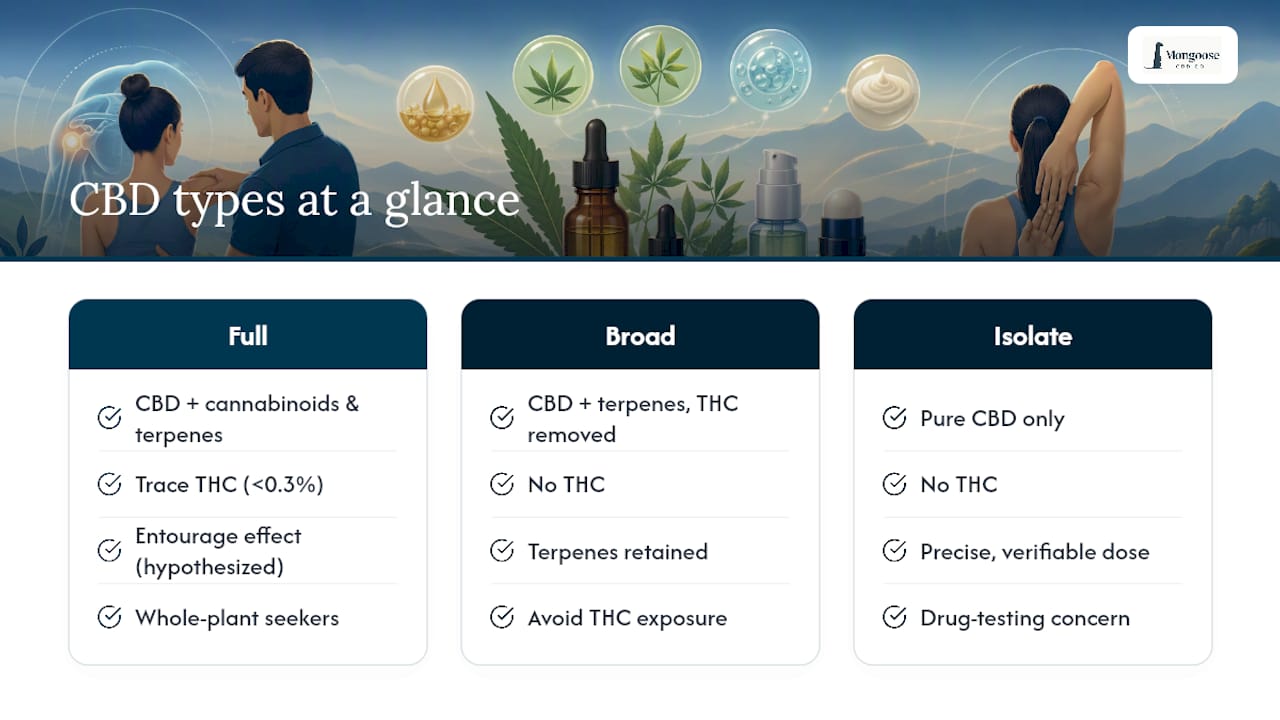
Full Spectrum, Broad Spectrum, or Isolate: Which Fits Shoulder Pain?
The three main CBD types differ in what travels alongside the CBD itself, and that matters more than most labels let on.
Full-spectrum products contain CBD plus the full range of naturally occurring cannabinoids and terpenes, including trace THC (under 0.3% in legal hemp-derived products). The theory behind full-spectrum, often called the entourage effect, is that these compounds work better together than CBD alone. Researchers behind the 2025 knee osteoarthritis trial note this effect is hypothesized but not yet proven to outperform isolated CBD in controlled testing.
Broad-spectrum products keep most of the same plant compounds but strip out THC entirely, a middle ground for people who want the added terpenes without any THC exposure.
Isolate is pure CBD with nothing else, the most straightforward option for anyone who wants a precise, verifiable dose or who needs to avoid THC completely for drug-testing reasons.
For a topical applied directly to a frozen shoulder, the spectrum matters less than what else is in the jar. A balm's added ingredients, arnica, turmeric, eucalyptus, or cayenne pepper, are doing real work of their own. Some topical muscle creams on the market lean on similar complementary ingredients, which is worth knowing when comparing formulas side by side. Those who want to dig deeper into cannabinoid and terpene profiles beyond CBD alone can find a useful primer in this chemical-profile guide to pain-relevant strains.
Is CBD Legal to Use for Frozen Shoulder Pain Relief?
Hemp-derived CBD containing less than 0.3% THC is federally legal in the United States under current federal law, and it is widely sold over the counter without a prescription. That legal status covers topical balms, oils, and most consumer CBD products you would consider for shoulder pain.
State laws can still vary on details like THC limits and retail rules, so it is worth a quick check if you are ordering from out of state or traveling with a product. What CBD is not is an FDA-approved medication for pain, joint disease, or frozen shoulder specifically. The FDA has approved exactly one CBD-based prescription drug, for two rare seizure disorders, which means every topical balm or tincture sold for pain relief is regulated as a supplement or cosmetic, not a drug. That distinction shapes the safety guidance already covered here: manufacturers cannot legally claim their product treats or cures adhesive capsulitis, and any product that does should raise a red flag rather than confidence.
Where Mongoosecbd Stands on Topical Pain Relief
We formulate our balms, including the Seriously Soothing Pain Balm, around a simple premise: CBD works best as one tool among several, not a replacement for rehab or medical care. That view lines up with how Harvard Health frames the evidence, promising in mechanism, still catching up in proof.
We built our breakdown of the rotator cuff repair trial and our look at CBD for rheumatoid arthritis around that same standard: short, honest trials, real citations, and a clear recommendation to loop in a clinician before combining CBD with any prescription medication. Evidence-aware does not mean evidence-free. It means being upfront about what a balm can and cannot do for a joint that heals on its own timeline.
— Cindy
Something Worth Trying Alongside Physical Therapy
If you are already committed to the stretching and PT work that actually resolves frozen shoulder, a topical balm can make those sessions less brutal to get through. Our Seriously Soothing Pain Balm combines 1,000 mg of CBD per ounce with arnica, menthol, turmeric, and clove, ingredients chosen for how they feel and work together on sore, stiff tissue, not just for the CBD alone.
The most practical way to test it is the same two-week window used in small joint trials: apply a small amount before your PT session, again afterward, and track your pain and range of motion daily. For patients managing more general muscle recovery on top of shoulder pain, the Rikki Tikki Recovery balm is formulated with athletes and chronic pain sufferers in mind. Some topical CBD products are vegan, THC-free, and may offer customer satisfaction policies, making trial use accessible for evaluating effectiveness. Start your trial today and see how your shoulder responds.
This article is general information, not a substitute for advice from a qualified doctor. Consult a qualified healthcare professional about your own circumstances before acting on anything here.
Sources
- Topical CBD randomized crossover trial for thumb basal joint arthritis (PubMed entry)
- Effects and safety of a CBD-rich Cannabis sativa oil in knee osteoarthritis: a double-blind, randomized, placebo-controlled trial – Frontiers (2025)
- Does CBD help with arthritis pain? - Harvard Health
FAQ
What Is the Best Medicine for Frozen Shoulder Pain?
There is no single best medicine. Doctors typically start with NSAIDs, physical therapy, and sometimes corticosteroid injections, while CBD is used by some patients as a supportive option alongside those standard treatments rather than a replacement for them.
Is CBD a Powerful Anti-inflammatory?
CBD shows anti-inflammatory activity in lab and animal studies, but Harvard Health points out that large, high-quality human trials have not yet confirmed how strong or reliable that effect is for chronic joint conditions.
Which Supplement Is Best for Frozen Shoulder?
No supplement is proven to reverse adhesive capsulitis. Topical CBD balms with complementary ingredients like arnica and menthol have the most direct short-term trial support for localized joint pain, but physical therapy remains the primary driver of recovery.
Does CBD Help Frozen Shoulder Specifically?
No trial has tested CBD on frozen shoulder directly, but related shoulder and joint studies show short-term pain relief is possible, especially with topical application, even though long-term benefit remains unproven.
Can I Use a CBD Cream on My Shoulder Every Day?
Most topical trials used twice-daily application for about two weeks without adverse events, which is a reasonable starting frequency, though you should stop and consult a clinician if you notice skin irritation or no improvement after that trial period.