
CBD is worth trying for joint stiffness if you frame it as a modest, targeted supplement rather than a cure. The clinical evidence is mixed: survey data show real symptom relief for many people, while some randomized trials find no advantage over placebo. Topical CBD is the lowest-risk starting point for focal stiffness, since it stays local and skips most drug-interaction concerns. If you take prescription medications, talk to your clinician first, and know that some products can still register on drug tests.
TL;DR:
- Topical CBD is recommended as a low-risk initial approach for localized joint stiffness due to its direct application and minimal systemic interaction risks.
- While survey data suggest most users experience pain relief, controlled trials often show no significant difference from placebo, highlighting the variability in results.
- Different delivery methods—topical, sublingual, inhaled—have distinct onset times and systemic effects, with topicals being fastest for targeted relief.
- CBD’s biological mechanisms suggest potential anti-inflammatory benefits, but effective dosing and products still lack standardization and consistent scientific validation.
- Quality control remains inconsistent in the market, so buyers should verify laboratory testing, cannabinoid content, and ingredient transparency before purchasing.
Table of Contents
- Does CBD Actually Help With Joint Stiffness?
- How Does CBD Help Joints on a Biological Level?
- Which Form of CBD Works Best for Stiff Joints?
- Is CBD Safe to Use With Arthritis Medications?
- What Should You Look for When Buying CBD for Joints?
- How Do You Run a Fair Trial of CBD for Joint Stiffness?
- When CBD Helps and When It Shouldn't Be Your Main Plan
- Try a Topical CBD Balm as Your Low-Risk Starting Point
- Sources
- FAQ
Does CBD Actually Help With Joint Stiffness?
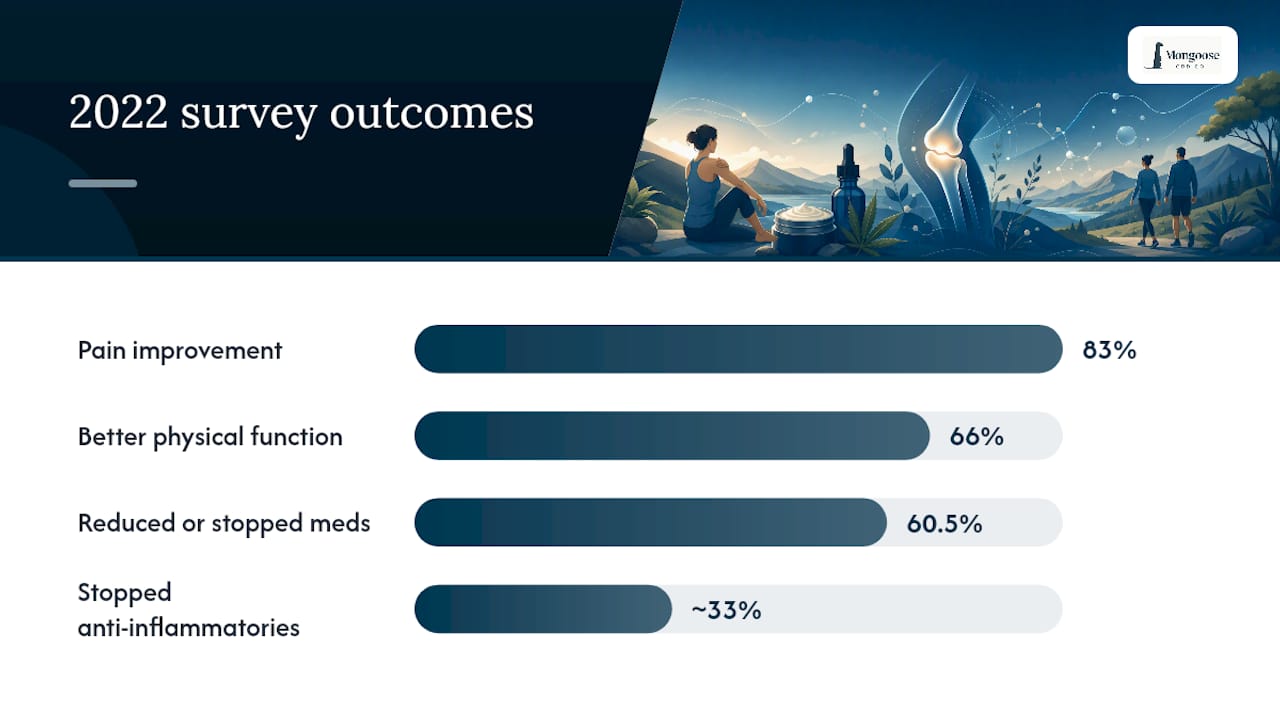
The honest answer is: it depends on which study you're reading and how you're measuring "help." A 2022 exploratory survey of 428 people using CBD for arthritis found that 83% reported pain improvement, 66% noted better physical function, and 60.5% reduced or stopped other medications entirely. Nearly a third stopped taking anti-inflammatories altogether. Those numbers look encouraging, especially for anyone tired of relying on NSAIDs.
Randomized controlled trials tell a different story. A 2025 double-blind, placebo-controlled trial tested a CBD-rich full-spectrum oil at 45 mg per day in people with knee osteoarthritis. At 60 days, there was no statistically significant difference versus placebo, though the oil was well tolerated with no serious safety issues. Other randomized trials report similar findings: no clear superiority over placebo for osteoarthritis pain specifically, even when tolerability looks fine.
So why the gap between what people report and what controlled trials measure?
- Product heterogeneity. Survey respondents use everything from full-spectrum oils to isolates to unregulated tinctures, while trials test one standardized formulation.
- Placebo response is strong in pain studies. Joint pain fluctuates naturally, and expectation alone can shift self-reported scores.
- Small sample sizes in many trials limit statistical power to detect a real but modest effect.
- Dosing and delivery vary widely between what people actually use at home and what gets tested in a lab setting.
A mechanistic review notes that CBD's anti-inflammatory and neuromodulatory effects are biologically plausible, which helps explain why some people notice a difference even when population-level trial data stays flat.
The gap in numbers: In the 2022 survey, 83% of users reported pain improvement. In controlled trials like the 2025 knee osteoarthritis study, CBD showed no statistically significant edge over placebo at 60 days. Both findings are real. They're just measuring different things: personal experience versus a controlled, blinded comparison.
Harvard Health's review lands in a similarly cautious place: trial results for CBD and arthritis pain are mixed, and the organization recommends discussing use with a clinician rather than assuming it will work the way anecdotes suggest. That's not a dismissal. It's a call to try CBD with realistic expectations and a way to measure whether it's actually working for you, which is exactly what a structured trial plan (covered further down) is built to do.
The practical takeaway: CBD isn't a proven disease-modifying treatment for arthritis, and it won't replace medications that control inflammation at its source. But for stiffness and day-to-day discomfort, enough people report meaningful relief that a short, well-monitored trial is a reasonable next step, especially with a topical product that carries minimal risk.
How Does CBD Help Joints on a Biological Level?
CBD interacts with the endocannabinoid system, a network of receptors involved in regulating pain signaling, inflammation, and immune response throughout the body. Joint tissue, synovial fluid, and surrounding nerves all carry components of this system, which is part of why researchers have looked at cannabinoids as a potential lever for chronic joint conditions in the first place.
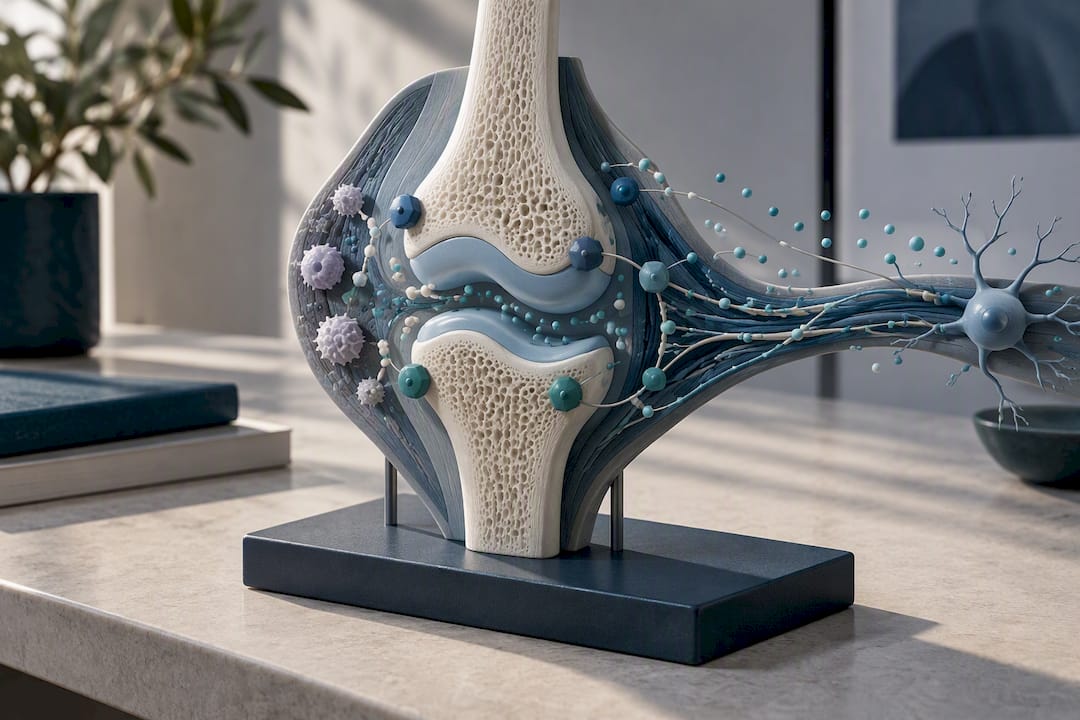
Laboratory and animal studies point to CBD reducing certain inflammatory signaling pathways and calming overactive pain receptors, according to the mechanistic evidence summarized in PMC. In cell and animal models, this translates into less swelling and reduced pain behavior. That's a meaningful starting point, but it's also where the caveats begin.
Animal and cellular results don't automatically scale up to a human knee that's been stiff every morning for a decade. Dosing that works in a lab model rarely maps cleanly onto a topical balm or a sublingual tincture used at home. Delivery method changes how much CBD reaches affected tissue, and most human trials still use small samples with inconsistent formulations, which makes it hard to pin down an effective dose with confidence.
None of that erases the underlying biology. It just means the mechanism explains why CBD might help stiffness, not that it will, for any given person, at any given dose.
Which Form of CBD Works Best for Stiff Joints?
The form you choose matters more than most people realize, and it should match the type of stiffness you're dealing with.
Topical balms applied directly to a stiff knee, knuckle, or shoulder offer local relief with fast onset and minimal systemic absorption. Because so little CBD reaches the bloodstream through skin application, topicals carry the lowest interaction risk of any delivery method, according to Harvard Health's guidance. Depth of tissue penetration isn't fully mapped in the research, but for one or two specific joints, a topical is the most sensible first move.
Sublingual and oral CBD work systemically, which makes sense for widespread stiffness affecting multiple joints at once. Onset is slower, typically 30 to 180 minutes, and effects last longer. The Arthritis Foundation's dosing framework supports a conservative starting point: something like 5 to 10 mg taken sublingually twice daily, adjusted slowly based on response.
Inhaled CBD delivers the fastest systemic effect, but most clinicians steer people away from it. Vaping carries respiratory risks unrelated to CBD itself, and product quality in the inhalation category varies widely.
- Topical: fastest local relief, lowest systemic risk, best for one or two joints.
- Sublingual/oral: slower onset, systemic reach, better for widespread stiffness.
- Inhaled: fast but carries respiratory risk; generally not recommended.
For people with stiffness in multiple joints, combining a topical balm on the worst spots with a low-dose oral or sublingual product can make sense. Start one at a time, though. If you introduce both simultaneously and something changes, you won't know which one caused it.
Pro Tip: Apply topical CBD and wait a minute or two before dressing or touching fabric. It gives the balm time to absorb into the skin instead of transferring onto your clothes, and a gentle rubbing motion toward the joint can help move it into the area that needs it most.
For a deeper look at why topical delivery often makes more sense than oral CBD for a single problem joint, this comparison of topical and oral approaches breaks down the tradeoffs further.
Is CBD Safe to Use With Arthritis Medications?
Most people tolerate CBD reasonably well, but "well tolerated" in a clinical trial isn't the same as "risk-free" for every individual. The 2025 osteoarthritis trial reported good tolerability at 45 mg per day, and other trials echo that pattern. Still, some studies have flagged liver enzyme elevations at higher doses, which is worth knowing if you already have liver concerns or take other medications processed by the liver.
Drug interactions are the bigger issue for people managing arthritis. CBD is metabolized by CYP450 liver enzymes, the same pathway responsible for breaking down warfarin and several common arthritis medications. That overlap can raise or lower blood levels of those drugs in ways that matter, particularly with blood thinners where the margin for error is thin.
- Ask your prescribing clinician before adding oral or sublingual CBD if you take warfarin, immunosuppressants, or other arthritis medications metabolized by the liver.
- Watch for unusual fatigue, appetite changes, or digestive upset in the first two weeks.
- Avoid inhaled CBD products given the added respiratory risk and inconsistent quality across that category.
- Check THC content before buying: hemp-derived products can legally contain up to 0.3% THC by weight, and at higher daily doses, that small percentage can add up to enough THC to affect a drug test or, in sensitive individuals, produce mild psychoactive effects.
If your job involves regular drug screening, this is not a minor detail. A THC-free formulation removes the guesswork, but always verify that claim against the product's own lab results rather than the label alone.
Safety signal to know: Some clinical trials have reported liver enzyme elevations at higher CBD doses. That's a reason to start low, monitor how you feel, and loop in your clinician, especially if you already take medications that affect liver function.
What Should You Look for When Buying CBD for Joints?
Quality control in the CBD market is inconsistent, and label accuracy is one of the biggest problems buyers face. The FDA has flagged that product labeling can be unreliable, meaning what's printed on the bottle doesn't always match what's inside.
- Demand a current certificate of analysis (COA). This is the single most important check. A legitimate COA shows the exact cannabinoid profile and screens for contaminants like heavy metals, pesticides, and residual solvents. If a brand can't produce one, move on.
- Confirm CBD content per serving and per container, not just a vague "1,000mg" claim on the front label. You should be able to calculate your actual dose per application.
- Look for manufacturers that disclose GMP practices and publish their testing methodology, not just a logo that implies third-party testing without a linked report.
- Check the full ingredient list. Added botanicals like arnica, menthol, or turmeric can support the balm's effect, but only if they're clearly listed rather than buried behind a proprietary blend claim.
- Skip anything promising a "miracle cure" or making disease-reversal claims. Legitimate CBD products describe supportive relief, not treatment of the underlying condition.
For more on what separates a genuinely effective topical from marketing noise, this breakdown of CBD balm formulations is worth a read before you buy. If you want a broader primer on how different CBD product categories are made and tested, this educational resource covers formulation differences in more depth.
How Do You Run a Fair Trial of CBD for Joint Stiffness?
Guessing whether CBD is working is the fastest way to waste money on it. A structured trial gives you a real answer in a few weeks.
- Set a baseline first. Track morning stiffness duration in minutes, note which joints are affected, and record one functional task, like climbing stairs or a short timed walk, before you start.
- Start with a topical balm applied one to three times daily directly to the stiff joint if your stiffness is localized.
- If you're adding a systemic product, begin with roughly 5 to 10 mg sublingually twice daily and hold that dose for one to two weeks before judging results.
- Increase gradually only if there are no side effects, and change one variable at a time.
- Keep a daily log of dose, timing, symptoms, and any medication changes so you're comparing real data, not memory.
- Set a stop point. If you see no meaningful improvement after four to six weeks, stop and reassess with your clinician rather than continuing indefinitely on faith.
Pro Tip: Rate your morning stiffness on a simple 0 to 10 scale every day at the same time. A pattern over two weeks tells you far more than how you feel on any single "good" or "bad" day.
For an example of this kind of short trial applied to a specific joint condition, this two-week protocol for bursitis pain shows how the same structure plays out in practice.
When CBD Helps and When It Shouldn't Be Your Main Plan
CBD earns a reasonable place in your routine when the goal is symptom relief for focal stiffness or general discomfort that hasn't responded well to over-the-counter options. It does not belong in place of disease-modifying treatment for inflammatory arthritis like rheumatoid arthritis, where controlling the underlying immune process is what actually prevents joint damage over time. If you have an inflammatory arthritis diagnosis, CBD is worth discussing as an add-on, never a replacement. Evidence for CBD in rheumatoid arthritis specifically is thinner than for general joint discomfort, and that distinction matters when your treatment plan involves medications that are actually slowing disease progression.
Three things worth remembering: document what you try and how you respond, tell your clinician before combining CBD with prescription medications, and never let a topical balm or tincture replace a treatment that's already keeping your disease under control. Used this way, CBD is a low-stakes experiment with a real, if modest, chance of paying off.
— Cindy
Try a Topical CBD Balm as Your Low-Risk Starting Point
If focal stiffness in a knee, shoulder, or hand is what you're dealing with, a topical is the most sensible way to start your trial, and a number of specialized formulations are designed for this purpose. The Seriously Soothing Pain Balm combines 1,000mg of CBD per ounce with arnica, menthol, and other botanicals in a formula built specifically for joint and muscle pain, applied directly where you need it, without the systemic exposure or drug-interaction concerns that come with oral products.
For people managing stiffness after activity or workouts, RIKKI TIKKI Recovery is formulated for muscle and joint recovery specifically. Both are vegan, non-GMO, paraben-free, and THC-free, which matters if you're concerned about drug screening or simply want to avoid an ingredient list you can't pronounce. Mongoosecbd backs every purchase with a 30-day full refund policy, so running your own trial doesn't require a leap of faith. Follow the trial plan outlined above, keep your clinician informed if you're on other medications, and pick up a balm to start tracking your own results this week.
This article is general information, not a substitute for advice from a qualified doctor. Consult a qualified healthcare professional about your own circumstances before acting on anything here.
Sources
- Exploratory cross-sectional study of CBD use for arthritis and joint pain (PubMed)
- Cannabidiol as a treatment for arthritis and joint pain (PMC)
- Does CBD help with arthritis pain? (Harvard Health)
- Randomized trials and clinical evidence summaries (PubMed)
- FDA consumer guidance on cannabis and CBD products
FAQ
Which Type of CBD Is Best for Joint Pain?
Topical CBD balms are generally the best starting point for joint pain localized to one or two areas, since they act directly on the affected tissue with minimal systemic absorption. Sublingual or oral CBD makes more sense for widespread stiffness across multiple joints, though it takes longer to work.
What's the Best Thing to Take for Stiff Joints?
There's no single best option, but topical CBD balms with added botanicals like arnica or menthol are a reasonable first try for localized stiffness because they're low-risk and fast-acting. Combining gentle movement, heat, and a topical CBD product tends to work better than any single approach alone.
How Long Does It Take for CBD to Help Joint Pain?
Topical CBD often produces a noticeable local effect within minutes to an hour, while sublingual or oral forms typically take 30 to 180 minutes to take effect and may need one to two weeks of consistent use to judge properly. A full trial of four to six weeks gives a clearer picture of whether it's genuinely helping.
What Is the Best Way to Take CBD for Joint Pain?
For focal joint stiffness, applying a topical balm directly to the area one to three times daily is the most practical starting method. For stiffness across multiple joints, a low sublingual dose, often starting around 5 to 10 mg twice daily, paired with a symptom diary, gives you a clearer read on whether it's working.
Does Mongoosecbd Offer a Way to Try Their Balms Risk-Free?
Yes. Mongoosecbd backs its topical balms, including the Seriously Soothing Pain Balm and RIKKI TIKKI Recovery, with a 30-day full refund policy, letting you run a real trial without financial risk if the product doesn't work for you.