
CBD, particularly in topical form, is a reasonable complementary option for localized SI joint discomfort, but it is not a fix on its own. Evidence is mixed: small topical studies and observational cohorts point to real symptom relief, while larger randomized trials show inconsistent results against placebo. Your best move is a short, tracked trial paired with a clinician's input, especially if your diagnosis isn't confirmed yet.
TL;DR:
- Topical CBD may provide symptomatic relief for SI joint pain, but its effectiveness varies and is supported mainly by small studies or observational data.
- A rigorous 2025 trial found no significant pain relief from CBD-rich cannabis oil compared to placebo, highlighting the importance of product formulation and study design.
- Topical application offers localized effects with lower systemic exposure, making it preferable over oral CBD for joint-specific discomfort.
- A short, monitored trial with guidance from a healthcare professional is recommended before considering topical CBD as part of a broader SI joint management plan.
- CBD is generally safe but requires caution due to potential drug interactions, liver enzyme effects, and inconsistent product quality or formulations.
Table of Contents
- Understanding SI Joint Pain and What Causes It
- Where CBD Fits Alongside Standard SI Joint Treatments
- What the Research Says About CBD and Joint Pain
- Topical vs. Oral CBD for Targeted SI Joint Relief
- How to Use Topical CBD for SI Joint Pain Safely
- Safety, Interactions, and Warning Signs to Watch For
- Pairing CBD With Physical Therapy and Movement Work
- An Honest Look at Where CBD Helps and Where It Doesn't
- Trying a Topical? Here's How Mongoosecbd Balms Are Built
- Sources
Understanding SI Joint Pain and What Causes It
The sacroiliac joint connects your pelvis to the base of your spine, and it does quiet but critical work: transferring load between your upper body and legs every time you stand, walk, or shift weight from one foot to the other. It barely moves, just a few degrees, but when it's irritated, you feel it.
SI joint dysfunction tends to announce itself in a specific pattern. Pain usually sits on one side of the lower back or buttock, often worsens with prolonged sitting, and flares during single-leg movements like climbing stairs or getting out of a car. Some people feel it radiate into the thigh, which leads to confusion with disc-related back pain or sciatica.
Common triggers include pregnancy (loosened ligaments plus shifted weight distribution), a fall or direct impact to the pelvis, repetitive stress from running or twisting sports, and prior lumbar fusion surgery, which shifts extra mechanical load onto the SI joints above and below the fused segment.
Diagnosis isn't always straightforward. Clinicians typically rely on provocative physical tests, such as the FABER test or thigh thrust, to reproduce your pain in a controlled way. When the picture is still unclear, a diagnostic intra-articular injection, numbing the joint with local anesthetic under imaging guidance, serves as the reference standard. The SI joint is responsible for up to 25% of axial low back pain cases, which is exactly why getting the diagnosis right matters before you invest time and money in any treatment, CBD included.
Where CBD Fits Alongside Standard SI Joint Treatments
Conventional care for SI joint dysfunction starts conservative and escalates only if needed. Physical therapy focused on stabilization, glute and core strengthening, and gentle stretching is typically the first line. Pelvic support belts, worn during flare-ups or pregnancy, can reduce excess joint motion enough to calm symptoms. Activity modification, meaning temporarily backing off high-impact or asymmetric loading, rounds out the basic plan.

When conservative measures fall short, doctors often add pharmacologic support: NSAIDs or other analgesics to bring inflammation and pain down enough to tolerate rehab. For pain that doesn't respond, interventional options exist, including corticosteroid injections directly into the joint, radiofrequency ablation (RFA) to interrupt pain signals from surrounding nerves, and in select severe or refractory cases, surgical fusion.
CBD, especially in topical form, fits into this picture as a symptomatic adjunct, not a replacement for any of the above. It makes the most sense once a diagnosis is reasonably confirmed and when it's used alongside active rehab rather than instead of it. Multispecialty consensus guidelines on SI joint pain stress that this condition is often multifactorial, and management works best as a multimodal plan involving movement therapy, manual treatment, and, when warranted, procedural care. A balm applied before a stretching session is a sensible use case. A balm used as a substitute for physical therapy, or worse, as a way to avoid getting evaluated for a joint that's getting progressively worse, is not.
What the Research Says About CBD and Joint Pain
The research picture on CBD for joint pain is genuinely split, and it's worth understanding why before you decide how much to expect.
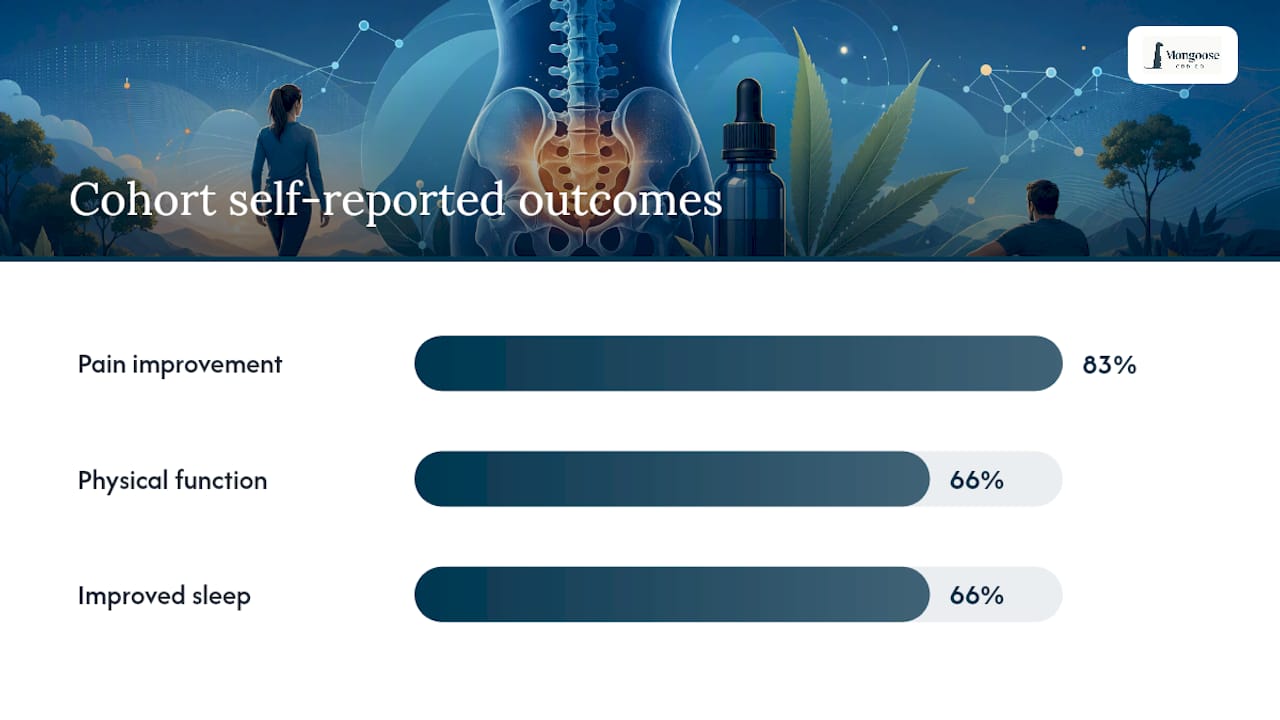
On the encouraging side, a 2022 cohort study followed 259 people with arthritis and joint pain using CBD and found meaningful self-reported gains: 83% reported improvements in pain, 66% reported better physical function, and 66% reported improved sleep. Those numbers sound compelling, but a cohort study without a placebo arm can't rule out expectation effects, natural symptom fluctuation, or the influence of other lifestyle changes participants made at the same time.
On the more sobering side, a 2025 double-blind, randomized, placebo-controlled trial tested a CBD-rich cannabis oil against placebo for knee osteoarthritis pain. The oil was well tolerated, but at 60 days it didn't outperform placebo on pain or function. This is the kind of rigorous design that cohort studies lack, and its null result deserves real weight.
A few factors explain the gap between these findings:
- Product formulation varies enormously between studies. Oil concentration, carrier ingredients, and full-spectrum versus isolate formulas are rarely standardized.
- Trial length and sample size differ widely. Some topical studies run only a few weeks with 15 to 18 participants, which limits how confidently results generalize.
- Self-reported outcomes in open-label or observational studies are more susceptible to placebo response than blinded, controlled measures.
One insight worth sitting with: when a well-designed trial finds no difference from placebo despite good tolerability, that doesn't necessarily mean CBD does nothing. It may point to a real but non-specific symptomatic effect, one tied partly to the ritual of applying a balm or the sensory input of a topical, rather than a pharmacologic effect unique to CBD itself. Systematic reviews and multispecialty groups consistently call for larger, better-controlled trials before anyone can make a confident recommendation. For now, the honest read is: modest potential for symptom relief, the strongest signal for topical, localized use, and still preliminary.
Topical vs. Oral CBD for Targeted SI Joint Relief
For a joint problem confined to one specific spot, like the SI joint, topical CBD generally makes more practical sense than oral or sublingual products.
Topicals work locally. You apply the product directly over the joint, and absorption stays largely confined to the skin and underlying tissue, with much lower systemic exposure than swallowing or holding an oil under your tongue. Oral and sublingual CBD, by contrast, enters your bloodstream and circulates throughout your body, which means slower onset (often 30 to 90 minutes for sublingual, longer for edibles) but broader, longer-lasting effects for people dealing with widespread discomfort rather than one joint.
Most topical pain balms don't rely on CBD alone. Ingredients like menthol, camphor, and capsaicin are common additions, and they produce their own cooling or warming sensations that can feel like relief independent of anything CBD is doing. This matters for how you interpret your own results: if a balm with menthol and CBD helps, you genuinely can't be sure which ingredient (or combination) is doing the work, and that's fine, as long as the product helps.
When choosing a topical, pay attention to:
- CBD concentration per ounce or gram, not just the total milligram count on the front label
- Third-party lab reports (COAs) confirming what's actually in the jar
- Full-spectrum versus broad-spectrum versus isolate, since full-spectrum carries trace THC while the others typically don't
- Any botanical ingredient you're personally allergic to, especially with warming or cooling additives
Pro Tip: Check the lab report's date and batch number, not just the presence of a report. A COA from a different production batch tells you nothing about the jar in your hand.
How to Use Topical CBD for SI Joint Pain Safely
Before applying anything liberally to a sore joint, run a patch test. Apply a small amount to your inner forearm and wait 24 hours, watching for redness, itching, or a rash. If your skin stays calm, you're clear to proceed.
Here's a practical way to structure your trial:
- Establish a baseline. Rate your pain (0 to 10) and note specific function limits, like how long you can sit before discomfort starts, before you apply anything.
- Apply consistently. Use a pea-sized amount over the SI joint area, roughly at the dimples above your buttocks, twice daily. Check the product label for actual CBD concentration since dosing isn't standardized across brands.
- Give it time. Topical effects for pain and stiffness are often noticeable within 15 to 45 minutes per application, but cumulative benefit over the joint may take one to two weeks of consistent use to assess fairly.
- Log your results. Track pain scores and function markers daily rather than relying on memory.
- Set a decision point. Give the trial 2 to 4 weeks. If you see a meaningful, trackable improvement, continue. If nothing changes, it's reasonable to stop and revisit your plan with a clinician.
If your discomfort is more diffuse rather than joint-specific, oral CBD is worth discussing separately, starting low at 5 to 10 mg sublingual twice daily and titrating slowly over several weeks rather than jumping to a higher dose.
| Trial Element | What to Do |
|---|---|
| Patch test | 24 hours on forearm before full use |
| Topical amount | Pea-sized dose over SI joint, twice daily |
| Time to notice | 15 to 45 minutes per application; 1 to 2 weeks for cumulative effect |
| Trial length | 2 to 4 weeks with daily logging |
| Oral starting dose | 5 to 10 mg sublingual, twice daily, titrate slowly |
Safety, Interactions, and Warning Signs to Watch For
CBD is generally well tolerated, but it isn't risk-free, and topical use doesn't mean zero systemic exposure. Repeated application of high-concentration balms can still lead to detectable CBD in your bloodstream over time, which matters if you're on interacting medications.
CBD is metabolized by liver enzymes in the CYP450 family, the same pathway used by warfarin, certain antidepressants, and several anticonvulsants. Harvard Health notes this interaction risk directly, and it's a real reason to loop in your prescriber, not just a formality.
A few other points worth flagging:
- Rare cases of liver enzyme elevation have been reported with sustained, higher-dose CBD use, mostly in oral formulations, so periodic monitoring makes sense if you're using it long-term.
- Full-spectrum products carry trace THC, which can occasionally show up on a drug test depending on sensitivity and frequency of use, a real concern if your employer tests.
- Seek urgent evaluation, not a CBD trial, if you notice numbness or weakness in your legs, changes in bowel or bladder control, or rapidly worsening pain. Those are red flags for a problem beyond simple SI joint dysfunction.
Pairing CBD With Physical Therapy and Movement Work
Topical symptom relief works best as a bridge, not a destination. Clinicians report better functional outcomes when short-term topical relief is paired with targeted rehab, rather than used as a standalone strategy, because reduced pain lets you actually do the exercises that build lasting stability.
Worth discussing with a physical therapist:
- Pelvic tilts and glute bridges to build supporting strength around the joint
- Core activation drills that reduce excess SI joint motion during daily activity
- A pelvic support belt during pregnancy or acute flares to limit aggravating movement
- Timing your CBD application 20 to 30 minutes before a therapy session, when discomfort is the main barrier to participating fully
Pro Tip: Track sitting tolerance and walking distance alongside your pain score. Function often improves before the pain number does, and that's the change that actually sticks.
An Honest Look at Where CBD Helps and Where It Doesn't
The evidence on CBD for joint pain doesn't hand you a clean answer, and I think that's actually useful information, not a disappointment. A positive cohort study and a null randomized trial can both be true at once. They're measuring different things: one captures how people feel in real-world use, the other isolates the drug's effect from everything else surrounding it. If you're dealing with SI joint pain, the practical takeaway isn't "CBD works" or "CBD doesn't work." It's "CBD might help you specifically, and a short structured trial is the only way to know."
What I'd push back on is the framing some wellness content uses, treating CBD as an anti-inflammatory silver bullet for joint conditions. It's better understood as one tool that might lower your pain enough to do the physical therapy that actually rebuilds joint stability. If you want a real-world reference point rather than just study data, the Two Week Topical CBD Trial for Bursitis Pain the Mongoosecbd team has documented is worth reading precisely because it shows the messy, non-blinded reality of daily use, not a controlled lab result. And if your pain is worsening, spreading, or accompanied by any neurological symptoms, no balm replaces a clinician's exam.
— Cindy
Trying a Topical? Here's How Mongoosecbd Balms Are Built
If you've decided a short topical trial makes sense for your SI joint discomfort, a high-quality topical balm can provide a straightforward starting point instead of a shelf full of unfamiliar brands with vague labeling. Each formula uses a substantial amount of CBD combined with supporting botanicals like arnica, turmeric, menthol, and eucalyptus, ingredients chosen for how they layer onto CBD's effects rather than as filler.
Before you commit to a full-size jar, patch-test a small amount on your forearm first, and pick a scent and ingredient profile that avoids anything you're personally sensitive to; the cinnamon and clove formulation uses warming spices, while the original Seriously Soothing Pain Balm keeps the ingredient list simpler. All products are vegan, THC-free, and paraben-free. Some brands offer refund policies to reduce the risk of trial, so testing it out may cost you nothing but the trial period. Start with a single jar, run your 2 to 4 week tracked trial, and decide from real data instead of guesswork.
Sources
- Clinical observations of CBD in arthritis and joint pain (PMC9400326)
- Effects and safety of a CBD-rich Cannabis sativa oil in knee osteoarthritis (Frontiers, 2025)
- Consensus practice guidelines on sacroiliac joint complex pain (RAPM multispecialty, 2025)
- CBD for arthritis pain | Arthritis Foundation
- Sacroiliac joint pain — StatPearls (NCBI Bookshelf)
This article is general information, not a substitute for advice from a qualified doctor. Consult a qualified healthcare professional about your own circumstances before acting on anything here.