
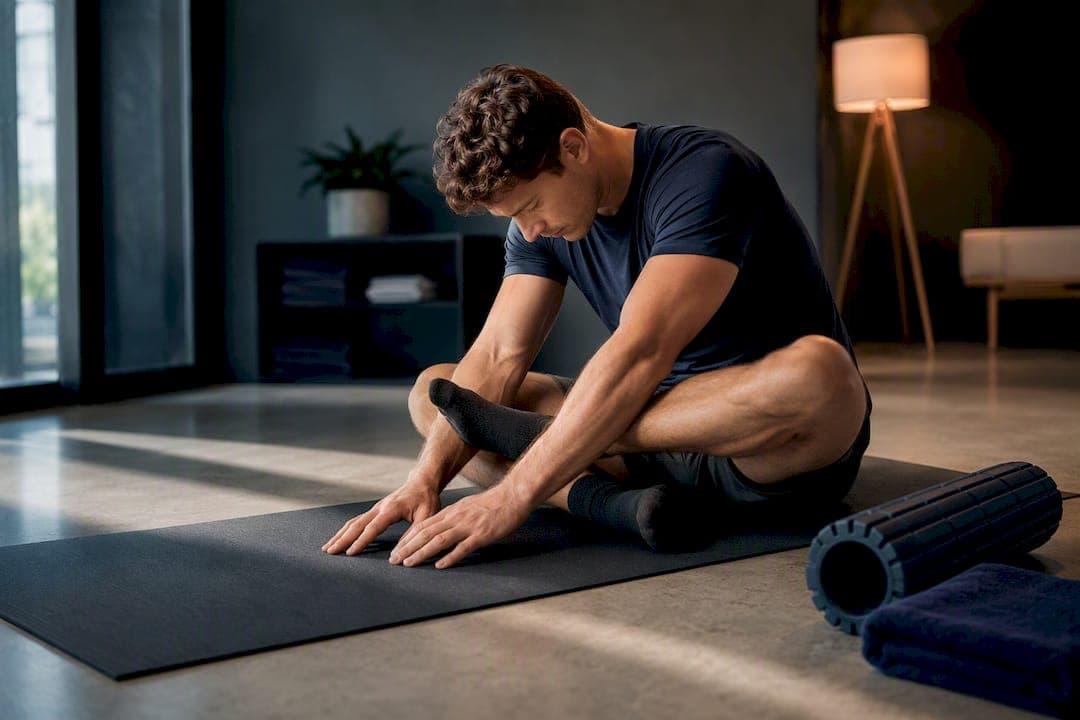
Topical CBD can offer real relief for piriformis syndrome when the pain comes from muscle spasm, but it will not fix a pinched sciatic nerve caused by disc or joint problems. The evidence supports localized, topical use paired with stretching more than it supports oral capsules or gummies. Start with a focused topical trial and rehab exercises, and watch for numbness, weakness, or pain that spreads below the knee.
TL;DR:
- Topical CBD can provide modest relief for muscle spasm-related piriformis pain, especially when combined with stretching and trigger-point therapy.
- The strongest evidence supports its use for localized muscle tightness, not for nerve compression caused by disc or joint problems.
- Formulation, concentration, and application technique significantly influence topical CBD’s effectiveness, with firm massage over the tender spot recommended.
- Systemic (oral) CBD shows inconsistent results and may interact with medications, making topical application the preferable method for most cases.
- Always monitor symptoms closely and consult a healthcare professional before using CBD, especially if you are on blood thinners or other prescription medications.
Table of Contents
- What Is Piriformis Syndrome, and Why Would a Topical Help?
- What the Research Actually Shows About CBD for Muscle and Nerve Pain
- Topical vs. Oral CBD: Which One Fits Piriformis Pain?
- How to Apply Topical CBD for Piriformis Pain, Step by Step
- Is Topical CBD Safe? Side Effects, Drug Tests, and Regulations
- What Mongoosecbd's Trial Protocols and Products Offer
- Dosing and Titration: Finding the Right Amount for Your Body
- What People With Piriformis Syndrome Actually Report
- Traditional Treatments for Piriformis Syndrome and Where CBD Fits
- Does CBD Interact With Medications for Piriformis Pain?
- How CBD Might Actually Relieve Piriformis Symptoms
- An Honest Look at What to Expect
- Try a Targeted Topical Balm Backed by a Real Guarantee
- Sources
- FAQ
What Is Piriformis Syndrome, and Why Would a Topical Help?
The piriformis is a small muscle deep in the buttock that runs from the base of the spine to the top of the thigh bone. In most people, the sciatic nerve passes just beneath it. In some, the nerve runs through the muscle itself. When the piriformis tightens, spasms, or gets inflamed, it can compress that nerve and mimic sciatica: pain radiating down the back of the leg, tingling, or a deep ache in the buttock that worsens with sitting.
Telling muscle-spasm pain apart from true nerve compression matters, because they respond to different treatments.
- Muscle-spasm pain tends to feel tender to the touch, worse after sitting, and eased by stretching or massage.
- Nerve compression from a herniated disc more often causes numbness, weakness, or pain that follows a clear line down the leg regardless of position.
A topical that combines CBD with anti-inflammatory and muscle-relaxing ingredients makes mechanistic sense for the first category. It targets the tight tissue directly rather than trying to calm a nerve that a herniated disc is physically pinching.
What the Research Actually Shows About CBD for Muscle and Nerve Pain
The honest answer is that the evidence is promising but thin. The FDA has not approved CBD for chronic pain, muscle spasm, or piriformis syndrome. Its only approved medical use covers specific childhood epilepsy syndromes, which means every pain-relief claim you see, including this one, rests on emerging research rather than regulatory sign-off.
The evidence gap: A 2026 randomized, double-blinded pilot study testing topical CBD gel after exercise-induced muscle damage found no clear acceleration of recovery compared to placebo, though some individual measures showed small effects. The researchers pointed to formulation and bioavailability as the likely reason results were inconsistent, not a failure of CBD itself.
Harvard Health notes that CBD may interact with the endocannabinoid system in ways relevant to pain, but most human trials mix CBD with THC, which makes it hard to credit CBD alone for any benefit observed. A systematic review of CBD in athletic recovery found limited positive effects on some physiological markers but inconsistent results overall for muscle strength and post-exercise recovery.
There is a more encouraging thread for spine and leg pain specifically. Observational research on hemp-derived CBD gel caps for lumbar spinal stenosis reported improved pain scores and quality of life, though small samples and loose study design limit how much weight that finding can carry.
Put together, here is where the evidence actually lands:
- Topical CBD trials show mixed, modest results, not a consistent large effect.
- Systemic (oral) studies are similarly inconsistent and often confounded by THC.
- The clearest supported use case is localized muscle-spasm pain, not structural nerve compression.
- Formulation and delivery method appear to matter as much as CBD content itself.
Topical vs. Oral CBD: Which One Fits Piriformis Pain?
For a muscle knot deep in one buttock, topical application usually makes more sense than swallowing a capsule. A detailed comparison of the two delivery methods breaks down the tradeoffs, but the short version applies directly here.
- Topical CBD stays local. It works on the skin and underlying tissue where you rub it in, produces a faster local effect, and carries far lower systemic exposure. That is the better fit for an isolated piriformis trigger point.
- Oral or sublingual CBD works throughout the body. It can help with sleep or anxiety that often ride along with chronic pain, but bioavailability varies widely between products and onset is slower, sometimes 30 to 90 minutes.
Choose systemic CBD when pain is widespread or anxiety is amplifying it. Choose topical when the problem is one tight, identifiable muscle. Spine-health's review on CBD for back pain notes that topical effectiveness depends heavily on formulation and skin barrier, and that the massage motion used to apply it may itself contribute to the relief people feel.
Pro Tip: If you compete in any sport with drug testing, skip full-spectrum products entirely and choose CBD isolate with a current certificate of analysis. Trace THC in broad or full-spectrum formulas has caused positive drug tests in athletes even when the label says "non-detectable."
How to Apply Topical CBD for Piriformis Pain, Step by Step
Technique matters as much as the product. Here is a practical protocol:
- Locate the muscle. Lie face down and find the midpoint between your tailbone and the top of your hip bone (the greater trochanter). The piriformis runs diagonally through that zone, roughly a hand's width below the top of the buttock.
- Apply with pressure, not a light rub. Massage the balm in with firm, deep-tissue pressure for 60 to 90 seconds directly over the tender spot. A light surface rub will not move product into the muscle belly.
- Repeat 2 to 4 times daily. Consistency beats intensity. Morning and evening, plus after activity that provokes symptoms, is a reasonable starting cadence.
- Layer with heat and movement. Applying a heating pad afterward or doing a gentle piriformis stretch (figure-four stretch, seated or lying) while the area is warm tends to compound the effect.
- Run the trial for 2 to 6 weeks. Keep a simple symptom diary rating pain on a 0 to 10 scale and note how far you can sit or walk before symptoms flare. Objective markers beat memory.
Pro Tip: Look for a topical CBD concentration on the higher end and pay attention to the carrier ingredients. Menthol and arnica in the formula tend to signal it was built for deep-tissue application, not just skin comfort. A sports massage trial protocol built around similar timelines can help structure your own trial.
Is Topical CBD Safe? Side Effects, Drug Tests, and Regulations
CBD has a reasonably clean safety profile at the doses used in topicals, but it is not risk-free, and the regulatory picture is thinner than most marketing implies.
- The FDA has not approved CBD for pain of any kind; its only approved use remains certain childhood epilepsy syndromes.
- Oral CBD can affect liver enzymes, cause drowsiness, or upset the stomach, especially at higher doses. Topicals carry far less of this risk since absorption into the bloodstream is minimal.
- If you take other medications, particularly blood thinners or anything metabolized by the liver, talk to your doctor before adding oral or high-dose CBD, even topical.
The drug-test risk is real and specific: broad- and full-spectrum CBD products can carry trace cannabinoids that trigger a positive drug test, even at levels the label calls negligible. Athletes and anyone subject to workplace testing should choose CBD isolate and confirm it with a current third-party lab report, not just a label claim.
Before buying anything, check for a certificate of analysis, a clear ingredient list, and explicit THC disclosure. A comparison of isolate versus full-spectrum topicals walks through how to read those reports.
What Mongoosecbd's Trial Protocols and Products Offer
Some brands offer trial guidance similar to the topical protocol above: a 2 to 6 week window, sports-massage-style application, and drug-test-conscious formulation choices for athletes.
- Products with higher concentrations of CBD per ounce are often blended with arnica, menthol, and other botanicals aimed at localized muscle relief.
- A refund policy backing purchases can provide a window to judge whether a product works for your body.
- These brand protocols supplement, but do not replace, independent clinical research; treat them as practical guidance, not proof of efficacy.
Dosing and Titration: Finding the Right Amount for Your Body
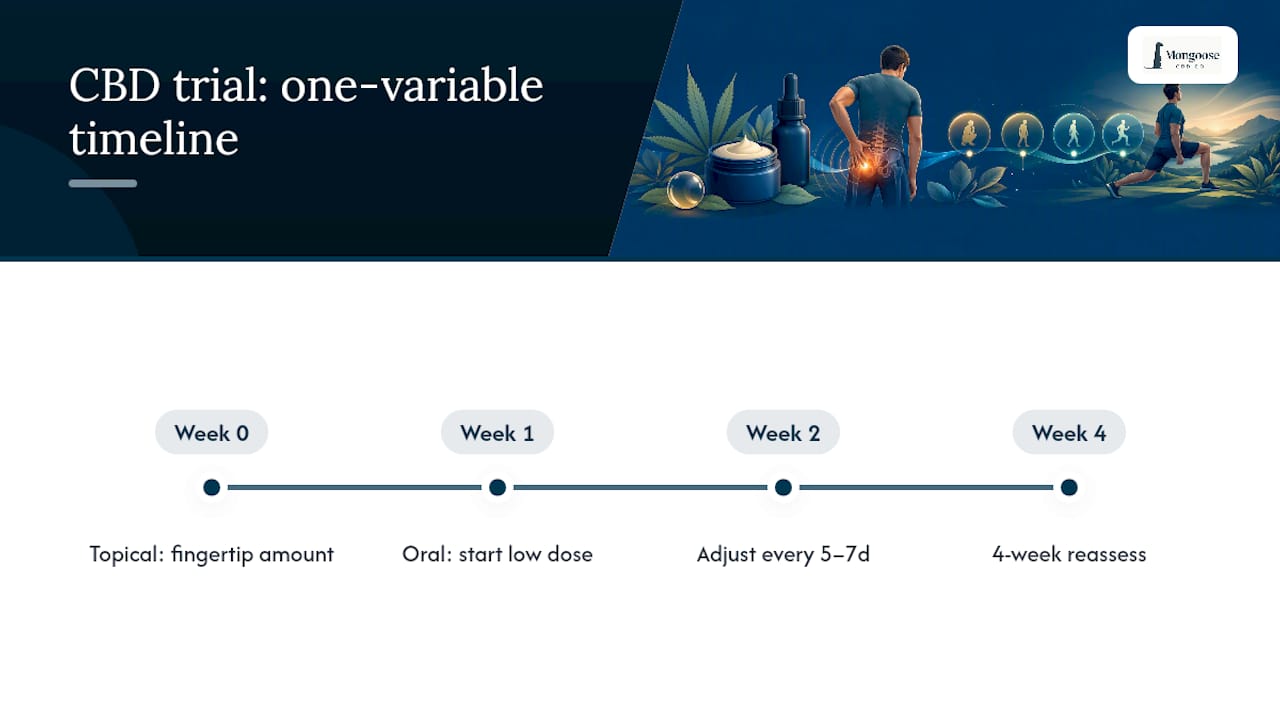
There is no universal milligram number for piriformis pain, because topical and oral CBD behave completely differently once they hit your system. Topical products are measured by concentration, usually expressed as milligrams per ounce, and the amount that reaches muscle tissue depends on formulation and how firmly you massage it in. Starting with a moderate application, about a fingertip's worth over the affected area, and increasing frequency before increasing amount, is a more reliable strategy than assuming more product means more relief.
For oral or sublingual CBD, titration follows a slower curve. A common starting point cited in early-stage research is a low dose taken once daily for the first week, watching for drowsiness or stomach upset, then increasing gradually every 5 to 7 days if no benefit appears. Because bioavailability varies so widely between oral products, the same labeled dose from two different brands can produce very different effects in your bloodstream.
The practical rule: change one variable at a time. If you are combining a topical balm with an oral tincture, do not increase both simultaneously, or you will not know which change produced the result. Track your symptom diary against whichever variable you just adjusted, and give each change at least a week before judging it. If you notice no shift after four weeks of consistent, escalating use, the formulation or delivery method is more likely the problem than your dose.
What People With Piriformis Syndrome Actually Report
Formal clinical trials specific to piriformis syndrome and CBD do not exist yet. What exists instead is a patchwork of adjacent evidence and firsthand accounts from people using topical CBD for deep buttock and leg pain, and the pattern in that feedback is consistent with the clinical data: modest, localized relief for spasm-type pain, little effect on nerve-related numbness.
People managing piriformis symptoms who report benefit from topical CBD tend to describe the same experience: reduced tenderness to touch, easier stretching, and better tolerance for sitting during a workday, rather than complete pain elimination. That lines up with the observational data on hemp-derived CBD for lumbar spinal stenosis, where participants reported improved pain scores and quality of life without dramatic across-the-board cures.
The absence of piriformis-specific trials is itself informative. It means every claim you read online, including brand testimonials, is extrapolated from broader muscle-pain and spine-pain research rather than a study of piriformis syndrome directly. Treat individual accounts as useful anecdotal signal about what to try, not proof of what will happen for you.
Traditional Treatments for Piriformis Syndrome and Where CBD Fits
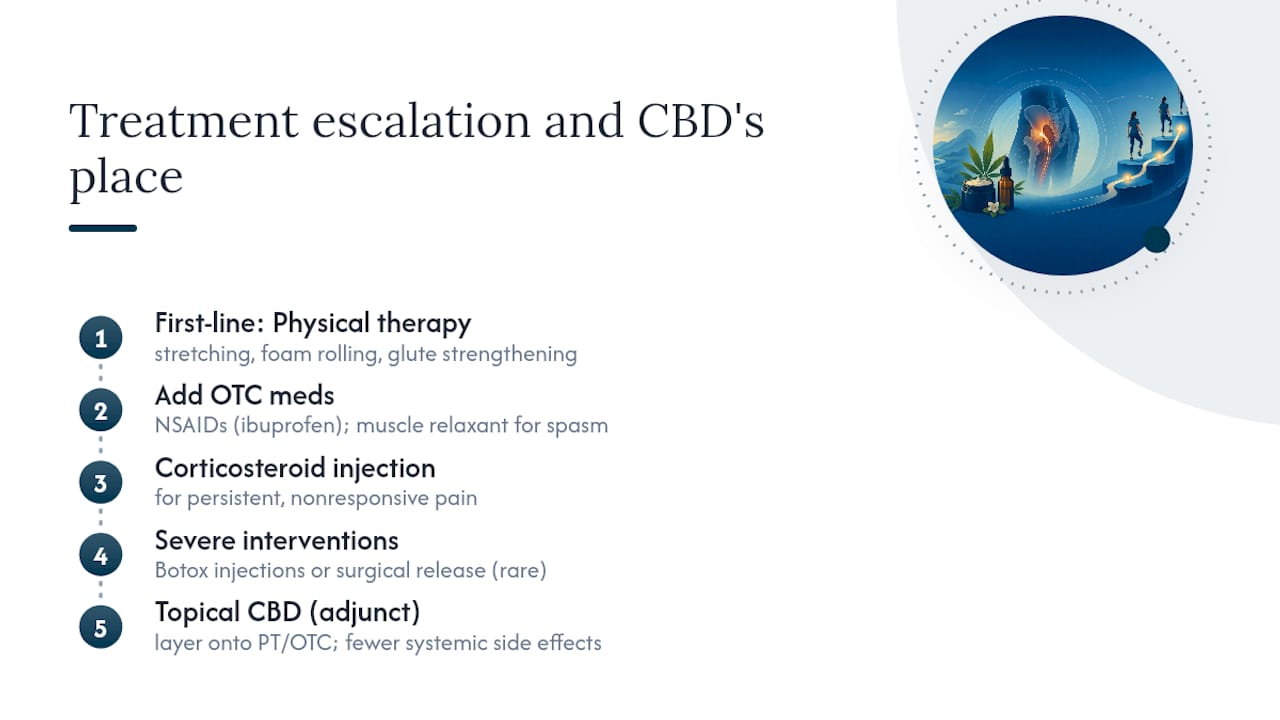
Physical therapy remains the backbone of piriformis treatment, built around stretching the muscle, releasing trigger points, and correcting the hip and gait mechanics that caused the tightness in the first place. Common approaches include the figure-four stretch, foam rolling, and targeted strengthening of the glutes to take pressure off the piriformis.
For pain that does not respond to stretching alone, doctors often add NSAIDs like ibuprofen for inflammation, occasionally a muscle relaxant for acute spasm, or, in persistent cases, a corticosteroid injection directly into the muscle. Severe, treatment-resistant cases sometimes lead to Botox injections or, rarely, surgical release of the muscle.
Topical CBD does not replace any of that. It slots in as a lower-risk adjunct, something you can layer onto physical therapy and over-the-counter anti-inflammatories rather than a substitute for either. The realistic comparison: NSAIDs and stretching remain the better-proven first line, while topical CBD offers a complementary option with fewer systemic side effects for people who want to reduce reliance on oral medication. A protocol built for SI joint pain follows a similar layered approach and translates well to piriformis-focused trials.
Does CBD Interact With Medications for Piriformis Pain?
CBD is processed by the same liver enzyme system, CYP3A4, that metabolizes a long list of common medications, which means interactions are possible even with topical use, though the risk rises sharply with oral CBD.
If you take muscle relaxants like cyclobenzaprine for piriformis spasm, adding oral CBD can compound drowsiness, since both act as central nervous system depressants to some degree. The same caution applies to combining CBD with prescription sedatives or sleep aids. NSAIDs like ibuprofen do not have a well-documented direct interaction with CBD, but both can affect liver function, so anyone taking either at high, sustained doses should mention it to a doctor.
Blood thinners deserve the most caution. CBD can raise blood levels of certain anticoagulants by competing for the same liver enzymes, a well-documented interaction that makes medical consultation necessary before combining the two. Topical CBD carries a much lower systemic absorption rate than oral products, which reduces but does not eliminate this risk, especially with frequent, high-concentration application over large areas. If you are on any prescription medication for pain, spasm, or blood clotting, run your CBD plan past the prescriber before starting, not after.
How CBD Might Actually Relieve Piriformis Symptoms
Two mechanisms show up repeatedly in the research, and neither is fully proven, but both are biologically plausible. The first is anti-inflammatory action. CBD interacts with receptors in the endocannabinoid system that influence how immune cells respond to tissue irritation, which may reduce local swelling around an overworked or spasming piriformis muscle. The endocannabinoid system explainer from Hemp Flower Co. and a broader overview of how cannabinoids affect pain and mood both cover how this receptor interaction is thought to work.
The second is a muscle-relaxant effect, though the evidence here is softer. Some researchers believe CBD may influence calcium signaling within muscle cells in ways that reduce involuntary contraction, which would explain why people report less spasm and tightness rather than less sharp pain. Study authors behind the 2026 topical CBD gel trial repeatedly flagged formulation and bioavailability as the deciding factor in whether either mechanism translates into a felt result. A poorly formulated topical can contain the right amount of CBD on paper and still fail to deliver it into the muscle tissue where these mechanisms would need to act.
An Honest Look at What to Expect
Expect modest relief for spasm-driven pain, not a cure. Topical CBD works best paired with stretching, trigger-point release, and a clinician's input, not used alone. Track your symptoms for a few weeks, and stop if pain spreads down the leg or new numbness shows up.
— Cindy
Try a Targeted Topical Balm Backed by a Real Guarantee
If stretching and NSAIDs have only gotten you partway there, a topical built specifically for deep muscle tissue is worth adding to the rotation. Mongoosecbd's balms combine 1,000 mg of CBD per ounce with arnica and other botanicals in formulas designed for exactly the kind of deep-tissue application a piriformis trigger point needs.
The Seriously Soothing Pain Balm is built for general muscle soreness and arthritis-type inflammation, while RIKKI TIKKI Recovery leans into faster post-activity recovery, useful if your piriformis flares after workouts or long runs. Both fit directly into the 2 to 6 week topical trial protocol outlined earlier: apply with firm pressure, twice to four times daily, and track your symptom diary as you go.
Every order carries a 30-day full refund policy, so testing whether it works for your specific pain pattern carries no financial risk. Start with the Seriously Soothing Pain Balm and give it the full trial window before judging the result.
This article is general information, not a substitute for advice from a qualified doctor. Consult a qualified healthcare professional about your own circumstances before acting on anything here.
Sources
- FDA: Regulation of Cannabis and Cannabis-Derived Products, Including Cannabidiol (CBD)
- Can CBD oil help manage pain? - Harvard Health
- Topical application of cannabidiol for muscle recovery after exercise-induced muscle damage: a randomized, double-blinded pilot study
- Systematic review: CBD, exercise capacity and post-load recovery (PubMed Central)
- Trace cannabinoid risk and drug testing considerations for athletes
FAQ
What can I do to get immediate relief from piriformis syndrome?
Gentle stretching like the figure-four stretch, along with heat and firm massage over the tender area, tends to bring the fastest relief for muscle-spasm-driven pain. A topical CBD balm applied with deep-tissue pressure can be layered on top of that routine for added relief without the systemic side effects of oral pain medication.
Is there a chair that is good for piriformis syndrome?
A firm, supportive chair with a cutout or wedge cushion that relieves direct pressure on the buttock tends to work best, since prolonged sitting on a hard, flat surface is one of the most common triggers. A standing desk setup or frequent position changes throughout the day help even more than the chair itself.
What aggravates piriformis syndrome?
Prolonged sitting, especially on hard surfaces or with a wallet in the back pocket, is the most common aggravator, along with running, climbing stairs, or any activity involving repetitive hip rotation. Poor warm-up before exercise and weak glute muscles that force the piriformis to overcompensate also make symptoms worse.
Does piriformis syndrome ever go away?
Yes, most cases resolve within a few weeks to a few months with consistent stretching, activity modification, and targeted treatment like physical therapy or topical anti-inflammatories. Cases that involve true nerve compression from a structural cause take longer and sometimes need medical intervention beyond home care.
Can CBD help piriformis syndrome specifically?
Topical CBD shows the most promise for the muscle-spasm component of piriformis syndrome, not for structural nerve compression. Combining it with stretching and a 2 to 6 week trial protocol gives you the most realistic shot at noticeable relief.