
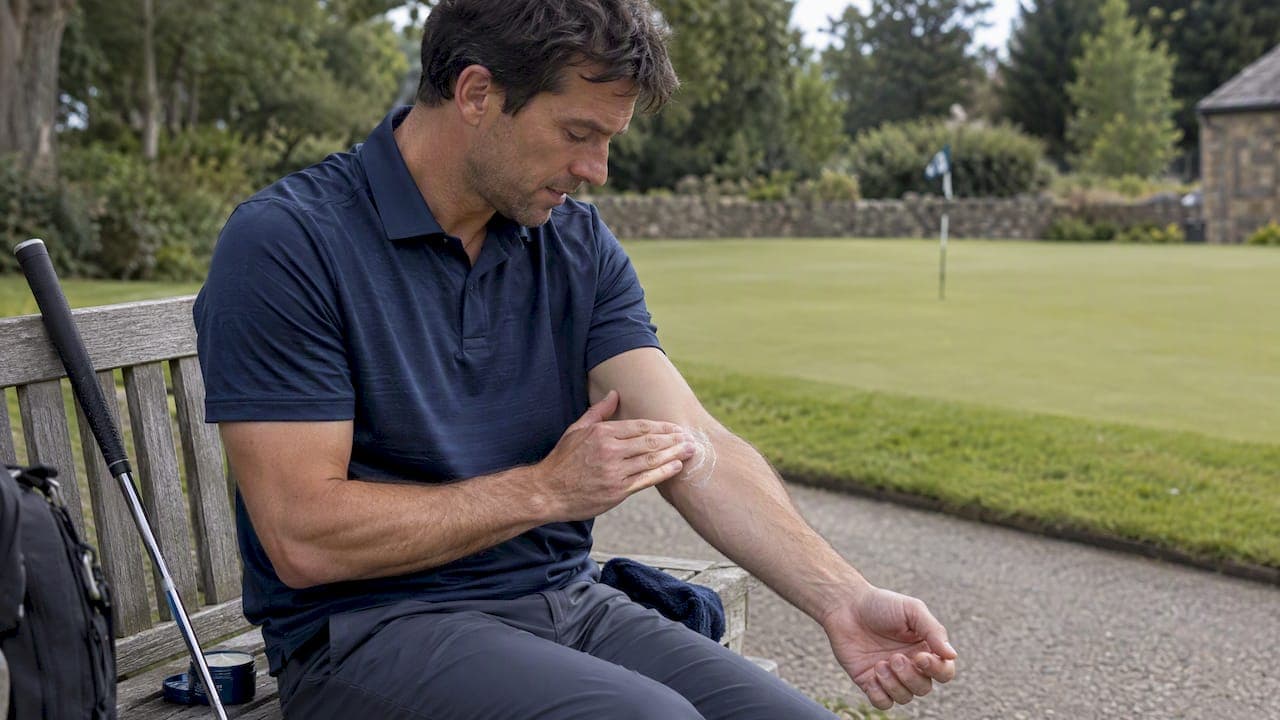
Topical CBD may ease pain and stiffness for some people with golfer's elbow, but it has not been shown to repair tendon tissue, and it works best as an add-on rather than a replacement for rehabilitation. Oral CBD has weaker support for localized elbow or tendon pain than topical forms. Load management and eccentric exercise remain the backbone of recovery from medial epicondylitis.
TL;DR:
- Topical CBD delivers higher local concentrations with fewer systemic side effects, making it more promising for localized tendon pain than oral CBD.
- Limited evidence suggests topical CBD can reduce pain temporarily, but it does not repair tendon tissue or speed up degenerative healing.
- Clinical studies for musculoskeletal pain are small and inconclusive, though some pilot data show potential symptom relief from topical applications.
- A two-week self-trial applying CBD balm over the sore area, with pain tracking and skin checks, provides a practical way to assess effectiveness.
- People on prescription medications or with severe nerve symptoms should consult a healthcare professional before using CBD products.
Table of Contents
- How CBD might affect pain and inflammation, and why topical vs. oral matters
- Clinical evidence: pilot studies, oral trials, and systematic reviews
- How to run a safe, practical topical CBD trial for golfer's elbow
- Safety: side effects, drug interactions, and special warnings
- Where CBD fits in a rehab-focused care plan for golfer's elbow
- Brand and author evidence: practical trial guidance from Mongoose CBD Co.
- When a topical CBD trial is worth trying
- Trying a topical balm: our products and trial support
- FAQ
- Sources
How CBD might affect pain and inflammation, and why topical vs. oral matters
CBD interacts with the body's endocannabinoid system, a network of receptors involved in regulating pain signaling, inflammation, and mood. The exact pathways are still being mapped, and claims that CBD "blocks" pain or inflammation outrun what the research currently supports. A more accurate way to describe it: CBD appears to modulate how pain signals are processed, which may reduce the perception of discomfort without changing the underlying tissue.
That distinction matters most when comparing application methods. A balm or cream applied directly over the medial epicondyle delivers CBD to local tissue while keeping systemic absorption low. Oral CBD, by contrast, has to survive digestion and liver metabolism before reaching the bloodstream, and only a fraction of the dose typically ends up circulating. For a problem confined to one tendon insertion point, that pharmacokinetic reality favors topical use.
Bioavailability is the crux of the issue. Oral CBD's first-pass metabolism in the liver cuts into how much active compound reaches tissue, and research on exercise-induced muscle and joint pain reflects that gap. A 2021 randomized crossover trial gave untrained men 150 mg of oral CBD after eccentric elbow-flexor exercise, then again at 24 and 48 hours, and found no improvement in soreness, joint angle, or peak torque compared to placebo. Local application avoids that metabolic bottleneck by putting the compound where the pain is, rather than asking it to travel through the whole system first.
A few practical distinctions are worth keeping straight:
- Topical CBD concentrates at the application site and carries a lower risk of systemic side effects.
- Oral CBD circulates throughout the body but loses potency to liver metabolism before it reaches sore tissue.
- Neither form has been shown to alter tendon structure or accelerate healing of degenerative changes.
Our comparison of topical versus oral CBD for pain walks through this distinction in more detail for readers weighing which format fits their situation.
Pro Tip: Apply topical CBD directly over the sore spot and massage it in fully. Absorption through skin is slower than injection or inhalation, so rubbing it in matters more than how much you use.
Clinical evidence: pilot studies, oral trials, and systematic reviews
The evidence base for CBD and musculoskeletal pain is still thin, and nothing in it speaks directly to golfer's elbow by name. What exists points toward cautious optimism for topical use and more skepticism for oral use.
A 2023 open-label pilot study followed 20 former elite athletes with chronic lower-extremity pain who applied topical CBD twice daily for six weeks. Self-reported pain dropped from a mean of 3.5 at intake to 1.7 at exit, a statistically significant change, and the balm was generally well tolerated. The study had no placebo arm and a small sample, so it cannot prove CBD caused the improvement, but it supports treating topical application as reasonably safe to try.
A meaningful minority of participants in that pilot reported a minor adverse effect, most often skin dryness or a localized rash, according to the same study. That is a meaningful number to know before starting, even though the effects were minor and typically resolved after stopping use.
Oral CBD tells a different story. Beyond the elbow-flexor trial mentioned above, a 2025 living systematic review covering 29 randomized trials and roughly 2,579 participants found that purified oral CBD alone was not associated with reduced pain intensity across the studies examined. Some whole-plant cannabis products with THC showed small pain reductions compared to placebo, but those came with a moderate-to-large increase in dizziness and sedation. The review's authors describe the overall evidence as low to moderate in strength, which is a polite way of saying the field needs more and better trials.
Those better trials may be on the way. Clinicaltrials testing topical CBD at 50 mg/mL, applied in 1 mL doses twice daily over two-week periods with a one-week washout between arms. The design itself is informative: researchers are treating two weeks as a reasonable window to detect a topical effect, which lines up with the trial length we suggest later in this article.

For a broader look at how these findings apply to recovery generally, our overview on CBD for muscle recovery summarizes the topical-versus-oral gap across several conditions.
How to run a safe, practical topical CBD trial for golfer's elbow
A trial works best when it has a defined length, a way to measure change, and clear rules for stopping. Here is a structure modeled on the two-week windows used in registered topical CBD research:
- Pick one balm and stick with it. Switching products mid-trial makes it impossible to tell what is working.
- Apply a small amount directly over the medial epicondyle, the bony bump on the inside of the elbow, two to three times daily.
- Rub it in fully rather than leaving a visible layer on the skin.
- Log a daily pain score from 0 to 10, ideally before and after your rehab exercises.
- Note whether you can complete your prescribed exercises more comfortably than before starting.
- Check your skin daily for redness, dryness, or rash at the application site.
- Reassess at day 14. If pain scores have not moved and you have no new side effects worth tolerating, it is reasonable to stop.
Pairing the trial with physical therapy matters more than the balm itself. Eccentric wrist flexor exercises, a counterforce brace, and activity modification address the tendon changes that cause golfer's elbow in the first place. A topical product that reduces discomfort enough to let someone complete those exercises consistently is doing real work, even if it never touches the tendon directly. Our guide to running a two-week CBD trial for sports-related pain covers similar pacing for other overuse injuries.
When choosing a product, a short checklist keeps the trial meaningful:
- THC-free labeling, especially relevant for anyone subject to drug testing.
- A third-party certificate of analysis (COA) confirming what is actually in the jar.
- A stated concentration per ounce, so you know roughly how much CBD you are applying per dose.
Pro Tip: Keep your rehab exercises on the same schedule you had before starting CBD. The goal of the trial is to see whether the balm changes your pain and function, not to replace the exercises that are already doing the real rehabilitation work.
Safety: side effects, drug interactions, and special warnings
Topical CBD carries a lower systemic risk than oral or inhaled forms, but "lower" is not "zero." The most commonly reported issues in trial data are local: skin dryness and rash. In the 2023 pilot study, skin dryness and rash were among the most common minor adverse effects reported by participants who experienced any side effects, and they generally cleared up once use stopped.
Systemic risk is lower with topical application because less CBD reaches the bloodstream, but it is not fully eliminated, particularly with frequent, heavy use over large skin areas. The 2025 living systematic review found a moderate-to-large increase in dizziness and sedation associated with cannabinoid products generally, a risk profile drawn mostly from oral and inhaled studies but worth keeping in mind.
Drug interactions deserve particular attention for anyone on prescription medication. The FDA prescribing information for EPIDIOLEX, the only FDA-approved cannabidiol product, documents somnolence, sedation, and clinically significant interactions through liver enzymes including CYP and UGT pathways, along with a recommendation for liver monitoring. That labeling applies to an oral, prescription-strength product, not an over-the-counter topical balm, but it signals that CBD is not metabolically inert. Anyone taking prescription medication, especially blood thinners or seizure medications, should check with a pharmacist before adding CBD in any form.
A few safety habits reduce risk:
- Patch test a small area of skin 24 hours before full use.
- Avoid layering CBD balm with other topical medications on the same skin area.
- Pause and assess before driving if you notice any drowsiness, even though topical use makes this less likely than oral use.
Where CBD fits in a rehab-focused care plan for golfer's elbow
Medial epicondylitis, the clinical name for golfer's elbow, involves degenerative changes in the tendons attaching to the inside of the elbow, usually from repetitive wrist flexion and forearm rotation. Clinical overviews of the condition consistently point to the same core treatments: eccentric strengthening exercises, load management, bracing, and short-term use of analgesics for flare-ups. Injections and surgery are reserved for cases that do not respond to months of conservative care.
Topical CBD has no role in that core treatment list, but it can support it in a practical way. Pain that is manageable makes it easier to show up for physical therapy sessions and to complete home exercises with proper form instead of avoiding movement altogether. A few small habits help:
- Apply balm roughly 30 minutes before a therapy session so it has time to take effect.
- Pair application with a counterforce brace or kinesiology tape rather than relying on either alone.
- Reapply after icing, since ice can leave skin less receptive to absorption immediately afterward.
Our post on using CBD as rehab support rather than a fix applies the same logic to a different overuse injury, and the underlying principle holds here too: symptom relief that enables consistent rehab is valuable, even without evidence that it changes tendon biology.
Brand and author evidence: practical trial guidance from Mongoose CBD Co.
This article is written by Cindy, drawing on internal trial write-ups we have published covering real-world use of our own balms. Posts like our account of immediate relief within the first application and our shin splints trial describe conservative seven-to-fourteen-day topical trials, which is the same window reflected in registered clinical research on topical CBD.
We offer a refund policy that allows a return within a defined period if the balm does not deliver. Our formulations undergo third-party testing to verify concentration and THC-free status, a detail worth confirming with any CBD product regardless of brand.
When a topical CBD trial is worth trying
A topical CBD trial makes the most sense for someone with mild to moderate golfer's elbow pain who is already doing eccentric exercises and bracing, not using it as a substitute for them. It fits best for people not currently on medications with known liver enzyme interactions, since that keeps the risk profile simple. If pain is severe, if there is numbness or weakness in the hand, or if you are taking prescription medication for another condition, talk to a doctor or pharmacist before adding any CBD product, topical or otherwise. Short of those red flags, a two-week trial with clear stopping rules is a low-risk way to find out whether it helps.
— Cindy
Trying a topical balm: our products and trial support
If you decide a trial is worth it, we offer CBD balms combining CBD with arnica and other botanicals aimed at fast, localized relief rather than a generic all-purpose rub. Some are formulated without THC, so drug testing may not be a concern depending on the product.
For a two-week elbow trial, apply either balm directly over the sore spot two to three times daily and track your pain score the way we outlined earlier in this article. If it does not work for you, the refund policy means you are not stuck with a product that did not help. Readers who want to try a smaller commitment first can start with a free sample of our Miracle Pain Balm before committing to a full-size jar. Full details on formulations and sizes are on our product page.
This article is general information, not a substitute for advice from a qualified doctor. Consult a qualified healthcare professional about your own circumstances before acting on anything here.

FAQ
Does CBD help with tendon pain?
Topical CBD may reduce the perceived pain associated with tendon conditions like golfer's elbow, based on a small 2023 pilot study in former elite athletes. It has not been shown to repair or strengthen tendon tissue, so it works as symptom support alongside rehabilitation rather than a treatment for the underlying tendon changes.
Is CBD cream better than Voltaren?
There is no direct head-to-head trial comparing CBD cream to topical NSAIDs like Voltaren for tendon pain, so neither can be called more effective based on current evidence. Voltaren has a longer track record of regulated clinical testing for musculoskeletal pain, while topical CBD's evidence is limited to small pilot studies, so the two are not interchangeable in terms of proof.
Does CBD oil help with a pinched nerve?
CBD oil has not been studied specifically for pinched nerve pain, and numbness, tingling, or weakness in the hand or arm warrants clinical evaluation rather than a CBD trial. If nerve-related symptoms are present alongside elbow pain, a doctor should assess the cause before trying any over-the-counter product.
Does CBD actually help with muscle pain?
The evidence is mixed and depends heavily on how it is taken. A 2021 randomized trial found oral CBD gave no benefit for exercise-induced muscle soreness, while small topical pilot studies report self-reported improvement, though without the rigor of a placebo-controlled design.
Sources
- Topical cannabidiol is well tolerated in individuals with a history of elite physical performance and chronic lower extremity pain | Journal of Cannabis Research
- The Effects of Cannabidiol Oil on Noninvasive Measures of Muscle Damage in Men
- Living systematic review on cannabinoids and other plant-based treatments for chronic pain: 2025 update
- Topical CBD for Musculoskeletal Pain (NCT05170451)
- EPIDIOLEX (cannabidiol) prescribing information — FDA