
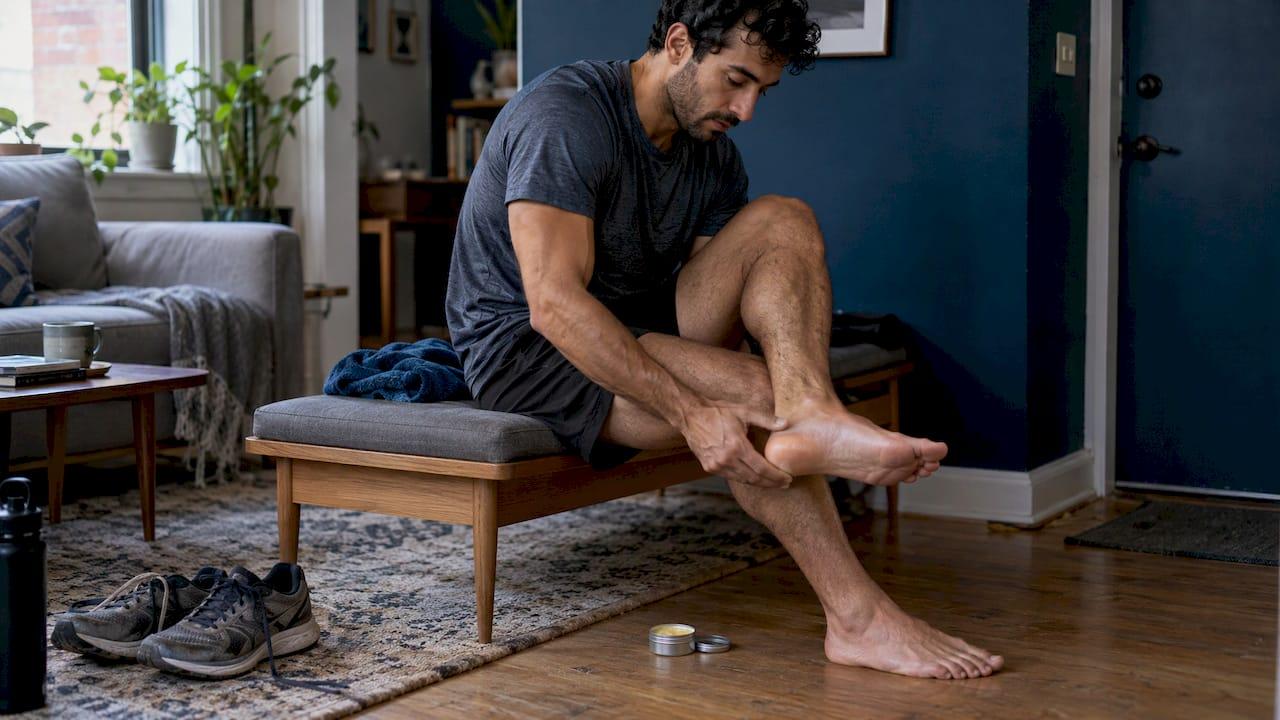
A CBD balm is the most common way to use CBD for foot pain. You rub it into the sore area, usually one to three times a day, and pair it with good footwear and stretching. Research on CBD for pain is still developing, and no CBD product is FDA-approved for pain. A balm works best as one part of a foot-care routine. It does not replace a diagnosis.
This guide covers what studies show, how heel pain differs from general foot soreness, how to apply a topical, how to read a label and when to see a podiatrist.
TL;DR
- Topical CBD is used for general foot soreness and tired feet. Study results are mixed, and research is ongoing.
- Heel pain lasting more than two weeks needs a diagnosis before you rely on any cream.
- Use a balm alongside stretching, proper shoes or orthotics, not instead of them.
- Look for third-party lab results, a clear CBD amount and a THC-free label.
- Talk to a physician first if you take blood thinners, seizure medication or antidepressants.
Table of Contents
- What the research says about CBD and foot pain
- How a topical CBD balm is meant to work
- Heel pain and plantar fasciitis
- How to use a CBD balm on your feet
- Our perspective
- What to check on a CBD balm label
- Safety, side effects and medications
- Build a foot-care routine around the balm
- Our balms for sore feet
- FAQ
- Sources
What the research says about CBD and foot pain
The research is mixed. Some small studies report relief. Larger trials have not shown a clear edge over placebo.
On the positive side, a 2024 systematic review found that 7 of 11 clinical trials indicated pain-reducing properties for CBD. The conditions included osteoarthritis-related pain, chronic or neuropathic pain and arthritis. The authors also said clinical evidence is limited and more studies are needed.
A 2023 study of topical CBD looked at chronic lower extremity pain. Participants applied 10 mg twice daily. Self-reported pain dropped from an average of 3.5 at intake to 1.7 at exit. Seventy percent completed the trial. Half reported minor side effects, mainly skin dryness and rash.
Other reviews are more cautious. A 2023 review in The Journal of Pain covered 16 randomized trials of CBD for pain. Fifteen showed no greater effect than placebo. A 2026 narrative review reached a similar view for knee osteoarthritis, fibromyalgia and acute low back pain. It also noted that no regulator has approved CBD as an analgesic.

The American Academy of Orthopaedic Surgeons says there is no FDA-approved CBD product for pain. The International Association for the Study of Pain said in 2021 that it does not endorse general use of cannabinoids for pain.
What this means in practice: many people try a topical for everyday soreness, and individual experience varies. Treat it as a trial with a clear start date and a clear way to judge it. Our guide to CBD topicals for pain also walks through the evidence in more detail.
How a topical CBD balm is meant to work
A balm is applied to the skin over the sore area. Podiatrist Dr. Tom Biernacki describes topical CBD as interacting with CB2 receptors in peripheral nerves, immune cells and joint tissue. The same page notes that several small human trials in diabetic neuropathy showed lower pain scores with CBD products.
There is a caveat on absorption. The 2023 study above notes that CBD is a highly lipophilic molecule with limited skin permeation, and that very little is known about the right topical dose. That is one reason the formula around the CBD matters. Balms that pair CBD with botanicals such as arnica, menthol, peppermint and eucalyptus add a cooling or warming feel as you apply them. Many people value that sensation on tired feet.
Heel pain and plantar fasciitis
Heel pain needs more care than general soreness. The most common cause is plantar fasciitis, which is irritation of the band of tissue along the sole. A heel spur can also be involved.
Podiatrist Dr. Kevin Lam says CBD cream can dull surface soreness for some people but does not treat plantar fasciitis or a heel spur directly. He advises getting a diagnosis if heel pain lasts more than two weeks. Dr. Biernacki notes the mechanical part of plantar fasciitis will not respond to CBD. He adds that some patients report meaningful pain reduction as part of a multimodal approach. He also advises patients not to drop orthotics and physical therapy in favor of CBD.
Research on this exact condition is just starting. A University of Florida phase 2 trial of a transdermal CBD cream in adults with plantar fasciitis is registered on ClinicalTrials.gov. The registry notes that no published trials have yet evaluated CBD in plantar fasciitis specifically.
Common causes of foot and heel pain
| Pain pattern | Often linked to | What helps most |
|---|---|---|
| Sharp heel pain with first steps in the morning | Plantar fasciitis | Stretching, supportive shoes, orthotics, a podiatrist exam |
| Achy, tired soles after long days | Overuse, footwear | Rest, better shoes, massage, a topical |
| Pain behind the heel or up the ankle | Achilles strain | Load management, calf work, an exam if it persists |
| Burning or tingling | Nerve irritation, neuropathy | A medical evaluation first |
This table is a general guide. It does not replace an exam.
For Achilles-area soreness, see our Achilles pain topical trial. For aching joints elsewhere, see CBD for joint pain.
How to use a CBD balm on your feet
A simple routine makes it easier to judge whether a balm suits you.
- Clean and dry your feet. Test a small patch of skin first and wait a day to check for irritation.
- Apply a thin layer to the sore area. Massage it in for a minute or two. Avoid broken skin and keep it away from eyes and mouth.
- Use it as directed on the label. One to three times a day is a typical range, according to Michigan Foot Doctors.
- Keep notes. Rate your pain from 0 to 10 each morning and evening.
- Review after two to four weeks. Dr. Lam advises seeking an exam if pain has not measurably improved after four weeks.
For more on how much to apply, see CBD dosage for topicals.
Our perspective
We make balms for people who are on their feet, training hard or living with daily aches. Feet take a lot of load, and a good topical gives you a simple, hands-on way to care for them.
Our balms combine CBD at 1,000mg per ounce with botanicals such as arnica, menthol, turmeric, eucalyptus, peppermint, cinnamon, clove, ginger and cayenne pepper. Our formulas are designed to give a pleasant sensation as you massage them in. They are THC-free, vegan, non-GMO, paraben-free and cruelty-free.
Our advice for sore feet is simple. Start with the basics: supportive shoes, stretching, rest. Add a balm as part of the routine. Track how your feet feel for a few weeks. If you are not happy, our 30-day full refund policy is there for that reason.
Cindy
What to check on a CBD balm label
Label accuracy varies across the CBD market, so a few checks help.
- Third-party testing. Look for a Certificate of Analysis from an accredited lab showing CBD content, THC content and contaminants. Dr. Biernacki recommends this for any product you buy.
- A stated CBD amount. A 2022 JAMA Network Open study of hemp-derived topicals found only 24% of products with a stated CBD amount were accurately labeled. THC was detected in 35% of the products tested.
- THC status. The same study found some products labeled THC-free still contained THC. A tested, THC-free product avoids that uncertainty.
- Directions for use. The FDA has issued warning letters to CBD salve and lotion sellers whose labeling lacked adequate directions. Clear directions are a good sign.
- Spectrum. Broad spectrum, full spectrum and isolate differ in what they contain. See our guide to broad spectrum vs isolate topicals.
For a longer checklist, see choosing a CBD cream.
Safety, side effects and medications
Topical CBD is generally well tolerated. The most common effects are on the skin. In the 2023 foot and leg study, skin dryness and rash were the main complaints. Stop use if you see redness, itching or swelling.
Serious allergic reactions are possible with CBD products in general. WebMD lists breathing problems, swelling of the face, lips, tongue or throat, and hives as signs. Seek emergency care if they occur.
CBD is processed by liver enzymes CYP3A4 and CYP2C19. That is why interactions with other medicines are a topic in the research. Most of the data concerns oral CBD. Michigan Foot Doctors notes interactions are minimal for topical-only use, and advises talking to a physician first if you take blood thinners, seizure medications or antidepressants. Our page on CBD topical interactions covers this in detail.
The MSD Manual notes that the FDA strongly advises against CBD use during pregnancy. If you are pregnant or nursing, ask your doctor before using any CBD product.

Build a foot-care routine around the balm
A balm is one piece. Dr. Lam notes that CBD cream works best when paired with stretching, proper shoes or orthotics. It does not stretch a tight plantar fascia or correct a gait fault.
A practical routine looks like this:
- Wear shoes with arch support and cushioning, and rotate pairs.
- Stretch calves and the sole of the foot daily, especially before the first steps of the morning.
- Roll the arch over a ball or bottle for a few minutes in the evening.
- Apply a balm after your stretch, using the massage as part of the routine.
- Build up running or walking mileage gradually.
See a podiatrist or physician if pain is severe, follows an injury, comes with numbness, burning or swelling, or gets worse. Seek an exam for heel pain that lasts more than two weeks, and if you have diabetes, get any new foot pain checked promptly.
Our balms for sore feet
Our two balms use CBD at 1,000mg per ounce with a blend of natural botanicals. Seriously Soothing Pain Balm and RIKKI TIKKI Recovery are priced from $26.95 to $39.95, depending on size. They suit athletes, active people and anyone looking for a soothing topical to work into a recovery routine. Our products are covered by a 30-day full refund policy.
The Seriously Soothing Pain Balm is our original formula. RIKKI TIKKI Recovery is formulated for recovery after hard days. You can also see everything on our homepage.
FAQ
Can CBD cream help heel pain?
CBD cream may dull surface soreness for some people. It does not treat plantar fasciitis or a heel spur directly. Heel pain lasting more than two weeks needs a diagnosis, and stretching, shoes and orthotics remain the foundation of care.
How often should I apply CBD balm to my feet?
Follow the directions on your product. A typical range is one to three times a day on the sore area. Track your pain for two to four weeks to see whether the balm fits your routine.
Is CBD cream safe with medications?
Topical-only use is generally considered low risk for interactions, but CBD is processed by liver enzymes that handle many drugs. Talk to your physician first if you take blood thinners, seizure medication or antidepressants.
Is there an FDA-approved CBD product for foot pain?
No. Harvard Health reports the only FDA-approved use of CBD is for certain childhood epilepsy syndromes. Topical balms are sold as consumer products, so choose ones with clear labeling and third-party testing.
Sources
- Cannabidiol (CBD): A Systematic Review of Clinical and Preclinical Evidence
- Topical cannabidiol is well tolerated in individuals with chronic lower extremity pain
- Cannabidiol (CBD) Products for Pain, The Journal of Pain
- Cannabidiol (CBD) for Pain: A Narrative Review of Evidence
- Cannabidiol (CBD) FAQ, AAOS OrthoInfo
- IASP 2020 to present
- CBD Topical Cream for Foot Pain, Michigan Foot Doctors
- CBD Cream for Foot Pain: Does It Work?, Naples Podiatrist
- ClinicalTrials.gov NCT07776405
- Cannabinoid Content and Label Accuracy of Hemp-Derived Topical Products, JAMA Network Open
- FDA warning letter, Discover Health
- Cannabidiol (CBD) Use by Older Adults for Acute and Chronic Pain
- Cannabidiol (CBD), MSD Manual
- Cannabidiol (CBD), WebMD
- Can CBD oil help manage pain?, Harvard Health