
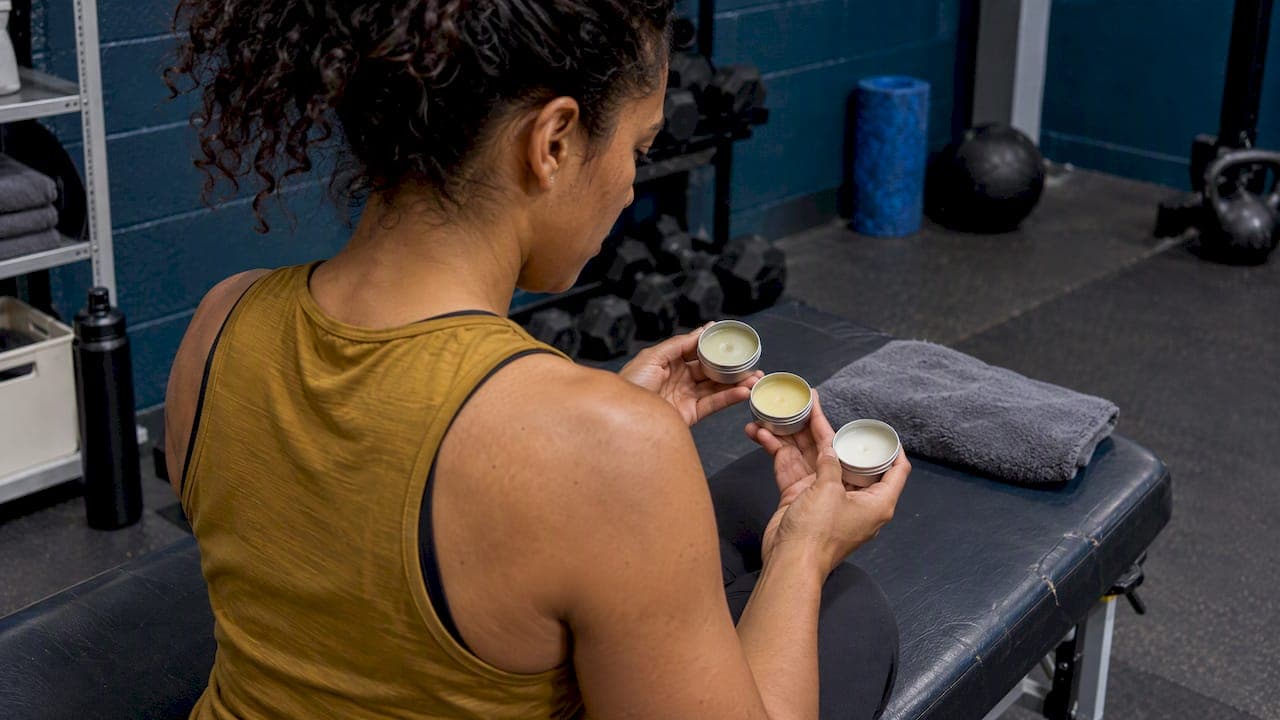
Broad-spectrum CBD topicals contain several hemp cannabinoids with THC removed. Isolate topicals contain CBD and little else. That is the core difference. For a balm, the choice comes down to three things: whether you want more than one cannabinoid, whether you need zero THC, and whether the label can be trusted. This guide covers each.
TL;DR
- Broad spectrum: multiple hemp compounds, THC removed to nondetectable levels. Isolate: more than 95% CBD, per a 2024 product analysis.
- Neither type is approved by the FDA to treat pain. Human evidence on topical CBD is still early and mixed.
- Label accuracy matters more than the type. Check for a current certificate of analysis (COA) from an independent lab.
- Athletes who are drug tested, and anyone pregnant or breastfeeding, should treat THC exposure as a safety issue, not a preference.
- Other ingredients in a balm, such as arnica or menthol, often shape how it feels as much as the CBD type does.
Table of Contents
- What the terms mean in a topical
- Broad spectrum vs isolate at a glance
- Does one type work better for pain?
- Why the rest of the formula matters
- Label accuracy: the bigger risk
- Who should care most about THC-free
- Which one should you pick?
- Our view
- Try a THC-free balm
- Regulation: what to know in the U.S.
- FAQ
- Sources
What the terms mean in a topical
Three labels appear on CBD balms: full spectrum, broad spectrum and isolate. Full spectrum keeps the whole hemp extract, including trace THC. Under the 2018 Farm Bill, hemp is cannabis and its derivatives with no more than 0.3% THC on a dry-weight basis. So a full-spectrum product may contain small amounts of THC.
Broad spectrum sits in the middle. According to a 2024 labeling and contamination analysis, broad-spectrum products come from hemp extract, include multiple cannabinoids, and have THC reduced to nondetectable levels during post-processing. Isolate goes further. The same analysis describes isolate products as containing more than 95% CBD.

This article compares the two THC-free options, since that is what the keyword asks. Full spectrum is covered in our longer guide, isolate vs full spectrum topical.
Broad spectrum vs isolate at a glance
| Factor | Broad spectrum | Isolate |
|---|---|---|
| Cannabinoids | Several, from hemp extract | CBD almost alone (more than 95%) |
| THC | Removed to nondetectable levels | Not part of the product |
| Other hemp compounds | Some retained | Largely removed |
| Scent and feel | Can carry a mild hemp note | Usually more neutral |
| Best fit | Readers who want a wider hemp profile without THC | Readers who want the simplest, most predictable formula |
| Main check | COA showing THC as not detected | COA showing CBD content and purity |
"Nondetectable" is a lab result, not a promise built into the name. A label that says broad spectrum should be backed by a COA that shows the THC line. More on that below.
Does one type work better for pain?
The honest answer: no study has settled it for topicals.
Some sites claim that the combined effect of several cannabinoids (the "entourage effect") makes broad spectrum stronger. The idea is popular in the CBD industry. We did not find a human trial that tests broad spectrum against isolate in a balm head to head, so we do not claim a winner.
What the human research on topical CBD does show is limited and varied:
- A randomized, double-blind, placebo-controlled pilot study found no significant effect of CBD cream on muscle recovery after exercise.
- A 2019 trial in Poland saw lower pain intensity and less masseter muscle activity in people with temporomandibular disorders who used a topical CBD formulation.
- In a pilot study, topical CBD was tolerated, with minor effects such as skin dryness and rash.
- The FDA has not approved cannabinoid products, including topicals, to treat pain or any other medical condition, as a 2024 review in the Journal of Pain notes. Its authors advise relying on evidence-based sources, not advertisements.
So treat any CBD balm as a personal trial, not a sure thing. Our posts on topical CBD for weightlifters and muscle knots walk through what human data exists and how to run a fair two to three week test.
Why the rest of the formula matters
A balm is not only CBD. Our balms use 1,000mg of CBD per ounce plus botanicals such as arnica, menthol, turmeric, eucalyptus, peppermint, cinnamon, clove, ginger and cayenne pepper. Those ingredients change the experience on the skin: cooling, warming, scent, texture.
This makes comparisons between two balms tricky. If one balm feels better than another, the cannabinoid type may not be the reason. A cooling sensation from menthol is not proof that CBD is working. We cover that in warming vs. cooling CBD and in our piece on arnica and menthol for pain.
A fair test changes one thing at a time. Use one balm, in the same spot, for a set period, and note the results.
Label accuracy: the bigger risk
The type on the front of the tin tells you little if the amount inside is wrong. Research on topicals has found real gaps.
In a 2022 case series of 105 topical cannabinoid products, 76% of the 89 products that listed CBD amounts were inaccurately labeled. The 2024 analysis also noted that topicals were more likely than other formats, such as gummies or vapes, to contain more than the labeled potency.
The FDA adds a wider caution. Products may contain THC, pesticides, heavy metals, bacteria or fungi, as FDA consumer guidance explains. The agency also treats cannabis-derived products as subject to the same regulatory requirements as other products it oversees, even when they count as hemp.

How to read a COA
A certificate of analysis is the lab report for a specific batch. Use this checklist:
- Lab and date. The report should come from an independent lab and match the batch number on your tin.
- CBD content. Compare the tested amount with the label claim. Large gaps in either direction are a red flag.
- THC line. For broad spectrum, look for THC listed as not detected. For isolate, the same.
- Contaminants. Look for pesticide, heavy metal and microbial panels.
- Access. A brand that makes the report easy to find is easier to trust.
For a deeper walkthrough, this guide on reading CBD lab reports and certificates of analysis explains each section of a typical report.
Who should care most about THC-free
For many readers, the broad spectrum vs isolate question is really a THC question.
- Drug-tested athletes. Even small THC exposure can be a concern. A product with a COA showing no detectable THC removes one variable. Our post on pregnancy, athletes and THC-free topical CBD goes into the risks of products that are labeled THC free but are not verified.
- Pregnant or breastfeeding. The FDA strongly warns against using CBD during pregnancy or while breastfeeding. Talk to your obstetrician or midwife before using any CBD product.
- People on medication or with skin conditions. Ask a doctor or pharmacist first. Patel and Lio note that topical absorption may differ from oral use and that unregulated products make THC exposure hard to assess.
Patch test any new balm on a small area of skin first. Stop use if a rash or irritation appears.
Which one should you pick?
Use this short framework.
- Start with THC. If you need zero THC, both broad spectrum and isolate fit. Confirm with a COA.
- Choose by preference. Want a wider hemp profile? Broad spectrum. Want the plainest formula? Isolate.
- Check the dose. Compare milligrams of CBD per ounce or per tin, not marketing words.
- Read the full ingredient list. Botanicals shape the feel of the balm.
- Run a time-limited trial. Two to three weeks, one product, one area, notes each day.
- Protect yourself. Look for a refund policy so a trial carries less risk.
Perspective
Our view
We make balms for people who train hard and people who live with daily aches. Both groups ask us the same thing: which type of CBD is better?
Our answer is that the label word is only part of it. We build each balm around 1,000mg of CBD per ounce, with arnica, menthol and other botanicals chosen for how they feel on sore muscles and stiff joints. Our products are THC-free, vegan, non-GMO, paraben-free and cruelty-free. The formula as a whole is what we stand behind.
We also think a balm should earn its place. That is why we test with third parties, and why we offer a full refund within 30 days of purchase. If it does not work for you, you get your money back.
Read the COA. Ask hard questions. Then try it on your own body.
Cindy
Try a THC-free balm
Our Seriously Soothing Pain Balm and RIKKI TIKKI Recovery are priced from $26.95 to $39.95, depending on size. The balms are made for sore muscles, post-workout recovery and arthritis discomfort. The Original Seriously Soothing Pain Balm is a good first pick.
Every order is covered by our 30-day full refund policy. If you are weighing balms against a menthol rub, see our comparison of Icy Hot alternatives for muscle soreness and arthritis.
Regulation: what to know in the U.S.
The 2018 Farm Bill removed hemp containing less than 0.3% delta-9 THC from the federal controlled substances list. That made hemp-derived CBD products legal to sell at the federal level in many forms. It did not create an FDA approval path for topical pain claims.
The FDA notes that CBD was not considered under the over-the-counter drug review, and that unapproved new drugs cannot be sold in interstate commerce. In practice, that is why reputable CBD brands describe balms as supporting comfort and recovery, not as treatments. It is also why the pharmacopeia group USP supports uniform national quality standards for cannabis-derived products. State rules differ, so check your own state's requirements.
FAQ
Is CBD isolate stronger than broad spectrum in a topical?
Not necessarily. Strength depends on the milligrams of CBD in the product and how it is formulated. Isolate is more than 95% CBD, while broad spectrum holds several cannabinoids. Compare the CBD amount on the COA, not the type name.
Does CBD isolate help with muscle soreness?
The evidence is limited. One placebo-controlled pilot study found no significant effect of CBD cream on muscle recovery, and a 2019 trial saw reduced pain in a jaw muscle disorder. Try a balm for two to three weeks and track how you feel.
Will a broad-spectrum balm show up on a drug test?
A properly made broad-spectrum product has THC removed to nondetectable levels, but labels can be wrong. Check that the batch COA lists THC as not detected. If you are tested for work or sport, ask your testing body before using any CBD product.
Is broad spectrum the same as THC free?
In most cases the goal is the same, since THC is removed to nondetectable levels during processing. The lab report is the proof. A product can only be called THC free with confidence when the COA for that batch shows it.
Can I use a CBD balm while pregnant?
The FDA strongly warns against CBD use during pregnancy and while breastfeeding. Speak with your doctor or midwife before using any CBD balm.
Sources
- Product labeling accuracy and contamination analysis, 2024 (PMC)
- Cannabinoid content and label accuracy of hemp-derived topicals, 2022 (PMC)
- Topical cannabidiol application and muscle recovery pilot study (PubMed)
- Myorelaxant effect of transdermal cannabidiol application (PMC)
- Topical cannabidiol is well tolerated (PMC)
- Cannabidiol (CBD) products for pain (Journal of Pain)
- Hemp production and the 2018 Farm Bill (FDA)
- FDA guidance on cannabis and CBD during pregnancy or breastfeeding
- FDA regulation of cannabis and cannabis-derived products
- Safety and sourcing of topical cannabinoids (PMC)
- USP policy position on cannabis-derived products, 2024
- How to read CBD oil lab reports and certificates of analysis