
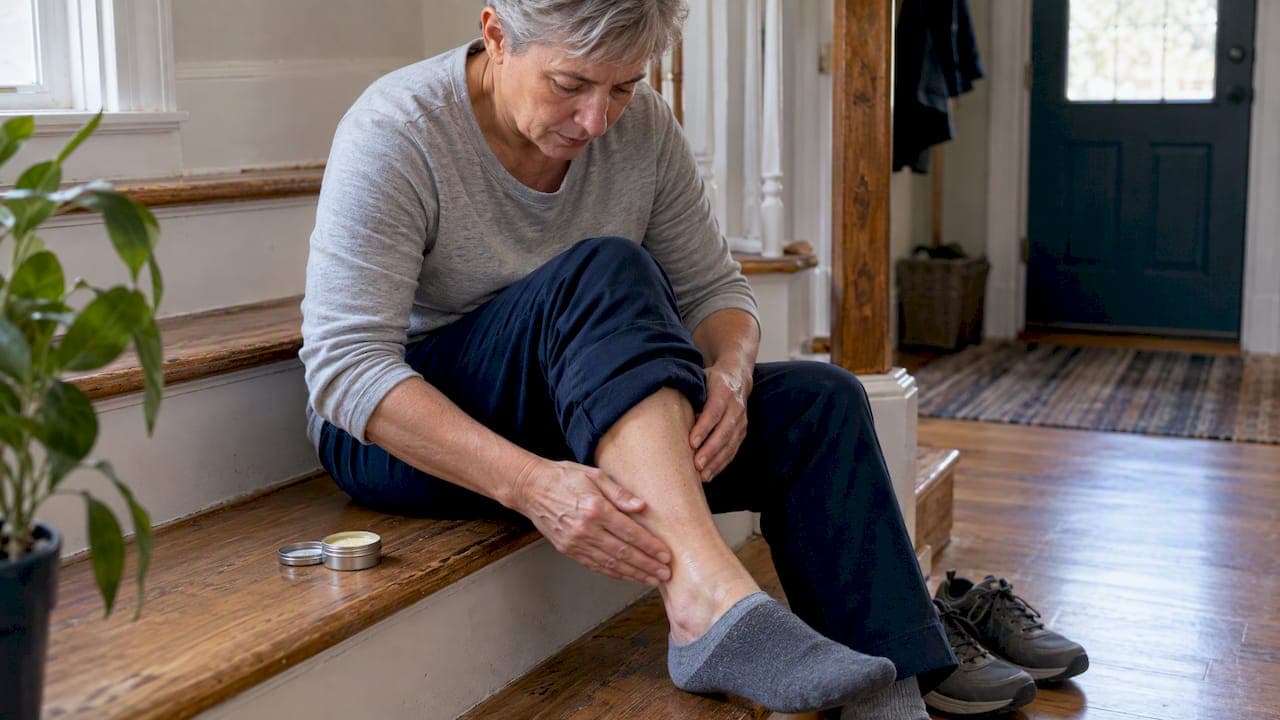
Current trials do not prove that oral or systemic CBD reliably reduces arthritis pain, but a short topical CBD trial is a reasonable, low-risk step for many people with ankle arthritis when done alongside a clinician's guidance. Patient surveys report meaningful relief, though that data is self-reported. A topical balm, applied directly to the joint for two to six weeks, is where the evidence and the risk profile line up best.
TL;DR:
- Controlled knee osteoarthritis trials found no significant pain advantage from oral CBD, while a user survey’s 83% improvement was self reported, not placebo controlled.
- Apply balm twice daily for two to six weeks, track pain and daily tasks, and reassess at weeks two and four for meaningful change.
- People taking warfarin, corticosteroids, tramadol, gabapentin, or certain antidepressants should consult a clinician first, because CBD may alter medication levels through liver enzymes.
- Choose a balm with independent lab testing and a Certificate of Analysis, and use CBD alongside physical therapy and supportive footwear, not instead of them.
- Balms may also contain menthol, capsaicin, or arnica, which can ease discomfort independently, so relief cannot automatically be attributed to CBD alone.
Table of Contents
- What clinical studies and surveys show about CBD for arthritis pain
- How CBD may work to reduce joint pain and why that doesn't guarantee relief
- Why topical balms are usually the first choice for ankle pain
- Known risks: side effects, liver signals, and medication interactions
- A simple 2 to 6 week topical CBD trial you can follow for ankle arthritis
- Why you can trust this guidance
- What people with ankle arthritis say about trying CBD
- Where CBD fits in long-term ankle arthritis care
- Recommended topical options from Mongoose CBD Co.
- FAQ
- Sources
What clinical studies and surveys show about CBD for arthritis pain
The clinical picture is mixed, and the direction of that mix matters. Randomized controlled trials testing oral CBD have not found it superior to placebo for joint pain, while observational surveys of real-world users report much larger improvements.
- A randomized, double-blind trial testing oral CBD added to paracetamol for chronic knee osteoarthritis found no significant pain benefit over placebo after 8 weeks of 600 mg daily dosing, along with more adverse events and liver enzyme increases in the CBD group.
- The CANOA trial, a separate double-blind study of a CBD-rich cannabis oil in knee osteoarthritis, found no statistically significant difference between the oil and placebo on pain scores after 60 days.
- An exploratory cross-sectional study of CBD users reported a far different picture: 83% of respondents reported improvement, with an average 44% reduction in pain scores.
That 44% figure comes from a self-reported survey, not a controlled trial, which means it reflects what users believed happened rather than a measured effect against placebo.
Putting the two types of evidence side by side tells a consistent story. Controlled trials, which account for placebo response and measurement bias, have not shown oral CBD outperforming an inactive substance for osteoarthritis pain. Surveys, which capture what people experience in daily life but can't rule out placebo effect, expectation bias, or selective reporting, show substantial self-rated benefit. Neither result cancels out the other. It means systemic CBD doesn't yet have trial-level proof behind it as an arthritis analgesic, while real-world reports suggest enough people feel better that the question remains worth exploring, especially through topical use, where the evidence base is thinner but the systemic risk is lower too.

How CBD may work to reduce joint pain and why that doesn't guarantee relief
CBD interacts with the body's endocannabinoid system, a network of receptors involved in regulating pain signaling and inflammatory response. Preclinical research suggests CBD may influence these pathways, which is the basis for most of the anti-inflammatory and pain-modulating claims made about it.
- CBD is thought to interact with receptors involved in pain perception and inflammatory signaling, based mainly on animal and laboratory studies rather than large human trials.
- The "entourage effect" describes the idea that whole-plant cannabis extracts, containing multiple cannabinoids and terpenes, may behave differently than isolated CBD alone, though this remains a hypothesis more than a settled finding.
- Topical balms rarely contain CBD by itself. Ingredients like menthol, capsaicin, and arnica have their own independent track records for easing muscle and joint discomfort, which makes it hard to credit CBD alone for any relief felt.
That last point deserves attention before anyone assumes a balm's effect is entirely CBD-driven. A product with menthol and capsaicin plus CBD could work well simply from the other ingredients, the CBD, or some combination. The mechanism matters less than whether a specific product helps a specific joint, which is why a measured trial beats guessing from theory.
Pro Tip: Track which balm ingredients you're using alongside CBD, since isolating what's actually helping takes a little record-keeping.
Why topical balms are usually the first choice for ankle pain
CBD comes in several forms, oral capsules, sublingual oils, topical balms, and inhaled products, and each behaves differently once it enters the body. For a joint as localized as the ankle, the differences matter more than they might for a whole-body condition.
- Oral CBD passes through the digestive system and liver before reaching circulation, which means slower onset, inconsistent absorption, and the liver enzyme concerns seen in trial data.
- Sublingual oil absorbs faster than oral capsules since it bypasses some digestion, and the Arthritis Foundation suggests starting at low doses (5 to 10 mg twice daily) if trying this route.
- Topical balms stay largely local to the application site, with minimal systemic absorption, which lowers the risk of the liver and drug interaction concerns tied to oral dosing.
- Inhaled CBD has the fastest onset but the least relevant role for a chronic joint condition, since effects fade quickly and repeated inhalation carries its own respiratory considerations.
For an ankle specifically, a topical balm puts the product exactly where the joint is inflamed, without routing it through the liver first. Clean the skin before applying, use a dime to nickel-sized amount depending on the balm's concentration, and massage it into the ankle and surrounding tissue for 30 to 60 seconds to help absorption. Reapply twice daily, and avoid applying to broken skin or open wounds.
Known risks: side effects, liver signals, and medication interactions
Safety data on CBD comes mostly from oral dosing in trials, and it is worth taking seriously before assuming topical use carries the same profile. The knee osteoarthritis trial testing oral CBD at 600 mg daily found adverse events in 56% of the CBD group versus 44% on placebo, along with more frequent liver enzyme elevations.
FDA-reviewed trial communications echo concerns about safety, noting liver enzyme elevations tied to therapeutic CBD doses and recommending monitoring where higher doses are used.
- CBD is metabolized through the liver's cytochrome P450 enzyme system, the same pathway many common medications use, which can raise or lower drug levels unpredictably.
- Anyone taking warfarin, corticosteroids, tramadol, gabapentin, or certain antidepressants should check with a clinician before adding CBD in any form, since interactions through this pathway are plausible even with topical products in some formulations.
- Choose products with third-party lab testing and request the Certificate of Analysis, which should confirm CBD content per unit and screen for contaminants.
- Starting topical before oral, as the Arthritis Foundation and Harvard Health both suggest, keeps systemic exposure low while you gauge whether CBD helps at all.
- Report any unusual symptoms, fatigue, appetite changes, or signs of liver irritation, to a healthcare provider promptly.
A simple 2 to 6 week topical CBD trial you can follow for ankle arthritis
A structured trial beats an open-ended "try it and see" approach, mainly because it gives you a clear answer either way.
- Set a baseline. Before starting, rate your ankle pain on a 0 to 10 scale, note which daily tasks are hardest (stairs, standing, walking distance), and list current medications to review with your clinician.
- Apply consistently. Use a topical CBD balm twice daily on the ankle for 2 to 6 weeks, and keep a short symptom diary noting pain level, stiffness, and any side effects.
- Check in at set points. Reassess at 2 weeks and again at 4 weeks using the same pain scale and task list. If there's no meaningful change by week 4, it's reasonable to stop and discuss other options with your clinician; if pain worsens or new symptoms appear, stop and seek medical advice sooner.
Pro Tip: Write your baseline numbers down somewhere you won't lose them. Memory of "how bad it was" shifts once you start feeling even slightly better.
Why you can trust this guidance
We built this guidance around the clinical trials, survey data, and patient-facing resources cited throughout, including the Arthritis Foundation and Harvard Health, rather than marketing claims. We specialize in topical balms formulated for pain relief and muscle recovery, and every purchase carries a 30-day refund window if a product doesn't work for you.
When reviewing any topical CBD product, look for a Certificate of Analysis that lists CBD content per unit and confirms the absence of contaminants, and favor brands that make that documentation easy to find.
What people with ankle arthritis say about trying CBD
Reports from people using CBD for joint pain tend to follow a pattern: modest, gradual relief rather than dramatic change. In the exploratory survey of CBD users, most respondents described improvements in pain, function, and sleep quality rather than complete resolution of symptoms, and a meaningful share specifically cited ankle pain among their affected joints.
This pattern lines up with what a topical trial is designed to test. Someone applying a balm to a stiff ankle each morning before walking the dog might notice less soreness by the second week, or notice nothing at all by week four. Both outcomes are useful information, not a failure of the product.
What's worth taking from these accounts isn't a promise of relief but a realistic expectation: some people feel a noticeable difference, some feel a small one, and some feel none. Framing a topical CBD trial as a personal experiment, with a defined start and end point, keeps expectations honest and makes the result actually mean something when you stop and ask whether it helped.
Where CBD fits in long-term ankle arthritis care
CBD, topical or otherwise, works best as one piece of a broader plan, not a replacement for physical therapy, supportive footwear, or medical treatment when the joint needs it. Shared decisions with a podiatrist, physical therapist, or rheumatologist still matter most, and benefits from CBD tend to be modest and gradual rather than dramatic.
— Cindy
Recommended topical options from Mongoose CBD Co.
A topical-first trial is only as good as the balm you're using, and that's the gap our Seriously Soothing Pain Balm and RIKKI TIKKI Recovery are built to fill. Both combine CBD with botanicals like arnica, menthol, and turmeric, formulated for joint and muscle discomfort, and both are vegan, non-GMO, and THC-free.
These formulations fit the exact trial protocol outlined above: apply topically, track your results over two to six weeks, and judge for yourself. Orders come with a refund window, so testing a balm on your ankle carries little financial risk. Browse the full product lineup to find the option that matches your routine.
This article is general information, not a substitute for advice from a qualified doctor. Consult a qualified healthcare professional about your own circumstances before acting on anything here.
FAQ
How can I treat ankle arthritis?
Conservative care usually comes first: physical therapy, supportive footwear like rocker-bottom shoes, and orthotics, with injections or surgery considered only when nonsurgical options haven't helped enough. A topical CBD balm can be added as a low-risk adjunct alongside these core treatments, not in place of them.
What is the best CBD for severe arthritis pain?
There's no single product proven best for severe arthritis pain, since controlled trials haven't shown oral or topical CBD to be a reliable standalone solution. A topical balm with third-party testing and a clear ingredient list is a reasonable starting point to test under a clinician's guidance, especially for localized joint pain.
What are some natural remedies for arthritis in the ankles?
Physical therapy, weight management, supportive footwear, and topical anti-inflammatory options like balms containing arnica or menthol are common non-drug approaches. Topical CBD balms may be worth trying alongside these, given their low systemic risk compared to oral options.
Is walking good for ankle arthritis?
Gentle, regular walking supported by proper footwear and orthotics can help maintain joint mobility and function, which is why physical therapy and activity modification are typically recommended as first-line care. Pushing through sharp pain or ignoring swelling after activity isn't advisable, so pacing activity based on your symptoms matters.
Sources
- Cannabidiol as a treatment for arthritis and joint pain - PMC
- Oral cannabidiol (CBD) as add-on to paracetamol for painful chronic osteoarthritis of the knee - The Lancet Regional Health – Europe
- Effects and safety of a CBD-rich Cannabis sativa oil in knee osteoarthritis: CANOA trial (Frontiers)
- CBD for Arthritis Pain: What You Should Know - Arthritis Foundation