
Yes, you can fly domestically with CBD cream. That threshold, established by the 2018 Farm Bill, is the federal dividing line between legal hemp and controlled marijuana. TSA's own guidance confirms hemp-derived CBD products meeting that threshold are permitted in both carry-on and checked baggage.
Before you pack, here's what to confirm:
- THC content: Product must be hemp-derived and ≤0.3% THC, verified by a third-party Certificate of Analysis (COA).
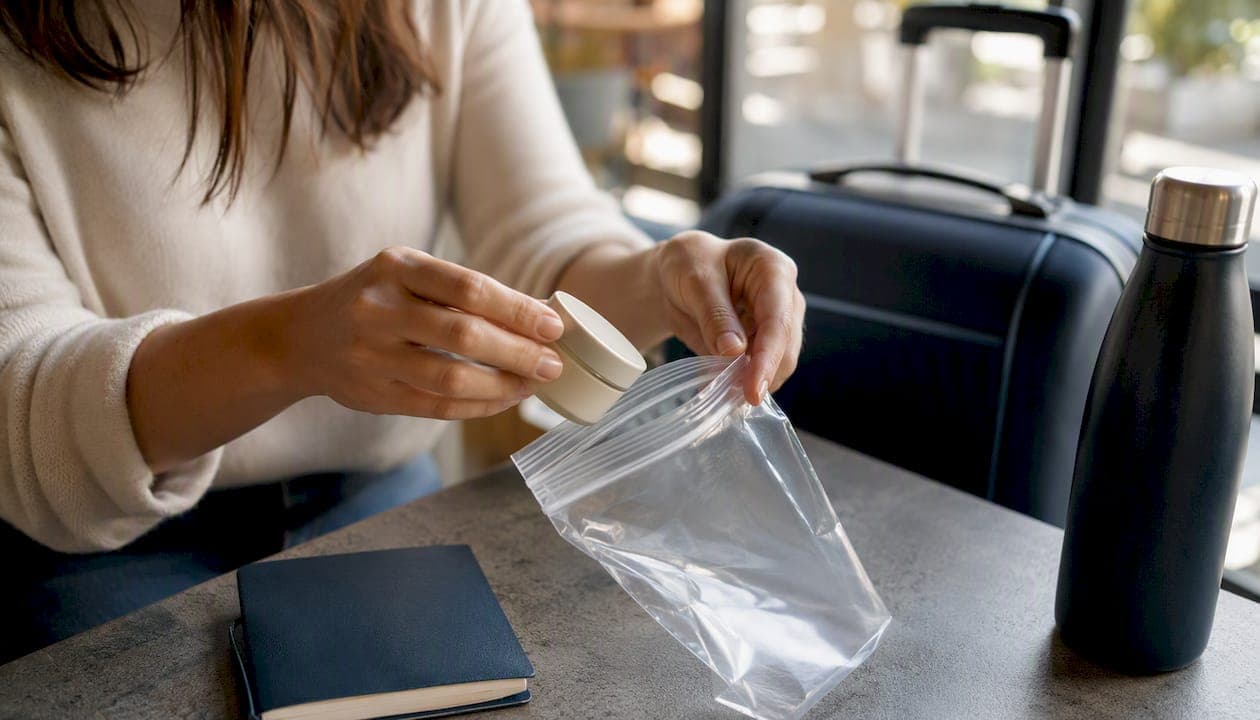
- Carry-on size: Any cream, lotion, or balm that flows or spreads counts as a liquid. Containers must be small and fit within the TSA liquids limit, all fitting in one quart-sized bag.
- Larger containers: Anything beyond the liquid carry-on size limits goes in checked luggage, no exceptions.
- Documentation: Keep the original labeled packaging and your COA accessible, not buried at the bottom of your bag.
The TSA's role is threat detection, not drug enforcement. Officers who spot something suspicious refer it to law enforcement. That's why the paperwork matters.
Key Takeaways
| Point | Details |
|---|---|
| Verify THC with a COA | Confirm ≤0.3% THC on a third-party lab report before every trip. |
| Follow the 3-1-1 rule | Carry-on creams must be in containers ≤3.4 oz; larger sizes go in checked luggage. |
| Check state and layover laws | Federal compliance doesn't override destination or transit state restrictions. |
| International travel is higher risk | Many countries ban CBD regardless of THC content; check customs rules before packing. |
| Mongoosecbd balms are travel-ready | THC-free, third-party tested, and available in carry-on-legal 2 oz sizes with COA access. |
Table of Contents
- What does the TSA actually say about CBD at checkpoints?
- How the 3-1-1 rule applies to creams, balms, and lotions
- What is the federal legal line between hemp CBD and marijuana?
- How state laws and layovers change your risk
- How to use a COA, labeling, and receipts to document compliance
- What happens if TSA or law enforcement flags your CBD cream?
- Why international travel with CBD cream is a different risk entirely
- Can airport dogs or scanners detect CBD in a cream?
- Step-by-step packing checklist for flying with CBD cream
- Mongoosecbd's approach to travel-ready topical CBD
- Travel-friendly balm that clears TSA checks
- Sources
What does the TSA actually say about CBD at checkpoints?
TSA's official guidance draws a clear line: hemp-derived CBD products containing no more than 0.3% THC are permitted in carry-on and checked bags. Marijuana and most cannabis products with higher THC remain prohibited. When officers encounter something they believe may be an illegal substance, they refer the matter to law enforcement. TSA does not test products on the spot.
There is no special declaration process for CBD at a checkpoint. You don't announce it, fill out a form, or request a separate lane. Treat your CBD cream the same way you'd treat any other lotion or balm: pack it within the liquids rules, keep the label visible, and have your COA within reach if a question comes up. The final call at any checkpoint belongs to the officer in front of you, regardless of what the policy says in writing.
How the 3-1-1 rule applies to creams, balms, and lotions
The TSA liquids rule is straightforward: carry-on containers must hold 3.4 fl oz (100 ml) or less, and all of them must fit inside a single quart-sized, clear, resealable bag. Creams and gels fall under this rule. Balms that squeeze or spread are treated as liquids.
3-1-1 at a glance: A limited volume per container, placed inside a single quart-sized bag, with one bag permitted per traveler.
There's a useful exception worth knowing. Solid balm sticks — the kind that don't flow, don't squeeze, and hold their shape like a stick of deodorant — are generally treated as solids, not liquids. That means a firm balm stick may not be subject to the 3.4 oz volume cap in carry-on. A soft cream in a jar, by contrast, is a liquid by TSA's physical-state test regardless of how thick it feels.
| Product Form | Carry-On Rule | Checked Bag |
|---|---|---|
| Cream or lotion (jar/tube) | ≤3.4 oz, in quart bag | Any size allowed |
| Soft gel or squeeze balm | ≤3.4 oz, in quart bag | Any size allowed |
| Solid balm stick | Treated as solid, no volume cap | Any size allowed |
| Spray or aerosol | ≤3.4 oz, in quart bag | Size limits apply |
If you're traveling with a full-size jar, the simplest move is to put it in your checked bag. Decanting into a travel-sized container under 3.4 oz for carry-on is also fine, as long as the container is clearly labeled.
What is the federal legal line between hemp CBD and marijuana?
Under the 2018 Farm Bill, hemp is defined as cannabis containing no more than 0.3% THC on a dry-weight basis. Anything above that is marijuana, a Schedule I controlled substance under federal law.
The threshold: 0.3% THC (dry-weight) separates federally legal hemp from federally controlled marijuana.
For a topical CBD cream, this means:
- Check the label: Look for "hemp-derived" and a THC percentage or "THC-free" claim.
- Verify with a COA: A Certificate of Analysis from an accredited third-party lab shows the actual tested THC percentage, batch number, and testing date. This is the document that proves compliance.
- Understand the risk above 0.3%: A product that tests over the threshold is legally marijuana under federal law. At a TSA checkpoint, that means potential confiscation and referral to law enforcement, regardless of what the label says.
Laboratory chemical testing is the only reliable way to confirm THC percentage. A label alone is not proof. A COA from an ISO-accredited lab is.
How state laws and layovers change your risk
Federal permission at a TSA checkpoint doesn't protect you once you leave the secure area. State cannabis and CBD laws vary significantly across the U.S., and some states still restrict hemp-derived CBD products in ways that conflict with federal standards.
The layover problem is real and often overlooked. If your connecting flight lands in a state with stricter CBD rules, you're subject to that state's law the moment you exit the secure zone, even if you never intended to stay. A product that's perfectly legal in California may create a problem in a state with tighter restrictions.
Before you travel:
- Check your destination state's rules. The NCSL's state medical marijuana law tracker is a reliable starting point.
- Check every layover state. Even a 90-minute connection counts if you leave the secure area.
- Look up airline policies. Some carriers have their own restrictions on cannabis-derived products beyond TSA rules.
- International flights are a separate category entirely (covered below).
Pro Tip: Search "[state name] hemp CBD possession law" on your state's official .gov site before any trip. NCSL's tracker covers medical marijuana but may not capture every nuance of hemp-specific rules, so going to the primary source is worth the extra two minutes.
How to use a COA, labeling, and receipts to document compliance
A Certificate of Analysis is a lab report issued by an independent, accredited testing facility. It shows the exact cannabinoid profile of a specific product batch, including the THC percentage. For travel purposes, it's the closest thing you have to proof that your cream is federally compliant.
Consumer travel guidance consistently recommends carrying a COA alongside original labeled packaging. Here's what to look for in a COA:
- THC percentage: Must show ≤0.3% for hemp compliance.
- Batch or lot number: Should match the batch number on your product packaging.
- Testing date: Recent tests (within the past year) carry more weight.
- Lab accreditation: Look for ISO 17025 accreditation or equivalent.
Pack these documents together and keep them accessible, not in a checked bag:
- Original product packaging with "hemp-derived" labeling
- Printed COA or a QR code linking to it on your phone
- Purchase receipt (shows legal point of sale)
At the checkpoint: If an officer asks about your cream, stay calm, state that it's a hemp-derived topical with under 0.3% THC, and offer the COA. You are not required to volunteer this information unprompted, but having it ready shortens any secondary inspection significantly.
For products with added ingredients like menthol, camphor, arnica, or eucalyptus, the same rules apply. Those ingredients don't change the federal classification. What matters is the THC percentage. The COA covers the whole formulation. For more on how topical ingredients like clove oil interact with CBD balms, the Mongoosecbd blog on clove oil for pain covers the specifics.
What happens if TSA or law enforcement flags your CBD cream?
Most encounters end quickly when you have documentation. But knowing the range of outcomes helps you stay calm if something goes sideways.
Possible outcomes, roughly in order of likelihood:
- Brief secondary inspection and release (most common when labeling is clear)
- Confiscation of the product without further action
- Referral to airport law enforcement for review
- Detention and questioning (rare, typically when THC content is ambiguous or high)
- Arrest (uncommon, but possible if the product tests above 0.3% THC in a state with strict laws)
If your item is flagged, do this:
- Stay calm and cooperative. Arguing with a TSA officer at a checkpoint accomplishes nothing.
- Present your COA and original packaging immediately.
- Ask clearly whether you are free to go or being detained.
- If law enforcement gets involved, comply with directions and say nothing beyond identifying yourself until you've spoken with an attorney.
- If your property is confiscated without arrest, ask for a receipt or documentation of the seizure.
- To challenge a seizure afterward, contact the TSA Contact Center or consult an attorney familiar with federal hemp law.
The referral process is straightforward: TSA hands the matter to airport police or local law enforcement, who then apply state law. That's why state law matters even at a federal checkpoint.
Why international travel with CBD cream is a different risk entirely
Domestic flights operate under U.S. federal law. International flights do not. The moment you cross into another country's customs jurisdiction, U.S. hemp law is irrelevant.
Many countries classify any cannabis-derived product, regardless of THC content, as a controlled substance. Possession at customs can result in confiscation, fines, or criminal charges.
Before flying internationally with any CBD product:
- Research the destination country's law. Some countries (Japan, UAE, Singapore) have zero-tolerance policies for cannabis-derived products, including topicals with trace THC.
- Check transit countries too. A layover in a country with strict drug laws can expose you to that country's enforcement even if you stay airside.
- Review your airline's policy. Some carriers prohibit cannabis-derived products in carry-on regardless of THC content.
- Consider shipping ahead if the destination country permits it, or purchasing locally if legal options exist there.
- When in doubt, leave it home. A CBD balm is not worth a customs detention in a foreign country.
The safest default for international travel: check the U.S. Embassy page for your destination and the destination country's customs authority directly. General travel blogs are not reliable sources for foreign drug law.
Can airport dogs or scanners detect CBD in a cream?
X-ray machines don't identify chemical compounds. They show shapes, densities, and material categories. A jar of CBD cream looks like a jar of any other cream on an X-ray screen. The scanner flags the container size or unusual density, not the CBD itself.
Sniffer dogs are a different matter. Drug-detection dogs are trained to alert on specific odor signatures, and cannabis has a recognizable scent profile. Some dogs are trained specifically for cannabis odors and may alert to hemp-derived products, particularly those with strong botanical ingredients like eucalyptus, peppermint, or camphor. An alert from a dog doesn't confirm illegal content; it triggers a human inspection.
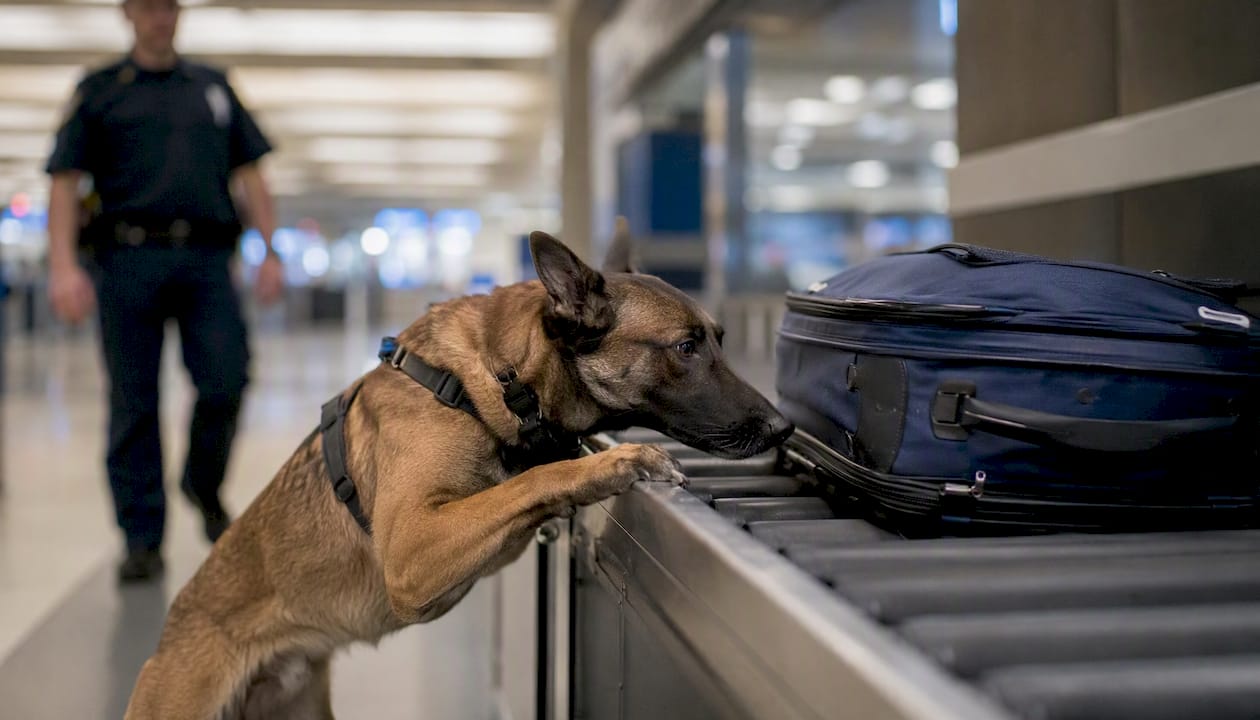
Chemical testing is the only method that can determine actual THC percentage. TSA officers don't carry field test kits for cannabinoids. If law enforcement gets involved after a dog alert or a visual inspection, they can seize the product and send it to a lab. That process takes time and creates delays you'd rather avoid.
Practical takeaway: clear labeling and a COA won't stop a dog from alerting, but they will shorten the human inspection that follows.
Step-by-step packing checklist for flying with CBD cream
Follow these steps before every flight where you're bringing a topical CBD product.
- Verify THC content. Pull up the COA for your specific product batch and confirm THC is ≤0.3%.
- Check container size. If the container is over 3.4 oz (100 ml), it goes in checked luggage. Period.
- Transfer if needed. For carry-on, decant into a clearly labeled travel container at or under 3.4 oz.
- Keep original packaging. The original label with "hemp-derived" language is part of your documentation.
- Print or download your COA. A printed copy is more reliable than a phone screen at a checkpoint. A QR code on your phone works as backup.
- Pack your receipt. A purchase receipt from a reputable retailer shows legal point of sale.
- Place documents together. Keep COA, receipt, and packaging in an outer pocket of your carry-on for quick access.
- Check state laws for destination and layovers. Use NCSL or official state .gov sites.
- Check your airline's policy. Search "[airline name] CBD policy" on the carrier's official site.
- For international flights: Verify destination country customs rules and transit country rules before packing anything.
Additional notes on quantity:
- Carry only what's reasonable for personal use during your trip. A single jar or travel tin raises no eyebrows. Multiple large containers may invite questions about intent.
- Vaping devices with CBD oil follow separate TSA rules: batteries must go in carry-on (not checked bags), and liquids still apply to the oil cartridge.
Pro Tip: Placing larger CBD items in checked baggage rather than carry-on reduces checkpoint friction significantly. If you're traveling with more than one product, checked bags are the lower-stress option.
Mongoosecbd's approach to travel-ready topical CBD
Mongoosecbd formulates every balm with third-party lab testing and clear "hemp-derived" labeling as standard, not an afterthought. The brand's products, including the Seriously Soothing Pain Balm, are THC-free and made with natural pain-relieving ingredients like arnica, menthol, turmeric, and eucalyptus. For travelers using topical CBD for chronic pain or arthritis, the evidence on CBD for rheumatoid arthritis is worth reading before your trip.
If you need a COA for a specific product batch before travel, Mongoosecbd makes that documentation available. The 30-day refund policy reflects the brand's confidence in what's inside every tin. For product questions before a flight, the Mongoosecbd blog covers ingredients, testing, and usage in detail.
Travel-friendly balm that clears TSA checks
The Rikki Tikki Recovery balm comes in a 2 oz tin, which puts it well under the 3.4 oz carry-on limit. It's third-party tested, THC-free, and labeled hemp-derived. The COA is available on the product page, so you can print it before you leave.
For athletes and chronic pain sufferers who don't want to go a week without their recovery routine, this is the practical answer: a carry-on-legal size, clear documentation, and a formulation built around arnica, menthol, and eucalyptus for real muscle relief. The Seriously Soothing Pain Balm in Eucalyptus Mint is another carry-on-friendly option in the same line. Order before your trip, download the COA from the product page, and pack with confidence.
Sources
These are the primary references to consult for any enforcement or policy questions:
- Medical Marijuana | Transportation Security Administration - TSA
- Hemp production and the 2018 Farm Bill - FDA congressional testimony
- CBD and Travel: Your FAQs Answered - Healthline
- Cannabidiol (CBD) review - PMC
This article provides general information about TSA regulations and federal law. It is not legal advice. Confirm current rules with official sources or a qualified attorney before travel, particularly for international itineraries or states with specific CBD restrictions.
This article is general information, not a substitute for advice from a qualified lawyer. Consult a qualified legal professional about your own circumstances before acting on anything here.