
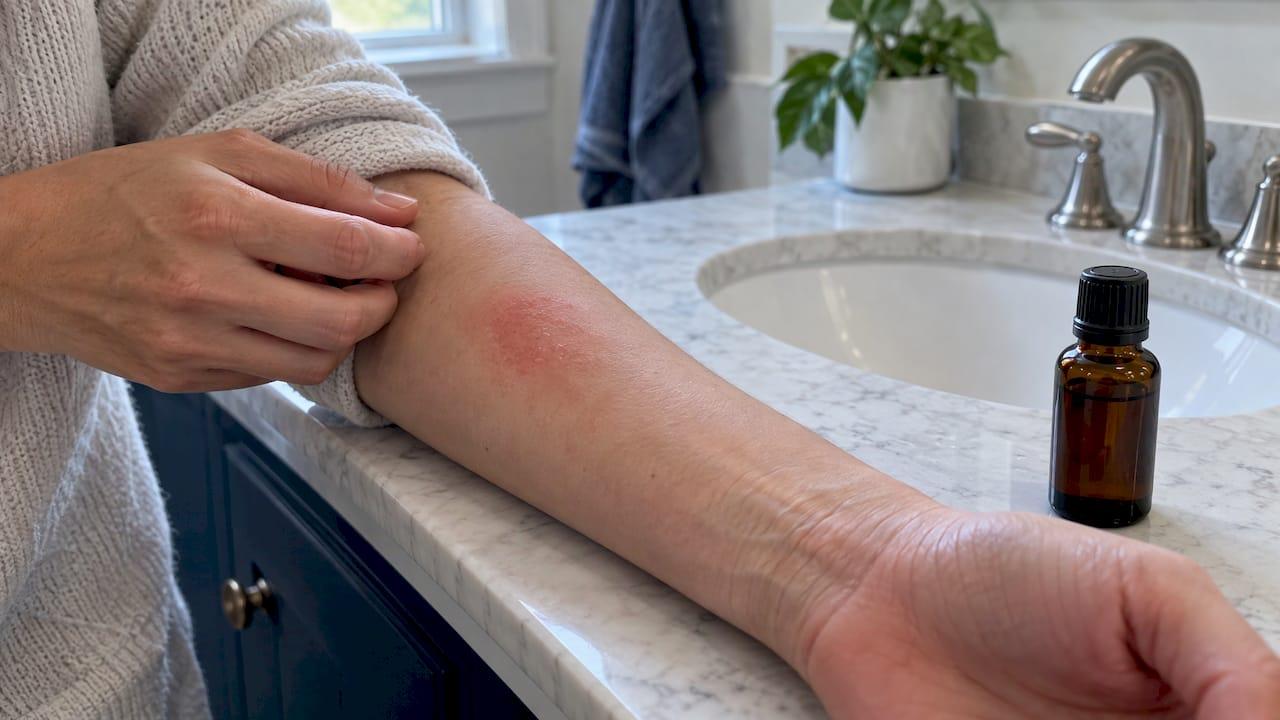
Peppermint oil can irritate skin, and in some cases it burns. The cause is mostly menthol, which makes up as much as half of the oil. Undiluted oil on skin is the most common trigger. If it happens, rinse the area with running water and stop using the product. If you want peppermint's cooling feel on sore muscles or joints, use a finished topical made for skin, not straight essential oil.
This guide is for people who use topicals for sore muscles, joint pain or recovery. It covers why the reaction happens, how to read the symptoms, what to do first, when to get medical care and how to lower the risk.
TL;DR
- Peppermint oil is concentrated and contains up to 50% menthol, which is why it can cause rashes, irritation and burning on skin.
- A burning, stinging reaction soon after contact usually points to irritation. An itchy, blistering rash that appears a day or two later points to allergy.
- First aid: remove contaminated clothing, rinse with room-temperature running water for at least 15 minutes, and call Poison Control at 1-800-222-1222 for guidance.
- Never apply undiluted essential oil. Adult dilutions in common guidance run up to about 3% to 5%.
- Do not use peppermint oil on the face or chest of infants and young children.
Table of Contents
- Why peppermint oil irritates skin
- Irritation, burn or allergy: how to tell
- What to do right away if peppermint oil burns your skin
- When to see a doctor
- How to lower the risk of irritation
- Who should avoid peppermint oil on skin
- Why people use peppermint on sore muscles
- A finished balm instead of a DIY oil blend
- Our view
- FAQ
- Sources
Why peppermint oil irritates skin
Essential oils are plant extracts in very concentrated form. Poison Control notes that they need dilution in a carrier oil to be used safely. It also says high-percentage menthol products on skin have caused irritation and even chemical burns. Some people react strongly to small amounts.
Peppermint oil is high in menthol. Poison Control says it contains up to 50% menthol. Small amounts on the skin or in the eyes can cause irritation and burning. Menthol gives the cooling sensation people like. At high strength, that same action can turn into stinging and a burning feeling.
The U.S. National Center for Complementary and Integrative Health (NCCIH, part of the National Institutes of Health) says peppermint oil appears safe on skin in commonly used doses. It also says skin rashes and irritation are possible side effects. So the issue is mostly strength, how it is applied and who is applying it.
A few things raise the odds of a reaction:
- Undiluted oil. Skin reactions are the most common problem with essential oils, and strength is the main driver.
- Damaged or inflamed skin. The National Association for Holistic Aromatherapy (NAHA) says damaged, diseased or inflamed skin is more permeable and more prone to reactions. It also lists peppermint as an oil needing special caution because of its menthol.
- Repeated use. Healthline notes that irritant reactions worsen with continued exposure.
- Heat and covering. The Maryland Poison Center advises applying oil only to the affected area, without tight bandages or heat. Both can intensify the effect.
Irritation, burn or allergy: how to tell
There are two kinds of reaction. They can look alike, which is why people mix them up.
Irritant contact dermatitis is direct damage to the skin surface. It is not a true allergy. Healthline says it is usually more painful than itchy. A review in the International Journal of Women's Dermatology says it occurs more quickly after application than the delayed allergic type, and can look clinically similar.
Allergic contact dermatitis is an immune response in a person who has become sensitized. MedlinePlus, the U.S. National Library of Medicine's health site, says it most often shows up 24 to 48 hours after exposure. Healthline gives a wider window of 12 to 72 hours. The rash can last for weeks after exposure stops.
| Irritant reaction (including a chemical burn) | Allergic reaction | |
|---|---|---|
| Timing | Soon after contact | Often 1 to 3 days later |
| Main feeling | Burning, stinging, pain | Itching |
| Look | Dry, red, rough skin; blisters if severe | Red bumps, weeping blisters, oozing, crusting or scaling |
| Where | Only the contact area | Contact area, and sometimes beyond it |
| Gets worse with | Repeated exposure | Any re-exposure once sensitized |
The location point comes from DermNet NZ, a dermatology reference. It says irritant dermatitis stays confined to the contact area, while allergic dermatitis can spread past it.
The skin-burn searches usually mean the first column. A red, painful patch right after applying oil is a burn-type irritation. A rash that arrives the next day and itches is more likely allergy. In some cases only a dermatologist can tell them apart. A 2021 review of essential-oil dermatitis explains why: irritant and allergic reactions can look identical, and patch testing is how doctors sort them out. The same review lists menthol, limonene, pulegone and other components as common allergens in peppermint oil.
What to do right away if peppermint oil burns your skin
Act fast. The steps below follow Poison Control's first aid guidance.
- Stop. Do not apply more oil or any more of the product.
- Remove contaminated clothing. Oil soaked into fabric keeps working on the skin.
- Rinse with room-temperature running water for at least 15 minutes. Use plenty of water. Mild hand soap can help remove material that sticks to the skin.
- Call Poison Control at 1-800-222-1222, or use its online tool, for advice on your situation. The line is free and open around the clock.
- Let the skin rest. Do not scrub. Do not put a heat pack or a tight bandage over the area.
A few points on what not to do. Do not try to "neutralize" the oil with vinegar, lemon or other home remedies. Water and mild soap are the standard approach. Rubbing the area with more oil to "dilute" it just adds menthol.
For mild redness that fades, the skin may settle on its own. For itching after the first rinse, ask your pharmacist or doctor which soothing cream suits your case.
When to see a doctor
Seek care right away if blistering appears, the burn is large or deep, or pain, redness or swelling gets worse or does not fade. Poison Control says to go straight to an emergency room after rinsing if symptoms are severe. WebMD advises stopping the product and contacting a health care provider right away if you get blistering, a rash, itching or burning after applying peppermint oil.
Get care too if:
- A rash spreads beyond where you applied the product.
- Itching or scaling lasts for days.
- You have a rash after each use of a product with the same ingredient.
- The reaction involves the face, eyes or genitals.
- Breathing trouble, swelling of the lips or face, or dizziness appear. Call 911.
A serious reaction to an ingredient is a reason to see a physician or dermatologist. They can run a patch test. The 2021 review notes that patch testing for peppermint can be done safely at 2% to 5% oil in petrolatum, under medical supervision.
How to lower the risk of irritation
Dilute, never apply neat
Kaiser Permanente says never to apply undiluted essential oils directly to the skin. Mix them into a lotion, butter or carrier oil first. It suggests staying at or below 3% for most adult uses and 2.5% for children. NAHA says most aromatherapy blends are 1% to 5% dilutions.
Peppermint is on the stronger end for irritation, so lower is safer. NAHA notes that some oils need much lower dilutions than usual to reach a non-irritant level.
For a rough idea of what percentages mean, WebMD describes mixing one drop of peppermint oil into 1 teaspoon (5 mL) of water, oil, cream, lotion or shampoo before skin use.
Do a patch test
Kaiser Permanente recommends a 24-hour patch test on the forearm with each new oil. Apply a small amount of the diluted mix, leave it, and watch for redness, itching or burning. Johns Hopkins also lists a 24-hour patch test before wider use. Remember that allergic reactions can take one to three days to show, so keep an eye on the spot after that first day.

Keep it on intact skin
Avoid open cuts, scrapes, sunburn and rashes. Keep it away from the eyes, and wash your hands after applying so you do not carry menthol to your face.
Know the quality gap
Kaiser Permanente notes that the federal government regulates essential oils as cosmetics and does not check them for purity or quality. The Maryland Poison Center also says most essential oils are not FDA regulated. Strength and purity can vary from bottle to bottle, so you may not know how much menthol is in the oil you are using.
Who should avoid peppermint oil on skin
Children need extra care. NCCIH says peppermint oil should not be applied to the face of infants or young children, because inhaled menthol may cause serious breathing side effects. Johns Hopkins advises not using peppermint oil on children under 30 months because of seizure risk. Its dilution guidance by age is:
| Age | Dilution guidance |
|---|---|
| Under 30 months | Do not use peppermint oil |
| 3 to 24 months (general essential oil guidance) | 0.25% to 0.5% |
| 2 to 6 years | 1% to 2% |
| 6 to 15 years | 1.5% to 3% |
| Over 15 years | 2.5% to 5% |
If you are pregnant, have eczema or very sensitive skin, or take medication, ask your doctor before using a new topical. Healthline notes that research on peppermint oil for eczema is very limited, and it advises against applying it to the face.
If you have had a reaction to peppermint, menthol or another essential oil before, talk to a doctor or allergist before using any product that contains it. For more on topical safety and medicines, see our guide to CBD topical interactions.

Why people use peppermint on sore muscles
Peppermint is popular in rubs and balms because of the cooling feel. A review in the Journal of Integrative Dermatology says peppermint oil is thought to work by cooling the skin and activating A-delta and kappa-opioid receptors, giving a mild analgesic effect. WebMD says menthol's cooling effect may ease itching and irritation from hives, poison ivy or poison oak.
The same sources say published research on topical peppermint oil is small. A 2016 trial in 50 patients with chronic itch from liver, kidney or diabetic causes found that peppermint oil applied twice daily for two weeks lowered itch scores from 15.18 to 7.94 on the 5-D scale, while the petrolatum group did not change significantly. Four patients reported burning. That trial studied itch, not muscle pain, so it says little about sports recovery. If you want a closer look at the pain question, read our piece on peppermint oil and pain and arnica and menthol.
A finished balm instead of a DIY oil blend
Mixing your own peppermint oil blend means you set the percentage. A small mistake in the drop count changes the strength a lot. A finished topical removes that step.
Mongoose CBD Co. makes balms for muscle soreness, inflammation and arthritis discomfort. Each uses 1,000mg of CBD per ounce, along with botanicals such as arnica, menthol, peppermint, turmeric, eucalyptus, ginger and cayenne pepper. They are vegan, non-GMO, paraben-free, THC-free and cruelty-free, and the company states they go through third-party testing.
- Seriously Soothing Pain Balm is the original formula, built for everyday aches and joint pain.
- RIKKI TIKKI Recovery is the recovery balm for athletes and active people.
Prices on the site run from $26.95 to $39.95. Orders come with a full refund within 30 days of purchase.

Use any balm the way you would use any new topical. Start with a small amount on intact skin, keep it off the eyes and broken skin, and wash your hands after. If you notice burning, stop and rinse. Our guides on CBD balm side effects and how much balm to use cover the details. You can see the full range on the Mongoose CBD Co. homepage.
Our view
Peppermint is in our balms because the cooling feel is a big part of why people reach for a topical after a hard session or on a stiff day. We built our balms to put it alongside CBD, arnica and other botanicals in one product, so you are not measuring drops of essential oil into a jar at home.
The risk with peppermint is mostly about strength and how it is applied. That is why we tell people the same things every time: keep topicals on intact skin, keep them off the eyes and face, wash your hands after use, and rinse with water if anything stings. If a reaction persists, see a doctor.
Our balms use 1,000mg of CBD per ounce, and we back them with a 30-day full refund. We want you to feel the relief without worrying about the product.
Cindy
FAQ
Is peppermint oil safe on skin?
NCCIH says peppermint oil appears safe on skin in commonly used doses, though rashes and irritation can occur. The safe approach is dilution in a carrier oil or lotion, use on intact skin only, and a patch test first. It should not be used on the face of infants or young children.
Can you put peppermint oil directly on skin?
No. Undiluted essential oil is strong enough to cause irritation, burning and in some cases chemical burns. Kaiser Permanente advises against applying any essential oil undiluted. Blend it into a lotion, butter or carrier oil first.
What should I do if peppermint oil burns my skin?
Remove any contaminated clothing and rinse the skin with room-temperature running water for at least 15 minutes. Mild soap can help. Then call Poison Control at 1-800-222-1222. Go to the emergency room if the burn is severe, or see a doctor if blisters form or pain and swelling persist.
How long does peppermint oil irritation last?
A mild irritant reaction often fades once you stop and rinse. An allergic reaction can last longer: MedlinePlus says the rash may persist for weeks after exposure stops. See a doctor if redness, itching or scaling lasts more than a few days or spreads.
Sources
- Peppermint Oil: Usefulness and Safety (NCCIH)
- Peppermint oil: Is it toxic? (Poison Control)
- Can menthol have harmful effects? (Poison Control)
- First aid: Act fast! (Poison Control)
- Safety (NAHA)
- Essential Oil Allergic Reaction (Healthline)
- Essential Oils for Eczema Treatment (Healthline)
- Poison Prevention Press, Essential Oils (Maryland Poison Center)
- International Journal of Women's Dermatology, essential oils review
- Art of Prevention: Essential Oils (PMC)
- Contact dermatitis (MedlinePlus)
- Allergic contact dermatitis to essential oils (DermNet NZ)
- Peppermint Oil: Uses, Side Effects, Interactions (WebMD)
- Are Essential Oils Safe for Children? (Johns Hopkins)
- Essential oils: Are they safe to use? (Kaiser Permanente)
- Effectiveness of topical peppermint oil on symptomatic pruritus (PMC)
- Topical Integrative Treatments for Pruritus (Journal of Integrative Dermatology)