
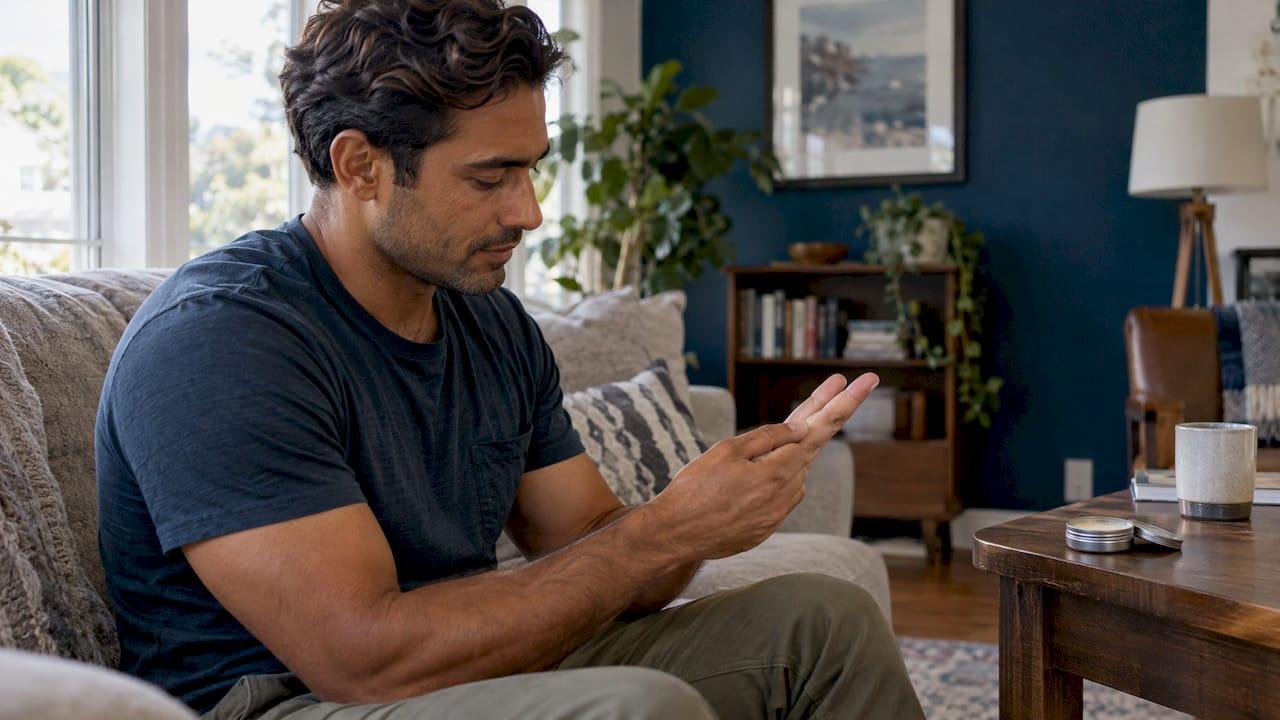
Trigger finger is a tendon problem, so the CBD that makes the most sense for it is one you apply right where it hurts: a topical balm on the palm side of the finger and hand. Our Seriously Soothing Pain Balm and RIKKI TIKKI Recovery are made for exactly that kind of localized, daily-use routine. A balm eases the soreness and stiffness around the joint while the established treatments, rest, splinting and a clinician's care, address the tendon itself. Below you will find what trigger finger is, what the research says about topical CBD in the hand, how to use a balm well, and when to get the finger examined.
TL;DR
- Trigger finger happens when a swollen tendon or a small nodule keeps the tendon from gliding through its sheath, causing stiffness, clicking and catching.
- Topical CBD suits the hand because the finger joints sit close to the skin. A small 2024 open-label study of a CBD gel in hand osteoarthritis reported lower pain scores and stronger grip.
- Use a THC-free balm with clear labeling, apply it to clean, unbroken skin, and keep it going alongside rest, splinting or the plan your clinician gives you.
- Tell your doctor or pharmacist about CBD if you take warfarin, certain antidepressants, seizure medicines or immunosuppressants.
- A finger that locks, or symptoms lasting weeks, deserve a hand clinician's exam. Injections and a minor release procedure work well.
Table of Contents
- What is happening inside a trigger finger
- Why a topical balm fits the hand
- What a balm adds beyond CBD
- A practical routine for a sore, catching finger
- Established treatments to pair with the balm
- When to see a clinician
- Using CBD safely
- Why we built our balms this way
- Our balms for hand and finger discomfort
- FAQ
- Sources
What is happening inside a trigger finger
Your finger tendons run through a tunnel-like sheath, like a fishing line through guides. Mayo Clinic explains that trigger finger (stenosing tenosynovitis) develops when the tendon can no longer glide smoothly in that sheath. The sheath may swell, or a small nodule may form on the tendon. The repeated back-and-forth irritation can create the nodule, which makes gliding harder still.
The typical signs:
- Stiffness in the finger, usually worst in the morning
- Popping or clicking when you bend or straighten it
- A tender lump at the base of the finger in the palm
- Catching or locking in a bent position, then a sudden pop straight
In most people no clear reason shows up for why the irritation begins. Risk goes up with repeated gripping, diabetes, rheumatoid arthritis, low thyroid function, and being a woman over 50, according to the same Mayo Clinic page. Cleveland Clinic adds that it is most common between ages 40 and 60 and that the nodule often catches on a band of tissue at the base of the finger called the A1 pulley.
That matters for the athlete or lifter. Barbell grip, climbing, racquet sports, kettlebells and long keyboard or tool use all load the same tendons over and over. Soreness at the base of a finger after heavy gripping is worth taking seriously early.
Why a topical balm fits the hand
The finger and wrist joints are among the most superficial in the body, with little tissue between the skin and the structures underneath. That is the practical argument for a topical: you put it directly over the sore spot rather than sending CBD through the digestive system.
The delivery question has support in the pharmacology. A 2025 review of CBD pharmacokinetics reports that oral CBD can have bioavailability as low as 6%, because the liver breaks much of it down on first pass. A balm sidesteps the stomach and liver step and keeps the product at the area you care about.
On the hand specifically, a 2024 open-label feasibility trial in Australia followed 15 people with hand osteoarthritis who applied a 4% transdermal CBD gel three times a day for four weeks. Pain scores on a 0 to 10 scale fell by roughly 1.9 points for current, average and maximum pain, and grip strength increased. Effects drifted back toward baseline after the gel was stopped, which fits a routine you keep up rather than a one-off. The authors say a placebo-controlled trial is needed to confirm efficacy, and that is the honest scope: this was a small study in hand osteoarthritis, not trigger finger itself.
A 2022 review of CBD in rheumatic conditions also notes that dosing for symptom relief has not been established yet. So the sensible approach is a steady, modest routine you can follow consistently and judge by how your hand feels and moves.
If you want to read how we approach other joints, our pieces on topical CBD for osteoarthritis, joint stiffness and wrist pain cover the same routine for neighboring areas.

What a balm adds beyond CBD
CBD alone is only part of what a balm does. Our formulas pair CBD, at 1,000 mg per ounce, with botanicals people have long rubbed on sore muscles and joints: arnica, menthol, turmeric, eucalyptus, peppermint, cinnamon, clove, ginger and cayenne pepper. Menthol and peppermint give a cooling sensation, and the warming botanicals give the opposite. For a stiff finger first thing in the morning, that sensation is part of why many people like massaging a balm into the palm and finger base.
The balms are vegan, non-GMO, paraben-free, THC-free and cruelty-free. They are designed to give a pleasant feel and fast comfort, which makes them easy to keep using on a daily basis.
A practical routine for a sore, catching finger
Here is a routine built around the balm, with the points where people most often go wrong.
- Clean and dry the skin. Wash your hands first and apply to intact skin only. Avoid cuts, cracks and any irritated or broken areas.
- Use a small amount. A pea-sized portion covers the palm side of one finger and the base of the palm. More does not help and wastes product.
- Massage slowly into the base of the finger. The nodule and the pulley sit in the palm, at the crease where the finger meets the hand. Press gently along the tendon, from the crease toward the fingertip, for a minute or two. Keep the pressure comfortable, never forceful.
- Apply on a schedule. The hand study applied the gel three times daily, so a morning, afternoon and evening rhythm is a reasonable pattern to build. Morning matters most, since stiffness peaks then.
- Move gently afterward. Open and close the hand slowly a few times. Do not force a locked finger straight.
- Wash your hands after use. Keep the balm away from your eyes and mouth.
- Keep a simple log. Note morning stiffness, how often the finger catches and how well you grip over two to four weeks. Your own notes tell you more than memory does.
This routine is meant to run alongside rest from the aggravating grip and, if you were given one, a splint, not instead of them. For athletes, that can mean swapping thick bar grips for padded ones or trimming grip-heavy sets for a short stretch while the finger calms down.
Established treatments to pair with the balm
Trigger finger often responds well to simple care, so it helps to know the sequence a hand clinician follows.
Splinting. A 2023 randomized trial of 120 adults found no clinically important differences in pain or hand function among splinting alone, a steroid injection alone, or both together over a year. The authors concluded splinting alone is a reasonable first treatment.
Corticosteroid injection. Medscape lists steroid injection as first-line treatment, with a 93% success rate at three months for fingers with a clear, palpable nodule. An evidence-based review of trigger digits found moderate evidence that it is a safe and effective short-term option.
Release procedure. The same Medscape page says fingers that fail two injections usually go on to an A1 pulley release, and that percutaneous release has reported success rates of 74 to 94%. The review above found strong evidence that surgical release manages trigger digit safely and has fewer recurrences than injection at six months.
A balm sits comfortably next to all of these. It is a daily comfort step for the skin and tissue over the area, and it keeps your routine going between appointments.
When to see a clinician
Book an appointment with a hand specialist, orthopedist or your primary care doctor when:
- The finger locks and will not straighten on its own
- Symptoms last more than a few weeks or keep coming back
- You have diabetes, rheumatoid arthritis or a thyroid condition, since these raise the risk and may need their own attention
- You notice numbness, tingling, swelling, redness or warmth, which point beyond a simple tendon catch
Medscape advises considering release for symptoms lasting longer than four months or after failed injection therapy. A clinician can also tell trigger finger apart from hand arthritis or carpal tunnel problems, which can feel similar and need different handling.
Using CBD safely
The safety points below are who, how much and when, kept short so you can act on them.
Medication interactions. A 2025 JAMA review states that CBD-containing products inhibit liver enzymes (CYP2C19 strongly, CYP3A4 moderately, CYP2D6 weakly to moderately). That can raise blood levels of some SSRIs such as citalopram, warfarin, seizure medicines such as clobazam, and immunosuppressants such as tacrolimus and cyclosporine. Most of that evidence concerns oral products, but if you take any of these, talk with your doctor or pharmacist before you start a CBD balm. Our page on CBD topical interactions goes through this in more detail.
Drug testing. A small trial cited in the 2022 rheumatic disease review found that half of 14 participants using a product with 0.02% THC tested positive for THC on a drug screen. If you are tested for work or competition, use a THC-free product and tell the testing body what you use. Our balms are THC-free.
Labeling and quality. The same review names inaccurate labeling and contaminants such as heavy metals and pesticides as the main risks with CBD products. It advises products with under 0.3% THC from a manufacturer that does not make exaggerated health claims. Mongoose CBD products undergo rigorous third-party testing. The JAMA review also notes that CBD products are not FDA approved and are overseen mainly at the state level, so product transparency matters.
Pregnancy, breastfeeding and children. Talk with your doctor before using any CBD product.
Why we built our balms this way
At Mongoose CBD Co., we make balms for people who use their hands, shoulders and knees hard: lifters, climbers, runners, and people living with arthritis and chronic pain. A tendon problem like trigger finger is a good example of why we focus on topicals. The sore spot is small, close to the skin and used every hour of the day, so what you want is something you can put exactly there, as often as you need.
That is why we formulate our balms with CBD at 1,000 mg per ounce alongside arnica, menthol, turmeric, eucalyptus, peppermint, cinnamon, clove, ginger and cayenne pepper. Our formulas are designed to give a pleasant, soothing sensation quickly, so the routine is one you will actually keep up. They are THC-free, vegan, non-GMO, paraben-free and cruelty-free, and every product goes through third-party testing.
We would suggest pairing the balm with the basics: rest from the aggravating grip, a splint if your clinician recommends one, and a hand specialist's exam when the finger locks. Our balms are made to be part of that plan, and our 30-day full refund policy is there so you can work with them with confidence.
Cindy
Our balms for hand and finger discomfort
The Seriously Soothing Pain Balm is our original formula for muscle soreness, inflammation and arthritis discomfort. RIKKI TIKKI Recovery is formulated for recovery after hard training, which suits grip-heavy athletes. Both are priced from $26.95 to $39.95 depending on size, and every order is covered by our full refund within 30 days of purchase.
You can see both balms and pick the one that fits your routine on the Mongoose CBD Co. homepage.
FAQ
Can CBD cure trigger finger?
No. Trigger finger is a mechanical problem in the tendon and its sheath, and the treatments that address it directly are rest, splinting, steroid injection and a release procedure. A topical CBD balm is a comfort step for the soreness and stiffness around the area, used alongside those.
Is a CBD balm better than an oral product for finger pain?
For a small, superficial area like the finger, a topical makes sense because you apply it right at the spot. A 2025 pharmacokinetics review reports that oral CBD can have bioavailability as low as 6%, since much is broken down in the liver. Our guide to topical CBD for osteoarthritis explains why we put topicals first.
How often should I apply a balm to my fingers?
The 2024 hand study used a CBD gel three times daily for four weeks, and a morning, afternoon and evening pattern is a practical rhythm to follow. Use a pea-sized amount on clean, unbroken skin and wash your hands afterward. Follow the directions on the product label.
Will a CBD balm show up on a drug test?
Our balms are THC-free. Still, research has shown that some CBD products with trace THC caused positive screens in a small trial, so if you are tested for work or sport, choose a THC-free product and tell the testing body what you use.
What else helps a trigger finger at home?
Rest from the gripping activity that set it off is the first step, and a splint worn as directed by a clinician is a reasonable first treatment according to a 2023 randomized trial. Gentle movement after warming the hand also helps stiffness. If the finger locks or symptoms persist, see a hand specialist.
Sources
- Trigger finger - Symptoms and causes, Mayo Clinic
- Trigger Finger: What It Is, Symptoms, Causes & Treatments, Cleveland Clinic
- The Therapeutic Potential of Cannabidiol in the Management of Temporomandibular Disorders, Pharmaceutics 2025
- An open-label feasibility trial of transdermal cannabidiol in hand osteoarthritis, 2024
- Cannabidiol (CBD) in Rheumatic Diseases, 2022
- Splinting, steroid injection and combination for trigger finger, randomized trial, 2023
- Trigger Finger: Practice Essentials, Medscape
- Evidence-based management of adult trigger digits, PubMed
- Therapeutic Use of Cannabis and Cannabinoids, JAMA 2025