
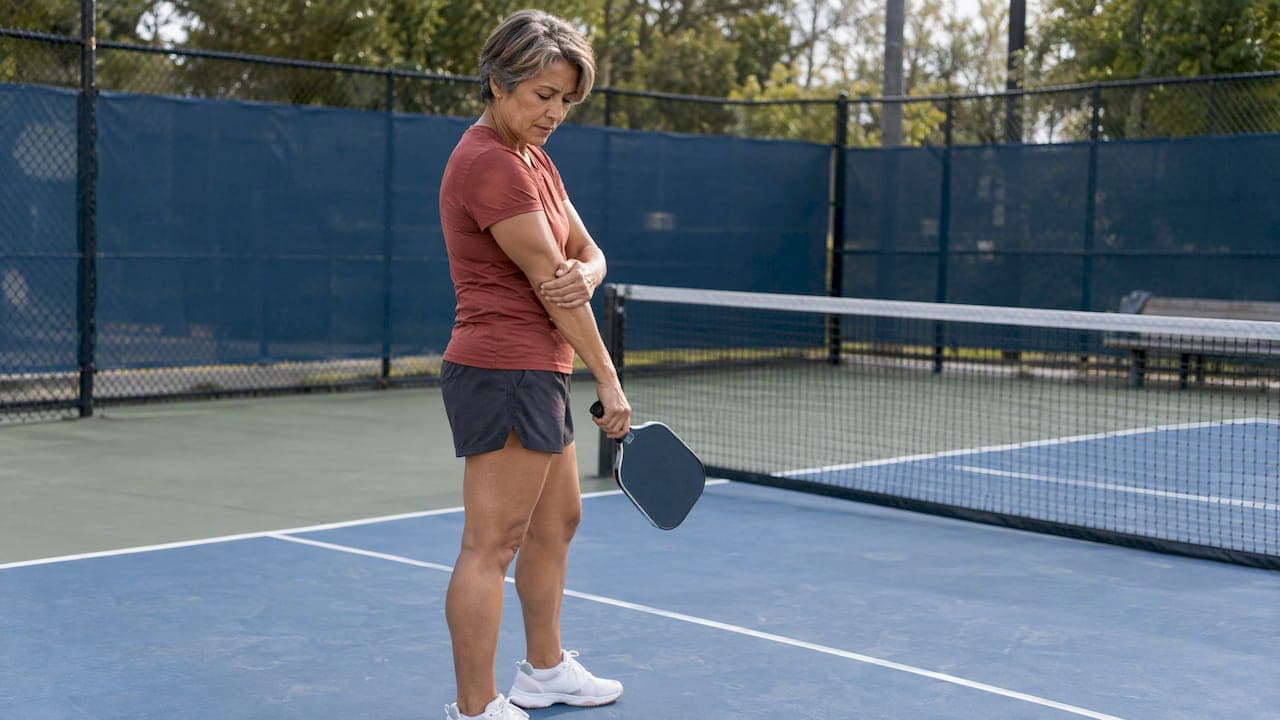
A CBD balm may ease the ache of pickleball elbow. It will not heal the tendon. The tendon heals through load management, strengthening and time. A balm is an add-on to that plan. Used for a set trial period, it is a low-effort way to see if it takes the edge off your pain.
This guide covers what pickleball elbow is, what the research says about topical CBD, how to run a fair trial, and when to see a clinician.
TL;DR
- Pickleball elbow is lateral epicondylitis, an overuse tendon problem on the outside of the elbow.
- Topical CBD has early, limited evidence for localized musculoskeletal pain. It is an adjunct, not a cure.
- Rehab does the healing: phased loading exercises, grip and technique fixes, and a gradual return to play.
- A fair balm trial is 2 to 6 weeks, applied 2 to 3 times daily, with pain tracked in writing.
- Pick a THC-free balm with a third-party Certificate of Analysis. See a clinician if pain persists or worsens.
Table of Contents
- What pickleball elbow actually is
- Where CBD fits, and where it doesn't
- How to run a fair balm trial
- What to look for in a CBD balm
- Our point of view
- Treat the tendon, not just the pain
- When to see a clinician
- Our balms for the elbow trial
- FAQ
- Sources
What pickleball elbow actually is
Pickleball elbow is the same condition as tennis elbow. Harvard Health describes it as a type of tendinitis called lateral epicondylitis. It can come from gripping a paddle tightly for long periods or from repeated wrist twisting.
Selkirk's education page describes the mechanism as repetitive overuse that causes microtearing of the forearm extensor tendons. Symptoms usually build over weeks or months. They include burning pain, tenderness at one point on the outside of the elbow, and a weaker grip.
The name is misleading. An orthopedic surgeon at Northeast Georgia Health System notes that tennis elbow is among the most common complaints in pickleball players in the Gainesville area.
Why it shows up in pickleball
Pickleball is easy to start and easy to overplay. Many people go from zero to four or five sessions a week. Forearm tendons have a lower metabolic rate than muscle, so they adapt more slowly. Bounce's recovery guide frames the injury as a recovery deficit more than a single event. The tendon takes more load than it can absorb between sessions.
Common contributors:
- A jump in playing volume
- A paddle grip that is too small or too large
- A tight, white-knuckle grip on dinks and blocks
- Backhand mechanics that lean on the wrist
- Little or no strength work for the forearm
Where CBD fits, and where it doesn't
The honest answer has two parts.
First, the evidence for topical CBD is early. It is not specific to pickleball elbow. A 2026 crossover trial in thumb arthritis tested topical CBD at 8.0 mg/mL against diclofenac gel over 14 days. It reported meaningful functional improvement. That is a different joint and a different condition. It does show that topical CBD can be tolerated and tracked in a hand and arm setting.
A randomized open-label trial of topical cannabis balms looked at feasibility and tolerability for musculoskeletal pain linked to aromatase inhibitors. That too is a different population. It points to the same practical lesson: balms are feasible to use and are studied over weeks, not minutes.
Second, the proven fix for tendon pain is exercise. The clinical practice guideline from the American Physical Therapy Association's hand and orthopaedic academies covers lateral elbow pain. Rehab that uses phased loading builds the tendon back. That means isometric, then concentric, then eccentric work. A typical timeline is at least 12 weeks. Nonsurgical treatment success rates for lateral elbow tendinopathy run from 80% to 95%.
So a CBD balm is best seen as a comfort tool. It may help you move, train and sleep with less discomfort while the real work happens. It should never be the reason you keep playing through pain that is getting worse.
What the balm can reasonably do for you
- Give a cooling or warming sensation at the sore spot
- Make your rehab sessions and post-play evenings feel better
- Give you a simple routine to track
What it cannot do
- Rebuild a damaged tendon
- Replace strengthening and load management
- Treat a nerve problem, a fracture or a joint injury that only looks like tennis elbow
How to run a fair balm trial
Most people try a balm for three days, feel little, and quit. Or they use it once and credit it with everything. A trial with a set length and a written log is better.
The research notes that for chronic tendinopathy, consistency matters more than intensity. Clinical protocols often suggest applying a topical 2 to 3 times daily for at least 2 weeks before judging. We use a 2 to 6 week window. Our own elbow pain trial protocol walks through it in more detail.
Steps
- Set a baseline. Before day one, rate your elbow pain from 0 to 10 at rest, during a game and the morning after. Test your grip by squeezing a towel or a ball and note how it feels.
- Patch test. Put a small amount on your inner forearm and wait a day. Stop if you see redness, rash or burning.
- Apply 2 to 3 times a day. Use clean, dry skin over the outer elbow and the top of the forearm. Rub it in with light pressure.
- Keep your rehab going. Do not swap exercises for the balm. Keep your strength work and play volume steady so the balm is the only thing you changed.
- Log weekly. Same three ratings each week. Add notes on sleep and grip.
- Decide at week 2, then again at week 6. If nothing has changed in the log, the balm is not doing much for you. If pain has dropped, keep it as an adjunct.
Two cautions apply. Do not put any balm on broken or irritated skin. And do not apply heat packs or wraps over a balm with menthol or cayenne unless the label says it is fine, since that can raise skin irritation.
What to look for in a CBD balm
CBD products vary widely in quality. The FDA advises caution because of that variation, so a few checks matter.
| Check | What to look for |
|---|---|
| Third-party testing | A Certificate of Analysis (COA) that confirms potency and screens for contaminants such as pesticides and heavy metals |
| THC content | THC-free if you are drug tested or want to avoid it |
| Stated dose | A clear CBD amount per ounce, not just a vague "hemp extract" |
| Complementary ingredients | Menthol, arnica or capsaicin-type ingredients that give a sensation on the skin |
| Return policy | A clear refund window so a trial carries little risk |
The complementary ingredients matter more than most people expect. Many of the balms that people report liking pair CBD with counter-irritants. That is why we build ours that way.
Our point of view
We make balms for people who train hard and hurt. Pickleball players fit that group well. Many are in their 40s, 50s and 60s, are new to racquet sports and want to keep playing.
Here is what we tell them.
The balm is part of a routine. We formulate each one with 1,000mg of CBD per ounce and add botanicals such as arnica, menthol, ginger and cayenne pepper in the Rikki Tikki Recovery balm. The aim is a pleasant sensation on the skin and support for sore, worked muscle and tendon areas. We do not promise that a balm fixes a tendon. We do say a fair trial costs little, since we offer a full refund within 30 days of purchase.

We suggest you treat the first two weeks as a test. Apply on schedule. Write down your numbers. Keep your rehab plan. If your elbow is better at week two, you will know the balm is part of the reason or at least not in the way. If not, you can return it.
We also suggest you stay skeptical of any product that promises to let you play through a tendon injury. The elbow has to be loaded in the right dose. A balm can make that feel easier. It cannot do the loading for you.
— Cindy
Treat the tendon, not just the pain
While you test a balm, put your main effort into the things with stronger evidence.
Reduce and then rebuild load
Bounce's guide says the first step is cutting back or stopping the activity that caused the injury. Full rest suits acute cases where pain is present even at rest. For milder cases, you can reduce play volume and skip the hardest sessions. If symptoms persist beyond two to four weeks of self-managed care, the guide advises getting evaluated.
Do the strengthening
The APTA-linked guideline puts progressive loading at the center of treatment. A physical therapist can set the exercises for your elbow: isometric holds first, then slow lifting and lowering of a light weight with the wrist. Expect the process to take around 12 weeks.
Fix your grip
Grip size is a common contributor. Selkirk explains two ways to check it. One is leaving room for an index finger between your fingers and the base of your thumb. The other, which it describes as more accurate, is measuring from the palm crease to the tip of your ring finger. Also ease up on your squeeze. A looser hold between points takes load off the tendon.

Watch your volume
Add sessions gradually. Do not jump from two games a week to six. If your elbow aches the morning after, you did too much.
When to see a clinician
See a doctor or physical therapist if:
- Pain is present at rest or wakes you at night
- Your grip is clearly weaker or you drop things
- You have numbness, tingling or swelling
- The elbow was hit or you felt a pop
- Pain has not improved after two to four weeks of self-care
Those signs can mean something other than tennis elbow, such as a nerve issue. A clinician can sort that out, and an exam is the right step before you rely on any topical.
If you are on medication, or are pregnant or nursing, ask your doctor before adding a CBD product. If you are drug tested, choose a THC-free product and read our notes on CBD and sports massage for athletes.
Our balms for the elbow trial
Two of our balms suit this kind of trial.
- RIKKI TIKKI Recovery: built for muscle recovery in active people, with 1,000mg of CBD per ounce plus botanicals including ginger and cayenne pepper.
- Seriously Soothing Pain Balm: the original formula, also with 1,000mg of CBD per ounce and natural pain-relieving ingredients such as arnica and menthol. A cinnamon and clove version is also available.
Both lines are listed at $26.95 to $39.95. All our products are vegan, non-GMO, paraben-free, THC-free and cruelty-free. Our 30-day full refund policy means you can run a full 2 to 4 week trial before deciding. You can see everything on the Mongoose CBD Co. homepage.
If your swelling is more of an issue than the ache, read our page on CBD for swelling. For a broader look at arm and joint pain, see our elbow pain protocol.
FAQ
Does CBD cream work for pickleball elbow?
There is no large trial of CBD cream for pickleball elbow yet. Small studies of topical CBD in other hand and joint conditions show it is tolerated and may help function. Treat it as a comfort aid to use next to rehab, and judge it with your own written log over 2 to 6 weeks.
How often should I apply a CBD balm to my elbow?
Protocols for chronic tendon pain often suggest 2 to 3 times a day for at least 2 weeks. Use clean, dry skin and rub it over the outside of the elbow and upper forearm. Follow the directions on your product label.
How long does pickleball elbow take to heal?
It depends on the case. The APTA-linked guideline points to a minimum of about 12 weeks of phased loading for full recovery. Most nonsurgical treatment succeeds, with reported rates of 80% to 95%. Pain that is not improving after two to four weeks of self-care calls for an exam.
Can I keep playing while I use a balm?
If pain is mild and does not rise during play or the next morning, many players cut back volume and keep playing. If pain shows up at rest or climbs during games, stop and get it checked. A balm should not be used to mask pain that is telling you to rest.
Sources
- Harvard Health: How to avoid this common pickleball injury
- Selkirk Sport: Pickleball elbow symptoms, prevention and treatment
- Northeast Georgia Health System: Common pickleball injuries
- Bounce: What is pickleball elbow?
- JOSPT: Lateral elbow pain clinical practice guidelines
- ORS 2026: Topical CBD versus diclofenac gel in thumb arthritis
- Experts@Minnesota: Topical cannabis balms trial