
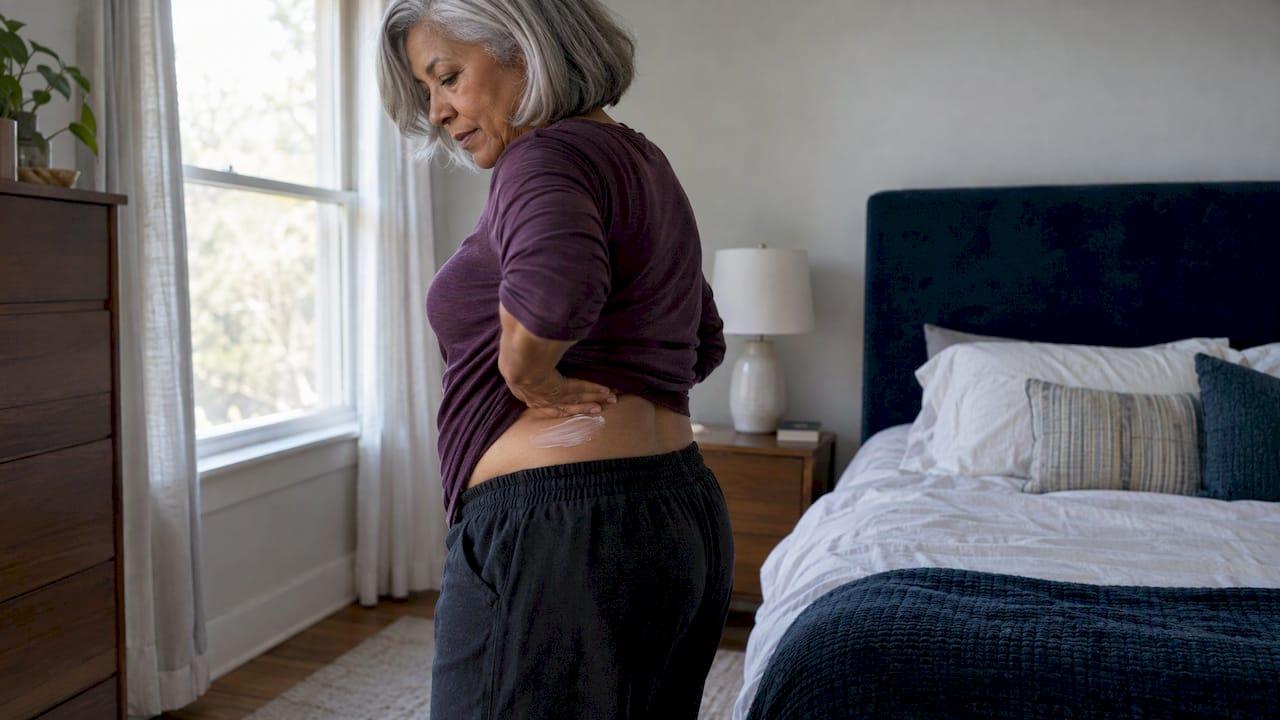
CBD has not been proven to treat arthritis in the back. Research on oral CBD for chronic pain is mostly negative. Studies of topical CBD in arthritic joints are small but more encouraging. If you want to try CBD for back arthritis, a topical balm used in a structured trial is the most practical way to do it. Check with your doctor first if you take other medicines.
This guide covers what back arthritis is, what the studies found, how to run a fair trial, and which safety points matter.
TL;DR
- Arthritis in the back is usually wear-and-tear osteoarthritis of the spine. It most often affects the lower back.
- Trials of oral CBD for pain have not beaten placebo. Small topical trials in hand and knee arthritis have shown some positive results.
- Topical balms are applied to the skin, so they avoid the liver-related questions raised for high-dose oral CBD.
- CBD can interact with common arthritis drugs. Talk to your doctor or pharmacist before you start.
- Use one product, one routine and a pain diary for 2 to 4 weeks. Then decide.
Table of Contents
- What arthritis in the back is
- What the research says about CBD and arthritis pain
- Why a topical balm suits a back trial
- Our perspective
- How to run a 4-week balm trial for your back
- Safety: what to check before you start
- What else helps a sore, arthritic back
- CBD and THC for back pain
- Our balms for back stiffness
- FAQ
- Sources
What arthritis in the back is
Osteoarthritis of the spine is the most common type of arthritis to affect the spine. It usually affects the lower back and develops through wear and tear. Johns Hopkins Medicine explains that the cartilage between the joints slowly breaks down. That leads to inflammation and pain, often more noticeable when you bend or twist.
The Arthritis Foundation describes the same process in the facet joints. The cartilage that pads the bone ends wears down. Bones rub together when you move. Bony growths called spurs can form and press on nerves, which adds pain.
Back pain is common in general. A JAMA review notes that up to 80% of people have low back pain at some point. It also describes how spurs on the facet joints and around the vertebrae can make the spine stiffer and less flexible. Spurs can also narrow the spinal canal or the openings where nerves exit.
This matters for the CBD question. Back arthritis pain often comes from three sources at once: the joint, tight surrounding muscle, and sometimes an irritated nerve. A single product may not touch all three.
What the research says about CBD and arthritis pain
The honest summary: the evidence is early and mixed. Here is what the main sources found.
Oral CBD
A 12-week randomized trial gave 20 to 30 mg a day of synthetic oral CBD to 136 people with hand osteoarthritis or psoriatic arthritis. It found no statistically significant difference from placebo for pain or sleep. The result is reported in this review of CBD in rheumatic diseases.
The American College of Physicians reached a similar view in 2025. Its Best Practice Advice says purified oral CBD with a low THC-CBD ratio probably has no effect on pain or function in chronic noncancer pain. It also says that for many patients the harms of cannabis products outweigh the small potential benefits.
The ACP found small improvements in one setting: chronic neuropathic pain, using formulations with a comparable THC-CBD ratio. It found the evidence insufficient for other types of chronic pain.

Topical CBD
Topical products are a different case. They are applied where the discomfort is, and they are the form most studied for joints close to the skin. The studies are small.
| Study | Who | Product | What was reported |
|---|---|---|---|
| University of Virginia, 2022 | 18 people with thumb base arthritis | Topical CBD, twice daily for 2 weeks | Significant improvement in pain and hand function scores versus control. No adverse events reported |
| Knee osteoarthritis trial, 12 weeks | 320 people, mean age 62 | Topical synthetic CBD gel | No difference in the primary pain endpoint. A secondary responder analysis showed 53% versus 34% response for CBD 250 mg versus placebo |
| Australian feasibility trial, 2024 | 15 people with hand osteoarthritis | 4% CBD gel, three times daily for four weeks | Pain fell by about 1.9 points on a 0 to 10 scale. Grip strength rose. It was open-label, so the authors call for a placebo-controlled trial |
Two points stand out. First, results are not uniform: one trial missed its main goal while showing a benefit in a secondary analysis. Second, none of these trials tested the spine. They covered hands, thumbs and knees, so a back trial is a personal experiment, not a proven protocol.
The Arthritis Foundation adds that it is not clear whether topical CBD products deliver CBD below the skin. It also notes that topicals often contain ingredients like menthol, capsaicin or camphor. That makes it hard to tell which ingredient helps. Anecdotes from people with arthritis are mixed: some feel noticeable relief and some feel none.
That last point is worth reading as a feature of a formulated balm. A balm that pairs CBD with soothing botanicals is built to give a cooling or warming sensation on the skin while you use it. Our formulas are designed on that principle.
Why a topical balm suits a back trial
There are practical reasons a balm is the usual first step for adults with back stiffness.
- Targeted use. You apply it to the area that hurts, such as the lower back or the muscles beside the spine.
- Easy to measure. You know when you applied it and can note how you feel an hour later.
- Low commitment. There is no daily capsule or dose to calculate.
- Sensory effect. Ingredients such as menthol, eucalyptus, peppermint and cinnamon create a noticeable sensation that many people find pleasant while they stretch or rest.
For related joints, see our guides on CBD for joint pain, topical CBD for osteoarthritis and CBD balm for arthritis. If you have an inflammatory form, read CBD for rheumatoid arthritis.
Our perspective
We make balms for people who hurt after training and people who hurt every day. Back arthritis is one of the hardest places to feel better, because the pain moves with every step and every bend.
Our approach is simple. Each balm is built around 1,000 mg of CBD per ounce, plus botanicals that people have used on sore muscles for a long time: arnica, menthol, turmeric, eucalyptus, peppermint, cinnamon, clove, ginger and cayenne pepper. The formulas are vegan, non-GMO, paraben-free, THC-free and cruelty-free.
We do not ask you to take this on faith. We ask you to run a fair trial: one product, the same routine, a short diary. Our 30-day full refund policy exists so the trial costs you nothing if the balm is not right for you. We also say plainly that CBD is not a replacement for your doctor's plan. It is one more tool to try alongside it.
Cindy
How to run a 4-week balm trial for your back
A trial turns "maybe it helps" into something you can judge. It follows the pattern of the short topical studies above.
- Talk to your doctor or pharmacist first. This is essential if you take prescription arthritis drugs or blood thinners. See the safety section below.
- Pick one product and one area. Do not start several new products at once. If you change three things, you will not know which one mattered.
- Write a baseline. For three days before you start, rate your back pain from 0 to 10 morning and evening. Note stiffness on waking and how long it lasts.
- Test a small patch of skin. Apply a little to your forearm and wait a day. Stop if you see redness or itching.
- Apply on a set schedule. Many trials used twice-daily application. Massage a thin layer into clean, dry skin over the sore area. Do not apply to broken skin. Keep it away from your eyes and mucous membranes.
- Keep other things steady. Use the same stretching, walking and medicine routine you had before.
- Review at 2 weeks and 4 weeks. Compare your diary scores with your baseline. A change of one or two points on the 0 to 10 scale, or easier mornings, is a meaningful signal.
- Decide. If the balm helps, keep it in your routine. If not, use the refund window and look at other options with your doctor.
We cover the same method for other joints in our shoulder arthritis trial guide and our checklist for seniors.
Safety: what to check before you start
Topical balms are used on the skin, but CBD is still an active compound. These points come from medical sources.
Drug interactions. The Arthritis Foundation lists drugs that CBD may interact with. They include prednisone, tofacitinib (Xeljanz), celecoxib (Celebrex), tramadol, gabapentin, pregabalin, warfarin and several antidepressants such as sertraline and fluoxetine. If you take any of these, ask your prescriber or pharmacist whether a CBD product is appropriate.
Liver. A 2026 narrative review of CBD for pain reports that oral CBD was linked to higher rates of liver enzyme elevation in clinical trials. It identifies high daily doses (1,000 mg a day or more) and use alongside antiepileptic drugs as risk factors. It reports no cases in adults using doses below 300 mg a day. Those findings concern oral CBD. If you have liver disease or take medicines that affect the liver, tell your doctor about any CBD product you use.
Pregnancy and specific groups. The ACP advises against starting or continuing cannabis or cannabinoids during pregnancy, breastfeeding or when trying to conceive. It also advises counseling young adults, people with a history of substance use disorder, people with serious mental illness, and frail people or those at risk of falls about harms. If you are in one of these groups, speak with your clinician before using any CBD product.
Label accuracy. The Arthritis Foundation says the biggest safety concern is a product that contains ingredients not identified on the label. An FDA sampling report found 94% of 147 tested products contained CBD, with mislabeling in the unregulated market. A 2025 study of CBD gummies found that 70% of 56 products differed from their labeled CBD dose by more than 10%, and 39% contained Δ9-THC. So buy from a brand that publishes its testing, lists every ingredient and states that its product is THC-free. We describe our products as tested by third parties and THC-free.

What else helps a sore, arthritic back
CBD works best as an add-on, not the whole plan. The Arthritis Foundation lists established options: oral and topical NSAIDs including diclofenac, acetaminophen, topical rubs, muscle relaxants, and steroid injections for some cases.
For chronic low back pain, CDC guidelines summarized by the American Academy of Family Physicians recommend non-drug approaches: exercise, massage, yoga, acupuncture, cognitive behavior therapy, mindfulness-based stress reduction and multidisciplinary rehabilitation. For osteoarthritis, they add weight loss.
The ACOEM's 2025 cannabis guideline states that treatments with strong evidence should come first. That is sound advice. A balm fits next to those treatments: you can apply it before a walk, after a stretching session, or at the end of the day.
CBD and THC for back pain
Many readers ask whether THC changes the picture. THC is the compound that causes a high, and it brings its own legal status and side effects. For a comparison of how the two compounds are used in pain management, see this overview of CBD versus THC in pain management.
Our balms are THC-free, which suits adults who want a topical option without THC.
Our balms for back stiffness
We make two formulas for sore, stiff areas. Seriously Soothing Pain Balm is our original pain balm. RIKKI TIKKI Recovery is formulated for muscle soreness after activity. Both use 1,000 mg of CBD per ounce with arnica and other botanicals. They are priced from $26.95 to $39.95 depending on size.
If you want to run the 4-week trial above, start with Seriously Soothing Pain Balm or RIKKI TIKKI Recovery. A 30-day full refund policy covers your purchase. You can also see everything on our homepage.
FAQ
Can CBD help arthritis in the lower back?
There is no proof yet. Small trials of topical CBD in hand and thumb arthritis reported pain improvements, but none tested the spine. Some people report relief from balms, and some do not. A short, tracked trial lets you see what happens for you.
Is a CBD balm better than CBD oil for back arthritis?
Research on oral CBD for chronic pain has been disappointing, including the 2025 ACP advice. Topical products have produced more positive small trials in joints near the skin. A balm also lets you target the sore area and avoids oral dosing questions.
Can I use CBD balm with my arthritis medicines?
Often a topical is used alongside other treatments, but you should check first. CBD may interact with drugs such as prednisone, celecoxib, tramadol, gabapentin and warfarin. Ask your doctor or pharmacist before you start, and bring the product label.
How long should I try a balm before deciding?
Topical CBD trials in the research ran from 2 to 12 weeks. A 2 to 4 week window with a pain diary is a practical test for most people. Review at two weeks and again at four.
What should I look for on a CBD balm label?
Look for the CBD amount per container, a full ingredient list, a THC-free statement and third-party testing. Avoid products that do not list what is inside. Skin-test a small patch before full use.
Sources
- Spinal Arthritis, Johns Hopkins Medicine
- Osteoarthritis of the Lumbar Spine, JAMA
- Osteoarthritis of the Back/Spine, Arthritis Foundation
- Back Pain Medications, Arthritis Foundation
- Prescribing Opioids for Pain: CDC Guidelines, AAFP
- Cannabidiol (CBD) in Rheumatic Diseases, NCBI
- CBD for Arthritis Pain, Arthritis Foundation
- Cannabis or Cannabinoids for the Management of Chronic Noncancer Pain, ACP
- ACOEM Cannabis Guideline
- Randomized Controlled Trial of Topical Cannabidiol, University of Virginia
- Open-label feasibility trial of transdermal CBD
- Cannabidiol (CBD) for Pain: A Narrative Review
- FDA report on the CBD marketplace
- Cannabidiol Gummy Products: LC-MS/MS Assessment
- CBD vs THC: Comparing Their Uses in Pain Management