
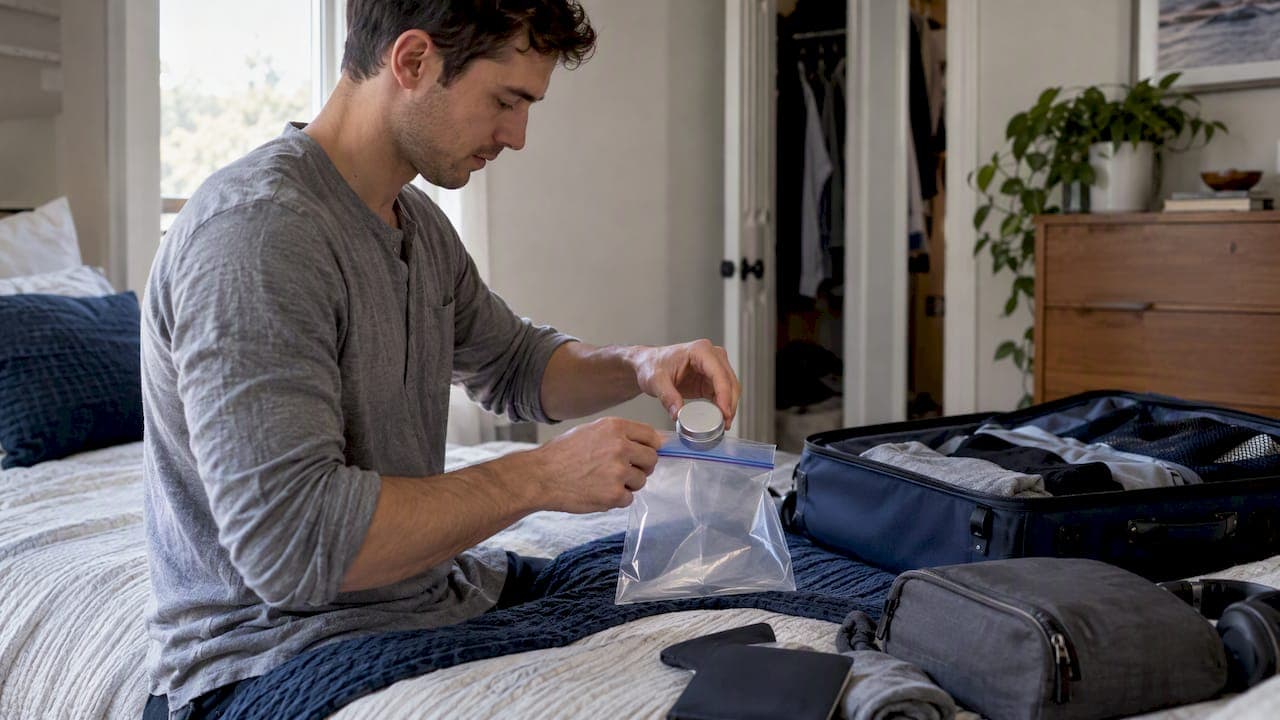
You can usually fly with CBD cream within the United States if it is hemp-derived and contains less than 0.3% THC. It must also meet the same carry-on size limit as any other cream: 3.4 ounces (100 ml) or less, or it goes in checked baggage. The catch is that no rule guarantees a smooth screening. The final call belongs to the officer at the checkpoint. Flying out of the country or back in is a different, riskier matter.
TL;DR
- Domestic flights: hemp-derived CBD cream under 0.3% THC is generally accepted. The decision rests with the TSA officer on the day.
- Carry-on creams follow the 3.4 oz (100 ml) rule. Larger tins go in checked baggage.
- Even a "THC-free" label does not protect you. Field tests cannot reliably tell hemp products from marijuana.
- International travel and returning to the U.S. carry real penalties. Leave CBD at home.
- Pack it in the original container, with the lab report, in your quart bag.
Table of Contents
- What TSA actually says about CBD
- The 3.4 oz rule applies to creams and balms
- Why a THC-free label does not settle it
- Flying out of the U.S. or coming back
- How to pack CBD cream for a domestic flight
- What to look for in a CBD topical you plan to travel with
- Our view: plan for the checkpoint, not for the best case
- Safety notes before you rely on a topical
- Our balms for travel
- FAQ
- Sources
What TSA actually says about CBD
TSA does not publish a clean "CBD is allowed" rule for topicals. Its medical marijuana page says that screening is focused on security threats. It also says the decision to allow any item through the checkpoint rests with the individual officer. TSA officers are not looking for drugs, but if they find something during screening, they may refer it to law enforcement.
The legal background is the 2018 Farm Bill, which made hemp with no more than 0.3% THC legal federally. That is why most travel guides say hemp-derived CBD is fine for domestic flights. It is a reasonable reading. It is not a written guarantee for your bag.
Two practical points follow:
- Your state's laws do not change what happens at a federal checkpoint. Federal agencies apply federal statutes, as U.S. Customs and Border Protection explains.
- A product that is legal where you bought it can still cause delays where you land. Some states are stricter about hemp products than federal law.
The 3.4 oz rule applies to creams and balms
TSA counts creams, gels and pastes as liquids. In a carry-on, each container must be 3.4 oz (100 ml) or less, and all of them must fit in one quart-sized bag. TSA's liquids, aerosols and gels rule says to pack anything larger in checked baggage.

There is an exception for medically necessary liquids. TSA's medication guidance says medications should be clearly labeled to help screening. But a CBD balm is not an FDA-approved medicine. Do not count on the medical exemption to carry a large tin through the checkpoint.
Quick size guide
| Container | Carry-on | Checked bag |
|---|---|---|
| 2 oz tin | Yes, if it fits in your quart bag | Yes |
| 3.4 oz or smaller | Yes, in your quart bag | Yes |
| Larger than 3.4 oz | No | Yes |
Our RIKKI TIKKI Recovery comes in a 2 oz tin, which sits under the carry-on limit. Check the size printed on any other container before you pack it.
Why a THC-free label does not settle it
This is the part most travelers miss. Even a cream with no THC can look suspicious at a checkpoint or border. CBP notes that CBD products are largely unregulated and that screening and field tests cannot always distinguish legal hemp products from marijuana. The CBP CBD fact page is written for its own employees, but its message applies to everyone: the legal status of CBD is confusing, and federal rules govern at the border.
The FDA adds another reason for caution. It warns that the CBD market is largely unregulated, and that products often contain more THC than the label says, or differ from their labels in quality and purity. That is why we point you to third-party lab results, not marketing claims.
In practice, for a domestic trip, the most likely outcome of a flagged tin is a delay, a conversation, or a request to leave it behind. That is annoying. It is not the same as the penalties below.
Flying out of the U.S. or coming back
International trips change the picture. Marijuana and THC remain prohibited under federal law, and CBP enforces that at ports of entry. CBP has issued civil penalties to travelers for cannabis products. In one Baltimore case, a traveler returning from Jamaica received a $500 Zero Tolerance penalty for THC edibles, vapes and other items. That case involved THC products, not a CBD cream. It shows how penalties work: a civil fine can be issued without an arrest.
Trusted traveler status adds another risk. In another Baltimore case, a Global Entry member lost the privilege and received a $500 penalty after a canine alert. If you hold Global Entry or similar status, the downside of carrying any cannabinoid product across a border is larger than the cost of a tin.
The destination country's laws also apply. Many countries treat CBD very differently from the U.S. Check the rules of your destination government before you pack anything. For a trip abroad, the simplest advice is to leave the balm at home and buy a non-CBD alternative there.

How to pack CBD cream for a domestic flight
Follow these steps. None of them is a guarantee, but together they make screening quicker and easier to explain.
- Check the THC content. Read the label and the certificate of analysis (COA). You want hemp-derived CBD at or below 0.3% THC.
- Print or save the lab report. Keep a copy on your phone and one on paper. A COA that matches the batch number on your tin is the best evidence you can offer.
- Keep the original container. Do not decant a balm into an unmarked jar. A labeled tin with the brand name and ingredients looks like what it is.
- Choose a size that meets the 3.4 oz limit. If you want to bring a carry-on, pick a tin of 3.4 oz or less and put it in your quart bag.
- Put it where you can reach it. If an officer asks to look at it, you should be able to take it out in seconds.
- Stay calm and be brief. Say what it is: a hemp-derived topical balm, with a lab report. Do not argue. If an officer says no, you can check it, leave it, or ask whether there is another option.
- Check your destination state. Look up its hemp rules before you land, especially if you are traveling with several products.
If you are heading to a competition or training camp, bring only what you need. A single small tin is easier to explain than a bag of topicals.
Carry-on or checked bag?
Both are allowed under TSA's general approach, but they work differently. In a carry-on, you can answer questions on the spot. In a checked bag, an officer may open the bag without you present and you will not be able to explain. Checked baggage also suits larger tins. If you need the balm during the trip, keep a small tin in your carry-on and any larger one in your checked bag.
Temperature is minor for a balm, but a tin in a checked bag can leak or soften in a hot hold. Put it in a zip-top bag.
What to look for in a CBD topical you plan to travel with
A travel-friendly balm is one you can document. Look for these:
- Third-party testing that you can actually open and read, with the batch number.
- A THC statement backed by a COA, not just a label claim.
- Clear ingredient list. Ours lists botanicals such as arnica, menthol, turmeric, eucalyptus and peppermint, so an officer or a doctor can see what is in the tin.
- A compact size that meets the carry-on limit.
- A refund policy in case a tin is confiscated or lost in transit.
Lab reports vary in how they are presented. If you want to see how a hemp retailer organizes lab-tested cannabinoid products, that is one example of the kind of transparency to look for, though rules there are German and not the same as in the U.S.
For more on how to compare formulas, read our guide to CBD balm ingredients that matter for pain relief. And if you are weighing options, see our best CBD cream for pain relief and recovery guide.
Our view: plan for the checkpoint, not for the best case
We make topical balms for people who train hard and for people who live with pain. Many of our customers travel for races, tournaments and work. They ask us the same question: "Will this get through?"
Our honest answer is that most domestic travelers have no trouble, and that nobody can promise it. Our balms use 1,000mg of CBD per ounce with botanicals such as arnica, menthol and turmeric. They are vegan, non-GMO, paraben-free, THC-free and cruelty-free, and they are third-party tested. Those facts help you explain the product. They do not change the fact that an officer makes the call, and that a field test cannot read a label.
So we tell customers to plan for the checkpoint, not for the best case. Carry a small tin. Keep the lab report. Stay polite. Have a plan if the answer is no: a backup option for sore muscles that has nothing to do with CBD, like a menthol rub, a foam roller or a heat pack.
We also tell them to be careful about what a CBD balm can do. The FDA has not approved any CBD product for pain, arthritis or muscle recovery, and we do not claim otherwise. If you have a condition that needs care, see your doctor. If you work in a safety-sensitive job, read our note on CBD cream and drug tests before you fly.
We also know that a trip is a poor time to try something new. Test a balm at home first. Our guide to a 2 to 6 week topical trial shows how, and our post on CBD balm side effects lists what to watch for. For a longer walk-through, see our own TSA guide for CBD cream.
— Cindy
Safety notes before you rely on a topical
Travel adds stress to the body: long sits, cramped legs, heavy bags, new beds. It is tempting to treat all of it with a balm. Keep these points in mind.
- It is not a cure. The FDA warns that relying on CBD instead of medical care for serious conditions can delay diagnosis and treatment. Swelling in one calf after a long flight, with pain or warmth, needs a doctor, not a balm.
- CBD has risks. FDA researchers have reported that CBD use can raise liver enzymes in some people. That study looked at CBD taken by mouth, not creams, but it is a reason to talk to your doctor if you use CBD regularly or take other medicines.
- Pregnancy and nursing. Ask your healthcare provider before using any CBD product.
- Skin. Do a patch test on a small area before you use a new balm on the road, away from broken skin and eyes.
Our balms for travel
If you want a balm you can pack with confidence, start with our two lines. Seriously Soothing Pain Balm and RIKKI TIKKI Recovery are priced from $26.95 to $39.95. Both are made for sore muscles, stiff joints and arthritis discomfort. A 2 oz tin of RIKKI TIKKI fits under the carry-on limit.
Every purchase is covered by our 30-day full refund policy, so you can try a balm at home before your trip. You can see the full range on the Mongoose CBD Co. homepage.
FAQ
Can I bring CBD cream in my carry-on?
Often yes, if it is hemp-derived, contains less than 0.3% THC, and the container is 3.4 oz (100 ml) or smaller and in your quart bag. The TSA officer has the final say. Larger containers belong in checked baggage.
Will a THC-free CBD cream pass a field test?
Not necessarily. Screening and field tests cannot reliably separate hemp products from marijuana, and the FDA notes that products labeled THC-free sometimes contain THC. A current lab report with a matching batch number helps you explain the product, but it does not guarantee the outcome.
Can I take CBD cream on an international flight?
We advise against it. CBP enforces federal law at the border, and travelers have received civil penalties, frequently starting around $500, for cannabis-related products. Your destination country may also ban CBD. Check its rules before you pack.
Should I pack CBD cream in checked luggage instead?
It is allowed in both, and checked bags suit tins over 3.4 oz. The trade-off is that you will not be there if someone opens the bag. Keep the lab report with the product and use a sealed plastic bag in case of leaks.
Is a CBD balm approved by the FDA for pain?
No. As of 2026, the FDA has not approved any CBD product for pain, arthritis or muscle recovery. The one approved CBD drug is a prescription medicine for certain seizure disorders. Talk to your doctor about pain that is severe or lasts.
Sources
- TSA: Medical Marijuana
- TSA: Liquids, Aerosols, and Gels Rule
- TSA: Traveling with medication
- CBP: CBD, Know the Facts
- CBP: Baltimore Zero Tolerance penalty, THC vapes and gummies
- CBP: Baltimore penalty on a trusted traveler
- FDA: Products containing cannabis or cannabis-derived compounds, including CBD
- FDA: CDER investigators address the safety of CBD in a randomized trial