

Cinnamon oil offers modest, short-term relief for muscle and joint pain when used topically, according to essential oil meta-analyses and cinnamon-specific animal research, but it works best as a supporting tool rather than your only line of defense. The strongest evidence points to an immediate effect after application, not a lasting cure. Dilute it properly, patch-test first, and treat it as an adjunct to whatever medical care you're already receiving.
TL;DR:
- The immediate pain relief effect of topical cinnamon oil is supported by animal studies and small human trials, but large-scale human evidence is lacking.
- Cinnamon's active compounds, cinnamaldehyde and eugenol, are linked to anti-inflammatory and warming sensations, yet concentrations and skin reactions vary widely in products.
- Proper dilution, patch testing, and cautious use are essential to avoid skin irritation; dilution guidelines recommend between 0.25% and 1% depending on sensitivity.
- Cinnamon oil’s pain relief is short-lived, with effects mainly seen immediately after application, making it a supportive adjunct rather than a primary treatment.
- It offers a warming, anti-inflammatory alternative to cooling oils like peppermint but should be used carefully, especially by pregnant women, children, or those on specific medications.
Table of Contents
- Does Cinnamon Oil Relieve Pain? What the Evidence Shows
- What Makes Cinnamon Oil Work? Cinnamaldehyde and Eugenol Explained
- How to Use Cinnamon Oil Safely on Skin
- Cinnamon Oil vs. Other Topical Options for Pain
- Side Effects and When to Stop Using Cinnamon Oil
- Dilution Chart and Two Safe Recipes to Try
- Where the Research Falls Short and What to Remember
- An Editor's Take on Cinnamon Oil's Real Role in Pain Care
- Try a Cinnamon-Based Balm Without Guessing on Dilution
- Sources
Does Cinnamon Oil Relieve Pain? What the Evidence Shows
The best available evidence on topical essential oils comes from a 2023 systematic review and meta-analysis that pooled results from multiple randomized controlled trials on musculoskeletal pain. The finding: essential oil application produced a statistically significant reduction in pain intensity, with the largest drop occurring immediately after application, at a mean difference of roughly −0.87 on standard pain scales. That number sounds small out of context, but on a typical 0 to 10 pain scale, a change close to one full point right after treatment is clinically noticeable to most people, even if it fades over the following days.
Here's the catch specific to cinnamon: that meta-analysis pooled data across several essential oils, not cinnamon oil alone. Cinnamon-specific human trials for pain are still thin on the ground. What exists instead is a growing body of animal research that looks promising but hasn't yet been replicated at scale in people.
The most compelling of these studies used a rat sciatic nerve injury model. Researchers applied cinnamon bark essential oil topically over a 28 day period and tracked motor activity, balance, and pain-related markers. The treated animals showed statistically significant improvement across all three measures compared to untreated controls, a meaningful signal for a compound tested in isolation rather than as part of a multi-ingredient blend, according to the 2023 sciatic nerve injury study.
Quick Stat: Topical essential oils reduce musculoskeletal pain intensity by a mean difference of about 0.87 points immediately after application, based on pooled randomized trial data. The effect is real, but it's front-loaded. It shows up fastest and fades over subsequent weeks.
Separate antinociceptive testing in mice has also linked cinnamon oil's core compounds to reduced pain response, adding a second line of preclinical support beyond the nerve injury model.
Where does this leave the evidence overall? A few honest limitations stand out:
- Sample sizes in the underlying trials are small, which widens the margin of error on any reported benefit.
- Essential oil types and concentrations vary widely between studies, making direct comparisons difficult.
- Many trials test oil blends rather than isolating cinnamon oil on its own, so it's hard to credit cinnamon specifically for the outcome.
- Grading systems used in systematic reviews rate the overall certainty of this evidence as low, largely because of these design issues, per the same 2023 systematic review.
None of this means cinnamon oil doesn't work. It means the research hasn't caught up to the everyday enthusiasm around it. The animal data is consistent and mechanistically sound, the pharmacology checks out, and the broader essential oil category has real clinical backing. What's missing is a large, well-controlled human trial testing cinnamon oil by itself. Until that arrives, the honest read is "promising, plausible, and not yet proven at scale in people."
What Makes Cinnamon Oil Work? Cinnamaldehyde and Eugenol Explained
Cinnamon oil's pain-relieving reputation traces back to two compounds: cinnamaldehyde and eugenol. Both are named repeatedly across pharmacological reviews as the drivers of cinnamon's anti-inflammatory and analgesic activity, and both have plausible mechanisms behind them rather than just folklore.
Cinnamaldehyde, the compound responsible for cinnamon's characteristic warmth, appears to interact with TRP channels, the same family of sensory receptors that respond to capsaicin's heat and menthol's cold. This is likely why cinnamon oil produces a warming sensation on skin rather than the cooling snap of peppermint or the numbing effect of clove. Eugenol, also found in clove oil, has documented anti-inflammatory activity and shows up in reviews describing suppressed inflammatory markers in laboratory models, according to the 2024 review of cinnamon oil's therapeutic potential.
A few things worth knowing about how these compounds behave in real products:
- Cinnamaldehyde and eugenol concentrations vary significantly between commercial cinnamon oils, and that variation affects both how well a product works and how likely it is to irritate skin.
- Higher cinnamaldehyde content generally means a stronger warming sensation, but also a higher risk of irritation if left undiluted.
- Standardization across brands is inconsistent, so two bottles labeled "cinnamon oil" can behave quite differently on skin.
Delivery matters too. Standard essential oils don't always penetrate deeply enough to reach the tissue layers where inflammation actually lives. Researchers have experimented with nanogel and nanoemulsion formulations, essentially engineering the oil into tiny particles that absorb more efficiently, and found improved anti-inflammatory and antinociceptive effects in animal models compared to plain oil, per the 2022 nanogel study on cinnamon and clove oils.
Most reputable topical blends keep active cinnamon compounds well below that threshold for a reason.*
How to Use Cinnamon Oil Safely on Skin
Cinnamon oil is potent enough that undiluted application is a genuine irritation risk, not a theoretical one. Cinnamaldehyde in particular has a track record of causing contact reactions at higher concentrations, so the entire safe-use approach hinges on dilution math you can actually follow.
Here's a practical sequence:
- Choose a carrier oil. Sweet almond oil, jojoba oil, and fractionated coconut oil are all common, stable choices that won't compete with cinnamon's effects.
- Dilute conservatively. For general massage over larger muscle groups, aim for 0.5% to 2% cinnamon oil in your carrier. For sensitive areas or your first-ever use anywhere on your body, drop to 0.25% to 0.5%.
- Do the math in drops. A 1% dilution works out to roughly 6 drops of essential oil per ounce (30 ml) of carrier oil. For a more sensitive 0.5% dilution, that's about 3 drops per ounce.
- Patch-test first. Apply a small diluted amount to the inside of your forearm and wait 24 hours before using it anywhere else. Watch for redness, itching, or burning that goes beyond a mild, temporary warming sensation.
- Know the difference between warmth and injury. A pleasant heat that fades within minutes is expected. Stinging, blistering, or spreading redness is not, and means you should wash the area with mild soap and water immediately.
- Limit frequency. Two to three applications per day on any single area is a reasonable ceiling; more than that increases irritation risk without added benefit.
Quick Stat: A 1% dilution, the upper conservative bound for general use, equals roughly several drops of essential oil per ounce of carrier oil, which is well below concentrations tested in some lab studies that used near-pure oil on animal skin.
A few groups need extra caution. Pregnant women, young children, and people managing diabetes should talk to a clinician before trying cinnamon oil topically, since some research has flagged glycemic effects worth discussing with a provider. Never apply cinnamon oil to open wounds, broken skin, or areas with active dermatitis. And if you're on prescription medication, especially anything affecting blood sugar or blood thinning, mention any new topical you're adding to your routine, since ingredient interactions aren't always intuitive.
Cinnamon Oil vs. Other Topical Options for Pain
Not every topical pain reliever works the same way, and picking the right one often comes down to matching the sensation and mechanism to the type of discomfort you're dealing with.
Peppermint oil leans on menthol, which produces a cooling sensation and has some of the strongest clinical signals in the essential oil category, particularly for tension headaches and surface-level muscle tightness. Cinnamon oil sits at the opposite end of the sensory spectrum: warming rather than cooling, with a profile that leans toward anti-inflammatory activity rather than the fast numbing effect menthol delivers.
Lavender and bergamot oils show up frequently in the aromatherapy literature, generally with softer evidence than peppermint but a track record across a broader meta-analysis of aromatherapy and pain showing the strongest effects for acute, nociceptive, and postoperative pain rather than chronic musculoskeletal complaints. Their strength lies more in the calming, whole-body aromatherapy effect than in a targeted anti-inflammatory action on a specific joint or muscle group.
Where does cinnamon fit against a CBD topical? The two aren't really competing mechanisms. CBD interacts with the body's endocannabinoid system and has a separate, growing evidence base around muscle recovery, which you can read more about in this breakdown of CBD for delayed-onset muscle soreness. Cinnamon oil, by contrast, works through TRP channel activation and anti-inflammatory compound activity. That's exactly why cinnamon shows up as a complementary ingredient in CBD balm formulations rather than a substitute for CBD. The warming sensation from cinnamaldehyde also gives users a felt cue that the product is working, which some people find reassuring even before the anti-inflammatory action kicks in.
If you're comparing options, here's a rough way to think about it:
- Fast, cooling relief for tension or headache: peppermint leads the pack.
- Broad anti-inflammatory support with a warming sensation: cinnamon oil fits, especially blended with clove.
- Calming, systemic support alongside topical relief: lavender or bergamot.
- Muscle recovery with a different biological pathway entirely: CBD topicals.
Side Effects and When to Stop Using Cinnamon Oil
The most common problem with cinnamon oil isn't a rare, severe reaction. It's plain old skin irritation from using too much, too concentrated, or too often. Contact dermatitis, redness, and a burning sensation that goes beyond mild warmth are the typical complaints, and cinnamaldehyde is the usual culprit, according to consumer safety guidance from Healthline's cinnamon oil overview.
Watch for these signs that mean it's time to stop:
- Redness that spreads beyond the application site or worsens after 30 minutes.
- Blistering, peeling, or any sensation resembling a chemical burn.
- Itching that persists for hours rather than fading quickly.
- Any breathing difficulty or facial swelling, which points to a genuine allergic reaction and warrants immediate medical attention.
If a reaction happens, wash the area with mild soap and cool water right away, and avoid reapplying anything to that spot until the skin has fully calmed down. Sun exposure on treated skin is another factor worth respecting. While cinnamon oil isn't among the classic phototoxic oils like bergamot or lime, any irritated skin becomes more sun-sensitive temporarily, so covering the area or avoiding direct sun for a few hours after application is a smart habit.
If you're managing diabetes or taking medication that affects blood sugar, loop in your provider before regular use, given some research interest in cinnamon's glycemic effects. Pregnant women and young children should avoid topical cinnamon oil unless a clinician has specifically approved it.
Pro Tip: Keep a small notebook or phone note logging when and where you apply cinnamon oil blends for the first two weeks. Skin reactions are sometimes delayed by a day, and a log makes it far easier to trace a reaction back to its actual cause.
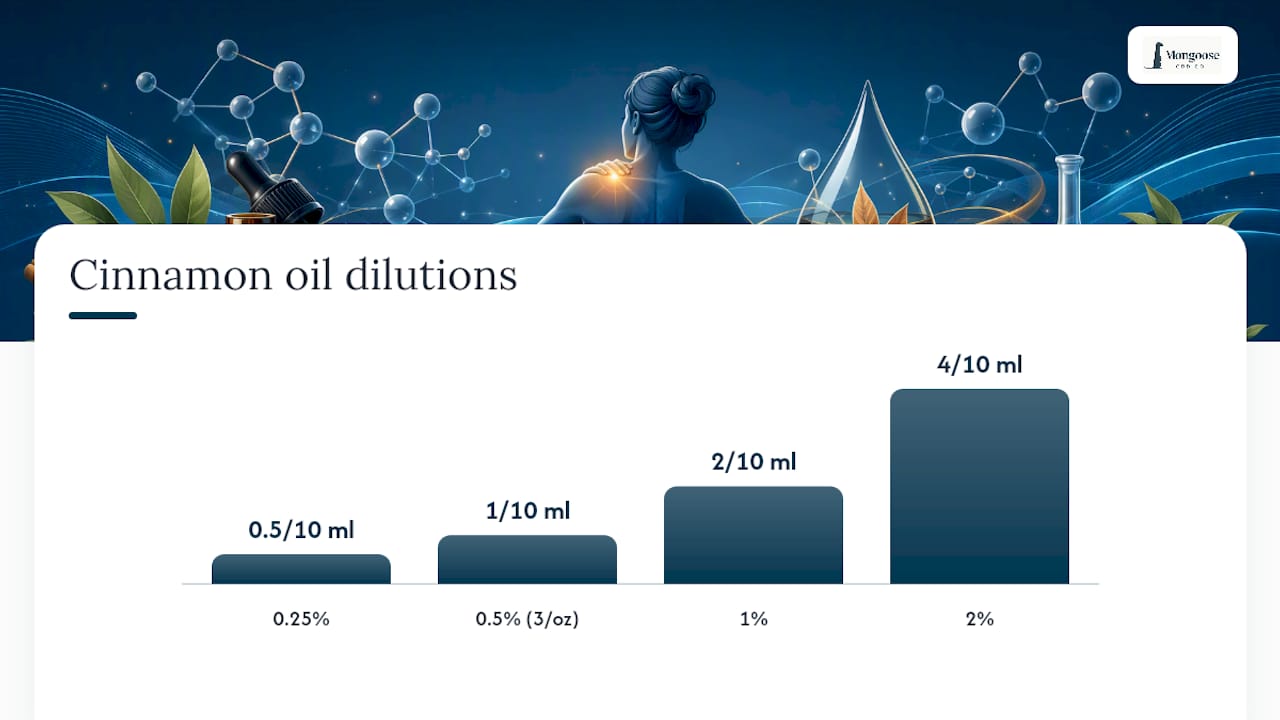
Dilution Chart and Two Safe Recipes to Try
Getting the ratio right is the single biggest factor separating a pleasant warming sensation from an irritated patch of skin.
| Dilution | Drops per ounce (30 ml) | Drops per 10 ml | Best use case |
|---|---|---|---|
| 0.25% | several drops | 0.5 drops | First-time trial, sensitive skin |
| 0.5% | 3 drops | 1 drop | Sensitive areas, daily light use |
| 1% | 6 drops | 2 drops | General massage, moderate muscle soreness |
| 2% | several drops | 4 drops | Larger muscle groups, tolerant skin |
Recipe 1: Large muscle massage blend. Combine 6 drops of cinnamon oil with 1 ounce of sweet almond or fractionated coconut oil for a 1% blend suited to shoulders, thighs, or the lower back after exercise.
Recipe 2: Focal joint warming blend. Combine 3 drops of cinnamon oil with 1 ounce of jojoba oil for a 0.5% blend, gentle enough for stiff knuckles or a cranky knee joint.
Before every use: patch-test on a new blend, check the skin is intact with no cuts or active irritation, and confirm you're not layering on top of another warming product like capsaicin cream. After use: wash your hands, watch the area for 30 minutes, and store the diluted blend away from heat and sunlight to preserve potency.
Where the Research Falls Short and What to Remember
The honest gaps: human trials testing cinnamon oil specifically, rather than blended with other oils, remain rare. Most positive data comes from animal models, and commercial product concentrations vary enough that lab results don't translate cleanly to what's on a store shelf.
What to actually take away:
- Expect a modest, mostly immediate effect, not a lasting fix.
- Always dilute and patch-test before broader use.
- Treat cinnamon oil as a supporting therapy, never a replacement for medical evaluation of chronic or worsening pain.
- Favor products with standardized concentrations over homemade blends of uncertain strength, and check in with a provider for anything beyond occasional, mild discomfort.
Quick Stat: The certainty of evidence behind topical essential oils for musculoskeletal pain is rated low by systematic review standards, a reminder that promising doesn't yet mean proven.
An Editor's Take on Cinnamon Oil's Real Role in Pain Care
The enthusiasm around cinnamon oil online often outpaces what the research actually supports, and that gap is where people get hurt, usually by skin irritation rather than anything more serious. The animal data is genuinely encouraging, and the mechanism makes biological sense. But cautious optimism is the right posture here, not blind faith. Cinnamon oil can help take the edge off sore muscles or a stiff joint in the short term, provided you dilute it properly and respect what your skin is telling you. For anything chronic, worsening, or accompanied by swelling that won't quit, a conversation with a clinician still beats another internet remedy. Formulated topicals from companies like Mongoose CBD Co. exist partly because getting the ratios right on your own kitchen counter is harder than it looks.
— Cindy
Try a Cinnamon-Based Balm Without Guessing on Dilution
One practical shortcut around all that dilution math: a pre-formulated balm that's already been calibrated for skin safety. Mongoose CBD Co.'s Seriously Soothing Pain Balm in cinnamon and clove pairs cinnamon's warming, anti-inflammatory profile with 1,000 mg of CBD per ounce, plus clove, giving you the sensory cue and the supporting compounds in one measured formula instead of a bottle of pure oil you have to dilute yourself.

It's built for the same use cases covered here: sore muscles after a workout, stiff joints, general inflammatory discomfort. Patch-test it the same way you'd test any new topical, on a small area of skin for 24 hours, since everyone's sensitivity differs even with a professionally formulated blend. If clove's warming profile appeals to you specifically, this guide to clove oil safety and dilution covers the overlapping ingredient in more depth. And if the balm isn't the right fit once you've tried it, Many companies back their products with a refund policy, so trying such balms carries little downside. Order the balm here and see how it fits into your routine.
Sources
For readers who want the primary research behind these claims: the 2023 systematic review and meta-analysis on topical essential oils anchors the clinical evidence. The rat sciatic nerve injury study and cinnamon and clove nanogel research cover the strongest preclinical findings. Readers interested in cannabinoid comparisons may also find this strain-selection guide for pain useful context.
This article is general information, not a substitute for advice from a qualified doctor. Consult a qualified healthcare professional about your own circumstances before acting on anything here.
- Cinnamon bark essential oil as an adjuvant treatment for sciatic nerve injury in rats (2023)