

Eucalyptus essential oil can genuinely help relieve sore muscles, and the evidence behind it is more solid than most herbal remedies can claim. The active compound, 1,8-cineole (also called eucalyptol), works through multiple pathways: it modulates pain-signaling receptors, reduces local inflammation, and produces a cooling-then-warming sensation that interrupts how your brain registers soreness.
-
Inhalation: Add 3–5 drops to a diffuser or place drops on a cotton pad and breathe normally for 5–30 minutes.
-
Topical: Mix a 2% dilution (about 12 drops per ounce of carrier oil) and massage into sore areas.
-
Safety first: Patch test before any topical use. Avoid eucalyptus inhalation around infants and young children, during pregnancy, or if you have known sensitivity to 1,8-cineole. PeaceHealth notes that evidence is suggestive but limited, so treat it as a complement to, not a replacement for, standard recovery practices.
Key Takeaways
Eucalyptus essential oil reduces perceived muscle pain through 1,8-cineole’s receptor-level activity and sensory modulation, with the strongest evidence supporting inhalation protocols over multi-day or multi-week periods.
| Point | Details |
|---|---|
| Inhalation works in trials | Two RCTs show significant VAS pain reductions: 30-minute sessions for 3 days (post-surgery) and 5 minutes 3x daily for 4 weeks (arthritis). |
| 2% topical is the evidence-based dilution | Mix 12 drops per 1 oz of fractionated coconut oil; apply at 0, 8, and 24 hours post-exercise for DOMS. |
| Relief timeline varies | Sensory cooling arrives within minutes; measurable pain reduction in chronic use takes 3–4 weeks of consistent inhalation. |
| Safety limits are firm | Avoid near infants and young children, during pregnancy, and in people with asthma or 1,8-cineole sensitivity. |
| Mongoosecbd’s Eucalyptus Mint Balm | Combines eucalyptus with CBD, menthol, and arnica in a standardized, third-party-tested formula with a 30-day refund policy. |
Table of Contents
-
What does the science actually say about eucalyptus for pain?
-
Ready balms vs. DIY eucalyptus blends: which should you choose?
-
Seriously Soothing Pain Balm: eucalyptus mint for muscle relief
What does the science actually say about eucalyptus for pain?
The strongest human evidence comes from two randomized controlled trials, and both point in the same direction: eucalyptus inhalation reduces perceived pain.
In a randomized clinical trial after total knee replacement, patients who inhaled eucalyptus oil for 30 minutes during continuous passive motion on three consecutive post-surgery days reported significantly lower VAS (Visual Analog Scale) pain scores than controls (P < .001). Blood pressure also dropped in the eucalyptus group, suggesting a broader autonomic calming effect. Inflammatory markers, specifically CRP and white blood cell counts, did not differ significantly between groups, which tells you the effect is more sensory and autonomic than a direct systemic anti-inflammatory response.
A separate randomized controlled trial in rheumatoid arthritis tested inhaling 1 mL of eucalyptus oil for 5 minutes, three times daily, over one month. Pain severity dropped significantly compared to placebo, with statistically meaningful differences appearing at weeks 3 and 4 (P < .05). Quality-of-life scores also improved (P < .001). That delayed benefit matters: if you try eucalyptus inhalation for two days and feel nothing, you haven’t given the protocol a fair run.
Animal and pharmacology studies add supporting detail. Research on 1,8-cineole in animal pain models shows reduced edema, suppressed cytokine secretion, and myorelaxant effects. These findings support the human trial results, though they don’t translate directly to dosing recommendations for people.
The honest limitation: most trials are small, conducted in surgical or arthritis populations, and few focus specifically on delayed-onset muscle soreness (DOMS) in otherwise healthy adults. A registered clinical trial protocol designed to test 2% topical eucalyptus for DOMS was terminated before completion, so that gap in the evidence still exists.
How does eucalyptus likely ease muscle pain?
It doesn’t work through a single mechanism; it hits several at once.
At the receptor level, 1,8-cineole activates hTRPM8 (the cold receptor), antagonizes hTRPA1, and inhibits P2X3 receptors. TRPM8 activation is what produces that familiar cooling sensation when you apply a eucalyptus product to skin. Blocking TRPA1 and P2X3 reduces the transmission of pain signals at the peripheral nerve level. Together, these actions dampen how intensely your nervous system registers soreness.
The anti-inflammatory side involves cytokine modulation. In animal models, 1,8-cineole suppresses pro-inflammatory cytokine production and shows antioxidant activity, which can reduce the local inflammatory signaling that makes muscles feel stiff and tender after hard exercise or injury.
There’s also a gate-control component. The strong sensory input from topical eucalyptus, that cooling-warming shift, competes with pain signals traveling to the brain. This isn’t a placebo effect; it’s the same mechanism behind ice packs and menthol creams. The Inflammopharmacology review confirms that both topical and inhalation routes are supported by this pharmacology, though the degree of effect depends heavily on concentration and how the product is formulated.
That’s the threshold recognized for medicinal use.*
How to use eucalyptus for sore muscles, step by step
Inhalation method
-
Add 3–5 drops of eucalyptus oil to an ultrasonic diffuser filled with water. Run it in a well-ventilated room for 30 minutes. This mirrors the protocol from the post-knee-replacement trial.
-
Alternatively, place 2–3 drops on a cotton pad or inhaler stick and breathe normally for 5 minutes, three times daily. This matches the rheumatoid arthritis trial protocol.
-
Keep the room ventilated. Don’t seal yourself in a small space with concentrated vapor.
-
Repeat daily for at least two to four weeks if targeting chronic soreness. Acute post-workout use can start immediately.
Topical application for DOMS or general muscle soreness
-
Mix a 2% dilution: approximately 12 drops of eucalyptus oil per 1 oz (30 mL) of fractionated coconut oil. This concentration aligns with the DOMS clinical protocol.
-
Patch test first: apply a small amount to your inner forearm, wait 24 hours, and check for redness or irritation.
-
Apply to the sore muscle group using moderate pressure. Work in the direction of muscle fibers, not across them.
-
Reapply at 8 hours and again at 24 hours post-exercise for DOMS, or two to three times daily for ongoing soreness.
-
Avoid applying over broken skin, open wounds, or acutely inflamed joints where the skin is visibly hot and swollen.
Eucalyptus compress
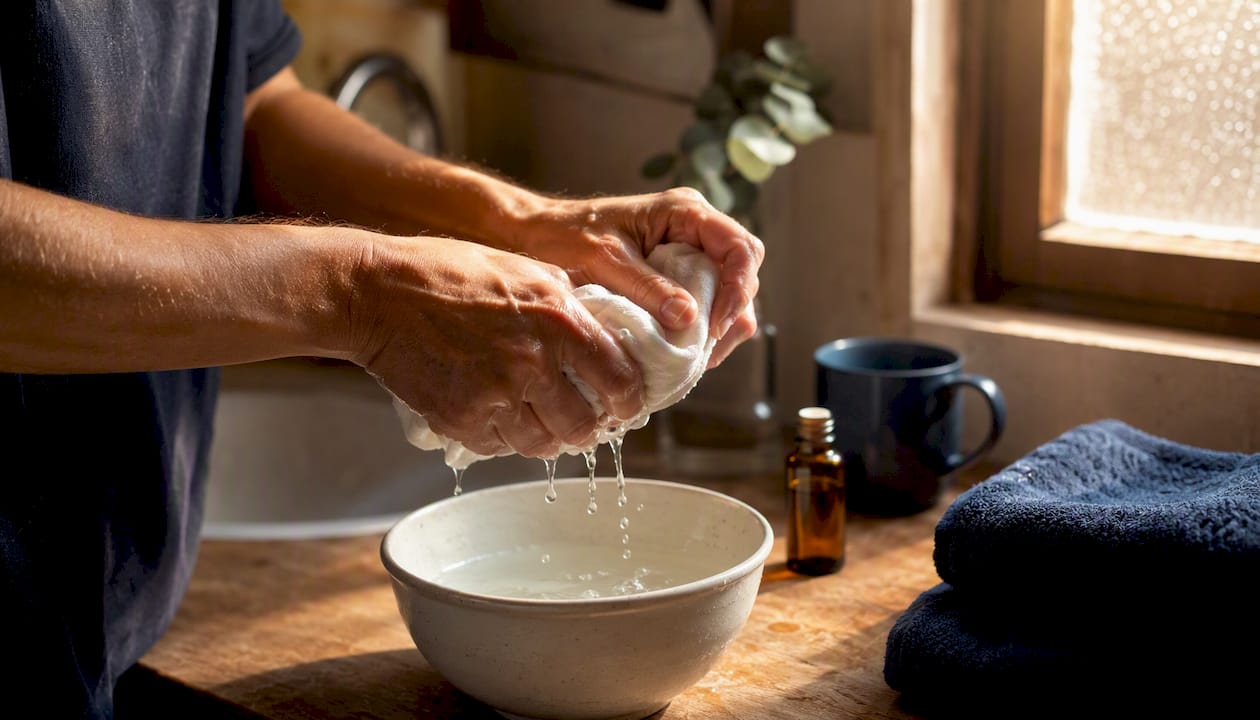
Soak a clean cloth in warm water with 4–6 drops of eucalyptus oil mixed in (stir well before soaking). Wring out and apply to the sore area for 10–20 minutes. The warmth helps the oil penetrate while the eucalyptus provides sensory relief.
Pro Tip: Eucalyptus pairs well with arnica and menthol in topical blends. If you’re using a ready-made balm that already contains these ingredients alongside CBD, you don’t need to layer a separate eucalyptus oil on top — the formulation handles the synergy.
Ready balms vs. DIY eucalyptus blends: which should you choose?
The case for a ready-made balm is mostly about consistency and convenience. A formulated product removes those variables.
Ready balms also tend to include penetration enhancers and complementary actives that a simple carrier oil doesn’t provide. Arnica reduces bruising and local inflammation. Menthol amplifies the TRPM8 cooling effect. CBD, at meaningful concentrations, adds its own anti-inflammatory and recovery-support properties. The combination isn’t just additive; these ingredients interact in ways that can produce a stronger sensory and biochemical effect than eucalyptus alone.
DIY blends have their place. If you want to control exactly which carrier oil you use (jojoba for sensitive skin, for example), or if you’re experimenting with concentration, mixing your own gives you that flexibility at lower cost. The tradeoff is that you’re responsible for sourcing a quality eucalyptus oil, verifying its 1,8-cineole content, and measuring accurately every time.
Buying checklist for any eucalyptus product:
-
Species listed as Eucalyptus globulus or E. radiata
-
1,8-cineole content stated (aim for 60% or higher for medicinal use)
-
Third-party testing certificate available
-
Full ingredient list with no undisclosed “fragrance” blends
-
Clear dilution percentage for topical products
For readers considering a CBD-plus-eucalyptus option, Mongoose CBD’s Seriously Soothing Pain Balm in Eucalyptus Mint combines eucalyptus with CBD, menthol, arnica, and other botanicals in a pre-tested, standardized formula. It’s also worth exploring the CBD balm for arthritis evidence if joint pain is part of your picture.
Safe dilutions and quick recipes for adults
The table below shows practical dilution percentages for adult topical use, based on clinical protocols and standard aromatherapy safety guidance.
| Dilution | Drops per 1 tsp (5 mL) | Drops per 1 oz (30 mL) | Best use |
|---|---|---|---|
| 1% | 1 drop | 6 drops | Sensitive skin, first use |
| 2% | 2 drops | 12 drops | Standard post-workout rub, DOMS |
| 3% | 3 drops | 12 drops | Targeted area rub, short-term use |
| 5% | 5 drops | 30 drops | Limited-area application, adults only |
Three ready-to-use recipes:
-
2% post-workout rub: 12 drops eucalyptus oil in 1 oz fractionated coconut oil. Apply to sore muscles within an hour of exercise, then again at 8 and 24 hours.
-
Eucalyptus compress: 5 drops eucalyptus oil in a bowl of warm water. Soak a cloth, wring, and apply for 10–20 minutes.
-
Inhalation pad: 3 drops on a cotton pad placed near (not touching) your nose for 5 minutes. Repeat up to three times daily.
Special population cautions:
-
Children under 10: Eucalyptus oil should not be applied to the face, chest, or near the airways of young children. The 1,8-cineole content can cause respiratory distress. Consult a pediatrician before any use.
-
Pregnancy and nursing: Avoid topical eucalyptus and concentrated inhalation without explicit guidance from your OB or midwife.
-
Asthma and severe eczema: Inhalation can trigger bronchospasm in sensitive individuals. Start with minimal exposure and stop immediately if breathing changes.
-
Sensitive skin: Always start at 1% dilution and patch test for 24 hours.
Risks, side effects, and when to avoid eucalyptus
The most common problem with eucalyptus oil is local skin irritation, ranging from mild redness to contact dermatitis. MedlinePlus documents these reactions alongside pediatric and respiratory cautions as the primary safety concerns for topical and inhalation use.
Patch test protocol: Apply a small amount of your diluted blend to the inner forearm. Leave it uncovered for 24 hours. If you see redness, swelling, or feel itching, don’t use that concentration on larger areas. Try a lower dilution or a different carrier oil.
Respiratory risk is real for specific groups. Concentrated inhalation around infants and small children can cause central nervous system depression and breathing problems. Adults with asthma or severe COPD should approach inhalation cautiously, starting with brief, low-concentration exposure in a ventilated space.
Systemic precautions worth knowing: eucalyptus may interact with certain medications metabolized by the liver (CYP enzyme pathways), and people with seizure disorders should consult a clinician before regular use. Pregnancy warrants caution because safety data for concentrated topical or inhalation use during pregnancy is limited.
Stop use and seek care if you experience: hives or severe rash, difficulty breathing, chest tightness, significant swelling, or if muscle pain worsens rather than improves after several days of consistent use.
How quickly can you expect relief?
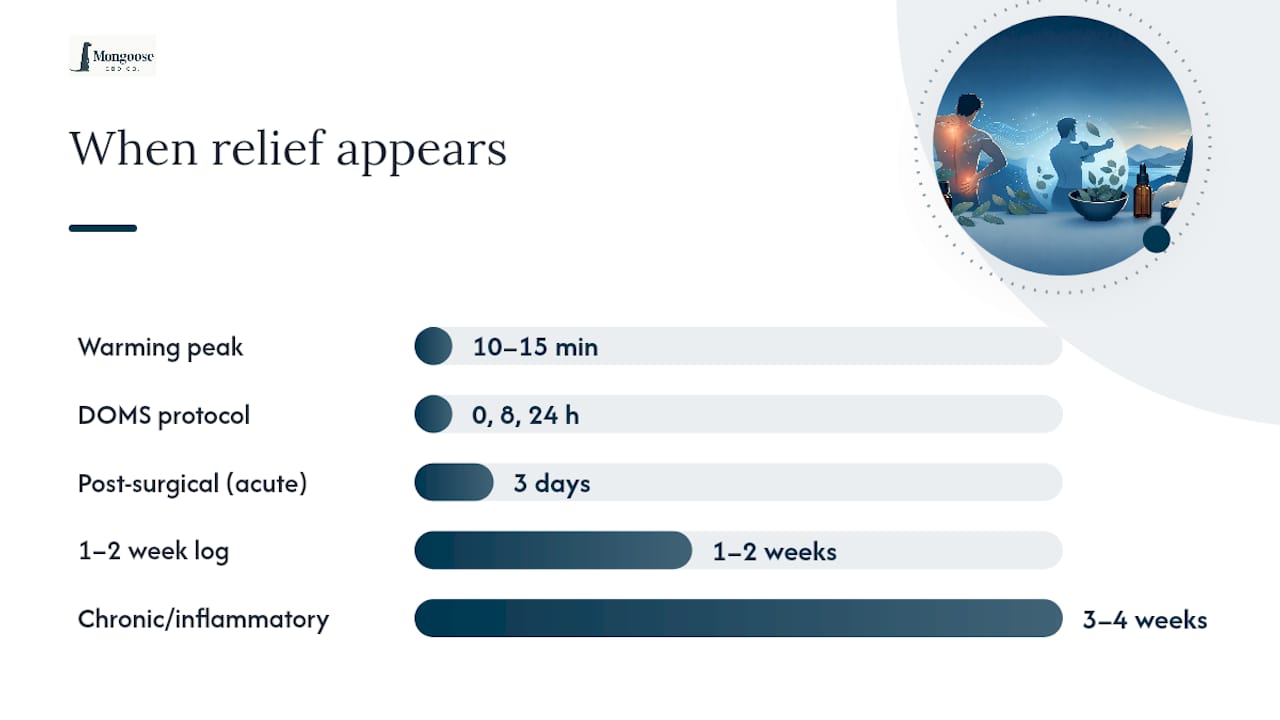
Sensory relief from topical eucalyptus tends to arrive within minutes. The cooling sensation from TRPM8 activation is nearly immediate, and the warming that follows usually peaks within 10–15 minutes of application. That short-term sensory shift can meaningfully reduce how sore a muscle feels in the moment, even before any anti-inflammatory effect has time to build.
Measurable pain reduction over time follows a different timeline:
-
Post-surgical or acute use: The knee replacement trial showed significant VAS reductions across three days of inhalation sessions, suggesting that consistent short-term use can produce cumulative benefit fairly quickly in acute pain settings.
-
Chronic or inflammatory soreness: The rheumatoid arthritis trial found statistically significant pain reductions at weeks 3 and 4. Expect a 3–4 week window before judging whether inhalation is working for ongoing soreness.
-
DOMS: Topical application at 0, 8, and 24 hours post-exercise is the protocol the terminated DOMS trial was designed to test. Anecdotally, the sensory relief is noticeable; the anti-inflammatory benefit likely builds over repeated sessions.
If you’re not feeling benefit after a reasonable trial:
-
Check your eucalyptus oil’s 1,8-cineole content. Low-quality oils may contain far less than 60%.
-
Increase inhalation frequency before increasing topical concentration.
-
Combine with other recovery strategies: adequate sleep, hydration, gentle mobility work, and ice or heat as appropriate.
-
Track soreness on a simple 0–10 scale daily. A 1–2 week log makes it much easier to see whether the protocol is actually moving the needle.
Why I recommend evidence-guided, cautious eucalyptus use
The evidence for eucalyptus as a muscle pain aid is real, but it’s also specific. The strongest trials tested inhalation in surgical and arthritis patients, not recreational athletes with post-leg-day soreness. That doesn’t mean it won’t help you; it means you should approach it as a well-supported adjunct, not a standalone treatment.
What I find genuinely useful about eucalyptus is that it works through multiple mechanisms simultaneously. The sensory relief is immediate and real. The anti-inflammatory and receptor-level effects build with consistent use. And when eucalyptus is combined with other evidence-backed actives like CBD, arnica, and menthol in a standardized balm, you’re stacking complementary mechanisms rather than relying on any single compound.
My recommendation: start with inhalation (it’s the best-evidenced route), add a properly diluted topical for localized soreness, and if you want a ready-made option that handles the formulation work for you, a product like Mongoosecbd’s Seriously Soothing Pain Balm is a transparent, well-specified choice. Keep moving, stay hydrated, and treat eucalyptus as one tool in a recovery plan, not the whole plan.
Seriously Soothing Pain Balm: eucalyptus mint for muscle relief

The Seriously Soothing Pain Balm in Eucalyptus Mint from Mongoosecbd delivers 1,000mg of CBD per ounce alongside eucalyptus, menthol, arnica, turmeric, and other botanicals in a single pre-tested formula. You get the sensory cooling of eucalyptus and menthol, the anti-inflammatory support of arnica and turmeric, and the recovery-focused properties of CBD, without measuring drops or sourcing multiple ingredients. It’s vegan, non-GMO, paraben-free, and THC-free.
Apply a small amount directly to sore muscles, massage in using circular pressure, and repeat two to three times daily. It layers well with stretching and light mobility work after application. For post-workout use, apply within an hour of exercise and again before bed.
Not sure it’s right for you? Mongoosecbd backs every purchase with a 30-day full refund policy. You can also try a free sample before committing to a full size.
Sources
-
The Efficacy of Eucalyptus globulus Essential Oil in the Management of Pain
-
Therapeutic applications of eucalyptus essential oils | Inflammopharmacology | Springer Nature Link
-
Eucalyptus for Sports & Fitness – Health Information Library | PeaceHealth
A note on evidence strength: Small trials and animal studies support eucalyptus for muscle pain, but they don’t carry the same weight as large, multi-site randomized trials. Clinicians typically treat this level of evidence as “promising and worth using cautiously” rather than “definitively proven.” That’s the right frame here: the mechanisms are plausible, the human trials are positive, and the safety profile for adults is manageable with proper dilution and patch testing.
This article is for general informational purposes only and is not a substitute for professional medical advice. Consult a qualified healthcare provider before using eucalyptus oil if you have a medical condition, are pregnant, or take prescription medications.