
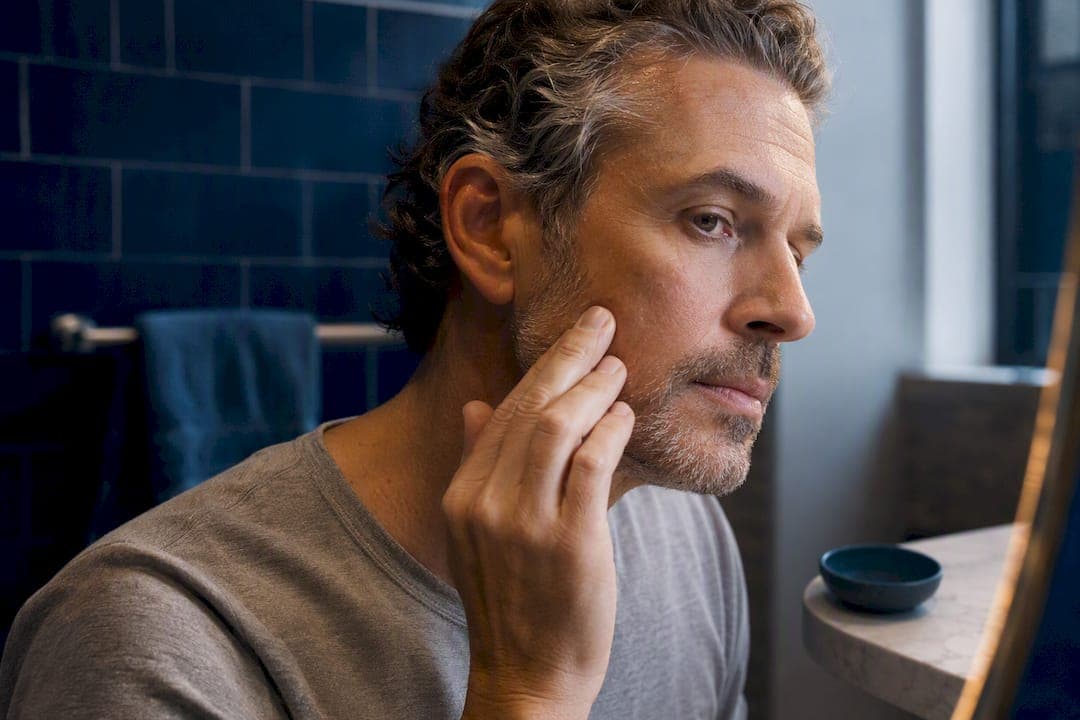
Topical CBD balms are a reasonable, low-risk option for some people managing localized facial or trigeminal-area discomfort, because they work at the skin rather than moving through the bloodstream. Start with a patch test, then apply a small amount to a nearby muscular hotspot rather than the nerve site itself, avoiding the eyes and mucous membranes. A formulation like Mongoose CBD Co.'s balms with a substantial CBD concentration per ounce backed by a 30-day refund policy gives you a low-risk way to test the approach. Severe or episodic nerve pain still needs a clinician's input.
TL;DR:
- Topical CBD balms with high CBD concentration and skin-penetrating formulations are a low-risk option for localized facial discomfort, but not for severe nerve pain.
- Patch testing is essential for facial use, especially for sensitive skin, to prevent irritation or allergic reactions before full application.
- Formulations with carrier oils, known CBD content, and botanicals like arnica and menthol improve effectiveness, but real absorption depends on product quality.
- Topical CBD interacts locally with endocannabinoid receptors, staying near the skin surface and reducing systemic drug interaction risks.
- Trial and logging are recommended to assess actual benefit, with a 30-day refund policy making a well-formulated balm a low-cost, low-risk experiment.
Table of Contents
- How Do Topical CBD Balms Work for Facial Pain?
- Is It Safe to Patch-Test CBD Balm on Your Face?
- What Should You Look for When Choosing a CBD Balm?
- How Do You Apply CBD Balm to the Facial Area?
- Does Research Support CBD for Nerve and Facial Pain?
- Can CBD Balm Interact With Other Medications?
- Are CBD Balms Better Than Other OTC Options for Facial Pain?
- Why I'd Trust a Balm Trial Over Guesswork
- Try a Targeted Balm Built for Real Relief
- Sources
How Do Topical CBD Balms Work for Facial Pain?
CBD applied to the skin interacts with receptors in the local endocannabinoid system, including CB1, CB2, and TRP channels, which appear to help modulate inflammation and calm overactive pain signaling right where you apply it. That local action is why balms behave differently than oral or inhaled CBD. A topical CBD review found that skin-applied cannabidiol tends to stay near the application site rather than reaching the bloodstream in meaningful amounts, which lowers systemic risk and makes balms a sensible choice for a targeted jaw or cheek hotspot instead of whole-body treatment.
Formulation determines whether any of this actually reaches the receptors that matter. CBD is lipophilic, meaning it dissolves in fats rather than water, so a balm's carrier oils and waxes have to be built to help it cross the skin barrier. A review of topical delivery methods notes that well-engineered formulations sometimes use penetration aids or nanoencapsulation to improve how much CBD actually gets absorbed into tissue, not just sitting on the surface.
What separates an effective balm from a scented lotion:
- A carrier base (oils, waxes) chosen for skin penetration, not just texture
- A stated CBD concentration per ounce, not a vague "infused" claim
- Complementary botanicals formulated to work alongside CBD, not just to add scent
- A texture that allows for controlled, localized application near the jaw or temple
Is It Safe to Patch-Test CBD Balm on Your Face?
Topical CBD is generally well tolerated, but the face is more sensitive than a shoulder or knee, so testing first matters more here. A review of CBD's effects on skin health recommends a patch test before applying any topical to sensitive or facial skin, since mild irritation can occur even with well-formulated products.
Here's a simple sequence to follow before your first full application:
- Apply a dime-sized amount to your inner forearm or behind the ear.
- Leave it undisturbed for 24 to 48 hours without washing the area.
- Check for redness, itching, or bumps; mild warmth from menthol or cinnamon is normal, but blistering is not.
- If the skin stays clear, apply a small amount near the facial hotspot, still avoiding the eyes, lips, and any broken skin.
- Stop immediately and rinse with water if you notice spreading redness, swelling, or a rash.
Contact a dermatologist if a reaction spreads or persists beyond a day. If your facial pain is a diagnosed neuropathic condition and you experience a severe attack, that's a signal to talk to the clinician managing that condition, not to increase how much balm you're using.
What Should You Look for When Choosing a CBD Balm?
Potency matters, but it's not the whole story. A balm listing 1,000mg CBD per ounce gives you a meaningful concentration to work with, though how well that CBD penetrates the skin depends just as much on the vehicle it's suspended in as on the number on the label. A high-potency balm in a poor carrier base can underperform a moderate-potency balm built with skin-penetration in mind.
Look past the CBD number and check what else is doing work in the formula:
- Arnica is a traditional anti-inflammatory botanical often used for bruising and muscle soreness.
- Menthol produces a cooling sensation that can distract from underlying ache, though it can feel sharp on facial skin.
- Eucalyptus and peppermint add a similar cooling effect and mild anti-inflammatory properties.
- Turmeric and cayenne bring warming, circulation-supporting compounds that some people find soothing and others find too intense near the face.
- Cinnamon and clove contribute warmth and a mild numbing sensation, popular in recovery-focused blends.
Before buying, confirm the brand publishes a third-party certificate of analysis (COA) verifying CBD content and confirming the product is THC-free, along with a full ingredient list and any allergen flags. A breakdown of isolate versus full-spectrum topicals explains why THC-free isolate formulas are often the safer starting point if you're new to CBD or applying near sensitive facial skin. For a first purchase, a smaller tin like the cinnamon and clove balm lets you control dosing without committing to a large jar.
Pro Tip: If you have sensitive skin or a history of facial dermatitis, start with a fragrance-light, lower-menthol formula. The warming and cooling agents that feel great on a sore hamstring can feel harsh on thinner facial skin.
How Do You Apply CBD Balm to the Facial Area?
Application technique changes how much benefit you get from any topical, and the face requires more care than a shoulder or forearm.
- Wash your hands and the target area with mild soap, then pat dry.
- Warm a pea-sized amount of balm between two fingers for a few seconds; this softens the wax base and helps it absorb.
- Massage it gently into the muscle or hotspot near the jaw, temple, or cheek, not directly onto broken skin or mucous membranes, using light circular motion for 30 to 60 seconds.
- Wait 10 to 30 minutes before deciding whether to reapply, and note how your skin and pain level respond.
- Keep a simple log for the first week: time applied, location, sensation, and pain level before and after.
Massaging balm into tissue rather than lightly spreading it appears to improve local uptake, since warming and friction help move product past the surface layer of skin. Stop use and contact a clinician if you notice persistent irritation, worsening pain, or any sign of skin infection like increasing redness or warmth. A practical guide to using CBD balm covers dosing and tracking in more detail if you want a broader routine beyond facial application.
Pro Tip: Apply before bed on the first few tries. If irritation shows up overnight, you'll catch it before you need to leave the house, and you'll have a clean baseline for judging next-day effects.
Does Research Support CBD for Nerve and Facial Pain?
The evidence for topical CBD's anti-inflammatory and pain-modulating effects is real but still developing, and it's important to be honest about where it stops. Preclinical work shows CBD applied to skin can reduce pro-inflammatory signaling and affect pain pathways through multiple receptor types, including CB1, CB2, TRPV, and serotonin receptors, according to a 2025 review of CBD's topical therapeutic potential.
What the same research makes clear:
- Clinical trials specifically testing topical CBD for trigeminal neuralgia don't currently exist; most support comes from broader neuropathic and localized pain research.
- Formulation differences between studies make results hard to compare directly, since one balm's penetration profile can differ wildly from another's.
- Preclinical and early clinical signals are promising for localized inflammation and pain, but they fall short of proof for any one nerve condition.
The realistic takeaway: trying a topical CBD balm as an adjunct for localized facial discomfort is a low-risk experiment worth running, but it shouldn't replace medical management of a diagnosed neuropathic condition. If your trigeminal neuralgia is medically diagnosed, keep your prescribing clinician in the loop rather than substituting a balm for their guidance.
Can CBD Balm Interact With Other Medications?
Because topical CBD balms act locally and largely stay out of the bloodstream, they carry a much lower interaction risk than oral CBD or prescription cannabinoids, which can affect liver enzymes that process other drugs. Still, a few situations call for extra caution.
If you're using other topical treatments on the same area, such as prescription creams, lidocaine patches, or capsaicin products, applying CBD balm on top can dilute or alter how those products absorb. Space applications apart or check with a pharmacist about layering topicals.
People managing trigeminal neuralgia are sometimes on anticonvulsants like carbamazepine or muscle relaxants for related jaw tension. Topical CBD isn't known to interact with these systemically the way oral CBD can, but if you notice unexpected drowsiness, dizziness, or a new skin reaction after starting a balm, mention it to your clinician rather than assuming it's unrelated.
Anyone with a known sensitivity to essential oils, menthol, or botanicals like arnica should read ingredient lists carefully, since a balm's supporting ingredients are more likely to cause a reaction than the CBD itself. If you're on blood thinners and considering arnica-containing balms for bruising, ask your doctor first, since arnica has mild effects on clotting in some formulations.
Are CBD Balms Better Than Other OTC Options for Facial Pain?
Standard over-the-counter options for facial and jaw discomfort include menthol rubs, lidocaine patches, capsaicin creams, and NSAID gels. Each works through a different mechanism, and none is automatically superior for every situation.
Menthol-only rubs create a cooling counter-irritant effect but don't address inflammation the way CBD combined with arnica or turmeric can. Lidocaine patches numb the surface effectively but wear off fast and can't be used near the eyes or mouth, which limits their use on much of the face. Capsaicin creams work through desensitizing nerve endings over repeated use, but the initial burning sensation is often too intense for facial skin. NSAID gels like diclofenac reduce inflammation systemically absorbed through skin, but carry their own interaction warnings for people on blood thinners or with kidney concerns.
A well-formulated CBD balm sits in a different lane: it combines local anti-inflammatory botanicals with a receptor-level mechanism, without the burn of capsaicin or the numbing blackout of lidocaine. That makes it a reasonable middle-ground option for people who want ongoing, repeatable relief rather than a one-time numbing effect. It's not automatically stronger than a prescription-strength NSAID gel for acute inflammation, but for daily, low-grade facial tension, the gentler mechanism and lower interaction profile make it worth trying first. A comparison of topical versus oral CBD breaks down why localized application outperforms oral CBD specifically for spot treatment rather than whole-body effects. For readers curious how CBD topicals stack up against classic menthol rubs, a comparison of Icy Hot alternatives covers that ground in more detail. If you want broader context on how CBD topicals fit among other hemp-derived products, a breakdown of hemp flower versus CBD flower versus THCA flower explains the category differences.
Why I'd Trust a Balm Trial Over Guesswork
Most people researching this topic have already tried a few things that didn't work, and that's exactly why formulation transparency matters more than marketing claims. Writing about TMJ, fibromyalgia, and arthritis pain for Mongoosecbd's blog has made one pattern obvious: the people who get real relief from topical CBD are the ones who treat it like a controlled experiment, not a miracle purchase. They patch-test, they log their response, and they give a formula a fair week or two before deciding it doesn't work.
That's why a balm formulated with a substantial CBD concentration per ounce with carefully chosen botanicals like arnica, menthol, eucalyptus, and turmeric designed for targeted effects rather than scent alone deserves more attention than a bargain-bin tub with a vague "CBD-infused" label. Mongoose CBD Co.'s vegan, THC-free formulations are built around that same discipline. If a balm doesn't deliver, a 30-day refund policy removes the main reason people talk themselves out of trying a topical in the first place: the fear of wasting money on something that doesn't help.
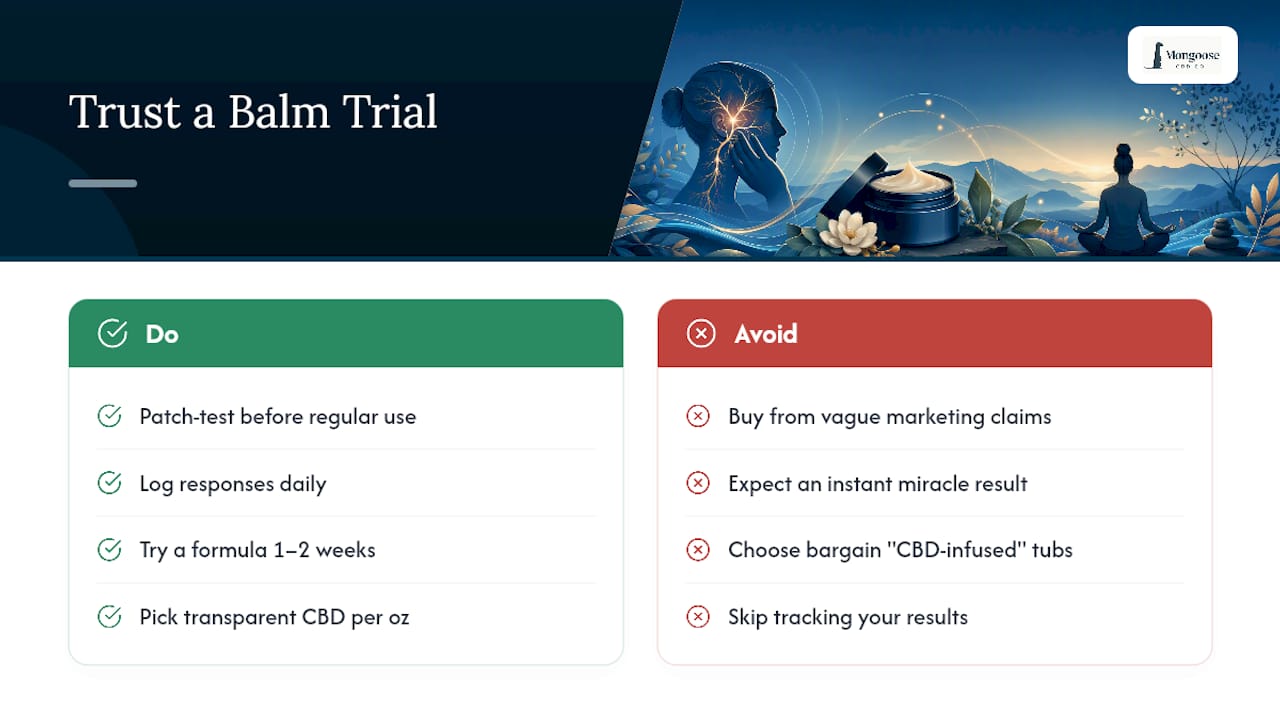
The honest opinion here is simple: skepticism is healthy, but it shouldn't stop you from running a low-risk, well-documented trial with a transparent product.
— Cindy
Try a Targeted Balm Built for Real Relief
If you've read this far, you already know that not every jar labeled "pain relief" is formulated with your facial or muscular hotspot in mind. Mongoosecbd builds balms around a stated 1,000mg CBD per ounce potency and a specific botanical purpose, whether that's arnica and menthol for inflammation or cinnamon and clove for warming relief, so you're not guessing what's actually in the jar.
The Seriously Soothing Pain Balm is the original formulation and a solid starting point for facial or jaw-area tension, while the Rikki Tikki Recovery balm is built for athletes managing broader muscle recovery alongside localized soreness. Every formula is vegan, non-GMO, paraben-free, and THC-free, and backed by a 30-day full refund policy if it doesn't work for your skin. Order a tin, run the patch test outlined above, and give it a fair trial on your own schedule.
This article is general information, not a substitute for advice from a qualified doctor. Consult a qualified healthcare professional about your own circumstances before acting on anything here.