
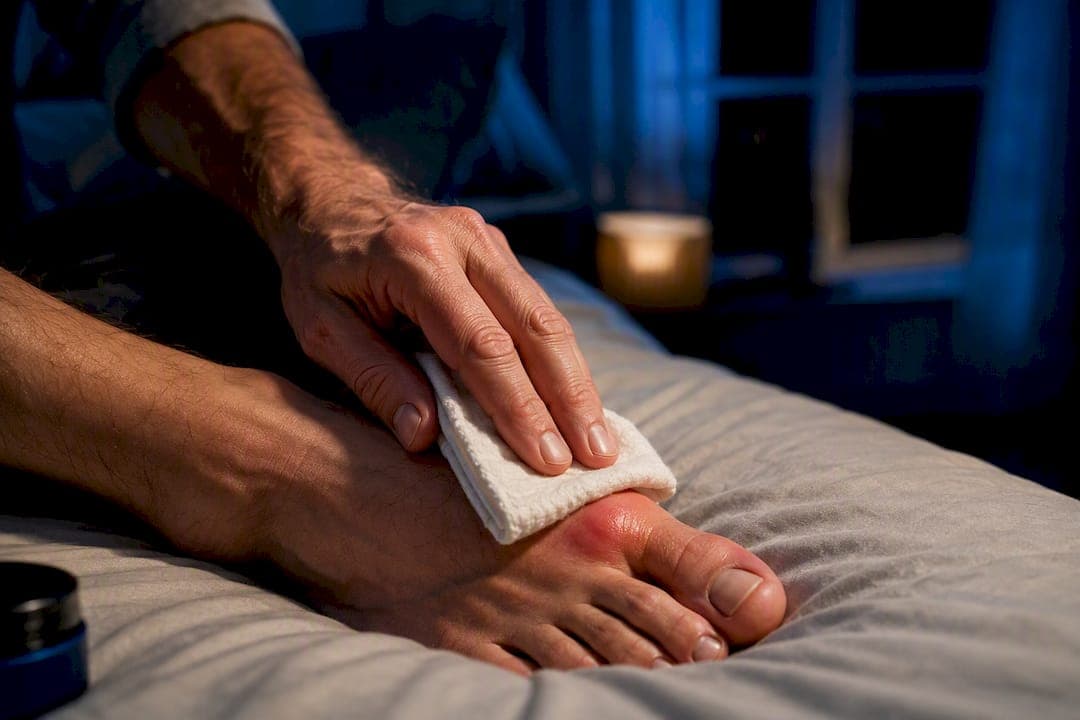
CBD may ease pain and swelling during a gout flare, but nothing shows it lowers uric acid or treats the disease itself. The bigger concern is drug interactions, especially with colchicine. If you want to try it, start with a topical balm on the affected joint and check with your prescriber first.
TL;DR:
- Topical CBD shows animal-based evidence of reducing joint swelling and pain, but human studies outside gout are mixed, and there are no gout-specific trials.
- CBD does not lower uric acid levels, so it only addresses symptoms; any anti-inflammatory effects are unproven for gout attacks.
- When trying CBD during a flare, applying a balm directly to the affected joint limits systemic exposure and reduces drug interaction risks, especially with colchicine.
- CBD interacts with liver enzymes that process gout medications, notably increasing colchicine levels and raising the risk of side effects.
- Always consult your healthcare provider before combining CBD with gout medications and perform patch tests before extensive topical use to ensure safety.
Table of Contents
- What the research actually shows on CBD for gout pain
- How CBD might work on gout pain and swelling
- Topical vs. oral CBD: which one fits a gout flare?
- Safety, side effects, and drug interactions with gout medications
- A stepwise plan for trying CBD safely during a gout flare
- Where a topical balm fits into this picture
- What actually matters here, and what gets overstated
- Try a Topical Balm Built for Joint Flares
- Sources
- FAQ
What the research actually shows on CBD for gout pain
No clinical trial has tested CBD specifically for gout. Everything doctors and researchers know comes from animal models of arthritis and human trials on other pain conditions, which is a real gap when you're trying to figure out whether topical CBD for gout will actually do anything for your swollen big toe at 2 a.m.
The animal data is the strongest piece of the puzzle. A 2015 study on rats with induced arthritis found that transdermal CBD reduced joint swelling and pain behaviors, and a follow-up study in 2017 reported similar results. That's encouraging for anyone asking how CBD helps gout pain through the skin, but rats with chemically induced joint inflammation aren't a perfect stand-in for a human gout attack driven by uric acid crystals.
Human evidence is thinner and more mixed. A small randomized trial testing oral CBD for acute low back pain found no benefit over placebo in around 100 emergency room patients. That result matters because it shows oral CBD doesn't automatically translate into pain relief just because it worked in a rat's joint.
Here's where that leaves the evidence:
- Animal studies: positive signals for topical CBD reducing joint swelling and pain markers
- Human pain trials outside gout: mixed, with at least one clear null result for oral CBD
- Gout-specific human trials: none exist as of now
The honest takeaway: CBD for inflammation and pain has a plausible biological basis, but nobody has proven it works for gout specifically. Treat it as an experimental add-on, not a replacement for standard care.
How CBD might work on gout pain and swelling
CBD interacts with several pain and inflammation pathways, though the exact mechanism in gout hasn't been mapped out. Review literature points to CBD engaging TRP channels and PPAR-gamma receptors, both involved in how the body senses and regulates pain signals.
In preclinical work, CBD has also been shown to dial down inflammatory cytokines like TNF-alpha and IL-6, along with some modulation of the NLRP3 inflammasome, a pathway strongly tied to gout flares since it's part of how the body reacts to uric acid crystals in the joint. That overlap is interesting, but it's a mechanistic clue, not proof of clinical benefit.
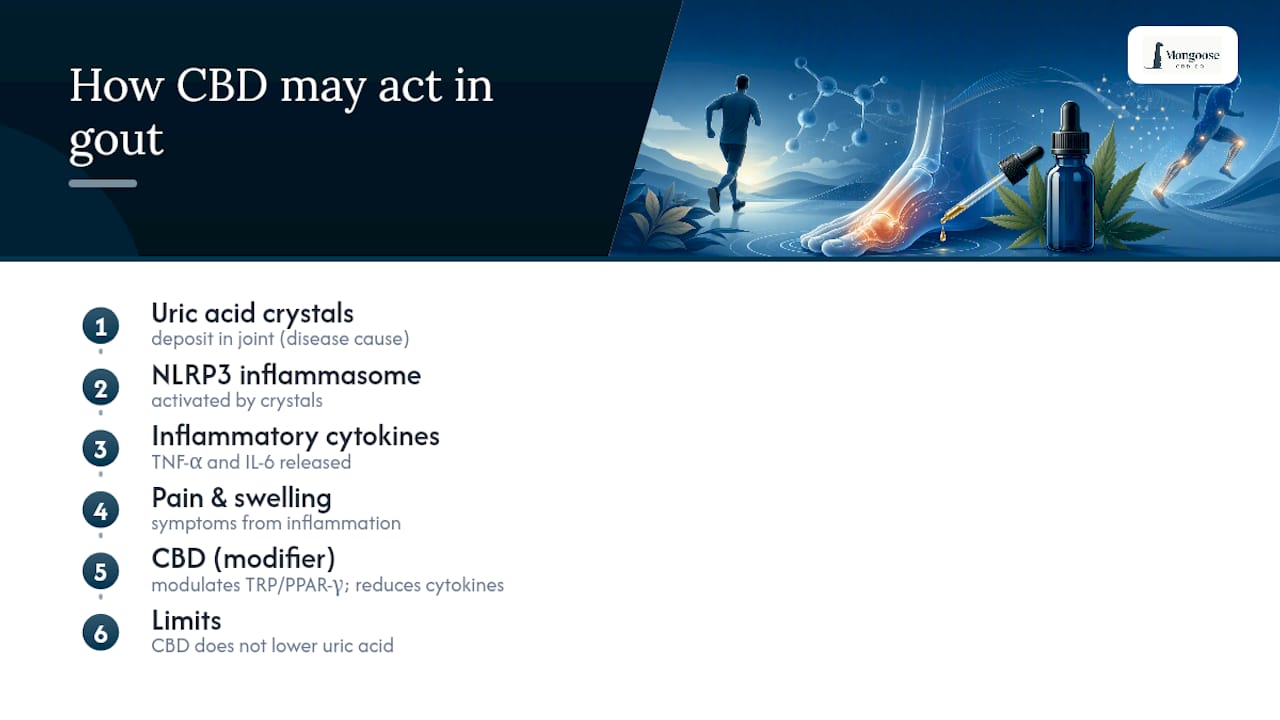
None of this touches the actual cause of gout. Uric acid buildup and crystal deposition drive the disease, and CBD does not lower uric acid levels. Anything CBD does for gout happens on the symptom side, not the disease side.
Topical vs. oral CBD: which one fits a gout flare?
For a single hot, swollen joint, topical CBD for gout makes more practical sense than a tincture or capsule. A balm applied directly to the toe or ankle stays localized, limits how much CBD enters your bloodstream, and sidesteps most of the interaction risk that comes with swallowing it. Oral tinctures and edibles work systemically and take longer to act, which suits people managing chronic, widespread arthritis pain more than an acute attack.
A few practical notes before you buy anything:
- Patch test any new topical on a small area of skin first and wait 24 hours
- Apply topical CBD 2 to 4 times daily during a flare, tracking pain levels as you go
- If you're drawn to oral CBD for broader joint pain management, start at the lowest labeled dose and increase slowly
- Check for third-party lab testing and accurate potency labeling before purchasing, since product quality varies widely across the CBD market
Secondary ingredients matter more than people assume. Many balms pair CBD with menthol, capsaicin, or arnica, and it's genuinely hard to separate what's doing the work, the CBD or the warming and cooling agents that hit your nerve endings within seconds.
Pro Tip: Keep a simple pain log (0 to 10 scale) for the first week of any new topical. It's the only way to tell if the balm is actually helping or if the flare was just fading on its own.
Safety, side effects, and drug interactions with gout medications
The single biggest safety issue with CBD for gout pain is drug interactions, not the CBD itself. CBD is broken down by liver cytochrome P450 enzymes, the same enzyme system that metabolizes colchicine, one of the most commonly prescribed gout flare medications. That overlap can raise colchicine levels in your blood, increasing the risk of gastrointestinal side effects like nausea and diarrhea.
What else to watch for:
- Common CBD side effects: fatigue, dry mouth, appetite changes, and diarrhea, usually mild but worth tracking
- Interaction risk with NSAIDs and COX-2 inhibitors: both are frequently used for gout, and combining them with CBD hasn't been well studied in humans
- Liver enzyme changes: some CBD users show elevated liver enzymes on bloodwork, particularly at higher oral doses
- Contaminant risk: unregulated products can contain heavy metals, pesticides, or inaccurate CBD content
Topical use lowers systemic exposure since less CBD reaches your bloodstream through skin. Still, avoid applying it to broken or irritated skin, and don't slather large areas multiple times a day without checking how your body responds first.
A stepwise plan for trying CBD safely during a gout flare
- Talk to your prescriber or pharmacist first. Bring your full medication list, especially if you take colchicine, allopurinol, or NSAIDs, and ask directly about interaction risk.
- Patch test, then apply topically for one to two weeks. Use a small amount on healthy skin first, then apply to the affected joint 2 to 4 times daily for 7 to 14 days, logging pain and any side effects.
- If you're considering oral CBD, go low and slow. Start at the smallest labeled dose, increase gradually, and never stop urate-lowering medication like allopurinol without your doctor's input.
Stop and call your doctor if the flare worsens despite treatment, if you notice unusual bruising or bleeding, or if you develop symptoms like severe fatigue or yellowing skin that could point to liver stress.
Pro Tip: If your flare hasn't improved within 3 to 4 days of standard treatment plus a topical trial, that's your signal to call your doctor rather than increase the dose on your own.
Where a topical balm fits into this picture
The balms are built around a topical-first approach, pairing CBD with botanicals like menthol, arnica, and turmeric rather than pushing oral products for systemic use. That formulation lines up with the safer, localized trial method described above for a single inflamed joint. Products are shipped THC-free and third-party tested, and purchases are backed by a refund window.
What actually matters here, and what gets overstated
The conventional wisdom on CBD and joint pain tends to swing to extremes: either it's dismissed as snake oil or treated like a cure-all for arthritis and gout alike. Neither holds up. The animal data on topical CBD reducing joint swelling is real and worth taking seriously, but it's animal data, and gout has a specific chemical trigger, uric acid crystals, that CBD does nothing to address.
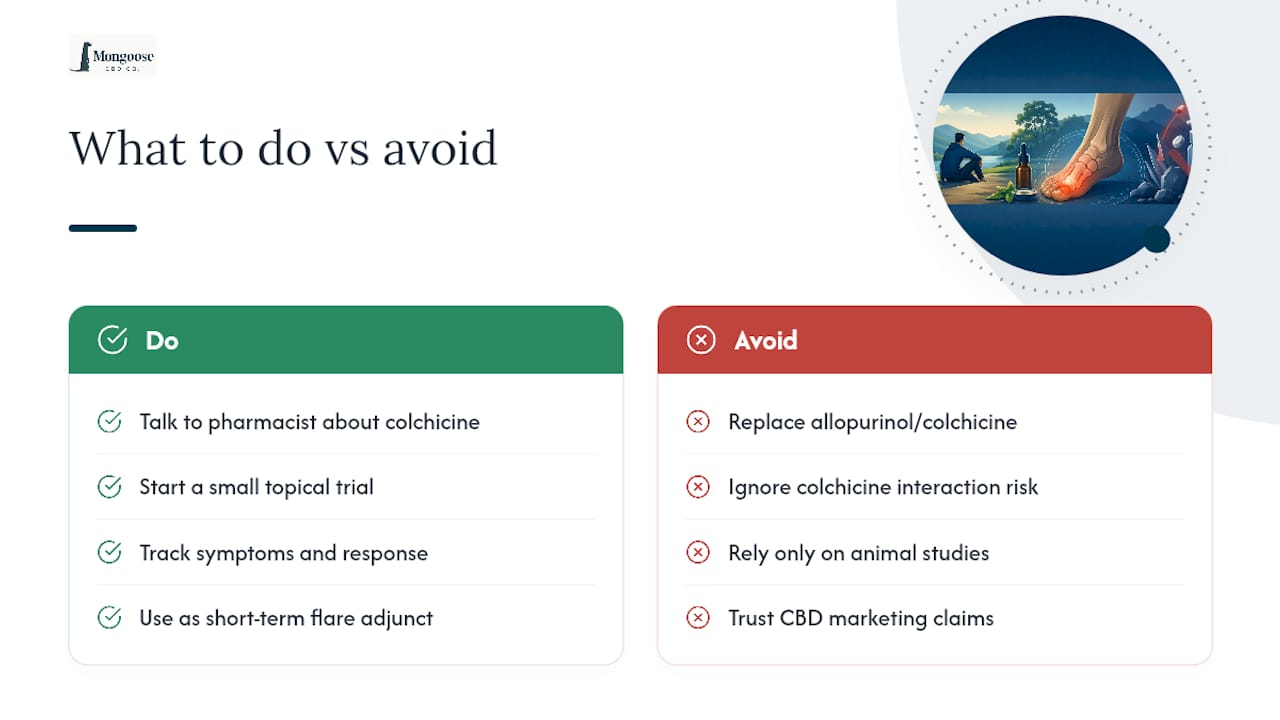
What gets underrated is the interaction risk. Most articles bury the colchicine warning under a wall of "may help with inflammation" language, when it should be front and center for anyone on multiple gout medications. If you take colchicine or NSAIDs regularly, that conversation with your pharmacist matters more than which brand of balm you pick.
My honest read: topical CBD paired with active botanicals is a reasonable, low-risk experiment for flare-day discomfort. It is not a substitute for allopurinol, colchicine, or a rheumatologist's guidance on managing uric acid long-term. Start small, track what happens, and let the results, not the marketing, decide if it stays in your routine.
— Cindy
Try a Topical Balm Built for Joint Flares
The balms are formulated specifically for localized application, which matches the topical-first trial approach outlined above for a gout flare. The Seriously Soothing Pain Balm combines CBD with arnica and menthol in a formulation designed to be applied directly to a swollen joint rather than swallowed, keeping systemic exposure low.
If your flares tend to hit the same joint (the big toe is the classic gout target), a focused topical trial makes more sense than jumping straight to an oral product. The balms are THC-free, vegan, and cruelty-free, and orders come with a refund window, so testing one during your next flare carries minimal financial risk. Browse the full product lineup or go straight to the Cinnamon & Clove balm if you want a warming formulation for stiff, achy joints.
Sources
- Transdermal cannabidiol reduces inflammation and pain-related behaviors in a rat model of arthritis (2015)
- CBD for Gout: What Patients Should Know
- FDA regulation of cannabis and cannabis-derived products, including cannabidiol (CBD)
FAQ
What clears gout quickly?
Standard fast-acting treatments include NSAIDs, colchicine, and corticosteroids prescribed by a doctor. CBD is not a proven flare treatment and works best as a symptom-focused addition, not a replacement, alongside those medications.
Does CBD take away inflammation?
Animal studies show topical CBD reduced joint swelling in arthritis models, and preclinical research links CBD to lower inflammatory cytokines like TNF-alpha and IL-6. Human evidence in gout specifically doesn't exist yet, so any reduction in inflammation is plausible but unconfirmed for this condition.
Is it safe to take CBD and colchicine together?
Caution is warranted. Both are processed by the same liver enzymes, and CBD can raise colchicine levels in the blood, increasing the risk of gastrointestinal side effects, so talk to your prescriber before combining them.
What kind of CBD oil is best for joint pain?
For a single painful joint, a topical formulation applied directly to the skin is generally more practical than an oral oil, since it limits systemic exposure and interaction risk. Look for products with third-party lab testing and clear potency labeling, such as Mongoosecbd's balms, which pair CBD with arnica and menthol for localized use.