
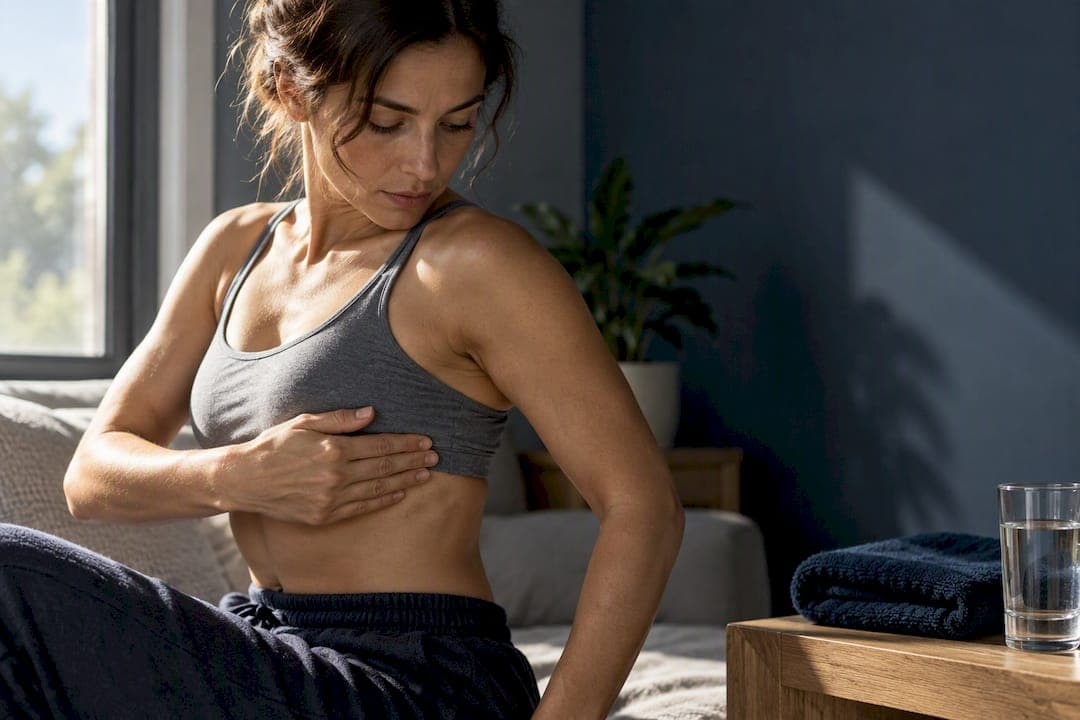
CBD can be a reasonable adjunct for costochondritis pain, and a topical balm applied directly to the sore cartilage is the sensible way to start. It won't replace an actual diagnosis. Chest pain always needs a checkup first, because costochondritis can feel almost identical to a cardiac event, and only a clinician can tell the difference. Once that's ruled out, a short, structured CBD trial alongside standard conservative care is worth considering.
TL;DR:
- Topical CBD is a low-risk option for costochondritis, especially since systemic absorption is minimal compared to oral products.
- A two-week trial of topical CBD, applied two to three times daily, can help determine if it offers meaningful pain relief alongside conservative care.
- Avoid trying CBD before ruling out cardiac causes, and discontinue use if symptoms worsen or no improvement is seen within two weeks.
- Systemic CBD carries liver interaction risks and should be used with medical consultation if on blood thinners, antidepressants, or with liver issues.
- Using high-quality, third-party tested topical CBD products ensures safety and accurate dosing for localized pain management.
Table of Contents
- What Is Costochondritis and When Does It Need Urgent Care?
- Standard Costochondritis Treatment Options and Where CBD Fits
- What Does the Research Actually Show About CBD for Musculoskeletal Pain?
- CBD Creams, Oils, Capsules, and Patches: Which Should You Try First?
- Is CBD Safe? Drug Interactions and Warning Signs to Know
- How to Run a Safe Topical CBD Trial for Costochondritis
- What Real Users Report, and What's Still Missing
- The Gap Between CBD's Reputation and What It Can Actually Deliver
- Trying a Topical CBD Balm for Costochondritis
- Where to Learn More
- Sources
- FAQ
What Is Costochondritis and When Does It Need Urgent Care?
Costochondritis is inflammation where your ribs meet your breastbone, causing pain that's usually sharp, localized, and reproducible when you press on the spot or twist your torso. It's a common, frustrating diagnosis precisely because it mimics something scarier. Most cases resolve within a short period, though some linger longer.
The distinguishing feature is that pressing on the chest wall reproduces the pain, something a heart attack won't do. Still, certain symptoms mean you stop reading and get checked immediately:
- Shortness of breath or pain that spreads to your arm, jaw, or back
- Fainting, dizziness, or a racing/irregular heartbeat alongside the chest pain
- Pain that worsens with exertion rather than with movement or pressure
Clinicians typically rule out cardiac causes with an ECG and sometimes a chest x-ray before landing on a costochondritis diagnosis, because chest pain needs to be checked by a professional given how closely musculoskeletal pain can imitate heart trouble.
Standard Costochondritis Treatment Options and Where CBD Fits
Conservative care comes first, and it works for most people. The Mayo Clinic's treatment guidance centers on pain relief rather than a cure, since the inflammation typically settles on its own.
Standard costochondritis treatment options include:
- Rest and modifying activities that trigger the pain (heavy lifting, certain stretches, sleeping positions)
- Heat or ice applied to the chest wall, whichever feels better for you
- Topical analgesics such as diclofenac gel, capsaicin cream, or lidocaine patches
- Oral NSAIDs like ibuprofen or naproxen, or acetaminophen for symptom control
- Physical therapy for cases that drag on past several weeks
MedlinePlus lists this same supportive approach as the default, and it's the backbone any CBD trial should sit on top of, not replace. Think of CBD as another tool in that topical-analgesic category, not a substitute for the basics. If ibuprofen and heat are already helping, CBD is worth layering in for extra relief rather than swapping out what's working.
What Does the Research Actually Show About CBD for Musculoskeletal Pain?
The honest answer: promising, not proven. A systematic review of clinical and preclinical evidence found CBD shows real analgesic and anti-inflammatory activity across several pain models, but high-quality randomized trials specific to conditions like costochondritis simply don't exist yet.
Evidence snapshot: Preclinical studies point to CBD interacting with TRPV1 receptors (involved in pain signaling), 5HT-1A receptors (linked to pain modulation and mood), and inflammatory pathways that drive swelling and tissue sensitivity. That's a coherent mechanism, but mechanism isn't the same as a clinical trial proving it works for your rib cartilage, specifically.
A separate 2022 systematic review on CBD for chronic pain reached a similar conclusion: some trials show benefit, results are inconsistent across studies, and researchers need more standardized formulations before anyone can call CBD a reliable pain treatment. Costochondritis-specific data is essentially absent, so any recommendation is extrapolated from broader musculoskeletal and osteoarthritis research, not condition-specific proof.
The takeaway sits somewhere between skepticism and optimism. CBD for inflammation relief has a real biological basis and encouraging early signals, but nobody has run the trial that would confirm it works for chest-wall cartilage specifically. That gap is exactly why a cautious, self-monitored trial makes more sense than treating CBD as a guaranteed fix.

CBD Creams, Oils, Capsules, and Patches: Which Should You Try First?
Not all CBD products carry the same risk profile, and that matters more for costochondritis than people realize.
- Topical creams and balms stay largely localized to the skin and underlying tissue, meaning less of the compound reaches your bloodstream and liver. For a sore, well-defined patch of cartilage, this is the lowest-risk, most logical starting point. Early research on topical CBD in joint pain models suggests localized application can ease pain and reduce sensitization right where it's applied.
- Oral tinctures and capsules get absorbed systemically, which means broader exposure, more potential drug interactions, and the liver-monitoring concerns discussed in the next section. They may make sense for widespread pain, but costochondritis is usually a small, specific area, so oral CBD adds systemic risk without an obvious added benefit.
- Transdermal patches offer sustained release over hours, but absorption varies a lot by skin type, patch quality, and placement. They're a reasonable middle ground, though less predictable than a balm you control by hand.
Pro Tip: Check the label for third-party lab testing, exact milligrams per ounce (not just "contains CBD"), and confirmed THC content under 0.3%. A product that won't show you a certificate of analysis isn't one you should be rubbing on a sore rib.
For a deeper comparison of how these delivery methods perform against each other, topical CBD versus oral dosing breaks down the trade-offs in more detail, and ingredient quality matters just as much as delivery method, which is covered in what actually belongs in a pain balm.
Is CBD Safe? Drug Interactions and Warning Signs to Know
Systemic CBD exposure isn't risk-free, and the clearest evidence comes from Epidiolex, the FDA-approved prescription CBD used for seizure disorders. Its prescribing information lists elevated liver enzymes as a documented risk requiring monitoring, which tells you something important: oral CBD at meaningful doses can affect how your liver functions.
CBD also interacts with the same liver enzyme system (CYP450) that metabolizes many common medications, including blood thinners, certain antidepressants, and some seizure drugs. That's a conversation for your pharmacist or doctor before adding oral CBD to your routine.
Before trying CBD for costochondritis, check these boxes:
- Ask your clinician about interactions if you take blood thinners, antidepressants, or antiepileptics
- Watch topical use for skin redness, itching, or irritation, and stop if it appears
- Get medical clearance first if you're pregnant, breastfeeding, or have significant liver disease
- Treat unexplained fatigue or yellowing skin as a reason to stop oral CBD and call your doctor
Topical application sidesteps most of this because so little reaches your bloodstream, which is a big part of why it's the safer entry point.
How to Run a Safe Topical CBD Trial for Costochondritis
Once a clinician has confirmed your chest pain is musculoskeletal, here's a structured way to test whether CBD actually helps:
- Set a baseline. Rate your pain 0 to 10, note which activities it limits (reaching overhead, deep breaths, sleeping on one side), and log any medications you're already using.
- Apply consistently. Rub a topical balm directly onto the tender area two to three times daily, keeping your existing conservative care (heat, ice, NSAIDs if appropriate) in place.
- Give it real time. Run the trial for at least two weeks, up to six, before judging results. Meaningful improvement usually looks like roughly a 30% drop in pain rating or a clear return of function, like sleeping through the night without waking.
- Reassess honestly. No improvement by week two, or symptoms getting worse, is your signal to stop and revisit the plan with a clinician rather than pushing through longer.
Pro Tip: Take a phone photo of your pain log each week. It sounds unnecessary until you're two weeks in and can't remember if you actually felt better on Tuesday or you're just hoping you did.
What Real Users Report, and What's Still Missing
Anecdotal reports on topical CBD for chest-wall pain often describe quick, localized relief, sometimes within minutes of application. That lines up with how topical products work mechanically, but it's still self-reported experience, not clinical proof.
What would strengthen this picture is a condition-specific trial: real patients, a placebo arm, and measured outcomes over weeks rather than forum posts. Until that exists, the responsible approach is tracking your own numbers, sharing that log with your doctor, and treating your own trial as data, not a verdict for everyone else with costochondritis.
The Gap Between CBD's Reputation and What It Can Actually Deliver
Most advice on CBD for pain either oversells it as a cure or dismisses it outright, and both miss the more useful middle ground. The preclinical mechanisms behind CBD's anti-inflammatory action are real. The absence of costochondritis-specific trials is also real. Neither fact cancels the other out.

What conventional advice gets wrong is treating "no condition-specific RCT" as a reason to skip CBD entirely, when the actual risk calculus depends heavily on delivery method. Oral CBD carries the liver-enzyme and interaction concerns documented with Epidiolex. Topical CBD, applied to a small area of inflamed cartilage, carries almost none of that systemic exposure. Lumping them together as equally risky is the biggest misunderstanding I see repeated across pain forums and even some clinical write-ups.
My priority order for anyone in this position: rule out cardiac causes first, lean on standard conservative care second, and treat a topical CBD trial as a low-risk experiment layered on top, not a replacement for either. Track your numbers. Give it real weeks, not days. And stop if it isn't working instead of assuming more product will fix it.
— Cindy
Trying a Topical CBD Balm for Costochondritis
If you've cleared the cardiac check and you're ready to try a topical approach, Mongoose CBD Co. builds its balms specifically for localized pain like this. The Seriously Soothing Pain Balm combines CBD with arnica and other botanical pain relievers in a formula that's vegan, THC-free, and made without parabens, so you're not adding synthetic ingredients to an already sore chest wall.
Running the trial protocol above is straightforward with either option: apply the balm two to three times daily to the tender area for two to six weeks and log your pain score along the way. If your symptoms run more toward general muscle recovery alongside the chest-wall pain, RIKKI TIKKI Recovery is formulated for that broader recovery use. Mongoose CBD Co. backs every purchase with a 30-day full refund window, so testing whether topical CBD helps your costochondritis doesn't mean committing to a product that doesn't work for you. Start your trial today by picking the balm that matches your symptoms.
Where to Learn More
- Costochondritis diagnosis and treatment from the Mayo Clinic covers conservative management in more depth.
- MedlinePlus's costochondritis overview details the typical disease course and home care.
- The FDA's Epidiolex prescribing information lays out systemic CBD's documented safety considerations.
- For a broader look at hemp-derived pain products, Hemp Flower Co.'s comparison of Delta 8 and THCA covers consumer-reported differences across product types.
Sources
- Systematic review: clinical and preclinical evidence on CBD in pain treatment (PMC)
- Costochondritis - Diagnosis & treatment - Mayo Clinic
- EPIDIOLEX (cannabidiol) highlights of prescribing information - FDA
- Chest pain may extend outside the chest, often needs to be checked by a professional | American Heart Association
FAQ
What Is the Fastest Way to Heal Costochondritis?
There's no shortcut that skips healing time, but combining rest, heat or ice, and oral NSAIDs alongside topical analgesics gives your fastest realistic path, since most cases resolve with conservative therapy within days to a few weeks. Avoiding the activities that trigger pain, rather than pushing through them, speeds recovery more than any single product.
What Form of CBD Is Best for Inflammation Relief?
For localized chest-wall inflammation, a topical balm applied directly to the sore area is the most sensible starting point, since it stays concentrated at the site with minimal systemic absorption. Oral capsules and tinctures work throughout the body but carry more interaction and liver-monitoring concerns, based on safety data from prescription CBD.
What Should You Avoid While Having Costochondritis?
Avoid activities that reproduce the pain, like heavy lifting, certain pushup or stretching motions, and sleeping positions that press on the chest wall. Also avoid self-diagnosing chest pain without a checkup first, since cardiac causes need to be ruled out before you treat it as musculoskeletal.
Does CBD Bring Down Inflammation?
Preclinical research shows CBD interacts with inflammatory pathways and can reduce inflammation markers in lab and animal studies, according to a review of clinical and preclinical evidence. Human trials for chest-wall conditions specifically don't exist yet, so the effect is plausible and biologically grounded, but not confirmed for costochondritis by name.
How Much Does Mongoose CBD Co.'s Pain Balm Cost?
The Seriously Soothing Pain Balm and RIKKI TIKKI Recovery both range from $26.95 to $39.95 depending on size, sold directly through the Mongoose CBD Co. website. Every purchase comes with a 30-day full refund policy if the balm doesn't work for you.