
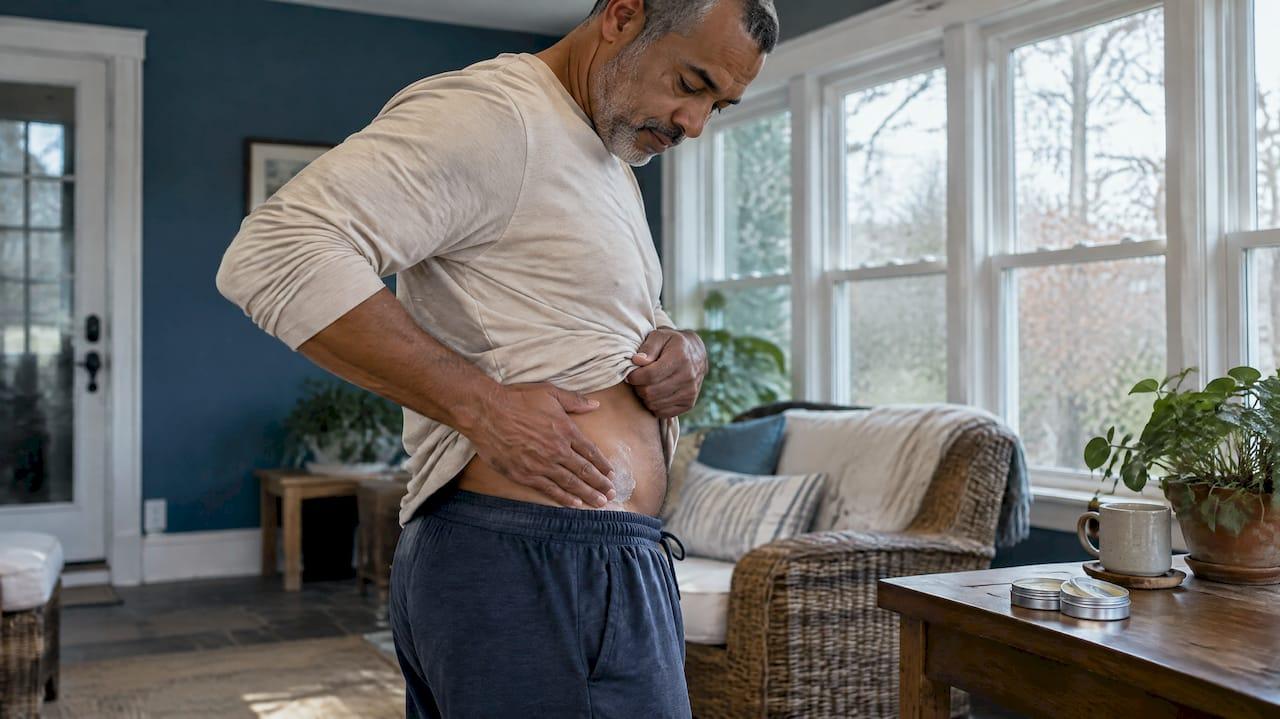
Ankylosing spondylitis (AS) is a type of inflammatory arthritis that mainly affects the spine and the joints where the spine meets the pelvis. If you live with its stiffness and aching, a topical CBD balm is a sensible way to try CBD. You apply it where it hurts, you can judge the result on your own body, and it sits alongside your prescribed treatment instead of replacing it. Our Seriously Soothing Pain Balm and RIKKI TIKKI Recovery are made for this kind of use.
This guide covers what the research says, what it does not say yet, how to run a fair balm trial, and what to discuss with your rheumatologist first.
TL;DR
- No large trial has tested topical CBD in ankylosing spondylitis. Research on CBD in AS and related arthritis is still early.
- A U.S. survey of adults using cannabis for arthritis pain linked topical use with higher perceived effectiveness.
- A balm is applied locally. You can target the lower back, hips or neck and track the result.
- CBD can interact with some medicines. Tell your rheumatologist before you start, and never stop prescribed AS treatment.
- Our balms carry a 30-day full refund, so a trial is low risk.
Table of Contents
- What ankylosing spondylitis feels like, and why people look at CBD
- What the research says about CBD and AS
- Why a balm suits AS stiffness
- What is in our balms
- How to run a 4-week balm trial
- Safety: what to know before you start
- Can a balm replace AS medication?
- Why we make balms for this
- Try the balm for your back and joints
- FAQ
- Sources
What ankylosing spondylitis feels like, and why people look at CBD
AS causes back pain and stiffness that are often worst in the morning or after rest. Movement usually eases it. Over time, inflammation can affect other joints too.
Standard care is prescription-led. A Cochrane review found high-quality evidence that NSAIDs (nonsteroidal anti-inflammatory drugs, such as ibuprofen and naproxen) improve pain and function in axial spondyloarthritis. Your rheumatologist decides what fits you.
Many people want something extra for flare days, training days or the stiff stretch after a long drive. That is where topicals come in. They are not a disease treatment. They are a way to take care of sore, tight areas.
What the research says about CBD and AS
Here is where things stand.
The evidence is early. A 2018 review in Nature Reviews Rheumatology found that clinical data on cannabinoids for rheumatic diseases are scarce. It said special attention is needed for side effects and drug interactions. A 2022 rheumatology review reached a similar view: CBD has potential for pain, sleep and mood, but sound clinical evidence is lacking.
The biology is plausible. A 2026 narrative review describes several routes by which CBD could act on pain and inflammation, including TRPV1 modulation and anti-inflammatory effects. TRPV1 is a receptor involved in sensing heat and pain.
Topical use stands out in patient reports. An American College of Rheumatology meeting abstract analyzed 1,718 adults using cannabis for arthritis-related pain. Authors found that products used on the skin and products containing THC were more likely to be seen as effective. They called for controlled trials. This is self-reported data, not proof, but it points the same way as common sense: for local stiffness, a local product makes sense.
No AS-specific topical dose exists. No published study sets a standard balm amount for ankylosing spondylitis. That is why a short, structured trial on your own body is the practical approach, described below.

Why a balm suits AS stiffness
A balm has three practical advantages.
- It goes where the problem is. AS often centers on the lower back, hips, neck and shoulders. You apply the balm to those areas.
- You can see the effect. You can compare how an area feels before and after, day by day.
- It is easy to fit around a routine. Rub it in after a shower, before a walk or after a workout.
If you also deal with other joints, our guides on CBD for joint pain and CBD for back arthritis cover the same trial approach. If you are comparing arthritis types, see CBD for rheumatoid arthritis.
What is in our balms
Our balms use 1,000 mg of CBD per ounce. They add botanicals chosen for soothing sore areas: arnica, menthol, turmeric, eucalyptus, peppermint, cinnamon, clove, ginger and cayenne pepper. The balms are THC-free, vegan, non-GMO, paraben-free and cruelty-free. We use third-party testing as part of our quality standard.
Menthol, peppermint and cayenne give a cooling or warming feel when applied. Many people with stiff backs and hips like that sensation on top of the CBD.
The Seriously Soothing Pain Balm comes in an original formula and a cinnamon and clove version. RIKKI TIKKI Recovery is formulated for muscle recovery. Prices run from $26.95 to $39.95, depending on size.

How to run a 4-week balm trial
Treat the balm like an experiment. A written log tells you more than memory does.
Step 1: Talk to your rheumatologist
Tell your care team you plan to try a CBD balm. Ask whether anything in your medicines list needs attention. Balms are applied to the skin, but CBD is a compound that your body handles through liver enzymes, so your clinician should know. Do not change or stop any AS medicine on your own. Healthline's review of the topic says the same: talk with a clinician and keep taking prescribed medication.
Step 2: Pick one area and one product
Choose the spot that bothers you most, such as the lower back. Use one balm only, so you know what you are judging. Our balm dosage guide explains how much to apply.
Step 3: Patch test first
Apply a small amount to a patch of skin and wait a day. Menthol, cinnamon, clove and cayenne can irritate sensitive skin. Do not apply to broken skin, and keep balm away from eyes and mucous membranes.
Step 4: Record your baseline
For one week before you start, note a 0 to 10 score each morning for stiffness and each evening for pain. Add how long morning stiffness lasts.
Step 5: Apply on a schedule
Massage a thin layer into the area once or twice a day, for example in the morning and before bed. Keep the timing the same each day. Use it the same way for four weeks.
Step 6: Compare and decide
At week four, compare your averages with your baseline. If the area feels better, keep going. If you see no change, our 30-day full refund covers the purchase. Share your log with your rheumatologist at the next visit. It is useful information for them.
Safety: what to know before you start
Topical products are used on the skin, but these points still matter.
- Medicine interactions. CBD inhibits liver enzymes including CYP3A4, CYP2C9 and CYP2C19, which may affect how other medicines are metabolized. A review of CBD interactions notes it may raise lamotrigine levels and suggests considering dose reductions for some medicines such as ibuprofen and diclofenac. If you take warfarin, a review reports that CBD can raise INR, the blood-clotting measure, so your prescriber should know. Ask your rheumatologist or pharmacist about your own list.
- Liver. Liver enzyme rises are dose-related and linked mainly to high oral doses. The 2026 review reports risk factors at 1,000 mg a day or more, or alongside antiepileptic drugs, with no cases in adults taking under 300 mg a day. If you take antiepileptic medicine, speak to your prescriber before any CBD product.
- Side effects. Reported effects of CBD in general include drowsiness, fatigue, dry mouth, nausea, reduced appetite and diarrhea, per the 2022 rheumatology review.
- Product quality. The same review advises products with Good Manufacturing Practice certification and under 0.3% THC. Our balms are THC-free.
- Pregnancy, nursing and children. Ask a doctor first.
Can a balm replace AS medication?
No. A balm is a support for sore areas. AS is a condition that needs medical follow-up. The aim of a trial is to add comfort and to keep your rheumatologist informed.
Why we make balms for this
We started Mongoose CBD Co. to make balms for people whose bodies hurt: athletes, people with arthritis, people with long-term pain.
Ankylosing spondylitis is a hard one. The pain sits deep in the back and hips, and it comes back. We cannot promise a result, and we will not claim to treat the condition. We can say what we built.
Our formula pairs 1,000 mg of CBD per ounce with arnica, menthol, turmeric, eucalyptus, peppermint, cinnamon, clove, ginger and cayenne. It is designed to feel good when you rub it in and to help sore, tight areas.
We favor topicals for good reasons. You put the product on the exact spot. You see what happens. You stay in control. Add a 30-day full refund, and the trial costs you little.
Keep your doctor in the loop, keep a log, and give it four weeks.
Cindy
Try the balm for your back and joints
The Seriously Soothing Pain Balm is our original balm for sore muscles, inflammation and arthritis discomfort. RIKKI TIKKI Recovery is built for recovery after training and tough days. Prices are $26.95 to $39.95. Every order has a full refund within 30 days of purchase.
See both balms on the Mongoose CBD Co. homepage.
FAQ
Does CBD help ankylosing spondylitis?
Research is still early, and no CBD product is FDA-approved to treat AS. Reviews say clinical evidence is limited. Some people with arthritis report that products used on the skin help sore areas, and a structured four-week balm trial lets you judge for yourself. Keep your rheumatologist informed.
Is a CBD balm better than oral CBD for AS?
For localized stiffness in the back, hips or neck, a balm lets you treat the exact area. It is easy to track, and it avoids questions about swallowed doses. Oral CBD has no established dose for AS. A balm trial is simpler to run and to measure.
Can I use CBD with my AS medicines?
Often your care team can say. CBD affects liver enzymes that process many drugs, including some NSAIDs, antiepileptics and warfarin. Tell your rheumatologist or pharmacist before you start. Do not stop or reduce any prescribed treatment on your own.
How long should I try a balm before deciding?
Four weeks is a fair window. Log stiffness and pain scores for a week first, then apply the same amount on the same schedule. Compare averages at the end. Our 30-day full refund covers the trial.
Sources
- Cochrane: NSAIDs for axial spondyloarthritis
- Cannabinoids for the treatment of rheumatic diseases, Nature Reviews Rheumatology
- Cannabidiol (CBD) in Rheumatic Diseases
- Cannabidiol (CBD) for Pain: A Narrative Review of Evidence
- Self-Reported Effectiveness of Cannabis for Arthritis-Related Pain, ACR abstract
- Healthline: CBD for Ankylosing Spondylitis
- Cannabinoids and drug-drug pharmacokinetic interactions
- Cannabidiol Interactions with Medications, Illicit Substances
- Evaluation of potential drug-drug interactions with medical cannabis