
Most CBD topical creams vary in price per jar, and the sticker price tells you almost nothing about what you're actually getting. The real comparison is price per milligram of CBD, not price per container. Before buying anything, check the certificate of analysis (COA), confirm the total mg on the label, and look for a clear refund policy. No prescription is typically required, but the FDA's oversight of CBD topicals is limited, which puts more responsibility on the buyer to verify quality.
TL;DR:
- Most CBD topical creams vary significantly in value, with price per milligram being the most accurate way to compare product costs.
- Full-spectrum, high-potency options in the premium tier often cost more but provide more plant compounds and transparent testing than lower-tier isolates.
- Calculating the cost per milligram by dividing the price by the total CBD content reveals true value, as cheaper jars can sometimes be less economical.
- A product's price is primarily driven by potency, botanicals, third-party testing, and packaging, but a high price does not guarantee higher quality.
- Buying directly from brands with transparent COAs and clear mg labeling, and avoiding vague marketing language, reduces the risk of overpaying for low-value products.
Table of Contents
- How Much Does CBD Cream Cost Across Price Tiers?
- How Do You Calculate Price Per Milligram?
- What Actually Drives the Cost of CBD Cream?
- Where Can You Buy CBD Cream for Less Without Cutting Corners?
- How Mongoose CBD Co. Lines Up With These Value Signals
- Balancing Price Against What the Evidence Actually Supports
- Try Mongoose CBD Co.'s Pain Relief Balms With Less Risk
- Sources
- FAQ
How Much Does CBD Cream Cost Across Price Tiers?
Budget CBD creams typically sell at lower prices and usually pack a moderate amount of CBD into a 1 to 2 ounce container. Mid-range products are moderately priced, often with higher CBD amounts and a broad-spectrum or full-spectrum formula. Premium options cost more, layering in higher potency, additional botanicals, and more rigorous testing documentation.
Those bands aren't arbitrary. They reflect real differences in what went into the jar.
- Budget tier ($15 to $25): Lower potency, isolate-based CBD, minimal added ingredients, basic packaging.
- Mid tier ($25 to $45): Higher mg counts, full-spectrum or broad-spectrum extracts, one or two functional botanicals like menthol or arnica.
- Premium tier ($45 to $60+): High potency (often 1,000mg or more per container), multiple active botanicals, third-party lab testing published with batch numbers.
A jar's price often shifts once you factor in the deal attached to it. Subscription discounts, first-time buyer codes, and bundle offers can knock 10 to 30 percent off the sticker price, but only for as long as the promotion or subscription stays active. That's an important distinction: the discounted price is not the standing price, and comparing a promo rate against another brand's full price gives you a false read on value.
Quick fact: Forbes Health's testing of popular CBD creams found that normalizing by volume and potency exposed real value gaps between products. A cheaper jar sometimes cost more per milligram than a pricier one with higher concentration.
The tier a product sits in usually says more about formulation choices than marketing budget. A $45 cream with 1,000mg of full-spectrum CBD and a published COA is fundamentally different from a $45 cream with 300mg of isolate and no lab documentation, even if they look identical on a store shelf.
How Do You Calculate Price Per Milligram?
Comparing two jars by their shelf price alone is like comparing two bags of coffee without checking the weight. The number that actually matters is cost per milligram of CBD, and it takes about ten seconds to calculate.
- Find the total mg of CBD on the label or product page, not the percentage or the "strength" claim.
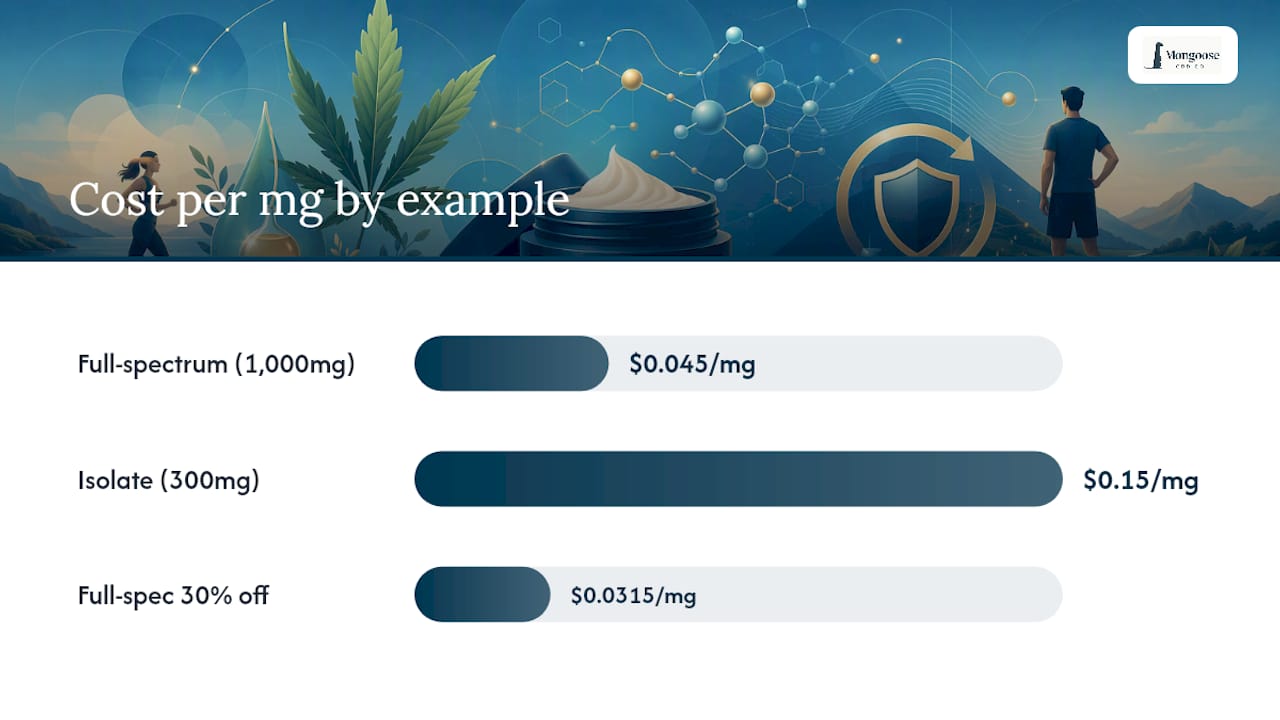
- Divide the price by the total mg. A $30 jar with 500mg of CBD costs $0.06 per mg. A $40 jar with 1,000mg costs $0.04 per mg, making it the better value despite the higher price tag.
- Calculate price per ounce or per mL separately if you care about how much product you're spreading on. A 1-ounce jar and a 4-ounce tub with the same total mg deliver very different amounts of cream per application.
- Compare both numbers side by side. A product can win on price-per-mg and lose on price-per-ounce if it's a small, ultra-concentrated jar. That's fine if you use small amounts per application; it's a problem if you're treating a large area like a back or thighs.
Here's the math with two real-world examples. Jar A costs about $27 and contains about 1,000mg of CBD in a 2-ounce container. Jar B costs about $20 with about 300mg in a 1-ounce container. The price per mg is lower in Jar A, making it better value despite the higher upfront price.
Quick fact: Forbes Health's price comparisons show that unit-cost math consistently reveals value gaps a shelf price hides, since container size and potency almost never scale together.
Price per mg is a value metric, not a performance guarantee. A low cost-per-mg tells you you're getting more CBD for your dollar. It says nothing about how well that particular formulation works on your skin or your pain, which depends on other ingredients, absorption, and your own body's response.
What Actually Drives the Cost of CBD Cream?
Potency is the biggest lever. Full-spectrum extracts, which retain the plant's natural cannabinoid and terpene profile, generally cost more to produce than isolate, which is CBD stripped down to a single compound. Broad-spectrum sits in between, keeping most of the plant compounds while removing THC. That processing difference shows up directly in shelf price.
Added botanicals are the second-biggest factor. Ingredients like menthol, arnica, capsaicin, turmeric, and eucalyptus aren't filler. They're functional additions meant to enhance the cooling, warming, or anti-inflammatory sensation on top of whatever the CBD itself contributes, and sourcing quality versions of them adds real cost to a formula. Understanding which ingredients actually affect pain relief helps you tell a functional additive from a marketing one.
Third-party lab testing and packaging round out the picture:
- COA testing costs money per batch, and brands that publish results consistently pass that cost to the consumer, but they're also the brands proving what's actually in the jar.
- Packaging and branding vary widely. A metal tin with a printed label costs more to produce than a plastic jar with a sticker, and that difference is visible in price without necessarily reflecting product quality.
- Fulfillment and shipping infrastructure for smaller direct-to-consumer brands adds overhead that larger retail-distributed brands don't carry the same way.
Pro Tip: A high price alone doesn't prove quality. A high price paired with a published COA, a specific mg count on the label, and a named extraction method is a much stronger signal than premium packaging or vague "clinical strength" language.
Red flags that inflate price without adding value include unverifiable buzzwords ("pharmaceutical grade," "maximum strength") with no COA to back them, proprietary blends that hide the actual mg count, and packaging language that emphasizes lifestyle branding over ingredient transparency. If you can't find a straight answer to "how many milligrams of CBD are in this jar," the price is not something you can evaluate rationally yet.
Where Can You Buy CBD Cream for Less Without Cutting Corners?
Three main channels sell CBD topicals: direct brand websites, e-commerce marketplaces, and dispensaries or specialty retail stores. Direct brand sites typically offer the most transparency, since the seller controls the product page, lab reports, and return process. Marketplaces can undercut on price but make it harder to verify whether the listing matches the actual product, especially with third-party sellers. Dispensaries offer in-person guidance but often carry a markup tied to overhead and state licensing costs.
A few tactics consistently lower cost without lowering quality:
- Try a sample size first before committing to a full-size jar, especially with a new formulation or extract type.
- Read subscription terms closely. Some "sale" prices only apply once you enroll in recurring shipments, and canceling after the fact can be more of a hassle than the discount is worth.
- Factor in shipping and tax before comparing totals. A $25 jar with $6 shipping is not cheaper than a $28 jar with free shipping.
- Always compare price per mg, not the sticker price, once you've narrowed down a shortlist.
Pro Tip: When a page says "40% off," check whether that discount applies to the one-time price or only kicks in after a subscription is active. Those two numbers can differ by ten dollars or more on the same product.
Missing COAs, vague labeling ("proprietary strength" instead of a milligram count), and no visible refund or customer support contact are the three clearest warning signs that a deal is priced for margin, not for value. A step-by-step guide to reading a certificate of analysis is worth bookmarking before you shop, since COA formats vary by lab and brand.
How Mongoose CBD Co. Lines Up With These Value Signals
Everything covered so far, potency transparency, COA availability, clear mg labeling, and a real refund path, maps directly onto what Mongoose CBD Co. builds into its product line. The company backs every purchase with a 30-day refund policy, which matters most as a risk-reduction tool: if a formulation doesn't work for your body, you're not stuck absorbing the full cost of a bad match.
Two core products illustrate formulation choices relevant to perceived value:
- A balm combining CBD with arnica and other botanicals aimed at relief for muscle soreness, inflammation, and arthritis discomfort.
- A recovery product targeting post-activity muscle recovery, designed for athletes needing a formula that supports recovery after physical strain rather than general everyday aches.
Both product lines list their ingredient details on the product pages, which is exactly where the price-per-mg exercise from earlier in this guide becomes useful. Before buying, check the total mg listed against the price, confirm the COA is accessible, and read the botanicals list against what you learned about which additives (menthol, arnica, capsaicin) genuinely add function versus which ones are filler.
For a deeper look at how price and formulation interact across the category, this roundup of pain relief and recovery options breaks down feature-by-feature comparisons worth reading before you commit to a jar.
Balancing Price Against What the Evidence Actually Supports
The regulatory ground under CBD topicals is thinner than most marketing suggests. The FDA has stated plainly that existing food and supplement frameworks don't fit CBD, and it has sent warning letters to topical brands making analgesic claims without proper drug approval. That gap means a premium price doesn't automatically mean premium regulatory scrutiny.
The clinical picture is similarly modest. NCCIH notes that over-the-counter CBD products can contain more or less CBD than labeled, sometimes with contaminants, and that evidence for cannabinoids across pain conditions remains mixed rather than settled. That's not a reason to avoid the category. It's a reason to lean harder on COAs and refund policies than on bold claims printed on a label.
If you're subject to workplace drug testing, pregnant, or taking prescription medications, talk to a clinician before starting a topical CBD routine, since topical absorption can still carry systemic effects in some cases.
— Cindy
Try Mongoose CBD Co.'s Pain Relief Balms With Less Risk
The pricing strategy includes 1,000mg of CBD per ounce, botanicals intended for functional use, and a straightforward money-back option if a formula isn't the right fit.
Both the Seriously Soothing Pain Balm and RIKKI TIKKI Recovery run $26.95 to $39.95, and every purchase is covered by a 30-day refund window if it doesn't work for your pain or recovery needs. That refund window is what turns the price-per-mg math from earlier into a low-risk decision instead of a gamble. If you'd rather test a formula before buying a full jar, a free sample of the Miracle Pain Balm is available, or you can browse the Lavender Lemongrass variant if scent matters to your routine. Head to the Mongoose CBD Co. shop to compare formulas and place an order today.
Sources
This article is general information, not a substitute for advice from a qualified doctor. Consult a qualified healthcare professional about your own circumstances before acting on anything here.
- FDA: A New Way Forward for Cannabidiol (CBD) and Other Hemp Products
- 7 Best CBD Creams And Topicals Of 2026 – Forbes Health
- Cannabis (Marijuana) and Cannabinoids: What You Need To Know — NCCIH
FAQ
Do You Need a Prescription to Buy CBD Cream?
No, most CBD topical creams sell over the counter without a prescription. That said, the FDA has warned that some products marketed with strong drug-like claims may fall outside current legal frameworks, so it's worth checking whether a brand is selling a cosmetic wellness product or making unapproved therapeutic claims.
Can You Rub CBD Cream on Sore Muscles?
Yes, topical CBD creams are designed for direct application to sore or inflamed areas like muscles and joints. Products like Mongoose CBD Co.'s Seriously Soothing Pain Balm and RIKKI TIKKI Recovery pair CBD with botanicals such as arnica specifically for that use case, though individual results vary and clinical evidence for cannabinoids in pain relief remains mixed, according to NCCIH.
What Are the Benefits of Using CBD Cream on the Skin?
CBD creams are typically used for localized relief from muscle soreness, joint discomfort, and minor inflammation, often enhanced with added botanicals like menthol or eucalyptus for a cooling or warming sensation. The benefit depends heavily on formulation quality, potency, and whether the product has been third-party tested, since label accuracy varies across the category.
How Much Does Mongoose CBD Co.'s Pain Balm Cost?
Mongoose CBD Co.'s Seriously Soothing Pain Balm and RIKKI TIKKI Recovery both price between $26.95 and $39.95 depending on size and variant, available directly through the Mongoose CBD Co. shop. Every purchase includes a 30-day refund policy, so you can try a formula without full financial risk if it isn't the right fit.
Is a Higher Price Always a Sign of Better CBD Cream?
Not necessarily. A higher price often reflects legitimate factors like full-spectrum extraction, added functional botanicals, or third-party lab testing, but it can also just reflect packaging and branding costs. The reliable way to judge value is calculating price per milligram of CBD and confirming a COA exists, rather than trusting the shelf price alone.