
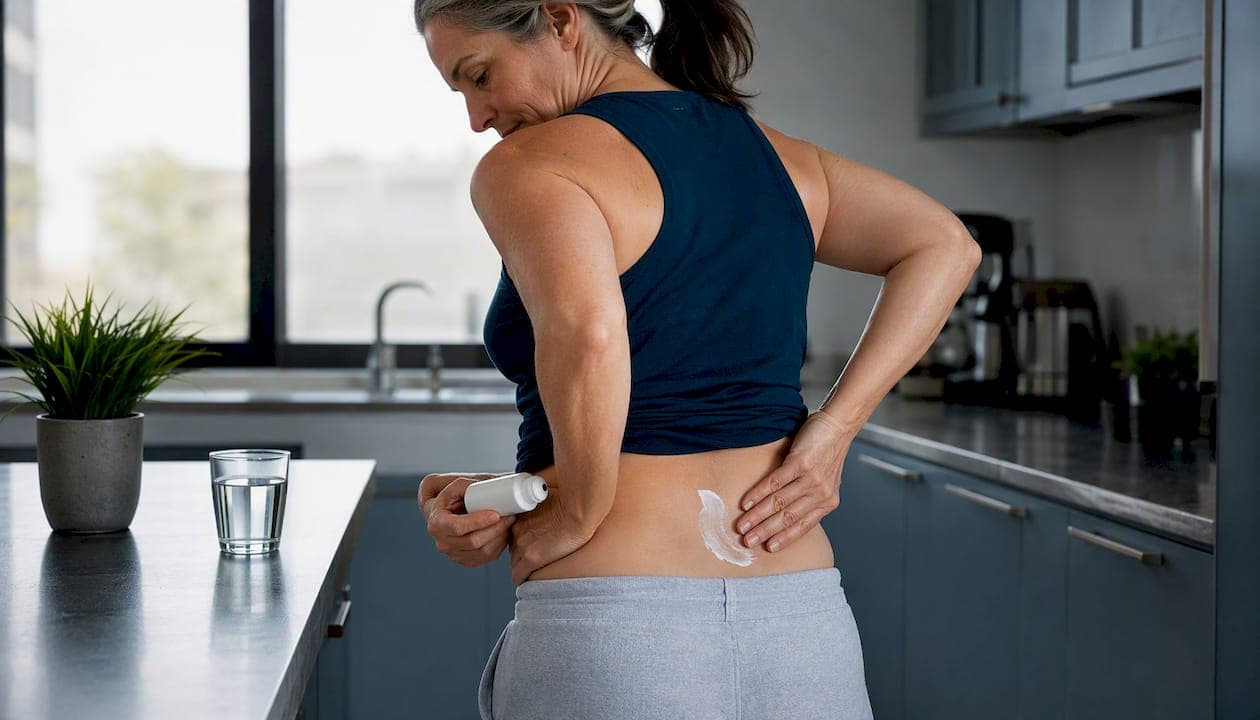
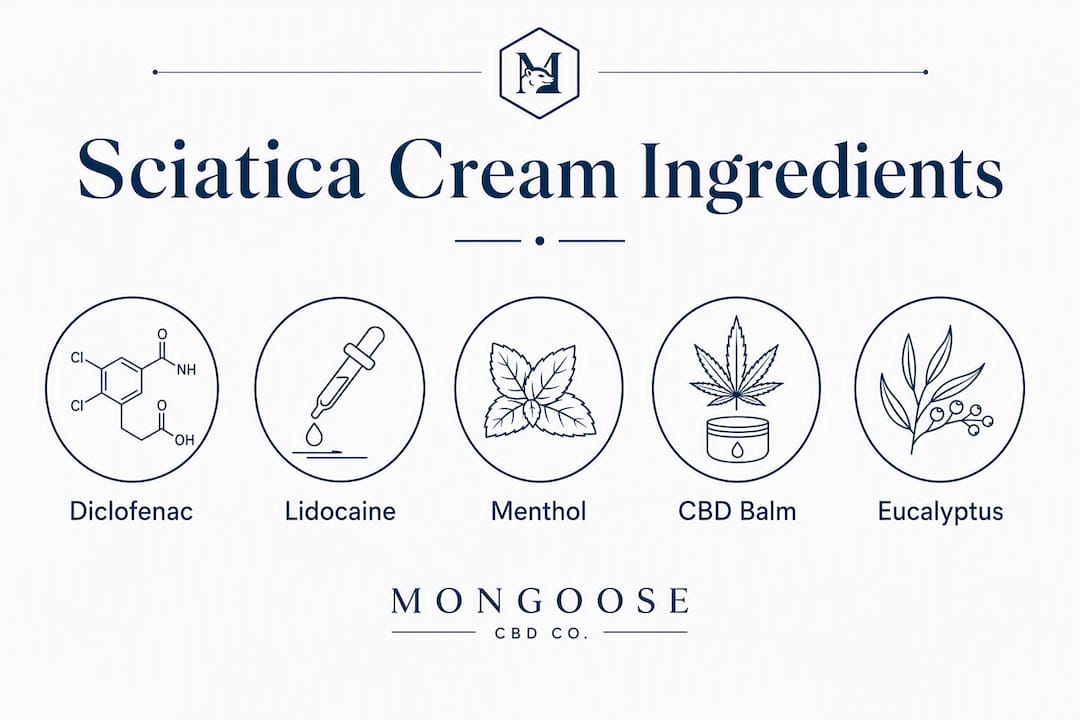
For most people, the best sciatica cream starts with one of four active ingredients: topical diclofenac (a topical NSAID) for inflammation near the nerve root, lidocaine for fast numbing of acute nerve pain, menthol or camphor for quick sensory distraction, or a CBD balm as a well-tolerated botanical adjunct. Capsaicin works too, but it takes days to weeks to build effect, so it's rarely the right first move.
- Deep inflammatory ache near the lower back or buttock: Topical diclofenac (Voltaren gel) or a CBD balm with arnica targets local inflammation without the GI risks of oral NSAIDs.
- Sharp, shooting nerve pain radiating down the leg: Lidocaine for rapid numbing, or menthol/camphor for fast counter-irritation; CBD balms with menthol pair both mechanisms.
- Surface muscle spasm tightening around the nerve: Menthol, camphor, or a botanical CBD balm with eucalyptus and peppermint to ease the surrounding muscle tension.
TL;DR: If you want to try something tonight, reach for a topical diclofenac gel or a high-quality CBD balm with menthol and arnica. Apply near the rear pelvis, not just where the pain radiates down your leg.
Table of Contents
- How do topical creams actually relieve sciatica?
- What each active ingredient does — onset, duration, and side effects
- What does the evidence actually say about topical creams for sciatica?
- How to pick the right sciatica cream for your symptoms
- Safe, effective application: dos and don'ts
- Red flags: when topical creams aren't enough
- Why a CBD balm is a sensible first choice and how Mongoosecbd fits
- Key Takeaways
- The case for topicals that most people miss
- Try Mongoosecbd for targeted sciatica relief
- Sources and further reading
How do topical creams actually relieve sciatica?
Topical creams cannot fix a herniated disc or decompress a nerve root. What they can do is meaningful: reduce the peripheral pain signals and local muscle tension that make sciatica feel unbearable day to day. Harvard Health notes that because the sciatic nerve root sits deep in the spine, topical molecules generally don't reach it directly. Instead, they modify how surrounding tissue signals pain.
Three mechanisms drive most of the relief:
- Numbing (local anesthetics): Lidocaine blocks sodium channels in surface nerve fibers, cutting pain signals at the skin level. Onset is fast, often within minutes, but duration is short.
- Counter-irritation: Menthol and camphor flood sensory receptors with a competing cooling or warming sensation, essentially distracting the nervous system from the deeper ache. Mayo Clinic research confirms these products show modest benefits over placebo for certain pain types, though effects vary by person.
- Local anti-inflammatory action: Topical NSAIDs like diclofenac penetrate skin tissue and reduce prostaglandin production in the local area, easing inflammation around muscles and soft tissue near the nerve root.
Pro Tip: Apply to the rear pelvis and lower back near the nerve's origin point, not only to the thigh or calf where pain radiates. Spine-Health guidance consistently recommends treating the source area for better symptom control. Combining a topical with gentle movement or physical therapy amplifies the benefit.
What each active ingredient does — onset, duration, and side effects
Here's how the main ingredients compare across the dimensions that matter for sciatica:
| Ingredient | Mechanism | Onset | Duration | Best symptom profile | Availability | Main cautions |
|---|---|---|---|---|---|---|
| Diclofenac (Voltaren) | Topical NSAID, anti-inflammatory | 30–45 min | 6 hrs | Deep inflammatory ache, joint/nerve root irritation | OTC (1% gel) | Skin irritation; avoid with oral NSAIDs; limit in renal disease |
| Lidocaine | Local anesthetic, numbing | Minutes | 1–4 hrs | Acute sharp or shooting nerve pain | OTC (patches, creams) | Avoid broken skin; don't combine with other anesthetics |
| Capsaicin | Depletes substance P, desensitizes nociceptors | Days to weeks | Sustained with regular use | Chronic nerve pain, burning sensations | OTC (low concentration) | Initial burning sensation; avoid eyes and mucous membranes |
| Menthol / Camphor | Counter-irritant, sensory distraction | Minutes | 1–3 hrs | Surface muscle spasm, acute ache | OTC (widely available) | Skin irritation at high concentrations; avoid in infants |
| Methyl / Trolamine salicylate | Salicylate NSAID, mild anti-inflammatory | 30–45 min | 4–6 hrs | Mild muscle and joint ache | OTC | Avoid with aspirin allergy; limit on large skin areas |
| CBD balm (with botanicals) | Cannabinoid receptor modulation + botanical counter-irritants | 30–45 min | 2–6 hrs | Muscle tension, chronic discomfort, nerve-adjacent inflammation | OTC | Generally well-tolerated; patch test advised |
A few points worth highlighting:
- Arthritis.org guidance places diclofenac at the top of the evidence hierarchy for topical anti-inflammatory relief, particularly for superficial inflammatory conditions.
- Capsaicin requires patience: the initial burning is real, and consistent daily application for at least a week is needed before most people notice meaningful relief.
- CBD balms work best when they combine cannabinoids with botanicals like arnica, menthol, or eucalyptus, since each ingredient targets a slightly different pain pathway.
- Individual response varies considerably. Physical therapists note that some patients swear by cooling menthol while others need the numbing effect of lidocaine — trial and adjustment is normal, not a sign that topicals don't work.
What does the evidence actually say about topical creams for sciatica?
The honest answer: topical creams have solid evidence for localized inflammatory and musculoskeletal pain, and weaker evidence for true deep nerve root compression. That distinction matters for setting realistic expectations.
Topical diclofenac has the strongest clinical backing among OTC topicals. Cochrane-level guidance cited by Arthritis.org shows meaningful improvement for osteoarthritis and local inflammatory pain. For sciatica specifically, the benefit is most likely when inflammation in the surrounding soft tissue is contributing to nerve irritation, not when a large disc herniation is the sole driver.
Clinical note: Orthopedic specialists recommend topical treatments as lower-risk options for localized pain, particularly for people where systemic NSAIDs pose GI or cardiovascular risks. Topical application limits systemic absorption significantly compared to oral dosing.
Menthol and camphor products show modest, variable benefits. They work fastest and feel most satisfying in the short term, but the effect is sensory distraction, not tissue-level repair. Lidocaine patches are useful for focal, surface-level nerve pain but don't address the underlying cause.
The clinical consensus, reflected across Harvard Health, Mayo Clinic, and Spine-Health, frames topicals as adjuncts to physical therapy and movement, not standalone treatments. A cream that reduces pain enough to let you complete your PT exercises is doing exactly what it's supposed to do.
How to pick the right sciatica cream for your symptoms
Match the mechanism to what you're actually feeling. That single step eliminates most of the guesswork.
Checklist before you buy:
- What's your primary symptom? (Dull ache vs. sharp shooting pain vs. muscle spasm)
- Do you need fast relief or sustained effect over days?
- Do you have sensitive skin or a history of NSAID reactions?
- Are you pregnant, breastfeeding, or taking oral NSAIDs or blood thinners?
- Do you prefer a gel, cream, patch, or balm texture?
- What's your budget and how often will you reapply?
Three common scenarios:
Acute sharp radiating pain down the leg: Lidocaine cream or patch first for fast numbing. A menthol-based balm works as a quick backup. Neither addresses the root cause, but both can make the next few hours manageable.
Deep dull ache centered in the buttock or lower back: Topical diclofenac gel is the evidence-backed choice here. A CBD balm with arnica is a reasonable alternative if you want to avoid NSAIDs or prefer a botanical option.
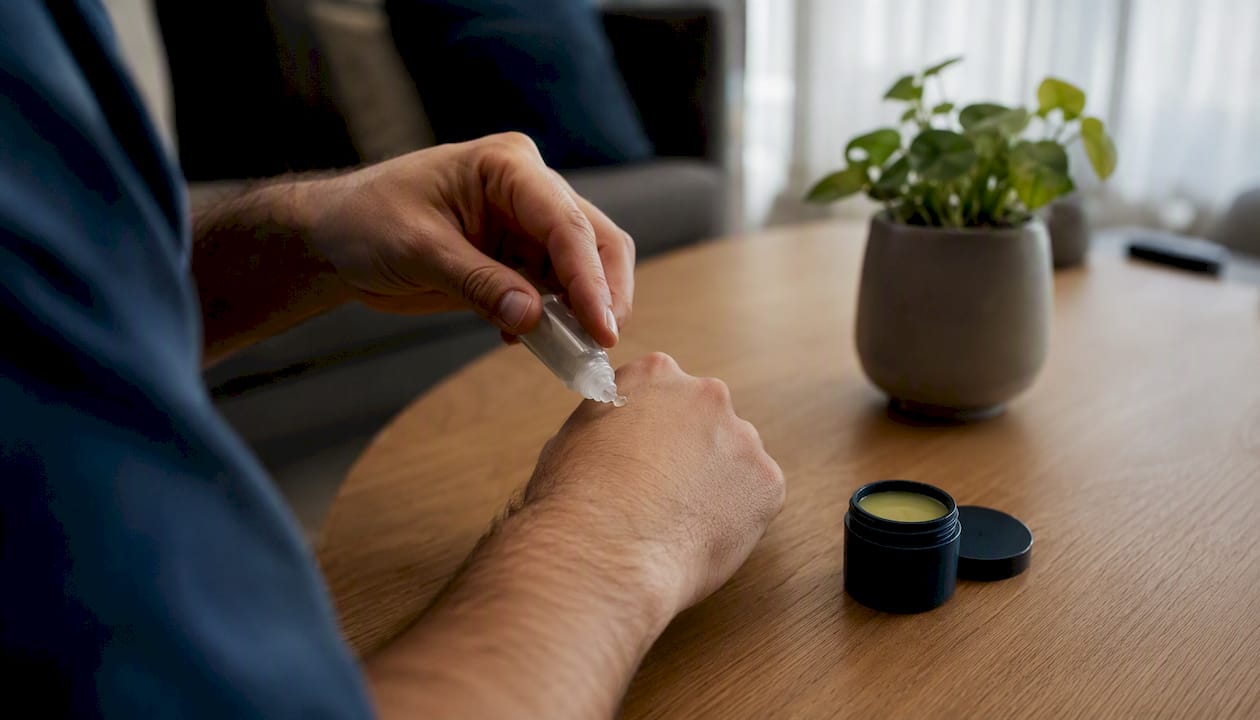
Muscle spasm tightening around the nerve: Menthol, eucalyptus, or a botanical CBD balm targets the muscle layer directly. The Rikki Tikki Recovery balm from Mongoosecbd is formulated specifically for this use case, combining CBD with recovery-focused botanicals.

Safe, effective application: dos and don'ts
Getting the application right matters as much as picking the right ingredient. Most people apply to where the pain radiates (the calf or thigh) rather than where it originates, which limits effectiveness.
Safe application steps:
- Patch test first — Apply a small amount to the inner forearm and wait 24 hours. Mayo Clinic advises this for any new topical, especially with sensitive skin.
Combining a topical with oral NSAIDs without clinician guidance raises the risk of exceeding safe NSAID exposure, particularly for kidney function. If you're already on a blood thinner or have liver or kidney concerns, check with your doctor before using any topical NSAID.
Red flags: when topical creams aren't enough
Topical creams are appropriate for managing sciatica symptoms, not for diagnosing or treating serious spinal conditions. Certain signs mean you need a clinician, not a stronger cream.
Seek urgent medical care if you experience:
- Progressive leg weakness or difficulty walking
- Loss of bowel or bladder control (this is a medical emergency)
- Numbness in the groin or inner thighs (saddle anesthesia)
- Severe, unrelenting pain that doesn't ease with any position
- New neurological symptoms appearing rapidly
- High fever alongside back pain (possible infection)
Realistic timelines for topical relief:
- Lidocaine and menthol/camphor: relief within minutes, lasting 1–4 hours
- Topical diclofenac: noticeable improvement within days of consistent use
- Capsaicin: meaningful effect after 1–2 weeks of daily application
- CBD balms: many people notice reduced tension within 30–45 minutes of application
If your symptoms haven't improved after two to three weeks of consistent topical use, or if they're getting worse, that's the signal to schedule a clinician visit. Topicals can mask pain while an underlying condition progresses, so don't let temporary relief delay a necessary evaluation.
Why a CBD balm is a sensible first choice and how Mongoosecbd fits
A well-formulated CBD balm sits in a useful middle ground: it combines cannabinoid receptor modulation with botanical counter-irritants and anti-inflammatory compounds in a single product, without the GI risks of oral NSAIDs or the short duration of lidocaine. For people with sciatica driven by muscle tension and soft-tissue inflammation around the nerve, that combination addresses multiple pain pathways at once.
Mongoosecbd's balms are built with a substantial amount of CBD per ounce, paired with botanicals including arnica, menthol, turmeric, eucalyptus, peppermint, cinnamon, clove, ginger, and cayenne pepper. The formulas are vegan, non-GMO, paraben-free, THC-free, and cruelty-free. The 30-day full refund policy means you're not risking money to find out whether it works for you.
Product options by symptom:
- Acute muscle tension and nerve irritation: Seriously Soothing Pain Balm (Eucalyptus Mint) — cooling botanicals that mirror the menthol counter-irritant mechanism.
- Chronic discomfort and deeper ache: Seriously Soothing Pain Balm (Original) — the base formula with arnica and turmeric for anti-inflammatory support.
- Post-activity muscle recovery: Rikki Tikki Recovery — formulated for muscle recovery after exertion, useful when activity-related spasm is aggravating the sciatic nerve.
How to apply Mongoosecbd balms for sciatica:
- Patch test a small amount on the inner forearm 24 hours before first full use.
- Apply a pea-sized to dime-sized amount to the rear pelvis, lower back, and the area around the piriformis muscle.
- Massage gently until absorbed. Reapply up to 2–3 times daily as needed.
- Avoid applying immediately before or after heat therapy on the same area.
- Pair with gentle stretching or physical therapy for best results.
This article provides general information, not medical advice. Confirm any treatment plan with a qualified clinician, especially for persistent or worsening symptoms.
Key Takeaways
Topical creams relieve sciatica symptoms by numbing, counter-irritation, or local anti-inflammatory action, but none reverse structural nerve compression — match the mechanism to your symptom, apply near the nerve's origin, and combine with physical therapy for lasting improvement.
| Point | Details |
|---|---|
| Match mechanism to symptom | Use diclofenac for deep inflammatory ache, lidocaine for sharp nerve pain, menthol for muscle spasm. |
| Apply at the source, not the symptom | Target the rear pelvis and lower back near the nerve root, not just where pain radiates down the leg. |
| Set realistic timelines | Lidocaine works in minutes; diclofenac takes days; capsaicin takes 1–2 weeks of consistent use. |
| Know the red flags | Progressive weakness, bowel/bladder loss, or saddle numbness require urgent medical evaluation, not more cream. |
| Mongoosecbd as a first try | The 1,000mg-per-ounce CBD balms combine cannabinoids with arnica, menthol, and turmeric for multi-pathway relief with a 30-day refund guarantee. |
The case for topicals that most people miss
Most articles on sciatica creams treat the ingredient list as the whole story. Pick the right chemical, apply it, feel better. That framing misses something clinicians understand immediately: the value of a topical isn't just what it contains. It's whether it reduces pain enough to let you move.
Sciatica rarely resolves on its own without some form of movement and rehabilitation. The structural problem, whether a disc bulge, piriformis tightness, or spinal stenosis, responds to physical therapy, not to creams. What topicals do is lower the pain barrier so that therapy becomes possible. A person in a 7/10 pain state doesn't stretch. At 4/10, they do.
That's why the ingredient ranking matters less than most people think, and why the application site matters more. Applying a menthol balm to your calf because that's where it hurts is the equivalent of treating a headache by rubbing your temples when the tension is in your neck. The cream needs to be near the problem, not the symptom.
CBD balms with botanical blends are genuinely useful here, not because CBD is a miracle compound, but because a well-formulated balm combines multiple mechanisms in one application. For someone who wants to try something safe, non-systemic, and easy to use before committing to a prescription or a specialist visit, that's a reasonable starting point. The evidence for CBD specifically in sciatica is still developing, but the safety profile is strong and the botanical co-ingredients carry their own documented benefits.
Try Mongoosecbd for targeted sciatica relief
Diclofenac, lidocaine, and menthol products all have their place, but they each address one mechanism at a time. Mongoosecbd's balms are built differently: 1,000mg of CBD per ounce combined with arnica, menthol, turmeric, eucalyptus, and cayenne pepper in a single formula that targets inflammation, muscle tension, and sensory pain pathways simultaneously. No prescription needed, no GI side effects, and a 30-day full refund if it doesn't work for you.
The Miracle Pain Balm is the highest-potency option in the lineup and the logical starting point for sciatica-related discomfort. Not ready to commit to a full size? Grab a free sample first and test it on your own terms. Apply to the rear pelvis, give it 30–45 minutes, and see what it does for your pain level before your next PT session.
Sources and further reading
The following sources informed this article's clinical claims and ingredient guidance:
- Harvard Health: What should you do when sciatica flares? — Explains topical mechanisms and why deep nerve root compression limits topical penetration.
- Mayo Clinic Press: Understanding your options for topical pain relief — Covers counter-irritant mechanisms, side-effect profiles, and patch-testing guidance.
- Arthritis.org: Topical Treatments for Arthritis Pain — Summarizes evidence hierarchy for topical NSAIDs, including diclofenac's clinical backing.
- Spine-Health: Medication for Sciatica — Addresses lidocaine use and application-site guidance for sciatica specifically.
- Cory Calendine MD: Topical Arthritis Pain Medications — Orthopedic specialist perspective on capsaicin onset, CBD adjuncts, and safety trade-offs of topicals vs. oral NSAIDs.
- Men's Health: Best Muscle Pain Relief Creams, According to Physical Therapists — Physical therapist commentary on individual response variation and ingredient selection.