
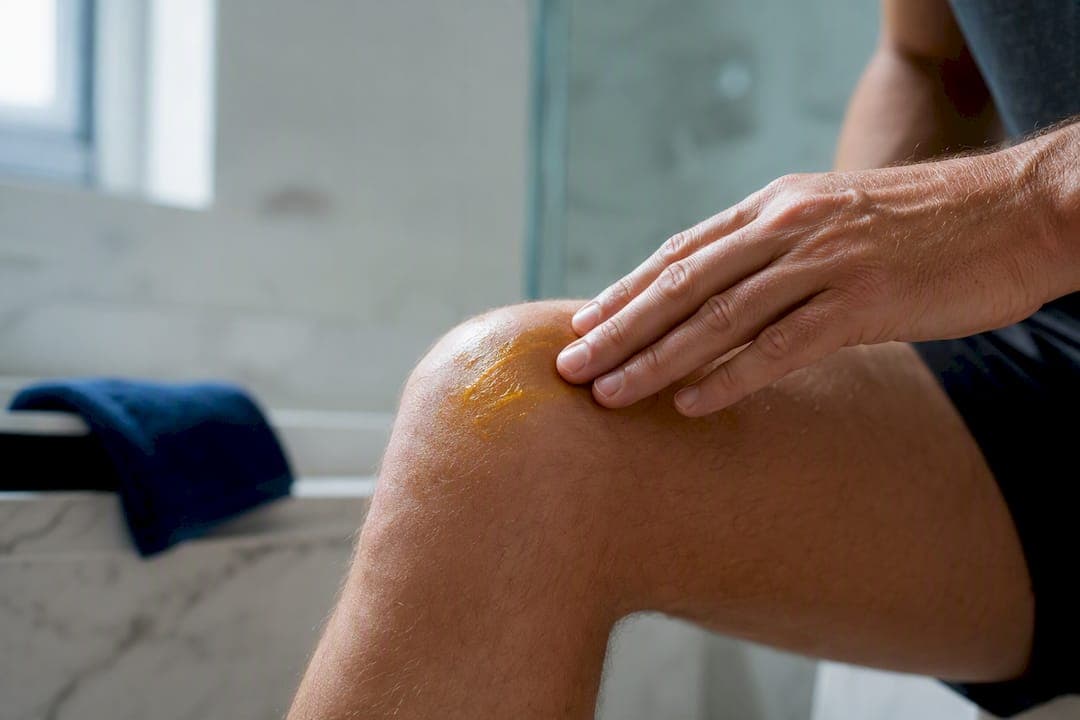
Topical turmeric, specifically curcumin, can ease localized inflammation and joint pain for some people, but the effect is modest and depends heavily on how the product is formulated. Randomized trials on curcumin ointments show real, measurable pain reduction over placebo, not a placebo-level fluke. The catch: skin barely absorbs plain turmeric extract, so formulation and delivery technology determine whether you feel anything at all. Patch-test first, then pick a product with transparent curcuminoid content and a clear delivery method.
TL;DR:
- Topical curcumin offers modest, clinically meaningful pain relief for knee osteoarthritis, but only when formulated with advanced delivery technology.
- Concentrated, purpose-built formulations like nano-emulsions or sustained-release hydrogels outperform simple pastes or extracts in penetrating the skin.
- About one-third of users may experience significant pain reduction, but most do not, and results depend heavily on formulation quality.
- Patch testing is essential to prevent skin reactions, and formulations with penetration enhancers can increase systemic absorption, requiring caution.
- DIY turmeric pastes lack standardization and effective absorption, making them less reliable for therapeutic pain relief but suitable for cosmetic or temporary use.
Table of Contents
- What Does the Clinical Evidence Say About Topical Curcumin?
- Why Formulation Determines Whether Topical Turmeric Works
- What Ingredients Do Turmeric Pain Creams Actually Contain?
- How Do You Patch-Test Turmeric Products Safely?
- How Do You Choose an Effective Turmeric Topical?
- How Should You Apply Topical Turmeric and What Should You Expect?
- Should You Make Your Own Turmeric Paste or Buy a Tested Product?
- Our Take on Turmeric's Place in Topical Pain Care
- A Balm Built Around What Actually Works on Skin
- Key Studies and Resources Worth Bookmarking
- Sources
What Does the Clinical Evidence Say About Topical Curcumin?
Two trials anchor most of what we currently know about turmeric for inflammation topical use, and both point the same direction: modest, real, but not dramatic relief.
The strongest data point comes from a randomized placebo trial published by Jamali and colleagues in 2020. Seventy-two older adults with knee osteoarthritis applied either a 5% curcumin ointment or plain Vaseline twice daily for six weeks. Pain scores, measured on a Visual Analog Scale, dropped by an absolute difference of roughly 11.3 millimeters in the curcumin group compared with placebo. That's a modest but clinically relevant effect in the trial, though it's also far from a cure.
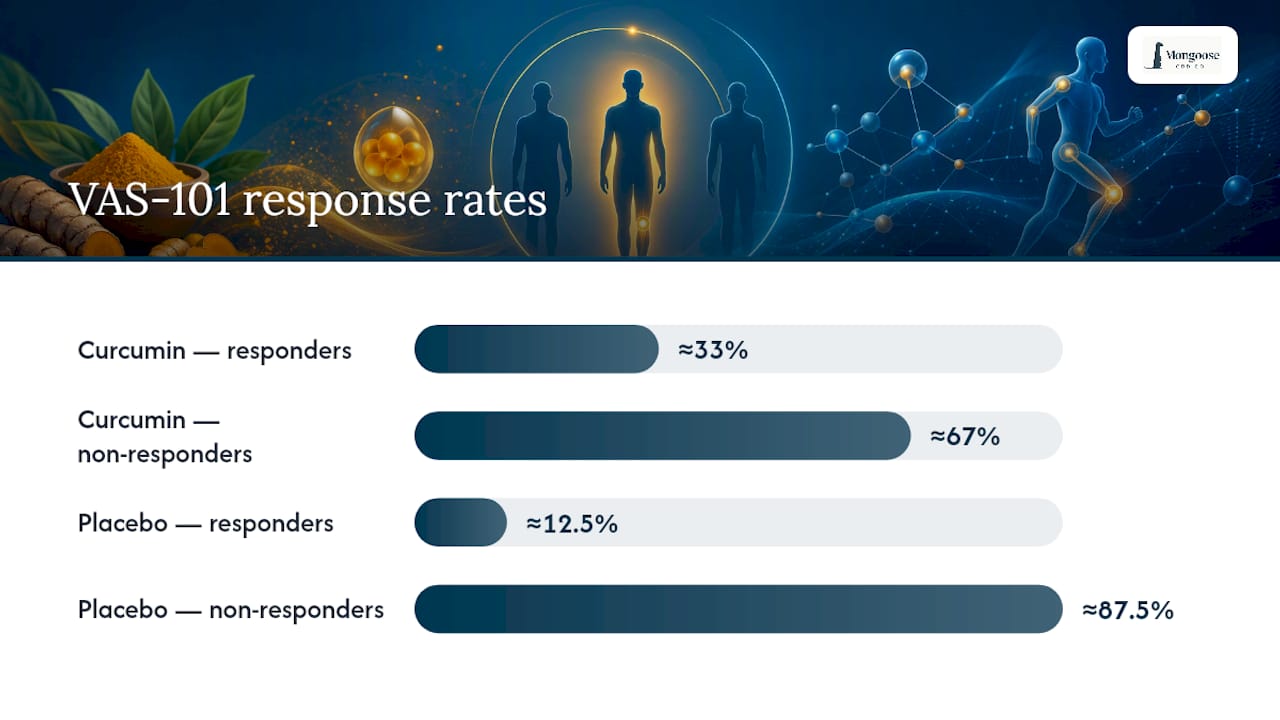
A more recent trial adds weight to the picture. The VAS-101 study, a 28-day randomized, double-blind, placebo-controlled trial of a topical curcumin gel, found that a sizable portion of participants achieved a clinically meaningful reduction in knee pain, with the active group roughly twice as likely as placebo to do so. That's a meaningful gap, roughly one in three responders versus one in eight, but it also means most people in the active group did not hit that clinically meaningful threshold.
A few things temper how far you should run with these numbers:
- Sample sizes were small (dozens, not thousands), which limits how confidently the results generalize.
- Follow-up windows were short, six weeks and 28 days, so nobody has tracked what happens after three or six months of use.
- The two trials used different formulations, concentrations, and application schedules, making direct comparison tricky.
- Oral curcumin research, which is more extensive, generally shows short-term anti-inflammatory benefits too, but oral and topical routes work through different absorption pathways and shouldn't be assumed equivalent.
Mayo Clinic's own review of the turmeric literature lands in a similarly measured place: curcumin has documented anti-inflammatory properties and may help with pain, but the evidence base is still thinner than most marketing copy suggests, and topical use carries its own quirks, including skin staining, that we'll get into later.
Quick stat check: In the VAS-101 trial, roughly 1 in 3 users hit a clinically meaningful pain reduction, against 1 in 8 on placebo. That's the kind of gap worth paying attention to, but it also means topical curcumin isn't working for everyone who tries it.
Why Formulation Determines Whether Topical Turmeric Works
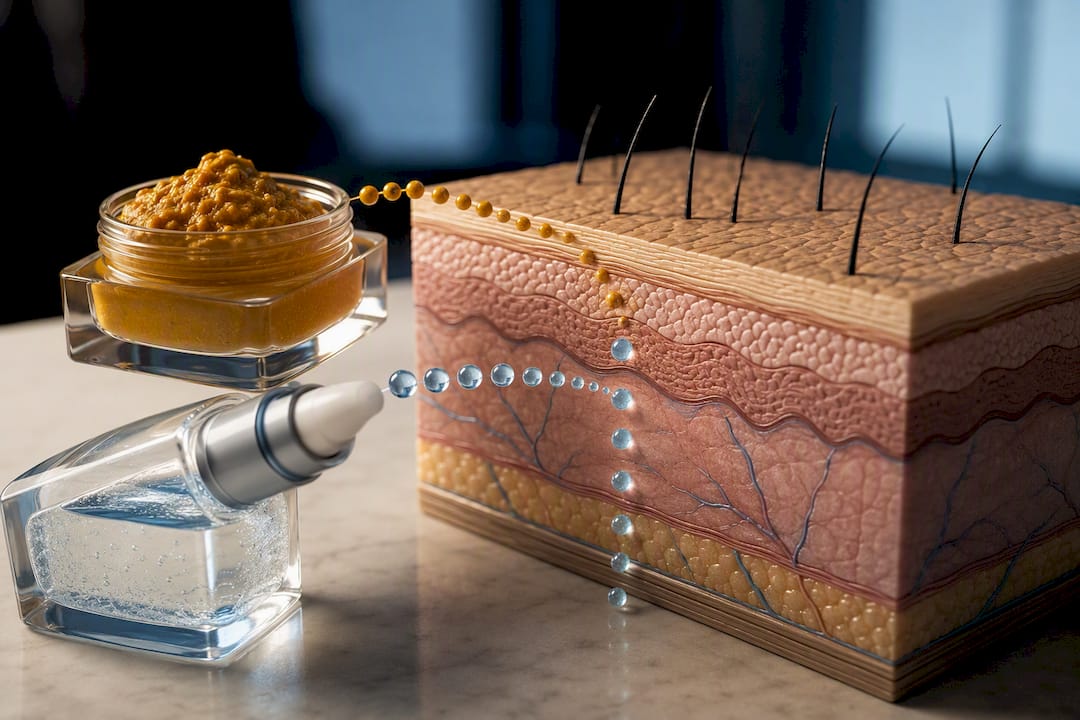
Curcumin, the active compound in turmeric, is hydrophobic. It doesn't dissolve well in water, and it doesn't cross the skin's outer barrier easily on its own. Smear raw turmeric powder mixed with water onto your knee, and most of that curcumin stays right on the surface instead of reaching the inflamed tissue underneath. This is the single biggest reason why two products both labeled "turmeric cream" can produce wildly different results.
Formulation science exists specifically to solve this problem. Researchers and product developers use several strategies to push curcumin past the stratum corneum, the skin's outermost layer, and into deeper tissue where inflammation actually lives:
- Oil-based carriers dissolve curcumin more effectively than water, since curcumin is fat-soluble.
- Nano-emulsions break curcumin into microscopic droplets, dramatically increasing the surface area available for skin absorption.
- Hydrogels create a matrix that holds curcumin at the skin's surface longer, giving it more time to penetrate.
- Penetration enhancers, such as propylene glycol or isopropyl myristate (IPM), temporarily loosen the skin's barrier to let more curcumin through.
- Sustained-release platforms control how fast curcumin releases from the base, keeping levels steady instead of spiking and dropping.
One study on a sustained-release hydrogel using Curcuma longa extract found that this kind of delivery platform achieved high curcumin loading with a prolonged release profile, improving the odds that therapeutic levels actually reach the skin over time rather than washing off or evaporating within minutes.
This is also likely why the Jamali and VAS-101 trials, both of which used concentrated, purpose-built formulations rather than simple pastes, reported outcomes better than what most home remedies produce. Delivery technology is the real dividing line between a kitchen-counter paste and a clinically active topical.
Pro Tip: Check the product label for words like "nano-emulsion," "liposomal," "sustained-release," or a named penetration enhancer. If a turmeric product only lists "turmeric extract" with no mention of how it's delivered into skin, treat its pain-relief claims with more skepticism.
What Ingredients Do Turmeric Pain Creams Actually Contain?
Most commercial turmeric creams aren't turmeric alone. Read the ingredient list on nearly any topical turmeric balm and you'll usually find it paired with one or more established over-the-counter analgesics, chosen because they deliver an immediate sensation that turmeric alone can't provide.
Menthol and camphor are the most common fast-acting partners. They trigger a cooling or warming sensation almost instantly by activating temperature-sensing receptors in the skin, which distracts from pain signals even though they don't reduce inflammation directly. Trolamine salicylate and methyl salicylate work differently. They're chemically related to aspirin and have their own documented, though modest, topical analgesic effects. FDA drug facts labeling for these OTC actives spells out standard concentrations you'll see repeated across brands.
| Ingredient | Typical concentration | Primary role |
|---|---|---|
| Menthol | Around 5% | Immediate cooling sensation, distracts from pain |
| Camphor | Around 4% | Warming sensation, mild counterirritant |
| Trolamine salicylate | Around 10% | Salicylate-based topical analgesic |
| Methyl salicylate | Around 10% | Salicylate-based topical analgesic, often warming |
| Curcumin or curcuminoids | Varies by product, often undisclosed | Anti-inflammatory support, slower onset |
Turmeric itself shows up on labels in a few different forms, and the wording matters. Some products list a specific "curcumin" or "curcuminoid" percentage. Others simply say "turmeric extract" or "turmeric oleoresin" with no amount given at all, which tells you almost nothing about actual potency. Products that include a named, quantified extract are more informative than vague listings, since you can't judge dosage from marketing language alone.
This distinction also matters for classification. Products containing FDA-recognized actives like trolamine salicylate are regulated as OTC topical analgesic drugs, subject to specific labeling rules. A turmeric-only cosmetic balm, by contrast, isn't held to the same drug-facts standard, which is one reason ingredient transparency varies so widely between brands. Beyond the actives, excipients like emollients and solvents shape how a product feels on skin and how well it spreads, and they can also influence how efficiently other ingredients absorb.
How Do You Patch-Test Turmeric Products Safely?
Turmeric is generally well tolerated, but it isn't risk-free on skin, especially in concentrated or absorption-enhanced formulations. Dermatology literature documents cases of contact dermatitis linked to topical turmeric and spice extracts, and recommends patch testing before applying any new product to a larger area.
Here's how to run a proper patch test before committing to regular use:
- Apply a pea-sized amount of the product to a small patch of skin on your inner forearm.
- Cover it loosely with a small adhesive bandage or leave it uncovered, depending on the product's instructions.
- Wait 24 to 48 hours without washing the area.
- Inspect closely for redness, itching, blistering, or any spreading beyond the original test spot.
- If you see none of those signs, you can proceed to broader use on the target area.
- If you see any reaction, stop and don't apply the product elsewhere on your body.
Contact dermatitis from turmeric usually shows up as localized redness, itching, or a mild rash confined to the application site. If a reaction spreads beyond where you applied the product, or if you notice blistering or swelling, discontinue use immediately rather than waiting to see if it resolves on its own.
Staining is a separate, cosmetic issue rather than a safety one. Turmeric's pigment, curcumin, can temporarily stain skin, nails, and light-colored fabric a yellowish tint. It usually fades within a day or two on skin with regular washing, though fabric stains can be more stubborn. Applying a thin layer and letting it fully absorb before dressing helps limit transfer.
Pro Tip: Apply turmeric topicals at night if you're worried about staining light clothing, and let the area fully dry before pulling on a shirt or sliding under sheets.
Talk to a healthcare provider before regular use if you're pregnant or nursing, currently taking blood thinners or other prescription medications, or if you experience a severe skin reaction. Absorption-enhanced formulations that use penetration enhancers push more curcumin into deeper tissue, which is the point, but it also means systemic absorption, while still low-probability, isn't zero the way it might be with a simple, poorly-absorbed paste.
How Do You Choose an Effective Turmeric Topical?
Not every jar labeled "turmeric cream" on a store shelf deserves the same trust. A few label checks separate the formulations worth trying from the ones that are mostly marketing.
- Look for a disclosed curcumin or curcuminoid percentage rather than a vague "turmeric extract" listing with no amount.
- Check whether the brand names its delivery platform, such as a nano-emulsion, liposomal base, or sustained-release hydrogel, since that's what determines whether the curcumin can actually reach inflamed tissue.
- Decide what you actually want: if you're after an instant cooling or warming sensation, look for menthol or camphor alongside turmeric; if you want longer-term anti-inflammatory support, prioritize the curcumin delivery claims over the sensory additives.
- Favor products backed by third-party lab testing or a certificate of analysis, which confirms the label matches what's actually in the jar.
- Avoid products with no clear usage instructions, no listed concentrations for any active ingredient, and no accessible return or refund policy, since a company confident in its formulation usually stands behind it.
- Read the classification: an OTC drug-facts label signals the product meets FDA labeling standards for its active ingredients, while a cosmetic-only listing means those same standards don't apply.
None of this guarantees dramatic relief. It just stacks the odds in your favor by steering you toward formulations built the way the clinical trials were built, concentrated, tested, and specific about what's inside.
How Should You Apply Topical Turmeric and What Should You Expect?
Clinical trials give us actual, repeatable regimens to reference instead of guessing at frequency. The Jamali 2020 trial used a curcumin ointment at a percentage typical for clinical studies, applied twice daily over several weeks. The VAS-101 trial used a smaller, more precise application, about 0.1 mL brushed onto the knee every other day, over 28 days.
You can borrow this structure for your own trial period:
- Apply a thin, even layer to clean, dry skin over the affected area, following the specific product's instructions for amount and frequency.
- Stick to a consistent schedule, once or twice daily is typical, for at least four to six weeks before judging whether it's working.
- Rate your pain on a simple 0 to 10 scale once a week, at the same time of day, so you're tracking a real trend instead of a day-to-day mood swing.
- If you see no meaningful improvement by the end of your trial window, or if you develop a skin reaction, stop and reconsider the product or approach.
- Pair the topical with conservative measures your provider may already recommend, such as light exercise, physical therapy, or weight management for joint-related inflammation.
Given that roughly one-third of trial participants achieved clinically meaningful pain relief with a dedicated topical curcumin formulation, it's reasonable to try a similar approach for a defined window, four to six weeks, while tracking your own results rather than assuming instant relief. Topical turmeric works best as an addition to what you're already doing for pain management, not a replacement for it.
Should You Make Your Own Turmeric Paste or Buy a Tested Product?
A homemade turmeric paste, usually turmeric powder mixed with water, coconut oil, or black pepper, is cheap and easy to throw together. It's also a poor substitute for a lab-formulated topical if you're hoping for measurable pain relief.
The limitations are real and specific. Kitchen turmeric powder has no standardized curcumin content, so you have no idea how much active compound you're actually applying. Without a proper delivery system, most of that curcumin will sit on your skin's surface rather than penetrating to inflamed tissue underneath, exactly the absorption problem formulation science exists to solve. DIY pastes also carry a contamination risk if mixed and stored without preservatives, and they stain skin and fabric more aggressively than commercial creams designed to minimize that effect.
That said, DIY turmeric isn't useless for everything. A short-term cosmetic face mask, or a one-off soothing application for minor surface irritation, carries low stakes and modest expectations. If you go this route, mix small batches, use it within a day or two, and keep it away from broken skin or eyes.
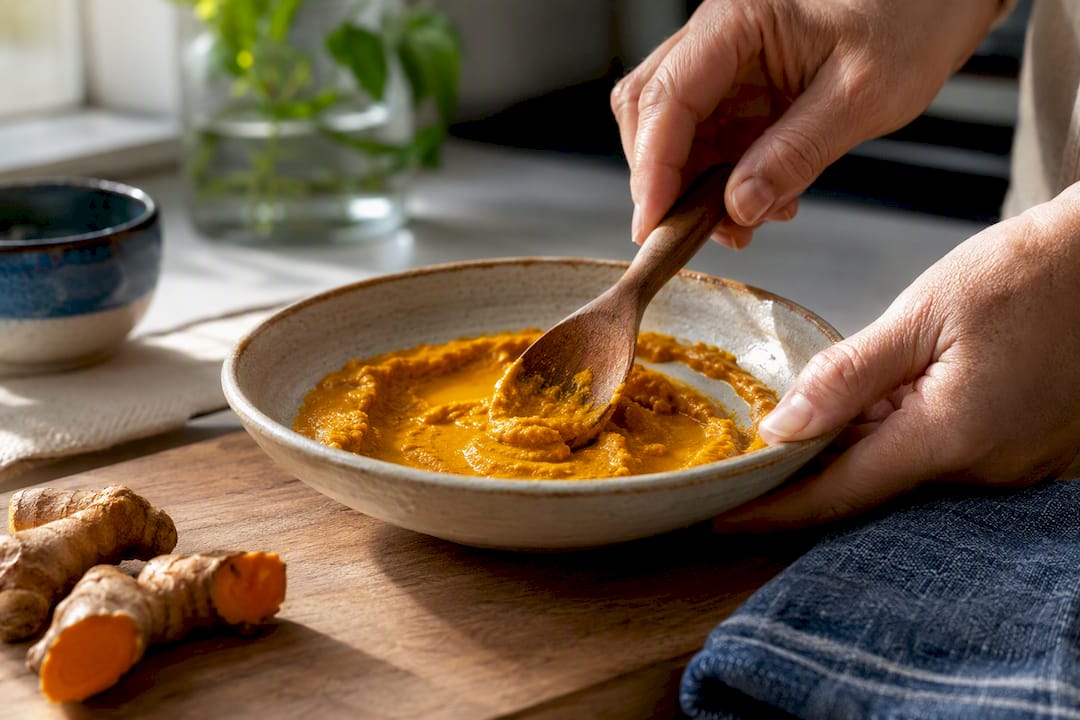
For actual therapeutic goals, meaningful reduction in joint pain or chronic inflammation, tested delivery systems built around known curcumin concentrations are simply a better bet than guesswork mixed in a kitchen bowl.
Our Take on Turmeric's Place in Topical Pain Care
Turmeric earns its reputation, but it earns it slowly and only under the right conditions. The mistake most people make is treating it like a standalone miracle rather than what the evidence actually supports: a modest, formulation-dependent anti-inflammatory that works better as part of a broader pain-management routine than as a solo act.
At Mongoosecbd, we build our balms around that reality rather than around turmeric hype. Our formulas pair CBD with a deliberate mix of natural actives, including turmeric, arnica, and menthol, because relief usually comes from combining a fast-acting sensation with ingredients that support recovery over time, such as this Broad Spectrum CBD Muscle Cream. We back every purchase with a 30-day refund policy, since we'd rather stand behind results than oversell a single ingredient. None of this replaces medical care for chronic or severe conditions. If pain persists or worsens, talk to a clinician. For everyday soreness and localized inflammation, a well-formulated topical is a reasonable, low-risk place to start.
— Cindy
A Balm Built Around What Actually Works on Skin
If you've read this far, you already know that turmeric alone rarely moves the needle without the right delivery and the right partners. That's exactly what Mongoosecbd's Seriously Soothing Pain Balm is built around: 1,000mg of CBD per ounce combined with turmeric, arnica, menthol, and other natural pain-relieving ingredients in one formula, instead of asking you to layer separate products and guess how they interact.

For post-workout soreness specifically, Rikki Tikki Recovery targets muscle recovery with the same ingredient philosophy: real concentrations, disclosed on the label, not vague marketing language. Every Mongoosecbd product is vegan, non-GMO, paraben-free, THC-free, and cruelty-free, and every purchase is protected by a 30-day refund window if it doesn't work for you. Still, run the patch test outlined earlier before applying any new topical broadly, turmeric or CBD-based, since individual skin reactions vary regardless of brand. Ready to try one? Order directly through the Seriously Soothing Pain Balm product page and see how a formulation built for real relief compares to what's sitting in your medicine cabinet now.
Key Studies and Resources Worth Bookmarking
The clinical picture on topical turmeric is still developing, but a handful of sources carry real weight if you want to dig deeper on your own.
- The Jamali 2020 randomized placebo trial remains the clearest peer-reviewed evidence that a concentrated curcumin ointment can outperform placebo for knee osteoarthritis pain.
- The VAS-101 trial in Frontiers in Pain Research offers the most recent randomized data on a purpose-built topical curcumin gel.
- Mayo Clinic's Q&A on turmeric gives a balanced clinical read on benefits, limitations, and staining concerns.
- FDA drug-facts labeling on DailyMed shows exactly how turmeric-containing OTC analgesics disclose their paired active ingredients.
- The dermatology review on contact allergy to spices explains why patch testing matters before regular topical turmeric use.
Each of these sources answers a different piece of the puzzle, whether turmeric works, how it's typically packaged, and what risks to watch for before you commit to daily use.
This article is general information, not a substitute for advice from a qualified doctor. Consult a qualified healthcare professional about your own circumstances before acting on anything here.
Sources
- The effect of curcumin ointment on knee pain in older adults with osteoarthritis: a randomized placebo trial
- The effect of a topical curcumin formulation (VAS-101) on knee pain in adults with knee osteoarthritis: a randomised, double-blind, placebo-controlled study
- Tumeric Pain Relieving Cream — Drug Facts (DailyMed)
- Contact allergy and dermatitis related to spices and plant extracts (review)
- Mayo Clinic Q and A: Turmeric for healthier diet, pain relief