
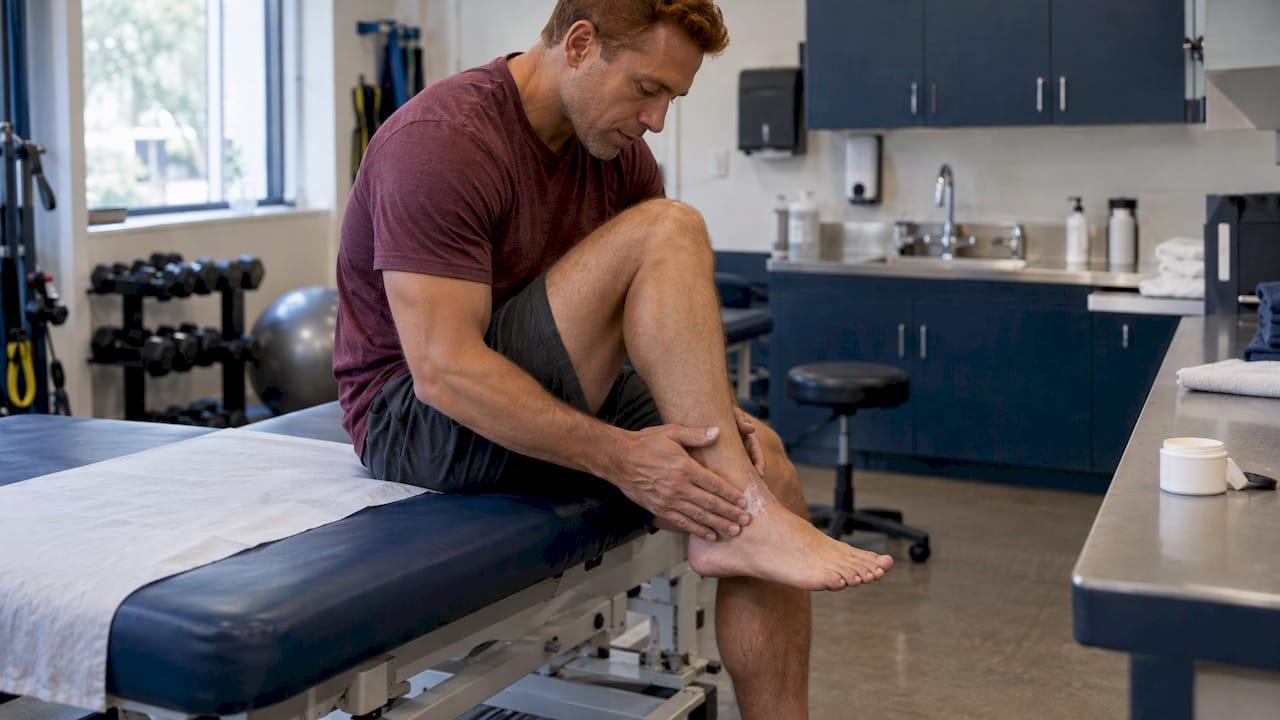
For ankle pain, a topical CBD balm is the practical way to use CBD. It goes on the skin over the sore area, so it stays local and keeps whole-body exposure low. Our Seriously Soothing Pain Balm and RIKKI TIKKI Recovery are made for this use. Each has 1,000mg of CBD per ounce plus arnica, menthol and other botanicals.
This guide covers what research says about topical CBD, how to apply a balm to an ankle, what to look for on a label, and the safety points to know first.
TL;DR
- Topical CBD is applied to the skin over the ankle. It is the form that delivers CBD to the sore area directly and keeps systemic exposure low.
- Human trials of CBD creams on joints are small, and no studies exist yet on ankles specifically. The closest are trials on thumb and hand joints.
- Our balms combine 1,000mg of CBD per ounce with arnica, menthol, turmeric, eucalyptus, peppermint, cinnamon, clove, ginger and cayenne pepper.
- Use a small amount, rub it in, and track your pain for 2 to 6 weeks. We back every purchase with a full refund within 30 days.
- Swelling after a twist, inability to put weight on the foot, or numbness need a clinician first, not a balm.
Table of Contents
- Why a balm suits the ankle
- What research shows about topical CBD and joints
- Which ankle pain a balm is for
- How to apply a CBD balm to your ankle
- What is in our balms
- How to judge any CBD balm label
- Safety: who should be careful
- Perspective
- Choose your balm
- FAQ
- Sources
Why a balm suits the ankle
The ankle is a small, shallow joint. Skin sits close to the ligaments, tendons and joint capsule. That is one reason people reach for something they can rub on instead of swallow.
A review of topical cannabinoids in dermatology explains the appeal. Topical products can place cannabinoids directly on the skin while minimizing systemic exposure. The same paper notes that CBD does not dissolve well in water, so it may collect in skin layers. For that reason it says each product should be judged by its own formulation.
That last point matters when you pick a balm. The base, the other ingredients and the strength all shape how a product feels and performs.
What a balm does that a capsule does not
- It goes where the discomfort is: the outer ankle bone, the Achilles area, the top of the foot.
- It can be paired with a massage, which many people already do after training.
- It carries other ingredients in the same step. Menthol and peppermint give a cooling sensation. Cinnamon, clove, ginger and cayenne give warmth.
- It lets you control the amount by the fingertip.
What research shows about topical CBD and joints
The honest picture is that the topical evidence is early and small. Here is what exists.
A 2024 systematic review of 40 CBD studies describes a double-blind trial of a topical CBD preparation (6.2 mg/mL with shea butter) in 18 people with thumb base arthritis. It showed notable improvements in pain and disability. The same review describes a trial of a 4% transdermal CBD gel in 15 people with hand osteoarthritis, which suggested possible improvement in pain and grip strength.

A foot and ankle industry publication reviewing cannabinoids in orthopedics says no published literature exists specifically in the foot and ankle space. It points to the thumb-base trial as the one study that might translate, in which a CBD cream beat a plain shea butter cream on a pain scale.
What this means for you: the joint results are encouraging for creams on small joints, and ankle-specific trials have not been run. A balm is a reasonable thing to try with a clear plan, not a guaranteed fix. The American Academy of Orthopaedic Surgeons' patient site says that relatively few high-quality studies exist, which is why a structured personal trial, described below, is the sensible way to judge it.
If your pain comes from arthritis, our guide to CBD for ankle arthritis goes deeper. For pain that spreads across the joints, see CBD for joint pain.
Which ankle pain a balm is for
The balm is a fit for the ordinary aches of active life and long-standing joint stiffness:
- Soreness after running, court sports, hiking or lifting.
- Stiffness in the morning or after sitting.
- Arthritis-related aching around the ankle.
- Tired, tight tissue around the Achilles and the arch. See our pieces on Achilles pain and foot pain.
When to see a clinician first
A balm is not a diagnosis. See a doctor, urgent care or an orthopedic specialist if you have any of these:
- A sudden injury with a pop, deformity or immediate bruising.
- Pain that stops you putting weight on the foot.
- Marked swelling, redness with heat, or fever.
- Numbness, tingling or colour change in the foot.
- Pain that is getting worse over several weeks.
Once a clinician has ruled out a serious injury, a balm can be part of your recovery routine.
How to apply a CBD balm to your ankle
There is no standard dose for topical CBD, so a simple, repeatable routine is best.
- Clean and dry the skin. Wash the area and dry it. Do not apply to broken skin, a rash or an open wound.
- Start with a pea-sized to nickel-sized amount. An ankle is small. Add more only if the area is not covered with a thin layer.
- Massage it in for one to two minutes. Work around the ankle bones and along the tendons at the front and back. Use light to medium pressure.
- Apply once or twice a day. Many people use it after activity and again in the evening.
- Wash your hands afterwards. Menthol, peppermint and cayenne can irritate the eyes.
- Keep it the same for 2 to 6 weeks. Change one thing at a time, so you can tell what is helping.
A simple way to track results
Before the first application, rate your ankle pain from 0 to 10 at the same times each day: morning, after activity and at night. Write it down for a week. Then start the balm and keep logging. After 2 to 6 weeks, compare the averages. A written record is more reliable than memory.
We built our approach to match this. With a full refund within 30 days of purchase, you can run your own trial without risk.

What is in our balms
Both balms use the same CBD strength and a blend of plant ingredients:
| Ingredient | What it adds to the balm |
|---|---|
| CBD, 1,000mg per ounce | The cannabinoid at the centre of the formula |
| Arnica | A botanical long used in rubs for sore muscles and joints |
| Menthol, peppermint, eucalyptus | A cooling sensation on application |
| Cinnamon, clove, ginger, cayenne pepper | A warming sensation |
| Turmeric | A botanical widely used in wellness products |
They are vegan, non-GMO, paraben-free, THC-free and cruelty-free. They come in an original version, a cinnamon and clove version and a formulated recovery version.
Which to pick for your ankle:
- Seriously Soothing Pain Balm is the everyday choice for aching, stiff or arthritic joints.
- RIKKI TIKKI Recovery is the one we formulated for athletes after hard training.
How to judge any CBD balm label
Quality is a real issue in this market. The FDA reports that in its testing, many cannabinoid products did not contain the CBD levels they claimed. The agency has also looked into reports of contaminants such as pesticides, heavy metals and THC. The AAOS adds that there are no quality standards for CBD products, so the label amount can differ from what is in the jar.
A label worth trusting shows:
- The CBD amount in milligrams per container. Not just "hemp extract".
- Third-party testing. Our products go through rigorous third-party testing.
- THC status. Ours are THC-free.
- A full ingredient list. You should see every botanical named.
- A clear return policy. Ours is a full refund within 30 days.
Safety: who should be careful
Topical CBD has a good tolerability record in the trials that exist. The FDA's 2019 safety review notes that in a placebo-controlled trial of topical CBD (250 or 500 mg a day for 12 weeks, 321 people), the adverse events more common than with placebo were application-site dryness (3.8% vs 0.9%) and headache (3.3% vs 1.9%). A 4-week trial of a topical CBD oil in 29 people with peripheral neuropathy reported no adverse events.
Practical steps:
- Patch test. Put a small amount on the inner forearm first, especially with a cooling or warming balm.
- Keep it off broken skin, eyes and mucous membranes.
- Stop if irritation appears. Redness, itching or a lasting burn means stop and wash it off.
- Talk to your doctor or pharmacist if you take regular medication, are pregnant or nursing, or are managing a liver condition.
- Drug testing. The dermatology review notes that interactions with drug testing remain unknown for transdermal CBD. If you are tested for work or sport, check with your testing body.
For context on oral use, a 2026 review cites a meta-analysis that found liver enzyme elevations with oral CBD, with no cases of drug-induced liver injury in adults at doses below 300 mg a day. A balm is applied to the skin, and the same review of topical products says it may minimize systemic exposure.
The legal picture in the US
The FDA has approved only one CBD product, the prescription drug Epidiolex for certain seizure disorders. That is a prescription medicine for a specific condition. Topical balms are sold as consumer products, and our balms are THC-free. Rules on hemp products have been changing since late 2025, so check the product page for current details before you order.
Perspective
We make balms for people who use their ankles hard: runners, lifters, players, and people whose joints ache from arthritis. Ankles take a lot of load and they are small, so the way you apply a product matters as much as what is in it.
That is why we put CBD in a balm and pair it with arnica, menthol, turmeric and the warming spices. A balm can be rubbed in and felt. You notice the cooling, you notice the warmth, and you can tell when your routine is working.
Our approach is to keep it simple. Use it consistently, log your pain, and judge after a few weeks. We stand behind that with a full refund within 30 days, because we want you to be able to try it without worry.
Cindy
Choose your balm
For everyday ankle aches and arthritis stiffness, start with the Seriously Soothing Pain Balm. For soreness after hard training, choose RIKKI TIKKI Recovery. Both are priced from $26.95 to $39.95 depending on size, and both carry the 30-day full refund.
You can see both on the Mongoose CBD Co. homepage.
FAQ
Can CBD help with ankle pain?
Topical CBD is the form most people use for a sore ankle. Small trials of CBD creams on thumb and hand joints reported pain improvements, but no trials have been published on the ankle itself. A tracked 2 to 6 week trial of a balm is a practical way to see how your own ankle responds.
Is CBD cream better than oral CBD for ankle pain?
A cream or balm goes on the skin over the sore spot. Researchers note that topical products can dose cannabinoids directly to the skin while minimizing systemic exposure. That makes a balm the natural choice for a single sore joint.
How much balm should I use on my ankle?
Start with a pea-sized to nickel-sized amount and massage it in for a minute or two. Use it once or twice a day. If the skin is not covered with a thin layer, add a little more.
Is CBD like a muscle relaxer?
No. CBD is not a muscle relaxer. A 2026 review of athletic recovery found that oral or sublingual CBD reduced markers such as creatine kinase and delayed-onset muscle soreness within 48 to 72 hours in some studies. The balm's menthol and warming ingredients give a cooling or warming feel on the skin.
Sources
- Safety and Sourcing of Topical Cannabinoids (JAAD review, PMC)
- Cannabidiol (CBD): A Systematic Review of Clinical and Preclinical Evidence (PMC)
- Cannabinoids in Orthopedics (Foot and Ankle Exchange)
- Cannabidiol (CBD) FAQ, OrthoInfo, AAOS
- FDA consumer update on products containing cannabis or cannabis-derived compounds
- FDA, Safety of CBD in Humans: A Literature Review
- Cannabidiol (CBD) for Pain: A Narrative Review of Evidence (PMC)
- Assessing the Efficacy of Cannabidiol (CBD) in Athletic Recovery (International Medical Journal)